She didn’t walk in there for revenge.
That’s what Dot Phelps kept telling herself the whole drive down from Louisville — hands steady on the wheel, the little brass thimble sitting in her coat pocket where her fingers could find it.
*E.P.* Engraved in letters so small you’d need good light to read them. Eleanor Phelps. Her mother’s thimble. The one Dot had found in a box at the Paducah Goodwill three years ago, on a Tuesday, the same week she’d found out the truth about the debt.
She wasn’t going in there for revenge.
She just wasn’t going in there to hide anymore, either.
—
The McCracken County Heritage Quilters Guild had been meeting in the Tillman Building since 1921. A hundred and four years of stitching, laughing, arguing over color choices, and pressing hands together over losses nobody outside those walls would ever fully understand.
By last January, the building had been six weeks from foreclosure.
The guild didn’t know who saved it. The donation came through an attorney’s office in Lexington — anonymous, certified, and exactly enough. The deed of gift was filed under a trust name that meant nothing to anyone in Paducah.
Until today.
Today was the emergency vote for a new guild chairwoman, following the unexpected resignation of Connie Bratcher. And today, the attorney was required by the terms of the gift to read the donor’s name aloud before the membership — a condition nobody had thought strange at the time, because donors always want acknowledgment eventually.
Nobody had thought to wonder *which* donor might want it acknowledged *this* way. In *this* room. On *this* particular Thursday in March.
Dot had thought about it for three years.
—
She arrived late on purpose.
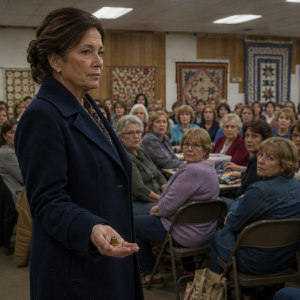
Forty-seven women were already seated in the folding chairs when she slipped through the side door and stood in the back, still in her good wool coat — the navy one Eleanor had always called *too plain, Dorothea, you have your grandmother’s figure, show it* — and she didn’t sit down.
She recognized faces immediately.
Wanda Crutcher, in the second row, who had told Dot at Eleanor’s funeral that the guild was “so sorry for the confusion about the estate.” The *confusion.* Like selling off fourteen of Eleanor Phelps’s hand-stitched quilts at a private sale for pennies apiece — to cover a debt the accountant later confirmed Eleanor had never actually incurred — was a clerical misunderstanding.
Patsy Holloway, guild treasurer, who had signed the bill of sale.
Barbara Fint, who’d bought three of Eleanor’s quilts herself at that sale and had the nerve to enter one in the regional show the following spring.
Dot’s fingers found the thimble in her pocket.
Turned it over once. Twice.
*E.P. E.P. E.P.*
She’d spent a long time being the kind of woman who processed grief quietly, who assumed the best, who told herself that people make mistakes and the guild had been good to her mother for decades, so surely —
But then she’d found the thimble at Goodwill. In a bin of miscellaneous sewing notions, inside a plastic bag marked *50 cents.*
Her mother’s thimble. Her mother’s *initials.*
Something had clarified in Dot after that. Like a seam being pressed flat.
—
The meeting was called to order.
The attorney, a young man from Lexington who clearly didn’t know a soul in the room, stood at the front with his briefcase and his paperwork and the mild expression of someone who senses he is about to become peripheral to something much larger than a property transfer.
He cleared his throat.
He explained the terms of the anonymous gift — the full restoration fund, the paid-off lien, the trust that had been established to cover maintenance costs for the next fifteen years.
There was grateful murmuring. There were women pressing handkerchiefs to their eyes.
Dot turned the thimble over in her fist.
He said the gift had one condition. That the donor’s name be read aloud to the full membership before any vote was conducted.
More murmuring. Of course. How generous. How wonderfully generous.
He opened the folder.
Wanda Crutcher was already halfway through composing a grateful smile for whoever it was.
The attorney read the name.
Silence.
He read it again, because the room had gone so quiet he seemed to think he’d been inaudible the first time.
And Connie Bratcher — who had resigned as chair just ten days ago, who was sitting in the front row and who had been present at the private sale seven years ago, who had co-signed the bill of sale alongside Patsy Holloway — Connie’s voice dropped to almost nothing when she said,
*”Would you read that one more time, please.”*
He did.
And every woman in that room turned around.
To look at the one person still standing in the back.
Still wearing her coat.
Still smiling.
Her right hand closed around something small and brass inside her pocket, and she didn’t let go.
—
Dot let the silence sit there for a moment, the way her mother used to let a freshly-pressed block cool before she moved it.
Then she walked down the center aisle.
She wasn’t hurrying. She wasn’t performing, either — she’d made a decision years ago that if this day ever came, she wasn’t going to be theatrical about it, because Eleanor Phelps had never been theatrical about anything in her life, and Dot had already decided that this was going to be her mother’s moment more than hers.
She reached the front of the room and stood beside the young attorney, who stepped aside with what she thought was admirable instinct for a man who had no idea what he’d walked into.
She looked out at forty-seven women.
Some of them she knew well. Margaret Pruitt in the fourth row had brought casseroles to Dot’s house for a month after Eleanor died. Sissy Darden had taught Eleanor to do cathedral window blocks back in 1987 and had cried genuinely at the funeral, and Dot had known even then that Sissy’s grief was real. Most of these women had nothing to do with what happened. Most of them were sitting here confused and a little frightened, their hands folded in their laps, waiting to understand.
It was important to Dot that she remember that.
She had written out what she wanted to say. Had revised it six times over three years. Had read it aloud to herself in the car on the drive down, just to hear how it sounded.
She didn’t use the paper.
“My mother joined this guild in 1974,” she said. “She was twenty-eight years old and she had just moved to Paducah from Hardin County and she didn’t know a soul. She walked in here because she saw the sign in the window. She told me that story every year on her guild anniversary. She said it was the first place she ever felt like she belonged somewhere that wasn’t just wherever her husband happened to be.”
She paused.
Wanda Crutcher was not looking at her. Patsy Holloway was looking at the floor. Barbara Fint had gone a particular shade of color that wasn’t quite gray and wasn’t quite pink.
“She belonged here for thirty-one years,” Dot said. “She gave this place thirty-one years of herself. When she got sick, she kept coming to meetings until she physically couldn’t get out of the car anymore. The week she died, she was finishing a log cabin quilt she’d promised for the guild auction.”
She knew her voice was steady. She’d made sure of that.
“She never finished it. I finished it for her. It took me two years because I’m not the quilter she was. But I finished it.”
There were women crying now. Real crying, not performance. Dot acknowledged it and kept going.
“Seven months after my mother died, fourteen of her quilts were sold at a private sale to cover a debt that a forensic accountant — who I hired in 2019 — confirmed in writing never existed. The documentation the guild used to justify that sale cited an account number that had been closed four years before the debt was allegedly incurred.”
The room was the quietest Dot had ever heard a room of forty-seven people be.
“I’m not a lawyer. I talked to several of them. The civil window had closed, and the criminal threshold for what happened here is a complicated thing to establish when records have a way of becoming incomplete over time.” She let that land. “So I did something else instead.”
She reached into her coat pocket.
She set the thimble on the table in front of her. Small. Brass. The engraving catching the light.
“I spent three years saving this building. Not for the people who wronged my mother. For the thirty-one years she gave it. For the women in this room who had nothing to do with what happened. For the woman in Hardin County who might walk past this window someday and see the sign and not know a soul and need somewhere to belong.”
She looked directly at Wanda Crutcher then. At Patsy Holloway. At Barbara Fint.
“But I needed you to know it was me.”
—
What happened in the next ten minutes was later described differently by almost everyone who witnessed it.
Most agreed that Connie Bratcher stood up first. That she didn’t say anything for a long moment. That when she finally spoke, what she said was: “I’ve been trying to figure out how to tell this room what happened for six years. I resigned because I couldn’t figure out how to do it and stay in that chair. I don’t deserve to be in that chair.” She sat back down. She didn’t cry, but she looked like a woman who had been very tired for a very long time and had just set something heavy on the floor.
Patsy Holloway did cry. She said she was sorry three times, which was two more times than Dot had expected and one fewer than Dot thought was probably adequate, but she said it like she meant it each time, which counted for something.
Barbara Fint didn’t say anything. She gathered her bag and her coat and she left, and the door closing behind her was a sound that carried.
Margaret Pruitt, who had brought those casseroles, came up to Dot afterward and held both her hands and said, “Eleanor was so proud of you. She said it constantly. I always meant to tell you.” Dot had not been prepared for that one. She held herself together, but just barely.
—
The attorney, to his considerable credit, waited through all of it without checking his phone once.
When things had settled, he quietly informed Dot that there was one additional document requiring her signature — the formal acceptance of the deed restriction that transferred a portion of the trust’s oversight to a named individual of the donor’s choosing.
Dot had chosen Sissy Darden, who had taught her mother cathedral windows in 1987 and who had cried genuine tears at the funeral, and who, when informed of this fact, put her face in her hands and said, “Lord have mercy, Dot.”
“My mother trusted you,” Dot told her. “That’s enough for me.”
—
The vote for a new chairwoman was held as scheduled.
Dot didn’t run. She’d been asked twice in the preceding month, through intermediaries who didn’t know how she was connected to the anonymous trust, and she’d declined both times. She had a life in Louisville. She had her own life. That wasn’t what this had been about.
They elected Margaret Pruitt, which Dot thought was the right answer. Margaret had casserole energy, which is to say she was the kind of woman who showed up, and that’s what a chairwoman needs to be.
—
Dot stayed for the better part of two hours after the meeting ended. She hadn’t planned on that. But women kept coming to talk to her — about Eleanor, mostly, about quilts she’d made or things she’d said or the way she’d laughed — and Dot found she wasn’t ready to leave that, not yet.
Sissy Darden showed her a Cathedral Window wall hanging that was mounted near the back of the hall, small and sun-faded. Eleanor Phelps, hand-lettered on the label in someone else’s handwriting. 1989.
Dot had never seen it before. She hadn’t known it existed.
She stood in front of it for a long time.
The colors were still good. Burgundy and cream and a soft blue-green that Dot remembered from a dress her mother used to wear. The little folded windows overlapping and overlapping, patient and precise, each one its own small frame around a piece of something else.
She took the thimble out of her pocket one more time.
She’d intended — she wasn’t entirely sure what she’d intended for it, honestly. Something definitive. Some gesture. She’d imagined leaving it somewhere, or giving it to someone, or some other clean ending that would feel like a period at the end of a sentence.
Instead she just held it, standing there in front of her mother’s wall hanging, and understood that it wasn’t a prop and it wasn’t a symbol and it wasn’t a statement.
It was just her mother’s thimble.
She put it back in her pocket.
She drove home to Louisville with the radio off and the windows cracked and the early March cold coming through, and somewhere around Elizabethtown she started crying, and she let herself, because she’d earned it and because Eleanor had earned it, and because some seams, no matter how well you press them, keep a little memory of the fold.
She cried until she didn’t anymore.
Then she drove the rest of the way home.
—
Six weeks later, a package arrived at her apartment. Flat, wrapped in brown paper, with a Paducah postmark.
Inside was one of her mother’s quilts.
A flying geese pattern in indigo and white, the kind of restrained, serious work Eleanor had done in her middle years before she started experimenting with color. Dot recognized it immediately. She had a photograph of her mother standing next to it at a guild show in 2003, laughing at something off-camera.
There was a note. No name, just a street address in Paducah and five words in handwriting Dot didn’t recognize.
*This one should come home.*
She hung it on the wall of her living room that same afternoon, in the good light by the window, where you could see the tiny even stitches in the quilting — *E.P.* worked into the border in the smallest possible letters, the way Eleanor always signed her serious work.
Dot stood back and looked at it for a long time.
Her mother had always said a well-made quilt was a conversation between the person who made it and the person who lived with it. New every morning, Eleanor used to say. You look at it a thousand times and it keeps telling you things.
Dot thought she might be beginning to understand what her mother meant.