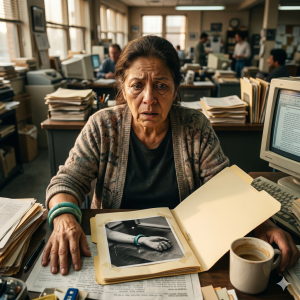
She found her own death certificate on a Tuesday morning, between a cup of lukewarm coffee and a stack of files she didn’t ask for.
Her name was Dolores Vega. Sixty-one years old. Semi-retired. She had been writing obituaries for the Albuquerque Journal for thirty-two years — long enough to know that death, on paper, always looked neater than it actually was.
She liked that about the job.
She did not like what was in that folder.
—
It started with a memo from her editor, Ray, slid under her desk like it was nothing.
*”Flagged file from archives. 1987 clerical error. Needs rewrite before we digitize. Just a cleanup job, Dolores. Thirty minutes, tops.”*
Thirty minutes.
She almost laughed.
She pulled out the folder. Yellowed at the edges. A rubber band so old it crumbled when she touched it. The kind of file that had been sleeping in a cabinet for nearly forty years, bothering no one, waiting for exactly the wrong person to open it.
She opened it.
The name at the top stopped her cold.
*Vega, Dolores M. Deceased: October 14, 1987. Age: 24.*
She sat very still.
Her coffee went cold.
—
Dolores M. Vega.
That was her name.
That was *her* name — the M for Marie, after her grandmother, a woman who used to make red chile from scratch every Sunday and hum songs Dolores still couldn’t identify.
She told herself it was a coincidence. Albuquerque wasn’t a small town, not really. There could be two Dolores Vegas. There had probably been a hundred of them over the years.
She turned the page.
And there it was.
A morgue photograph. Black and white. Grainy, the way everything from 1987 seemed grainy now, like the whole decade was trying to forget itself.
The woman in the photograph was young. Twenty-four, just like the file said. Her face was turned slightly away — you couldn’t see her features clearly.
But her wrist.
Her left wrist was visible.
And on it, clear as anything, was a bracelet.
Faded turquoise. Bakelite. A simple oval bangle, worn smooth on one side the way a piece of jewelry gets when it’s been loved for a long, long time.
Dolores looked down at her own left wrist.
The bracelet was there.
It was always there.
Her mother had slipped it onto her arm when she was seven years old. Dolores still remembered the weight of it — the way it felt both too big and exactly right. Her mother’s hands had been warm. Her voice had been quiet.
*”You keep this on,”* she’d said. *”Don’t ever take it off, baby. Not for anything.”*
Dolores had never asked why.
She had never taken it off.
Not once. Not in thirty-two years of marriages and funerals and surgeries and swimming pools. It had been on her wrist the morning her mother died. It had been on her wrist the day she filed for divorce. It had been on her wrist last night when she fell asleep in front of the television.
It was on her wrist right now.
The same bracelet.
In a morgue photograph.
From 1987.
—
She breathed.
She told herself there was an explanation.
There were always explanations.
She turned page after page, hands steadier than she felt. The paperwork was meticulous — someone had done this carefully, whoever had filed this in 1987. Cause of death listed as accidental. A residential address on Monte Vista that Dolores didn’t recognize. No employment history. No photograph on the intake form.
Just a name.
Her name.
And that bracelet.
She kept reading.
The file went deeper than most. There were signatures, authorizations, burial permits — all the paperwork that turns a person into a past tense.
She reached the last page.
The next-of-kin authorization form. The one that had to be signed before the county would release a body for burial.
Someone had signed it.
The signature was looping and familiar in a way that made Dolores’s chest go tight before her brain had fully caught up with what she was seeing.
She knew that handwriting.
She had grown up with that handwriting.
She had gotten birthday cards in that handwriting for fifty-four years.
Her sister.
Her sister Gloria, two years older, who still called every Sunday, who still made red chile from scratch the way their grandmother had taught them both.
Gloria, who had never once — not in fifty-four years — mentioned a word about any of this.
Dolores’s hand was shaking now.
She picked up her phone.
The bracelet caught the light as she dialed.
—
It rang four times.
Gloria always let it ring four times. She said answering on the first ring made you seem like you had nothing going on. She had held that opinion since approximately 1979 and saw no reason to revisit it.
“Lori.” Dolores used the name she hadn’t used since childhood. The name their mother had used. “I need you to talk to me right now.”
A pause.
Not a surprised pause. Not a confused pause.
A different kind of pause. The kind that meant someone had been waiting for a particular phone call for a very long time and had always known, somewhere behind everything else they were doing — the chile, the Sunday calls, the birthday cards — that it would eventually come.
“What did you find?” Gloria said.
Her voice was careful. Careful in a way that told Dolores this was not a conversation Gloria was unprepared to have. It was a conversation Gloria had rehearsed.
“Tell me everything,” Dolores said. “Right now. All of it.”
—
Gloria drove over.
She didn’t suggest it. She just said, “I’ll be there in twenty minutes,” and she was, because she only lived in the Northeast Heights and because she had clearly already been sitting by her keys.
She was sixty-three years old, thicker in the middle than she used to be, with their mother’s nose and their grandmother’s eyes and a look on her face when Dolores opened the door that Dolores had never seen on her before.
It was relief.
That was the thing that undid Dolores more than anything else. Her sister looked relieved. Like she had been holding something heavy for forty years and had just been told she could finally put it down.
Dolores handed her the file without a word.
Gloria sat at the kitchen table and looked at it for a long time. She didn’t seem surprised by any of it. Not the name. Not the date. Not the bracelet in the photograph.
She touched the corner of the photograph very gently, with one finger.
“Her name was Dolores too,” she said. “That’s the first thing you have to understand.”
—
It went like this.
Their mother, Esperanza Vega, had a sister. A younger sister, also named Dolores — a family name, their grandmother’s name, passed down the way those things get passed down in families that believe in the continuity of names. This Dolores, the other one, had moved to Albuquerque from Tucson in 1985. She was twenty-two years old and she was not doing well and she needed her sister, and Esperanza had taken her in without question because that was who Esperanza was.
For two years, the two of them had lived quietly side by side on the east side of town. The other Dolores waitressed at a place on Central. She was funny and sad in equal measure. She had a habit of leaving coffee cups everywhere and never finishing them. She liked old westerns and hated the cold.
She died in October of 1987.
A car accident on I-40. Nobody’s fault, the police said. Just a wet road and a moment and then not.
She had no identification on her when they brought her in. Her wallet had been thrown from the car and was never recovered. The intake form listed her as a Jane Doe.
And Esperanza, who was twenty-six years old and had just lost her sister and was standing in a county office trying to make sense of paperwork that felt like it was designed to grind her down, had made a decision.
She gave the county worker her sister’s name.
Her sister’s full name.
Dolores Marie Vega.
She didn’t have a birth certificate with her. She didn’t have anything. And the woman behind the counter was tired and the forms were long and Esperanza just gave the name and signed the authorization and buried her sister under the name they had both been given, because she couldn’t stand the thought of the word Jane Doe on a burial record for someone she had loved.
It wasn’t fraud. It wasn’t anything. It was a twenty-six-year-old woman doing the only thing she could think of to give her sister some dignity in death.
She never told anyone.
Not their mother. Not the parish. Not the child she was carrying at the time — her daughter Dolores, seven years old when the bracelet came off her own wrist and went onto a small arm that she loved more than anything.
That bracelet had belonged to the other Dolores.
She had been wearing it the night she died.
The county had released her effects to Esperanza in a manila envelope, the way they do, efficient and impersonal. The envelope had sat in Esperanza’s closet for seven years before she took the bracelet out and put it on her daughter’s wrist and said what she said.
*You keep this on. Don’t ever take it off, baby. Not for anything.*
Because it had been her sister’s. Because her sister had loved it. Because Esperanza could not carry the weight of a secret alone and could not tell her daughter the truth and could not throw the thing away, so she gave it as close as she could give it to where it belonged.
To a daughter who carried her aunt’s name without knowing it.
—
Gloria had been sixteen in 1987. Old enough to understand, mostly. Old enough to help their mother carry it afterward. Too young to fully know what to do with what she knew, and then too much time had passed, and then it was just a thing they carried.
“Mama made me swear,” Gloria said. “She didn’t want you growing up feeling like you were named for someone dead. She didn’t want that weight on you.”
Dolores sat across from her sister for a long time without speaking.
The folder was on the table between them.
The bracelet was on her wrist.
“What was she like?” Dolores finally asked. “The other one.”
Gloria smiled. And it was a real smile, the kind that comes with actual memory attached to it, not just grief.
“She was loud,” she said. “She laughed too hard at her own jokes. She burnt everything she tried to cook. She used to do this thing where she’d narrate what she was doing, like, out loud, step by step, just to make Mama laugh.” She paused. “She would have liked you. She would have thought you were hilarious, actually. The obituary thing. She would have gotten a real kick out of that.”
Dolores looked down at the bracelet.
Worn smooth on one side. The way a piece of jewelry gets when it’s been loved.
First by one Dolores. Then by another.
—
She didn’t rewrite the file the way Ray had asked.
She went back to the office and she sat at her desk and she wrote something else instead. Not an obituary, exactly — they don’t usually run those for people who have been gone forty years. But something. A small piece about a woman named Dolores Marie Vega who had come to Albuquerque from Tucson in 1985 and loved old westerns and left coffee cups everywhere and died too young on a wet road in October.
Ray read it and looked at her over the top of his glasses.
“This the clerical error?” he said.
“The file is fine,” she said. “The woman in it deserves a paragraph.”
He ran it. Tucked at the bottom of the local section, just a few hundred words. The kind of thing most people scroll past.
But some people don’t scroll past.
A woman in Tucson called the next week. She was seventy-eight years old. She said her cousin had moved to Albuquerque in the eighties and the family had lost touch and she had wondered, sometimes, what had become of her.
Dolores talked to her for an hour and a half.
—
She still wears the bracelet.
She always will.
She understands it differently now — not as a mystery or a coincidence or a thing to be afraid of. It’s a piece of faded turquoise Bakelite that passed through a woman’s life and then through another woman’s and is passing through hers, carrying a small piece of someone who laughed too loud and burnt everything she cooked and left coffee everywhere and didn’t deserve to be a Jane Doe.
There’s no mystery to it, really.
There’s just a family that had more Dolores Vegas than it knew what to do with.
And a Tuesday morning.
And a folder that had been waiting in a cabinet for nearly forty years for exactly the right person to open it.