Every Friday for eleven months, he came in and bought exactly one dollar’s worth of crickets.
Not a dollar-fifty. Not two dollars. One dollar.
Mamie Thibodaux had run the bait shop on the edge of Breaux Bridge for thirty-one years — long enough to know that a man who buys exactly one dollar’s worth of crickets isn’t going fishing for fun. He’s feeding something. A child, maybe. A quiet desperation he doesn’t have words for yet.
She never asked.
That wasn’t her way.
His name was on his work shirt — *Dillon* — but she never called him by it. He never gave her more than a nod and two quarters. Eyes down. Shoulders carrying something invisible and heavy.
The third Friday he came in, she set a brown paper bag on the counter next to his crickets without a word.
“What’s this?” he asked.
“Boudin,” she said. “Made too much.”
She hadn’t made too much. She’d made extra. There’s a difference, and they both knew it, but neither one said so.
He took it.
He came back the next Friday. She had another bag waiting.
It became their arrangement — unspoken, unacknowledged, as natural as the Spanish moss on the cypresses outside. One dollar of crickets. One bag of boudin. A nod from him. A nod from her.
What Dillon didn’t know — what Mamie never mentioned — was the index card.
Every week, she tucked one inside the bag. A small white card, written in her careful, old-fashioned printing, the kind they taught in Louisiana schools before everything went to cursive and then forgot cursive too.
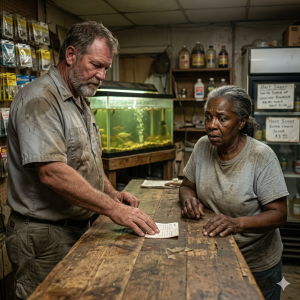
Three words.
*You’re doing fine.*
She never signed them. Never mentioned them. She assumed he threw them away — probably thought they were the receipt, or a note from the supplier, or something meant for someone else. She kept writing them anyway. It was the thing she could do.
Eleven months of Fridays.
Forty-seven index cards, give or take.
Then one Friday, he didn’t come.
Mamie told herself it was nothing. Truck trouble. Overtime. Life gets in the way of life. She set the bag aside in the cooler and waited.
He didn’t come the following Friday either.
Or the one after that.
She stopped making the extra boudin. Or she tried to. The truth is she made it anyway, two more times, out of habit, and had to give it to her neighbor before it turned. Her hands knew his Friday before her heart did.
Three weeks passed.
Then the door opened.
The man who walked in wasn’t Dillon. He was older, broader, with the same dark eyes but none of the same sadness — or maybe a different kind of sadness, harder to place. He was holding something.
A brown paper bag.
*Her* brown paper bag, she realized. The one she’d left three weeks ago. He must have gone to the truck and found it, or someone had given it to him, or —
She didn’t finish the thought.
Because she saw what else he was holding.
A small white index card, worn soft at the edges like a letter carried in a wallet. Creased. The ink slightly faded from handling.
He set it on the counter between them.
Smoothed it flat with one broad hand, the way you’d smooth something precious.
*You’re doing fine.*
Mamie’s heart went very still.
The man looked at her for a long moment. His jaw worked once, like he was practicing the words before he said them.
“Ma’am,” he finally said. “My brother asked me to find the woman who wrote this.”
He pressed his fingers gently against the card.
“Because it was in his pocket the night he decided not to give up.”
Mamie gripped the edge of the counter.
The ceiling fan turned overhead. The minnow tank hummed in the corner. Outside, the bayou was the same green it had always been, unhurried, unchanged, older than any of them.
She looked at those three words she had written without thinking, week after week, certain they meant nothing, certain they were thrown away —
And she opened her mouth to ask the question that was pressing up through her chest like something trying to breathe.
“Is he all right?”
The man — his name was Curtis, she’d learn that later — took a slow breath through his nose. He looked at the card instead of at her.
“He’s better,” he said. “He’s in a program over in Lafayette. Been there six weeks. Doing real good, they say.”
Mamie let go of the counter. She hadn’t realized how hard she’d been holding it.
“He wanted me to come in person,” Curtis continued. “Wouldn’t let me just call. Said that wasn’t right. Said some things have to be done face to face or they don’t count.”
He finally looked up at her. Those dark eyes. Dillon’s eyes, a generation removed.
“He kept every one of them,” Curtis said. “Every card you put in the bag. He kept them in his glovebox, in a rubber band. Forty-something cards. He’d read them on his lunch break, he said. Sometimes that was the whole lunch break.”
Mamie pressed her lips together. She was seventy-one years old. She had buried a husband and a son and most of her generation. She was not, as a rule, a woman who cried in her own shop.
She made an exception.
It wasn’t dramatic. Just her eyes filling up and the quiet sound of the ceiling fan and Curtis standing there with the decency to look out the window and give her a moment.
“I didn’t know him,” she finally said. “I never even knew his last name.”
“Fontenot,” Curtis said. “Dillon Fontenot. Our mama was a Broussard before she married. We grew up about twelve miles from here.”
She nodded slowly. Fontenot. A name as Cajun as the bayou itself, as old as half the headstones in the parish.
“He started coming in here after his divorce came through,” Curtis said. “Lost his house, lost his girls on the weekdays. He was living out of his truck for a while. Didn’t tell anybody. You know how men are.” He paused. “You know how *we* are.”
She did know. She’d watched it her whole life. Men carrying ten-ton loads in silence because someone told them once that asking for help was the same thing as falling down.
“The crickets were for his daughters,” Curtis said. “He had them on weekends by then. They’d fish off the bank behind our mama’s house. That was his — that was the thing he held onto. Those Saturday mornings with those girls.”
Mamie thought of all the Fridays. All the nods. All the eyes-down, shoulders-up, two-quarters-on-the-counter Fridays, and the image of a man on a Saturday morning watching his daughters bait a hook.
People carry more than you can see. She’d always known that. But knowing it and feeling it are two separate things.
“He said the boudin was the first hot food he’d eaten in three days, that first time,” Curtis said. He almost smiled, but it had too much ache in it to get all the way there. “Said he sat in his truck and ate it and read that card you put inside, and he just — he sat there a long time. Didn’t know what to do with it. Said he felt like somebody knew something they shouldn’t.”
Mamie let out a breath that was almost a laugh. “I didn’t know anything. I just — he looked like he needed a meal.”
“No, ma’am.” Curtis shook his head once, firm and certain. “He said you looked at him like he was worth looking at. He said that was the thing. Said most places, when you’re down, people look through you. You looked *at* him. Treated him like a man who came in to buy something, not a problem standing in line.”
Mamie had to look away. She studied the far wall, where the old license plates were nailed up — decoration, mostly, and memory, the way things are in shops that have been around long enough to collect a past.
She’d never thought of herself as doing anything particular. She’d thought of herself as doing what you do.
“Where is he now?” she asked. “Day to day, I mean.”
“Staying with me and my wife until he gets on his feet. He’s got a job at a dry dock over in Henderson. Starts Monday.” Curtis picked up the index card with the same careful hands he’d used to smooth it down. He held it like it had weight to it. “His girls are coming to stay the first weekend of next month. He wants to take them fishing.”
“Good,” Mamie said. It was the most complete thing she’d said in several minutes, and she meant all of it.
Curtis tucked the card into his chest pocket. He reached into the brown paper bag — her bag, the three-week-old one — and she saw that someone had repacked it. New boudin, store-bought from the look of it, and a small envelope on top.
“He wanted to leave you this,” Curtis said, setting the envelope on the counter. “He wrote it himself. Took him four tries, he told me to tell you. Said the other three were too much.”
He held out his hand. Mamie shook it — a real handshake, firm and held a beat longer than a transaction.
“Thank you,” he said. “From all of us. From the girls too, even though they don’t know your name. Somewhere down the line, they’ll have their daddy because of a woman in a bait shop in Breaux Bridge. That’s — ” He stopped. Cleared his throat. “That’s something.”
He walked out. The screen door swung shut behind him with its familiar wooden clap, and then Mamie was alone with the hum of the minnow tank and the slow turn of the fan and a small white envelope on the counter.
She waited a little while before she opened it. She wasn’t sure why. Maybe she wanted to let it be what it was for one more moment before it became something she’d read.
The handwriting inside was careful and slightly uneven, the handwriting of a man who doesn’t write often but was trying to do this right.
*Mrs. Thibodaux,*
*I don’t have good words for what I want to say. But my brother is driving me down to see you and I wanted to write this out first.*
*You didn’t know me. You just saw me come in every week and you treated me decent. You put food in a bag and you didn’t make me feel like I had to explain myself or be grateful in a way I could see. You just put it there.*
*The cards meant something I can’t say right. The first time I found one I thought it was a mistake. Second time I thought you maybe put them in all the bags. Third time I knew you meant it for me and I didn’t know what to do so I kept it. I kept all of them. I don’t know if that’s strange.*
*There was a night in October I was sitting in my truck and I wasn’t doing good. Not at all. I had the cards out and I read through them all and I don’t know how to tell you what that was like but it was enough. It was enough to get me to the next morning.*
*I should have said something a long time ago. I didn’t know how.*
*You’re doing fine. That’s what you said. I’m trying to make it true.*
*— Dillon Fontenot*
*P.S. Curtis says you probably want to know I’m okay. I am. I’m going to be.*
Mamie read it twice. Then she folded it along its creases and held it in both hands for a moment, the way you hold something you’re not sure where to put yet because everywhere feels too ordinary.
She found a place for it eventually. There was a cigar box on the shelf behind the register — the same shelf where she kept the good rubber bands and the spare keys and a photograph of her husband on the dock, the last good summer. She put Dillon’s letter in the box. Smoothed the top shut.
She thought about October. About a man in a truck in the dark, reading three-word cards by the dome light.
She thought about how thin it all is sometimes. How close the margin. How a bag of boudin costs maybe three dollars in ingredients and a few minutes of time, and how the math of that still doesn’t come out to anything she could calculate, because the numbers are the wrong kind.
The door opened. A teenager came in for a container of nightcrawlers. She sold them to him. He left. The bayou went on being the bayou.
After a while Mamie took out a fresh index card and set it on the counter in front of her. She didn’t have anyone in mind for it. She just left it there, the way you leave a light on.
She’d find the right bag to put it in.
She always did.