She walked into that bank wearing the key that was supposed to be buried.
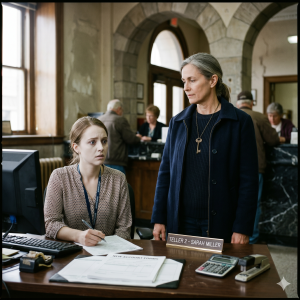
And the look on that young woman’s face — the one sitting behind the desk marked *Branch Manager… Pending* — told Ruthanne everything she needed to know.
But we’ll get to that.
—
Twenty-five years ago, Ruthanne Decker was twenty-three years old and in love with a man whose mother had already decided she wasn’t good enough.
She’d spent three years filling that hope chest.
Three *years.*
Hand-stitched quilts she’d learned from her grandmother. A cast-iron skillet she’d saved for over four months. Letters she’d written to her future self — the wife she planned to become. She’d sanded that cedar chest herself, in her daddy’s garage, on Saturday mornings when the light came in just right.
She was proud of it.
She shouldn’t have left it at the church hall. She knew that now. But when Gerald called off the engagement — two weeks before the wedding, over the phone, while his mother sat right there in the room, Ruthanne could *hear* her breathing — she hadn’t been in any condition to go collect her things.
She was barely in condition to get out of bed.
—
She found out later what happened. Everyone in Millhaven found out.
Patsy Grelle — Gerald’s mother, a woman who wore pearls to breakfast and cruelty like a second skin — had marched into the church bazaar the following Saturday morning and put the cedar chest on the auction table herself.
Called it *”abandoned junk from a girl who didn’t belong here.”*
Said it in front of the whole congregation.
Ruthanne heard it secondhand, from three different people, each one whispering like the shame was somehow hers to carry.
She left Millhaven that same month.
—
The only thing she’d taken from that chest — the one thing she’d kept in her coat pocket the whole time — was a small brass skeleton key.
It had belonged to her grandmother. What it opened, she’d never known. But she’d worn it on a chain around her neck for twenty-five years like a quiet promise she’d made to herself.
She was still wearing it this morning.
—
The Millhaven Savings & Loan ribbon-cutting was a modest affair. Local news, some chamber of commerce folks, a photographer from the *Gazette.*
Ruthanne had driven in from Nashville the night before. She’d checked into the Holiday Inn off Route 9 under her maiden name — *Decker*, not *Decker-Holt*, not the name attached to the investment group, not yet — and she’d slept better than she had any right to.
She was, as of thirty days ago, the majority owner of this bank.
She hadn’t told anyone in Millhaven.
She wanted to see their faces first.
—
The key caught the light when she signed the ceremonial paperwork.
An older man in a gray suit — one of the loan officers, she’d learn later — glanced at it and then quickly looked away.
Strange.
A woman near the coffee table, mid-fifties, name tag reading *Carol*, stopped mid-sentence when she saw it and pressed her lips together like she was swallowing something.
Ruthanne tucked it back inside her blouse.
But she kept thinking about those looks.
—
She noticed the girl — the young woman — at the desk in the back. Late twenties, dark hair, professional blazer. The nameplate read *Branch Manager… Pending*, which Ruthanne’s attorney had already explained meant the position was hers to confirm or reject within sixty days.
Something about the girl’s face was familiar in the way that old photographs are familiar. A resemblance you can’t quite name.
Ruthanne was halfway through her second cup of coffee when it clicked.
The eyes.
Patsy Grelle’s eyes.
—
She walked over slowly. No rush. Twenty-five years had taught her that patience was its own kind of power.
“I don’t think we’ve been introduced,” Ruthanne said.
The young woman stood, extended her hand, professional and polished.
“Leigh Grelle,” she said. “I’m so glad you’re here, Ms. Decker. My grandmother actually grew up in Millhaven — she used to talk about this town all the time. Small world, right?”
Ruthanne smiled.
“Small world,” she agreed.
Then the key slipped out from her collar again — just the chain shifting as she reached to set down her cup.
Leigh Grelle’s eyes dropped to it.
And stayed there.
The color left her face the way water leaves a glass. Slow, then all at once.
“That key,” Leigh said, and her voice had gone to something thin and careful.
“Mm?” Ruthanne said pleasantly.
Leigh Grelle stood up slowly, her face gone the color of old chalk, and said, “Grandma told me that key was buried with the chest. She said nobody alive knew what it opened.”
Ruthanne felt something settle in her chest. Something that had been waiting a long, long time.
She smiled for the first time all morning.
“Funny,” she said. “Because I do.”
—
She let the silence sit there for a moment. She’d earned that moment.
Leigh was gripping the edge of her desk now, not so much for balance as for something solid to hold onto. Her eyes kept moving between the key and Ruthanne’s face, trying to work out the math of it.
“Ms. Decker,” she started.
“Why don’t we go somewhere quiet,” Ruthanne said. Not a question. “I have a feeling we have a great deal to discuss.”
—
The conference room at the back of the branch smelled like new carpet and coffee and the particular anxiety of a woman who had just realized she was on the wrong side of something she didn’t fully understand yet.
Leigh closed the door. She sat across from Ruthanne at the small oval table and folded her hands in front of her like she was composing herself from the outside in.
“I want you to know,” Leigh began, “that whatever my grandmother did — I’m not her. I’ve only been in Millhaven three months. I applied for this position because I thought it was a good opportunity.”
“I know that,” Ruthanne said. And she did. She’d had Leigh Grelle researched six ways from Sunday before she ever set foot in this town. Finance degree from Belmont. Two years at a credit union in Knoxville. Clean record, strong references, no reason in the world to be held accountable for a woman she’d been raised by.
Ruthanne was many things. She was not Patsy Grelle.
“Then what does the key open?” Leigh asked. Her voice had steadied some. Whatever else she was, the girl had a spine. Ruthanne respected that.
Ruthanne lifted the chain from her neck and set it on the table between them.
“I didn’t know for the first twenty-four years,” she said. “My grandmother gave it to me two weeks before she died and told me it would open something important when the time was right. Which is the sort of thing a woman says when she’s ninety-one years old and feeling poetic.” Ruthanne smiled a little. “I thought she might have just been talking.”
Leigh looked at the key like it might move on its own.
“But she wasn’t talking,” Ruthanne continued. “She was trying to tell me something she hadn’t finished working out how to say.”
—
Three years ago, Ruthanne had been back in Tennessee for a charity event in Nashville, and she’d sat next to a woman named Dorothy Pell — a retired schoolteacher from Harlan County who had a gift for talking and a memory like a filing cabinet.
Dorothy had grown up three counties over from Millhaven. She’d known the Decker family.
She’d also known what the key was for.
“Your grandmother kept a safe deposit box at this very bank,” Dorothy had told her, over chicken piccata and white wine, with the cheerful delivery of someone dropping a casual remark. “Had it for forty years, maybe more. I always thought it was funny she kept it here in Millhaven and not closer to home. But your grandmother was a private woman.”
Ruthanne had set down her fork.
“I beg your pardon?”
“Oh, she never told you? Lord, I assumed the family knew. Edna Decker had a box at Millhaven Savings & Loan going back to the early sixties at least. I only knew because my cousin worked the front desk there for a spell.”
—
Ruthanne had spent the next week making phone calls.
Then she’d spent the next six months making a different kind of plan.
The box was still there. Forty-year-old safe deposit boxes at small-town banks have a way of persisting, especially when the annual fee had been prepaid through a trust arrangement no one had ever thought to dissolve. Her grandmother’s attorney — the son of her grandmother’s original attorney, now in his sixties himself — had confirmed it with some embarrassment and a great deal of apologizing.
The box was still there, and it had never been opened, and it required exactly one small brass skeleton key to open it.
And the bank it sat in had come up for sale eight months ago, when the previous ownership group ran into the kind of financial trouble that a well-positioned investment group from Nashville could quietly resolve.
So she’d bought it.
She hadn’t planned, exactly, for Patsy Grelle’s granddaughter to be sitting behind the branch manager’s desk when she walked in. But she’d learned a long time ago that the universe had a sense of humor, and the best thing you could do was appreciate it.
—
She explained all of this to Leigh in the same measured tone she’d used in a thousand boardrooms. Leigh listened without interrupting, which confirmed Ruthanne’s read on her.
When she finished, Leigh sat quietly for a moment.
“She sold your things,” Leigh said finally. “At a church sale. And you came back and bought the bank.”
“I came back for my grandmother’s safe deposit box,” Ruthanne said. “The bank was just the most direct route.”
Something moved across Leigh’s face — something complicated that Ruthanne suspected had a lot of old history behind it.
“Grandma Patsy,” Leigh said slowly, “was not a kind woman. I want you to know that I know that.”
Ruthanne said nothing.
“She passed two years ago. Dementia, at the end. She used to talk about Millhaven constantly — it was one of the things she held onto longest. And she talked about a cedar chest.” Leigh paused. “She talked about it like it was something she’d won.”
The air in the room shifted.
“Did she,” Ruthanne said.
“She kept a small cedar jewelry box on her dresser. Right up until she died.” Leigh’s voice was careful and even. “She called it her good luck. She said it held the things that mattered.” A beat. “I always thought that was strange, because I never once saw her open it.”
—
They walked together to the vault room — Ruthanne and Leigh and the bank’s operations manager, a heavyset man named Terry who had the look of someone who had stopped being surprised by anything a long time ago.
The safe deposit boxes lined two walls, floor to ceiling, dull silver faces with small keyholes. Terry found the number in the ledger — Box 114, registered to Edna Marie Decker, active since 1961 — and showed Ruthanne to it without comment.
She put the key in.
It turned on the first try, smooth as anything, like it had been waiting patiently and saw no reason to make a fuss about it now.
—
Inside the box were four things.
The first was a bundle of letters tied with kitchen twine, addressed in her grandmother’s handwriting to a name Ruthanne didn’t recognize — a man’s name, in care of a post office box in Chattanooga. The letters were sealed. Had never been sent.
The second was a photograph. Black and white, slightly creased. A young woman standing in front of a building Ruthanne didn’t know, laughing at something off-camera, her head tipped back, completely unguarded. Ruthanne stared at it for a long moment before she understood that the young woman was her grandmother. She’d never seen a picture of her grandmother young. She’d never imagined her grandmother laughing like that.
The third was a land deed. Forty acres in Harlan County, Kentucky, deeded to Edna Marie Decker in 1959 and never transferred, never sold, sitting in a safe deposit box in a small Tennessee town for sixty-four years.
Ruthanne’s hands were steadier than she expected.
The fourth thing was a note. One page, fountain pen, dated 1987, which would have made her grandmother seventy-three years old when she wrote it.
*For Ruthanne, when she finds this —*
*I wanted you to have something that was only yours. Land is the only thing they can’t take back once it’s given right. The key goes to Box 114 at Millhaven Savings. Don’t let anyone tell you that you don’t belong somewhere. You come from people who built things from nothing and I am the proudest of you.*
*All my love, Gran*
—
Ruthanne stood in that vault room for a long time.
Terry had quietly stepped out. It was just her and Leigh, and after a moment Leigh stepped out too, without being asked, because she was perceptive enough to understand when a woman needed to be alone with something.
Ruthanne read the note twice. Then she folded it carefully and put it in her jacket pocket, close to her chest, right where the key used to sit.
—
She found Leigh waiting in the hallway, leaning against the wall with her arms crossed, not performing anything, just waiting.
“Everything you needed?” Leigh asked.
“Everything,” Ruthanne said.
They walked back toward the main floor together. Through the glass front of the branch, Ruthanne could see the ribbon-cutting debris still being tidied up — a stray curl of red ribbon on the sidewalk, the photographer packing his bag.
“I’ve been thinking,” Ruthanne said, “about the branch manager position.”
Leigh kept walking, kept her face neutral, but Ruthanne caught the slight tension in her jaw.
“The previous candidate,” Ruthanne continued, “was recommended by the prior ownership group, and I have some concerns about that recommendation that have nothing to do with his qualifications and everything to do with the fact that he’s the prior owner’s nephew.” She paused. “I think Millhaven Savings needs someone with fresh eyes and no legacy entanglements.”
Leigh stopped walking.
“Ms. Decker—”
“Your application was strong on its own merits,” Ruthanne said. “I reviewed it before I knew your name. I want you to know that.” She looked at her directly. “The job is yours, if you want it. Not as a favor and not as a statement. Because you earned it.”
Leigh stood very still.
“Why are you telling me this now?” she asked. “After all of — this?”
Ruthanne considered the question seriously, the way it deserved.
“Because my grandmother left me a note about not letting anyone tell you that you don’t belong somewhere,” she said. “And it seemed like the right thing to pass along.”
—
She drove back to the Holiday Inn that afternoon with the four items from the box on the passenger seat. She’d called her attorney from the parking lot — the land deed was going to take some untangling, sixty-four years of untangling, but it was real and it was hers and it wasn’t going anywhere.
She’d call her daughter tonight. Tell her about the forty acres in Harlan County that had been waiting for them since before either of them was born.
She held the key in her palm for a moment before she put the car in reverse. It was just a small brass skeleton key. It looked like nothing.
She’d worn it for twenty-five years not knowing what it opened, only knowing that her grandmother had thought it was worth keeping. Worth passing on. Worth the weight of it, every day, against her skin.
Now she knew.
It had opened exactly what it was supposed to.
She set it on top of her grandmother’s note on the passenger seat, and she drove out of Millhaven in the late afternoon light, and she didn’t look back — not because it still hurt, but because there was nothing back there left to reclaim.
She had everything.