The notary public turned white as a sheet the moment he saw her.
But I’m getting ahead of myself. Let me back up to the beginning — because you need to understand what kind of woman Dorothy Mae Calloway is before you understand what she did at that party.
—
Dottie had lived on Clover Hill Farm for thirty-one years.
She’d planted every fence post. Named every horse. Buried her first husband, Ray, under the big oak by the south pasture, and kept right on going because that’s what Tennessee women do.
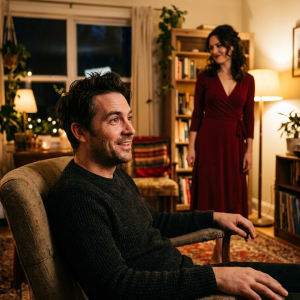
So when Gerald came along — charming, soft-spoken Gerald with his pressed khakis and his out-of-state manners — her friends smiled politely and said nothing.
Dottie was happy. That was enough.
The wedding was small. The honeymoon was a long weekend in Gatlinburg.
And the week after they got back, while Gerald was in Nashville on “business,” Dottie pulled her dryer away from the laundry room wall to chase down a missing sock.
That’s when she found it.
A small spiral notebook. Water-stained along the bottom edge, the cardboard cover warped like it had gotten wet and dried wrong. She almost threw it in the trash.
Almost.
She tucked it into her apron pocket instead.
—
She read it that night at the kitchen table, alone, with a glass of sweet tea she never touched.
She didn’t sleep.
By morning, she had smoothed down her hair, fed the horses, made Gerald his eggs, and said absolutely nothing.
But she kept that notebook.
Every single day after that, it went into her apron pocket. Every single day, if Gerald came close — or his daughter Renee called on the phone — Dottie’s hand dropped to her apron and pressed flat against the lump of it, like she was steadying herself.
She told no one what was in it.
Not yet.
—
It was Renee who first mentioned the farm paperwork.
“Daddy said you’d be fine with the transfer,” she said over the phone, breezy as you please. “Just a formality.”
Dottie said, “Of course, sweetheart.”
Then she hung up and made one very quiet phone call to a lawyer in Knoxville whose name she’d gotten from her friend Carol.
The lawyer called her back in less than two hours.
His voice was careful. Measured.
“Mrs. Calloway,” he said. “Do you know what a power of attorney is?”
She did now.
Clover Hill Farm — thirty-one years, every fence post, every horse, Ray’s grave under that oak tree — had been signed over to Renee three weeks after the wedding.
Signed by Dottie.
Except Dottie had never signed a single thing.
Her hand went to her apron pocket. She pressed the notebook flat.
“I know,” she said quietly. “I have something you need to see.”
—
Gerald planned the party himself.
A “Welcome Home” celebration for Renee, who was moving into the farmhouse — her farmhouse now, he kept saying, like the words tasted good.
He hired a caterer. Strung lights on the porch. Invited half the county.
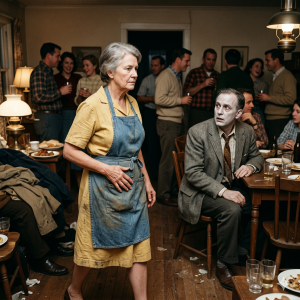
Dottie baked her chess pie and wore her yellow dress and smiled at every single person who came through that door.
She mingled. She laughed. She refilled the sweet tea.
And every few minutes, her hand dropped to her apron pocket.
Press. Release. Smile.
Nobody noticed her watching the driveway.
Nobody noticed when a silver sedan pulled up just after seven o’clock and a man in a gray jacket got out, tugging his collar like it had suddenly gotten too tight.
Gerald didn’t recognize him.
Renee didn’t recognize him.
But several people in that room would have, if they’d looked close enough — because in a small county, certain people are known by the stamp they carry.
Dottie set down her pie server.
She smoothed her apron with both hands, slow and deliberate.
She felt the notebook against her palm one last time.
Then she walked — calm, steady, unhurried — straight across that party, straight through the laughing and the fiddle music and the smell of Gerald’s expensive catered food, straight toward the man her husband had never once mentioned to her.
Not once.
The man who had notarized every document.
The man whose stamp was on every single page.
He saw her coming and he stopped moving entirely.
Dottie smiled.
“I believe,” she said, “you know why I called you.”
—
His name was Dennis Farwell.
He’d been a notary public in Harlan County for eleven years. He had a small office above the insurance agency on Main Street and a reputation for being discreet, which, it turned out, was exactly why Gerald had chosen him.
Dennis had gone pale because he’d had three weeks to think about this moment and dread it, and here it was anyway.
Dottie took him gently by the elbow and steered him toward the hallway, away from the noise, past the coatrack, into the little sitting room off the kitchen where she kept Ray’s books and her grandmother’s rocking chair.
She closed the door behind them.
She did not raise her voice. She had not raised her voice once through any of this.
She reached into her apron pocket and laid the notebook on the side table between them.
Dennis looked at it the way a man looks at something he recognizes and wishes he didn’t.
“The notebook,” Dottie said, “has a list. Names, dates, and what I’ll call transactions, though I suspect the law has a more specific word for them. Your name is on that list, Mr. Farwell. Twice.”
Dennis opened his mouth.
“Don’t,” she said pleasantly. “My lawyer is in the next room.”
That was true. Thomas Briggs of Knoxville had driven two and a half hours and was currently standing near the fireplace eating a piece of Dottie’s chess pie, looking, to all the world, like just another party guest.
Dennis closed his mouth.
—
The notebook had belonged to Gerald’s first wife.
A woman named Patricia, who had died four years ago of what her death certificate called natural causes, and who had apparently spent the last year of her life writing down everything she knew, in a small spiral notebook, and hiding it behind a dryer in the laundry room of a house she no longer lived in.
She and Gerald had divorced. He’d gotten the house in the settlement.
But Patricia had kept a copy of her key.
And sometime before she died, she’d gone back.
Whether she’d intended for someone to find the notebook eventually, or whether she’d simply run out of time to decide what to do with it, Dottie would never know for certain. But she’d thought about it often, those long quiet weeks with her hand pressed to her apron pocket.
She thought about a woman who knew something terrible and hadn’t known who to trust.
She thought about a woman who’d hidden her evidence behind a dryer and hoped.
Dottie had found it. And she had not thrown it in the trash.
—
Gerald had done this before.
Not the farm — Patricia hadn’t had a farm. But the pattern was the same. Charming. Soft-spoken. Pressed khakis. And then the documents, the transfers, the signatures that didn’t belong to anyone who’d actually signed them.
Patricia had documented two properties, a brokerage account, and a vehicle — all moved out from under her before she’d understood what was happening.
She’d tried to fight it. Gerald’s lawyer had been better than hers, or at least more expensive, and the divorce had ground her down to nothing.
But she’d kept the notebook.
And Dennis Farwell’s name was in it, from the first time around.
Which meant Dennis had known, when Gerald walked into his office the second time with a new wife’s signature to notarize, exactly what he was stamping.
He’d done it anyway.
—
“Here is what I want you to understand,” Dottie said to Dennis, in the same tone she used when she was explaining something simple to someone who ought to have known better. “I am not an unreasonable woman.”
Dennis was sitting now. He hadn’t been invited to sit. He’d simply lost the ability to stand.
“My lawyer has prepared a document. It is a full sworn statement of what you did, and when, and for whom. You’re going to sign it tonight, Mr. Farwell, in front of witnesses, and then you’re going to make a phone call tomorrow morning to the State Attorney’s office, which I’m told handles notary fraud.”
“Mrs. Calloway—”
“In exchange,” she continued, “my lawyer will note your cooperation. He believes it will matter. I’m choosing to believe him because I was raised to extend good faith to people even when they haven’t earned it.”
She picked up the notebook. Smoothed the warped cover with her thumb, the same way she’d smoothed it a hundred times in the past weeks.
“Patricia couldn’t get anyone to listen to her,” Dottie said. “I think about that. She was alone, and she was sick, and she wrote it all down and hid it, and nobody found it until it was too late to help her.”
Her voice didn’t waver.
“It’s not too late to help me.”
—
Dennis Farwell signed the statement at 8:47 in the evening, at Dottie’s kitchen table, with Thomas Briggs and Dottie’s friend Carol as witnesses.
Carol had been there the whole time. She’d come early to help set up, the way she always did, and she’d known something was happening because Dottie had called her two weeks prior and said, “I may need you to be there for something. I can’t tell you what yet. Can I count on you?”
Carol had said yes without a second’s hesitation, because that’s the kind of friend she was, and that’s the kind of woman Dottie was, that people said yes to her like that.
—
Gerald was still at the party when it happened.
He was on the porch talking to his cousin from Chattanooga when Thomas Briggs came out of the side door and crossed the yard toward the driveway.
Gerald watched him go with a small frown. He’d noticed the man arrive. He hadn’t figured out why.
Then Dottie appeared in the doorway.
She was still wearing her yellow dress. She was still perfectly composed. She looked, from a distance, like she was just coming out to check on her guests.
Gerald smiled at her across the porch.
She did not smile back.
And something about that — the stillness of her, the way she was looking at him not with anger but with a kind of clear, arrived certainty — made the smile slide right off his face.
“Gerald,” she said. “I think it’s time your guests headed home.”
—
I won’t tell you everything that happened after, because some of it is still working its way through the court system and Thomas Briggs has advised Dottie to be measured about what she shares publicly.
What I can tell you is that the fraudulent transfer of Clover Hill Farm was reversed.
What I can tell you is that Gerald is no longer at Clover Hill Farm, and neither is Renee, and the locks have been changed.
What I can tell you is that Dennis Farwell made that phone call to the State Attorney’s office, and that his cooperation was noted, and that Gerald did not have the same opportunity to cooperate because by the time anyone approached him, he’d already hired the expensive lawyer.
Some things take time.
Dottie is patient.
—
The last time I spoke with her, she was on the porch.
She’d been repainting the porch rail, white, the same white it had always been, the same white she’d painted it the first summer she and Ray moved in, thirty-one years ago.
She had a smear of paint on her forearm and a glass of sweet tea on the step beside her, and she was looking out at the south pasture like she was taking inventory.
I asked her how she was doing.
She said, “I’m home.”
I asked her if she ever thought about what would have happened if she hadn’t found the notebook.
She was quiet for a moment. She set down her brush.
“I think about Patricia,” she said. “I think about her coming back to that house and choosing the laundry room. Somewhere dry. Somewhere out of the way. Somewhere a careful person might eventually look.”
She picked up her tea.
“I don’t think she hid it. I think she left it.”
She took a sip and looked back out at the pasture.
“I think she left it for the next one.”
—
Clover Hill Farm is thirty-one years of fence posts and horses and one oak tree with a man named Ray buried underneath it, and it belongs to Dorothy Mae Calloway.
It always did.
She just had to remind a few people of that.