Twenty-three years ago, a woman stood up in this very room and told everyone I wasn’t good enough.
Today, I’m the one at the podium.
And she’s sitting in the front row.
—
My name is Lena Cutler. And I want to tell you what happened the Tuesday morning that changed the entire direction of my life — because I think some of you have been in a room like that, too.
I was twenty-nine years old. I was engaged to be married. I had saved up eleven hundred dollars for a wedding dress, and I had a little emerald ring on my finger that I loved more than anything I’d ever owned.
His name doesn’t matter now. What matters is his mother.
Margaret Howell.
She was — and still is — a pillar of this community. On the board of everything. At the front of every room. Pearls, always. A smile that never quite reached her eyes.
She never liked me. I knew it. But I didn’t know how far she was willing to go.
The morning of the Rotary luncheon, I got a call. Come, someone said. You need to hear this.
I walked in wearing a yellow blazer I was so proud of. Thrifted. Pressed twice. I thought I looked professional.
I sat down.
Margaret Howell stood up.
And she read aloud from what she called my credit report.
Fabricated numbers. Fabricated debts. A fabricated eviction I’d never had. She’d typed it up herself — I would learn that later — on something that looked official enough that half the room believed her before she even finished the second paragraph.
*Financially unfit to marry into this family*, she said.
She said it like a verdict.
I sat there in my yellow blazer and I did not cry. I saved that for the parking lot.
The engagement ended four days later. He never once asked to see the original document.
—
But here’s the thing about parking lot moments.
Sometimes, when everything falls apart, the only thing left to do is build something they can never take from you.
I went back to school that fall. Took out loans I was terrified of. Ate peanut butter sandwiches for two years and learned everything I could about financial literacy — not because I wanted to prove something to Margaret Howell, but because I was so angry at how little I’d understood about money, and I never wanted another woman to feel as powerless as I felt in that room.
I started a nonprofit. Small at first. A folding table at a church basement in Decatur.
Then a website. Then a staff of four. Then twelve.
Then, last spring, a national financial literacy program serving over 80,000 women across thirty-one states.
And somewhere along the way — I can’t even tell you exactly when — I started carrying a little card in my jacket pocket.
Laminated. Index-card size. I’ve had it for twenty-three years.
I touch it when I’m nervous. I touch it when I walk into rooms where I’m not sure I belong. I turned it over and over in my fingers this morning in the car on the way here.
It’s small. The print is tiny. Nobody’s ever been close enough to read it.
I’ve never shown it to anyone.
—
When the Rotary Club called to ask me to keynote their annual luncheon, I said yes before they finished the sentence.
I didn’t tell them why.
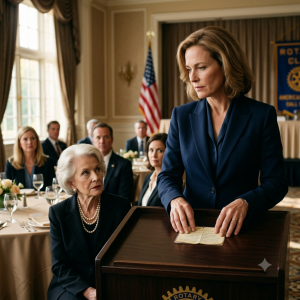
I walked into this building this morning in a navy blazer — bought new, no apology — and I found my name on the little tent card at the speaker’s table, and I looked out at the room filling up with people, and my hand went straight into my jacket pocket.
The card was there.
It’s always there.
I turned it over twice. Then I put my notes on the podium and I waited.
She came in at 11:47.
Margaret Howell. Older now. Still the pearls. She took a seat in the front row like she owned the architecture of the room — which, in her mind, I suspect she does.
She didn’t recognize me at first.
Then she did.
I watched it happen. The slight adjustment of her posture. The way her smile went careful.
I smiled back. Genuine. That part surprised even me.
The program director said my name. Said my organization’s name. Said the number — eighty thousand women — and I heard the room respond to it the way rooms respond to something real.
I walked to the podium.
I smoothed my notes.
I looked at Margaret Howell for the first time in twenty-three years.
And then I reached into my jacket pocket, took out that small laminated card I have carried every single day since the morning she humiliated me in this room —
and I laid it flat on the lectern, where everyone could see it.
—
It’s a receipt.
That’s all it is.
A receipt from the Decatur Public Library. Dated November 4th, 2001. Six days after the luncheon. Six days after the parking lot.
It itemizes four books I checked out that morning.
*Personal Finance for Beginners. Understanding Your Credit Report. Starting a Small Business on a Shoestring. The Woman’s Guide to Financial Independence.*
Total cost: zero dollars.
Because that’s the thing about libraries. They let you in regardless of what anyone says about you.
I checked out those four books with shaking hands and a tear-swollen face, and I sat in a carrel in the back corner of that library for six hours straight, and somewhere in hour three I stopped crying and started taking notes.
The receipt was in the front pocket of the first book when I returned them. I don’t know whose it was. I don’t know who checked out those same books before me, or why they left it there, or whether they ever found the thing they were looking for.
But when I found it, I kept it.
I don’t entirely know why. Maybe because it meant someone else had stood in the same place. Had needed the same things. Had quietly, without fanfare, decided to start.
I laminated it the following spring, when I realized I was still carrying it in my wallet and the edges were going soft.
—
I looked out at the room.
I said, “This is not a story about revenge. I want to be honest with you about that, because I think you came here expecting it to be, and I think part of me did too.”
A few people laughed. Nervous, recognition-laugh.
“Twenty-three years ago, a woman in this room used the language of money to make me feel like nothing. And the thing that undid her — the thing that completely dismantled the power of what she did — was not that I went on to succeed. It’s that I went to the library.”
I tapped the card.
“Because what she understood, and what I didn’t yet, was that financial knowledge is not neutral. It is not just practical. It is power. It determines who gets believed in a room. It determines who gets to speak and who gets spoken about. She knew that. She weaponized it. And the only answer — the only real answer — was to learn it. To learn it, and then to hand it to every woman I could find.”
I paused.
I had not planned what I said next. It arrived the way true things sometimes do, without your permission.
“Margaret.”
The room went very still.
She looked up at me. Her expression was not what I expected. It wasn’t defiance. It wasn’t the careful smile. It was something older than either of those things.
“I don’t know what your life looked like from the inside,” I said. “I don’t know what you were afraid of, or who had ever made you feel like the only way to hold your position was to push someone else out of the room. I’m not here to forgive you in some public performance. That’s between me and myself and I’ve been working on it for a long time.”
I picked up the laminated card. Held it for a moment.
“But I am here to tell you that you are the reason eighty thousand women now know how to read their own credit reports. You are the reason they know what a debt-to-income ratio is, and how to spot a predatory loan, and what their rights are when a collector calls. Every single one of them. Because of one Tuesday morning and a yellow blazer and a parking lot.”
I set the card back down.
“So I suppose what I’m saying is: thank you. Not for what you did. But for what it made me unable to ignore.”
—
I don’t know what I expected after that.
I gave the rest of the speech. I talked about the program. I talked about the women we serve. I got a standing ovation, which still makes me uncomfortable in a way I’m not sure I’ll ever fully resolve.
Afterward, in the reception line, I braced myself.
She waited until almost everyone else had gone through. That was deliberate. That is very Margaret Howell.
She stood in front of me in her pearls and she was quiet for a moment.
Then she said, “I owe you more than an apology.”
I said, “Yes. You do.”
She nodded. Just once. Like she’d expected that. Like she maybe needed to hear it said plainly.
She didn’t cry. Neither did I. We are, it turns out, more alike in that particular way than I would have ever wanted to admit.
She shook my hand, and she left, and I stood there watching the door close behind her and I felt — not healed, exactly. Not finished. But lighter than I’d been that morning in the car, which is maybe all you can ask for from a single afternoon.
—
I still have the card.
It’s back in my pocket right now, as I write this.
I’ve been thinking about making copies. Laminated. Index-card size. To hand to every woman who comes through our program at the very beginning, before she knows anything yet, before she believes she belongs anywhere near this subject.
So she has something to hold when she walks into a room where someone is trying to make her feel like she doesn’t.
So she knows someone else was there first.
So she knows she can start from where she is, with what she has, and that a library costs nothing, and that the most powerful thing anyone ever did to try to diminish her can, if she lets it, become the exact shape of the thing she builds.
I haven’t decided yet. But I’m thinking about it.
And I think that’s probably enough for now.
— Lena Cutler is the founder and executive director of Open Ledger, a national nonprofit providing free financial literacy education to women in thirty-one states. You can find them at openledgerwomen.org.