He thought he’d won.
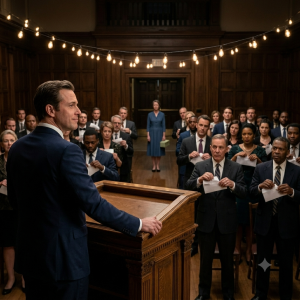
He hadn’t even opened his mouth yet, and he already had that look — chin up, hand resting on the podium, that slow smile spreading across his face like he owned every inch of the room.
And then he said the words.
And the whole place went quiet in a way that had nothing to do with respect.
—
Let me back up eighteen months.
Wanda Thibodaux had run her mama’s bait shop on the Gulf Coast for eleven years after her mother passed. Nothing fancy — a screen door that stuck, a handwritten price board, a chest freezer that hummed too loud. But it smelled like salt water and motor oil and every summer of Wanda’s childhood, and she had never once thought about selling.
Then Clayton Merritt moved in down the street.
Charming. Good-looking in that just-got-off-the-sailboat way. Brought a peach cobbler to the block party. Remembered everyone’s grandkids’ names. Within six weeks, half the neighborhood thought he was the best thing to happen to Palmetto Cove since the new Publix opened.
Within four months, he had a petition.
*Environmental concerns.* *Property values.* *The town deserves better than a rundown bait shop on a prime waterfront lot.* That’s what it said. Wanda’s neighbors — her neighbors, people she’d brought casseroles to during surgeries and sat with at funerals — signed it. Thirty-one names. She counted them herself, standing in her kitchen at midnight, hands shaking.
The zoning board cited the petition. Fines followed. Then an inspector she’d never seen before. Then a letter from an attorney.
Wanda sold for $47,000.
Clayton flipped it to a developer for $190,000 four months later.
She found out on a Tuesday. She sat in her car for a long time.
Then she went home, made a pot of coffee, and got to work.
—
Nobody noticed the index cards at first.
Small, plain white, water-stained just slightly at the corner — like they’d been carried a long while before they arrived. Tucked under a windshield wiper outside the Piggly Wiggly. Slipped under a door on Camellia Street. Found by Donna Prejean inside her own casserole dish when she went to return it after Wanda’s church potluck.
Just a date. A time. And five words:
*You’ll want to be there.*
No name. No explanation. People mentioned it to each other in that half-laughing, half-curious way — *Did you get one of those little cards? What on earth do you think it means?*
And then they’d forget about it for a few days.
And then another one would show up.
—
Meanwhile, Wanda was busy.
She had coffee with Rhonda, who’d signed the petition and felt terrible about it ever since. She helped Gary move a riding mower into his garage and stayed for two hours of sweet tea and genuine conversation. She brought Barbara’s mother communion when Barbara couldn’t make the drive. She listened. She asked questions. She remembered answers.
She was not performing forgiveness. That’s the thing people who knew Wanda understood later, when they talked about it.
She was building something.
And somewhere in the middle of all those front porch conversations and shared meals and slow afternoons, she mailed thirty-one white envelopes.
She wrote each name by hand.
Inside each one: a single folded document, and a note that said only —
*Wait until he says “this town deserves better.” Then open it. You’ll understand.*
—
Clayton’s gala was everything he’d planned it to be.
The old bait shop lot was now a gleaming event space — Edison bulbs strung overhead, a raw bar, a jazz quartet in the corner, everyone dressed like a magazine. Clayton had invited the whole neighborhood. Of course he had. He wanted witnesses.
Wanda came in her good blue dress and her mother’s pearl earrings.
She stood near the back and she waited.
Clayton took the microphone just after eight o’clock. He talked about vision. He talked about community. He talked about what this stretch of coastline could become. His voice was warm and round and easy, and more than a few people were nodding along.
And then he said it.
*”Because this town —”* he paused, let it breathe, smiled just slightly *— “deserves better.”*
The room went dead silent.
Not the silence of agreement.
The silence of thirty-one people reaching into their purses and jacket pockets at the exact same moment.
Thirty-one white envelopes.
Thirty-one people who had signed that petition — who had sat with Wanda, laughed with Wanda, been genuinely, unhurriedly loved by Wanda for eighteen months — turning slowly to face the man at the microphone.
Clayton’s smile didn’t fall all at once.
It fell the way a tide goes out — slowly, and then completely.
He looked at the envelopes.
He looked at Wanda.
She looked back at him with the calmest expression he had ever seen on a human face.
And then, one by one, they began to open them.
—
Inside each envelope was a single document. Two pages, stapled.
The first page was a printout of the Palmetto Cove property records — specifically, the chain of title for the bait shop lot. Clayton Merritt’s name. The purchase price. The sale price. The four-month gap between them laid out in black and white like a math problem a child could solve.
The second page was a copy of an email.
Clayton’s email. Sent from his personal account to a man named Duvall at a development company in Sarasota, dated three weeks before the first petition signature was collected.
The subject line read: *Palmetto Cove waterfront — moving the pieces.*
The body of the email was brief and businesslike and absolutely damning. It described the bait shop as an “obstacle asset.” It outlined the petition strategy. It named Wanda Thibodaux specifically — *owner is elderly, isolated, likely to fold under sustained civic pressure* — and it estimated the profit margin on a quick flip at somewhere between $120,000 and $150,000, depending on how fast the owner could be moved out.
Wanda had not been elderly. She had been forty-four.
But that wasn’t the part that made Donna Prejean’s hand start shaking.
The part that made Donna’s hand shake was the postscript, the last two lines of the email, typed out plain as anything:
*Suggest we move quickly before she builds community support. These types tend to.*
*These types.*
—
The jazz quartet had stopped playing. Nobody had told them to. They just looked at the room and understood.
Clayton set the microphone down very carefully on the podium. He seemed to be choosing his next words with great deliberation, the way a man does when he’s realized there are no good next words, only less bad ones.
“This is — there’s context here that —”
Gary, who was a large quiet man who had never once in his life raised his voice at a public event, said, “Don’t.”
Just that. Don’t.
Clayton closed his mouth.
Rhonda Beaumont — who had been the third name on the petition, who had cried at Wanda’s kitchen table six months earlier and said she’d never forgive herself — walked across the polished concrete floor in her good heels, the sound of each step carrying in the new silence of that gleaming room. She walked past the raw bar and the Edison bulbs and the jazz quartet and she stopped in front of Wanda.
She held up the document.
“You could have used this eighteen months ago,” Rhonda said. It wasn’t a question.
“Yes,” Wanda said.
“Why didn’t you?”
Wanda was quiet for a moment. Out through the big glass doors, you could see the water, dark and moving, the same water that had been there when the building was a bait shop and before that a fish house and before that nothing but salt grass and Gulf wind.
“Because I wanted you to know me first,” Wanda said. “I wanted you to have something to weigh it against.”
Rhonda stood there holding that piece of paper for a long moment.
Then she turned around and looked at Clayton Merritt, and whatever was on her face made him take one small involuntary step backward.
—
Two people at that party were reporters. One worked for the local paper, which had maybe twelve hundred subscribers and a website that hadn’t been updated since 2019. The other had a regional lifestyle blog that was, against all reasonable expectation, about to have the biggest month in its four-year history.
By midnight the email was photographed and posted.
By morning it had been picked up by three Florida news outlets.
By noon the following day, a real estate attorney in Tampa had called Wanda’s phone number, which she had not given out publicly, to ask whether she’d considered the question of fraudulent misrepresentation and tortious interference and a few other phrases that Wanda had to write down because she wasn’t familiar with them yet but was about to become very familiar with indeed.
She had considered it. Wanda had been doing her homework for eighteen months and she had considered quite a lot of things.
The attorney’s name was Patricia Osei and she did not charge Wanda for that first call or the second one and by the third call they had an arrangement.
—
Clayton Merritt left Palmetto Cove on a Wednesday, which felt fitting. Midweek, midmorning, loading boxes into a rented trailer with no one to help him. He had sold the event space back to the development company at a loss — they had gotten quietly nervous about the association and had leaned on him until he agreed. The developer’s legal exposure was murkier and they had better lawyers and they knew how to make themselves scarce in a way that Clayton, newer to this particular game, had not yet mastered.
He drove past Wanda’s house on the way out. Nobody knew if that was intentional.
Wanda was on her front porch with a cup of coffee. She did not wave.
—
The settlement took fourteen months. Patricia Osei was a thorough and unhurried woman who reminded Wanda, in certain ways, of herself.
The final number was not $47,000.
It was not $190,000.
Wanda Thibodaux does not share the exact figure, and Patricia has advised her not to, and that is their right. What Wanda will say, when people ask — and people ask, at the Piggly Wiggly, at church, at the new coffee place on Harbor Street where the teenagers hang out — is this:
“Enough to build something.”
—
The lot is hers again.
She bought it back from the development company at a price that Patricia negotiated with a patience that bordered on the theological. The event space fixtures came with it. She sold the Edison bulbs to a restaurant in Pensacola and kept the big glass doors because she had always liked looking at the water.
The new shop opened on a Saturday in early March, when the Gulf was that particular color of green it only gets in late winter, pale and bright and cold-looking even when it isn’t cold.
The sign above the door says what the old sign said: THIBODAUX BAIT & TACKLE. Same hand lettering, copied from an old photograph.
The screen door still sticks a little. Wanda says she’s going to fix it. Her regulars don’t believe her and they’re probably right.
There’s a framed index card on the wall beside the register. Plain white, water-stained at the corner. Five words:
*You’ll want to be there.*
Donna Prejean asked about it once, asked if it was hard to see it every day, if it brought back bad memories.
Wanda thought about that for a moment in the particular unhurried way she had.
“It reminds me what I’m made of,” she said. “Mine and other people’s. I like having that where I can see it.”
Donna nodded and bought two dozen shrimp and didn’t say anything else, which was the right response.
—
The chest freezer hums too loud again. New one, same problem.
The salt water and motor oil smell came back within a week, the way some things do when they belong somewhere.
Wanda opens at six in the morning and she is never in a hurry and she remembers everyone’s names.
She always did.
That was always the whole thing.