Dottie Marsh had waited tables at the Sunrise Diner for forty-one years, and she knew a thing or two about people carrying weight they couldn’t put down.
She recognized it the way you recognize a song from three notes.
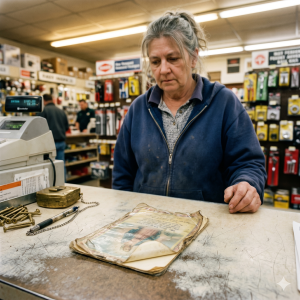
The girl — she couldn’t have been more than twenty-five — always came into Henderson’s Hardware on Thursdays. Always in that faded blue pharmacy smock, the kind with the little white collar that’s been washed so many times it’s gone the color of a winter sky. Always quiet. Always counting.
She’d set her items on the counter — a roll of weatherstripping, a package of drawer pulls, a box of light switch covers — and she’d open that little coin purse like she was performing surgery.
That’s when Dottie first saw it.
Tucked inside the coin purse, folded small, was a laminated prayer card. The kind they hand out at funerals, or sometimes at the little rack by the door at St. Anthony’s. The edges were worn soft, rounded by handling, like it had been folded and unfolded so many times the laminate had started to separate at the corners.
The girl’s fingers moved around it carefully. Like it was the most important thing in that purse. Like everything else — the quarters, the dimes, the carefully folded dollar bills — existed around it, not the other way around.
The first time, the girl came up forty cents short.
She started putting things back without a word. No fuss, no embarrassment on her face. Just a quiet resignation that broke something open in Dottie’s chest.
“I’ve got it,” Dottie said, before she’d even decided to say it.
The girl looked up.
“Please,” Dottie added. “Let me.”
She almost argued. You could see it — that particular pride of someone who has learned to accept nothing from nobody. But something in Dottie’s face must have looked safe, because she gave one small nod and whispered, “Thank you, ma’am.”
After that, Dottie started coming in on Thursdays.
Not every week. But enough. She’d browse the plumbing aisle, or ask Earl Henderson questions about door hinges she didn’t need the answers to, and she’d keep one eye on the door.
And the girl would come in, and she’d count out her change, and that little prayer card would appear for just a moment — worn soft, folded careful — and Dottie would drift to the counter and make up whatever the difference was.
She never made a thing of it.
She learned the girl’s name was Amber. She learned this only because Earl said it once, gently, when Amber asked if she could put something on a tab. “I’m sorry, Amber, I can’t do tabs anymore.” He’d looked sorry about it, too.
Amber had nodded like she’d expected that answer. Like she’d stopped expecting any other kind.
Three weeks ago, Dottie noticed the prayer card was looking more worn than before. One corner had gone white where the laminate had peeled all the way back. Whatever was printed on the front — a saint, maybe, or a verse — was getting harder to make out.
Whatever Amber was praying for, she was praying for it harder.
Last Thursday was different.
Amber came in later than usual. Close to six, nearly closing time. The pharmacy smock was gone — she was in a regular jacket, arms crossed over her chest even though it wasn’t cold inside.
She walked straight to the locksets aisle.
Dottie pretended to read the back of a paint can.
Amber stood in front of the deadbolts for a long time. She picked up one box, set it down. Picked up another. Her hands, Dottie noticed, were not steady.
She brought a single deadbolt to the counter.
One.
The coin purse came out. The prayer card appeared — more worn than ever, that one corner completely bare now, pale as bone.
Amber counted out the exact amount, down to the penny, and slid it across to Earl without looking up.
Dottie didn’t need to cover anything this time.
She stood near the door, not wanting to intrude, but not wanting to leave either.
Something felt different. Something in the set of Amber’s shoulders, in the way she tucked the bag against her body like she was protecting it.
Earl handed over the receipt.
And then he leaned forward on the counter, voice dropped low, and he looked — not at Amber, who had already turned toward the door — but directly at Dottie.
“You know she’s been in here three times this week,” he said quietly.
Dottie waited.
His jaw tightened.
“And every time — every single time — she’s asked me if I sell locks that can’t be opened from the outside.”
The bell above the door chimed.
Amber was already gone.
Dottie stood there with Earl’s words sitting in her chest like a stone dropping into still water, and she looked down at the counter where the coin purse had rested — and there, left behind, was the prayer card.
Just lying there.
Like it had finally let go.
Dottie picked it up without thinking.
The laminate was cool against her fingers, softened at the edges the way old things get soft. She turned it over.
It wasn’t a saint on the front. It was a name. Printed in that simple funeral-home font, black ink on cream cardstock, sealed under plastic that had gone milky with age. A woman’s name she didn’t recognize. The dates underneath told her the woman had been forty-three years old. Below the dates, in italics, a single line: She kept us safe.
On the back, handwritten in a young person’s careful print, were two words.
Be brave.
Dottie looked at Earl.
Earl was already reaching for his phone.
She didn’t wait to see who he was calling. She pushed through the door and out into the early October evening, and the cold air hit her face, and she stood on the sidewalk looking both ways down Merchant Street.
The light was going. The street was mostly empty — a couple coming out of the pizza place on the corner, a kid on a bike, a truck pulling out of the hardware store’s small lot.
The truck.
An older model. Dark green. It had been idling there in the far corner of the lot every Thursday. She realized this now, the way you realize something you’ve known in your body before your brain catches up. She had registered it and filed it away as nothing, the way you do with things that don’t fit the story you’re trying to tell yourself.
It sat there now with the engine running.
Amber was nowhere on the sidewalk. She hadn’t gone north or south on Merchant. The only place she could have gone in thirty seconds was the lot.
Dottie walked toward the truck.
She had waited tables for forty-one years. She had talked down a man with a broken bottle on a Tuesday night in 1987. She had sat with a woman in a bathroom stall and held her hand until the shaking stopped. She had done things in her life that required a certain quality of nerve that she had never once named out loud because naming it felt like pressing on a bruise.
She walked up to the passenger window and knocked on the glass.
Amber was in the driver’s seat.
She startled, hard, and turned with an expression Dottie recognized. It was the expression of someone bracing for something. Her eyes moved past Dottie to the lot entrance, then back, and then something rearranged itself in her face when she understood it was only the old woman from the hardware store.
She rolled the window down two inches.
“You left this,” Dottie said. She held up the prayer card.
Amber stared at it. Something crossed her face that was very hard to watch.
“I don’t need it anymore,” she said.
Her voice was flat. Not unkind. Just flat, the way voices get when a decision has been made and a person is on the other side of it.
Dottie heard that flatness and felt the stone in her chest drop lower.
“Where are you going tonight?” she asked.
“Home.”
“Where’s home?”
A pause. “Crestview Apartments. On Dalton.”
Dottie knew Crestview. Second-floor walkups, thin walls, a parking lot that flooded every spring. Not a terrible place. Not a great one.
“You putting that deadbolt in tonight?”
The flatness flickered. Just for a second.
“Yes,” Amber said.
“You need help with that?”
Another pause. Longer this time.
“I’ve watched videos.”
“Videos are fine,” Dottie said. “But I put in three deadbolts after my first husband, and I can have it done in twenty minutes and I won’t ask you a single question you don’t want me to ask.”
The sentence surprised Dottie almost as much as it surprised Amber. She hadn’t planned to say any of that. She hadn’t planned to say anything about her first husband, which she hadn’t spoken of to anyone new in close to fifteen years.
But there it was.
Amber looked at her for a long time. Those careful eyes, reading Dottie’s face the way she read everything — the way she counted her change, slow and precise, making sure of the value of each thing before she committed to it.
“Okay,” she said finally.
She said it the way she’d said thank you, ma’am that first time. Small. Like a door opening just an inch to see if the light outside was safe.
Dottie walked around to the passenger side and got in.
They didn’t talk much on the drive over. Amber asked once if Dottie needed to be anywhere, and Dottie said no, which was true. The Sunrise had been under new management for six years now. Dottie’s Thursday evenings were her own.
Crestview Apartments was a ten-minute drive. Second floor, unit 214. The door had a knob lock and a chain — the chain with the kind of give in it that wouldn’t slow anyone down who’d made up their mind.
Inside, the apartment was clean. Careful. A few things on the walls, a plant on the windowsill that was doing its level best. The furniture was the kind that comes from different places and different times in a life and has been arranged to look like it belongs together.
On the kitchen counter, Dottie noticed: a neat row of seven pill bottles. Prescription labels. A glass of water. A notepad beside them with a list on it that Amber flipped face-down when she saw Dottie looking.
Dottie looked away without comment.
She had not asked a single question. She did not intend to.
She opened the bag from Henderson’s and looked at the deadbolt. Good one — Schlage, solid brass cylinder, keyed entry on the outside, thumbturn on the inside.
On the inside.
She felt Earl’s words again. Every time she’s asked me if I sell locks that can’t be opened from the outside.
She set the deadbolt on the counter and looked at Amber. Amber was standing in the kitchen doorway with her arms crossed again, watching.
“Amber,” Dottie said.
Just her name.
Amber’s jaw tightened.
“He has a key,” she said.
That was all she said. She didn’t explain who. She didn’t explain anything. She just said it the way you say a true thing out loud for what might be the first time, because someone in the room has created enough quiet for it to exist in.
“Okay,” Dottie said. “This lock here — once it’s in, he can put his key in the outside all he wants. The thumbturn on your side overrides it.”
Amber went very still.
“He can’t get in,” Dottie said. “Not with a key. Not without breaking the door.”
“And if he breaks the door?”
“Then it’ll make enough noise that your neighbors will hear it, and you’ll have time to call 911, and the broken door is evidence.” She paused. “But we’re also going to put the chain back on after. And I’m going to show you how to do a door wedge with what you have here, and there’s a two-dollar thing you can buy at any hardware store that goes under the handle that will hold better than anything else short of a steel bar.”
Amber stood very still for a moment, and then she sat down at the kitchen table.
She put her face in her hands.
She didn’t make much sound. It was more like something releasing than something breaking — like a breath held so long that the body finally just had to let it go. Her shoulders shook once, twice, and then she was still.
Dottie put a hand on her back and left it there. She didn’t say anything. She’d learned a long time ago that some moments don’t need words, and talking into them is just a way of making yourself feel less helpless at the expense of the person who needs the silence.
After a while, Amber lifted her head.
Her face was composed in that particular way of people who have cried quickly and quietly their whole lives, in bathrooms and cars and back storerooms, people who have learned to give themselves sixty seconds and no more.
“I didn’t mean to leave the card,” she said.
“I know.”
“She was my mom.” She looked at the prayer card, still in Dottie’s hand. “She died four years ago. Car accident.” She was quiet for a moment. “She used to say that. Be brave. Every time something scared me.”
Dottie set the prayer card on the table in front of her.
“Then I’d say let’s put that somewhere safe while we work,” Dottie said. “Because I need you to hold the flashlight.”
Something small and almost unguarded moved across Amber’s face.
It wasn’t a smile exactly. It was the thing that lives just beneath a smile, when a smile isn’t quite possible yet but might be later. The seed of it.
“Okay,” she said.
They put the deadbolt in.
It took twenty-five minutes, not twenty, because the door frame was old and needed a little convincing, and Amber had a lot of questions once she started having them — good questions, practical questions, the questions of someone who has decided she is going to understand the thing that is keeping her safe. Dottie answered every one.
When they were done, Amber worked the thumbturn back and forth several times. Locked. Unlocked. Locked again. Like she was learning it by hand.
She left it locked.
Dottie stayed another hour. She showed Amber the door wedge trick using a rubber-soled slipper and the spot at the bottom of the door where it would hold. She wrote down the name of a specific doorstop alarm — six dollars online, shrieked like a fire alarm if anything disturbed it — on a piece of paper and set it on the counter.
She did not ask about the pill bottles. She did not ask about the list Amber had flipped over. She trusted that the door was the thing that needed doing tonight, and that the rest was Amber’s to decide about when she was ready.
But when Dottie picked up her purse to go, she stopped.
“I work the morning shift at the Sunrise Diner on Route 9,” she said. “You know it?”
Amber nodded.
“I’m there Tuesday through Saturday, six to two. If you ever want a cup of coffee and somewhere to sit for a while, you come in and you ask for Dottie and I will see to it personally that nobody bothers you.” She paused. “And if you ever need to make a phone call in private, my office is the back booth by the emergency exit, and I keep it reserved for important business.”
Amber looked at her.
“Why are you doing this?” she asked. Not suspicious. Just — genuinely asking. The way a person asks when they’ve stopped assuming they know the answer.
Dottie thought about it.
“Forty-one years of watching people carry things,” she said. “After a while you just want to help set some of it down.”
She patted Amber’s hand once, firmly, and she left.
Walking to her car in the Crestview lot, Dottie stopped and stood still in the cold October air for a moment. Above her, on the second floor, she could see the light in unit 214.
She stood there until she heard it — faint but clear, through the old building’s thin walls — the small, solid, final sound of a deadbolt sliding home from the inside.
Then she got in her car and drove.
The prayer card was still on Amber’s kitchen table, exactly where Dottie had put it. Right where it was supposed to be.
She had a feeling it wasn’t going anywhere.