She walked into that Fourth of July party uninvited, carrying a manila envelope and a secret that was about to burn the whole thing down.
But let me back up.
—
Dottie Harwell turned 66 in April, and she celebrated the way she always did — quietly, with sweet tea on the porch of her grandmother Memaw Ruth’s lake house up in the Ozarks.
That porch had been in their family for fifty-three years.
The weathered cedar planks. The wind chime made from old spoons. The smell of pine and lake water that Dottie said was the closest thing to heaven she’d ever found on this earth.
She thought it would always be there.
She was wrong.
—
Her younger cousin Brandi had always known how to work a room.
Prettiest smile at every family reunion. First one to offer help — and first one to make sure you noticed her offering. The kind of woman who called you “hon” and meant something entirely different by it.
Last November, Brandi showed up at Dottie’s house with a thick stack of papers and a story about estate taxes.
“Just routine stuff, Aunt Dottie — I mean, Dottie. Lawyer said we need signatures on a few things before the end of the year. You know how it is.”
Dottie didn’t really know how it was. She trusted family. She signed where Brandi pointed.
Three weeks later, the deed to Memaw Ruth’s lake house had a new name on it.
Brandi’s name.
—
By the time Dottie figured out what had happened, she’d already cried herself dry.
She called a lawyer. She called the county clerk. She sat at her kitchen table for two weeks staring at photocopies of documents she didn’t remember signing — documents that had been slipped into that stack like a snake hiding under a welcome mat.
Everyone told her the same thing.
It was done. It was legal. Move on.
But Dottie kept one thing through all of it.
A recipe card.
Memaw Ruth’s handwriting on the front — the peach cobbler recipe, the one she made every Fourth of July without fail. Dottie had found it tucked inside the old recipe box when she was cleaning out the lake house for the last time.
She’d slipped it into her cardigan pocket before she left, because she couldn’t leave without taking something.
It wasn’t until she got home that she turned it over.
And saw the stamp on the back.
A notary seal. Faded, water-stained, pressed into the card sometime long ago. With a name on it she recognized.
She sat very still for a very long time.
Then she made a phone call.
—
Brandi threw herself quite a party.
Red, white, and blue streamers on the porch — Memaw Ruth’s porch. A hired caterer. A bluegrass band set up near the dock. Thirty-some guests spilling out onto the lawn, laughing, holding their plastic cups up against the July sky.
She’d even had a little wooden sign made for the yard.
*The Brandi Lynn Kellner Lake House. Est. 2025.*
Dottie saw it when she pulled up the gravel drive.
She touched the recipe card in her cardigan pocket — just once, the way you touch something you need to be sure is still there — and she got out of the car.
She was not alone.
—
The party went quiet in that rolling way a crowd does when something shifts.
People noticed Dottie first. Then they noticed who was walking beside her.
An older woman. Seventies, maybe. Church clothes on a Saturday. Sensible shoes. The kind of face that had spent decades being the most trustworthy person in every room she entered.
Brandi’s smile faltered for just a half-second.
She recovered fast. She always did.
“Dottie. Honey, this is a private —”
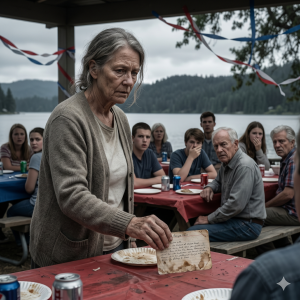
“I know it is.” Dottie walked to the picnic table near the porch. The one with Memaw Ruth’s old red tablecloth on it, though Brandi had probably convinced herself she’d picked it out herself. The potato salad was right there in the big ceramic bowl. The deviled eggs. The same spread Memaw Ruth used to make.
Dottie set the manila envelope down on the table.
Right next to the potato salad.
She smoothed it once with her palm.
Then she looked at her cousin — really looked at her — and she smiled.
It was the smile Memaw Ruth used to get right before she laid her cards down. Quiet. Patient. Like she’d been waiting for this exact moment since before the game even started.
“Cousin,” Dottie said, “I’d like you to meet someone.”
She stepped aside so the older woman could come forward.
“This is the original notary on those documents you had me sign. The one who’s been trying to track down who used her seal.” She paused. “The one who says she never stamped a single page of what you handed that judge.”
The bluegrass band had stopped playing.
Nobody moved.
Brandi’s cup was still raised halfway to her lips.
And Dottie reached into her cardigan pocket, and slowly drew out the water-stained recipe card, and turned it over so the faded seal caught the afternoon light —
—
The name on that seal was Marvella Goins.
Retired. Thirty-one years as a licensed notary in Baxter County. The kind of woman who kept meticulous carbon copies of every single document she had ever stamped, in binders, alphabetically, going back to 1994.
Dottie had found her the same way she’d found everything else in this ordeal — slowly, carefully, one thread at a time.
The recipe card had confused her at first. Why would Memaw Ruth have had a notarized card sitting loose in a recipe box? It didn’t make any sense until Dottie flipped it back over and read the handwriting again more carefully — not the peach cobbler recipe, but a note Memaw Ruth had written to herself in her tiny cramped cursive at the bottom of the card.
*Signed over my mineral rights today. Had Marvella witness. Lord forgive me if this was a mistake.*
That was dated 1987.
The seal was from a transaction almost forty years old. It had nothing to do with the deed. Nothing to do with Brandi.
But the name.
The name was what mattered.
Because when Dottie called the county clerk’s office and asked for the name of the notary on the deed transfer documents — the ones Brandi had used — the clerk had read it back to her over the phone.
Marvella Goins.
And when Dottie tracked down Marvella Goins at her home outside of Mountain Home, the woman had answered the door in a housedress and looked at the paperwork Dottie handed her and gone so still you’d have thought time had stopped.
“Honey,” Marvella said, “I have never seen these pages in my life.”
Someone had lifted her seal. Copied it, or forged it, or used an old impression somehow. Marvella couldn’t say exactly how. But she could say — and did say, to Dottie, and then to Dottie’s new attorney, and then in a signed affidavit that was now sitting in that manila envelope on Memaw Ruth’s picnic table — that she had not notarized a single document related to Harwell family property. Not in 2024. Not ever.
And a forged notarization on a deed transfer is not a technicality.
It is fraud.
—
Brandi set her cup down.
The plastic made a small hollow sound against the picnic table and everyone heard it because everyone was listening to everything now.
“I don’t know what she told you,” Brandi started, her voice still practiced and smooth, still doing the work her smile usually did, “but whatever she said, she’s confused. She’s an old woman. I’m sure she just doesn’t remember —”
“I am seventy-three years old,” Marvella Goins said, “and I have never once in my life notarized something I forgot about.”
That landed.
Brandi looked around at the faces of her guests. Some of them were cousins. Some of them were neighbors who’d been coming to that lake house since they were children, back when it still belonged to Ruth Harwell and smelled like pine sap and cobbler and everything good about summer.
Nobody was smiling anymore.
“There’s a letter in that envelope,” Dottie said. She wasn’t loud about it. She had no need to be. “From my attorney. And there’s a copy of Marvella’s affidavit. And there’s a letter from the Baxter County Sheriff’s office confirming they have opened an investigation into the deed transfer.” She paused. “The originals are already filed.”
Brandi opened her mouth.
Dottie held up one hand. Just one. The way their grandmother used to.
“I’m not here to embarrass you in front of your company, Brandi. I want you to know that. I’m here because my attorney advised me to deliver notice in person, with a witness present. That’s all this is.” She looked down at the envelope. “Legally speaking.”
What happened next was not something Dottie had planned.
Brandi’s mother — Dottie’s Aunt Cecille, who was seventy-eight years old and had been sitting in a lawn chair near the dock pretending to watch the water — pushed herself up to standing. She was a small woman. Had always been small. But she walked the full length of that yard with a steadiness that made people move out of her way.
She stopped in front of her daughter.
She didn’t say anything for a long moment.
Then she said: “Brandi Lynn. What did you do.”
It wasn’t a question.
Brandi’s composure cracked so fast it was almost like watching something fall.
“Mama, I just — the taxes, and I was going to fix it, I was going to put it back in the family trust eventually, I swear I was just trying to protect it —”
“You tried to protect it from your own cousin.” Aunt Cecille’s voice was flat. “From Ruth’s granddaughter.”
“Mama —”
“That porch was where Ruth died.” Her voice broke at the end of that sentence. Just the once. “You knew that.”
Brandi was crying now. The guests were looking at the grass, the water, their own shoes. The caterer had quietly retreated to the far side of the yard.
—
The Brandi Lynn Kellner Lake House sign came down that evening.
Not dramatically. Not in front of anyone. Dottie was already gone by then, sitting in the parking lot of a Dairy Queen in town with Marvella Goins, eating soft-serve and watching the sun go down over the ridge.
She found out about it later, from her cousin Devin, who texted her a photo sometime around nine o’clock.
It was just the yard. The wooden post still in the ground, the little sign face-down in the grass beside it. The porch behind it, with the wind chime made from old spoons just barely visible in the fading light.
Dottie looked at the photo for a long time.
She didn’t feel triumphant. She’d thought she might. She’d spent enough nights in the last eight months lying awake imagining this — imagining the moment Brandi understood that she’d been caught, that family wasn’t the same thing as loyalty, that some things couldn’t be papered over with a stack of documents and a story about estate taxes.
But sitting in that Dairy Queen parking lot, what she mostly felt was tired.
And sad. Sad in the specific way you only get sad about things that should never have happened in the first place.
—
The investigation took four months.
Brandi’s attorney negotiated. There were conversations Dottie was not privy to and did not ask about. She had her own attorney, and she let him do the work she was paying him to do.
In November — almost exactly a year after Brandi had shown up at her door with that stack of papers — the deed to Memaw Ruth’s lake house was transferred back.
Dottie drove up alone.
She parked in the gravel drive and sat in her car for a little while. The lake was flat and silver in the morning light. The pines smelled exactly the way they always had.
She got out and walked up to the porch.
The wind chime made from old spoons was still there. It had survived everything, the way old things sometimes do, simply by not being important enough to move.
She sat down in the same chair she’d always sat in.
She had the recipe card in her cardigan pocket.
She took it out and held it. Both sides. The peach cobbler recipe in Memaw Ruth’s handwriting, and the faded notary seal on the back, and the small note at the bottom that had started all of it.
*Lord forgive me if this was a mistake.*
Memaw Ruth had been writing about mineral rights in 1987. Something small and practical and long-since resolved. She hadn’t known she was leaving a map. She hadn’t known her granddaughter would need it.
But she had.
Dottie sat on that porch until the sun got high enough to warm the cedar planks under her feet. She listened to the wind chime. She watched a heron work its way along the far edge of the water.
She thought about making peach cobbler.
She thought she probably would.
—
She told me this story at her church’s fall potluck, standing next to a folding table covered in casseroles, and I have to be honest — I stood there with my paper plate going cold in my hand for the better part of twenty minutes just listening.
I asked her what she wanted people to know about it.
She thought about that for a second.
“Read what you sign,” she said. “That’s one thing.” She picked up a plastic fork. “And the other thing is — don’t ever leave somewhere you love without taking something with you. Even if it’s just a recipe card.” She smiled a little. “You never know what’s written on the back.”