The ribbon never got cut that day.
But I’m getting ahead of myself.
—
Bev Thibodaux had worked that smokehouse since she was nineteen years old.
Forty-five years of 4 a.m. mornings. Forty-five years of boudin links and crawfish bisque and a roadside sign her daddy painted himself that still leaned a little to the left no matter how many times they straightened it.
She never minded the lean. She said it had character.
Her brother Dale didn’t care about character. Dale cared about square footage and foot traffic counts and what a corner lot on Highway 182 was worth per acre in a seller’s market.
Dale was twelve years younger and twice as charming and had a smile that made parish clerks forget to read things carefully.
—
Nobody could explain exactly how it happened.
One Tuesday in March, Bev drove out to open the smokehouse and found a padlock she didn’t recognize on the door.
By Wednesday, Dale had filed paperwork showing she’d voluntarily transferred her 50% ownership — signed, notarized, witnessed — six weeks prior.
She didn’t remember signing anything.
But there it was. Her signature. Right next to his.
The family believed Dale. Of course they did. He brought boudin to every gathering and hugged the aunts first and called their mama every Sunday. He had a way of making confusion sound like your own fault.
“Bev, honey, you were going through a hard time. You probably just don’t remember.”
She remembered everything.
—
What Bev did next, nobody expected.
She didn’t hire a lawyer right away. She didn’t call the news. She didn’t make a scene at Easter dinner even when Dale sat at the head of the table like he’d always belonged there.
She just started carrying a notebook.
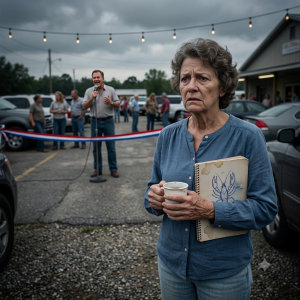
Spiral-bound. Water-stained around the edges, like it had been left out in one of those slow Louisiana rains that don’t fully commit. On the cover, someone had drawn a crawfish in blue ballpoint — claws up, like it was ready for something.
She took it everywhere.
To the diner. To church. To the courthouse steps where she’d sit some mornings with a cup of coffee and just watch people come and go.
She never opened it in front of anyone.
Her cousin Luanne asked about it once.
Bev just smiled and said, “I’m a woman who likes to keep notes.”
—
Eight months passed.
Dale renovated. Dale rebranded. Dale put up a new sign — straight, no lean — and booked a local news crew and invited the mayor and ordered a custom ribbon in red, white, and blue.
He told the story of the smokehouse like it was his inheritance alone. Like Bev had simply wandered out of it one day and handed him the keys out of love.
People believed him.
He was very good at being believed.
—
The morning of the grand reopening, Bev got up before dawn.
She made coffee. She fed her cat, Remy. She put on her good blue blouse — the one with the pearl buttons her daughter always said made her look like she meant business.
She picked up the notebook.
Ran her thumb along the crawfish on the cover.
And she drove to Highway 182.
—
The parking lot was full by ten.
String lights. A folding table with a sheet cake. The mayor shaking hands near the door, laughing at something Dale had just said.
Dale looked good. Relaxed. The way a man looks when he believes there is nothing left to surprise him.
He didn’t notice the woman standing near the back of the crowd at first.
Most people wouldn’t have.
She was small and quiet, the kind of person who made a habit of going unnoticed. She’d worked as the smokehouse bookkeeper for eleven years before Dale let her go on his very first day of ownership.
Her name was Patrice Fontenot.
And for eleven years, Patrice had written down everything.
Every transaction. Every signature request. Every phone call she’d been asked to sit in on and then asked not to mention. She had a memory like a crawfish trap — things went in and did not come back out.
Bev had found her in October. They’d had coffee. Then lunch. Then several long afternoons at Bev’s kitchen table, going through things slowly and carefully and thoroughly.
The notebook had started filling up around November.
—
At 10:47 a.m., the mayor reached for the oversized scissors.
Dale raised the microphone to say a few words.
He was smiling the smile.
And that is when Patrice Fontenot stepped forward from the back of the crowd, walked calmly to the front, and said five words into that warm February air:
“Before we cut that ribbon—”
The crowd went quiet.
Dale’s smile didn’t move. Not yet. He hadn’t placed her face.
“—I believe the parish recorder has something he’d like to read aloud.”
A man in a gray suit near the door opened a manila folder.
Bev stood at the edge of the parking lot, both hands wrapped around her coffee cup, the water-stained notebook tucked under her arm.
The crawfish on the cover faced forward.
Claws up.
—
The parish recorder’s name was Gerald Mouton, and he had worked in that office for going on twenty-two years. He was not a dramatic man. He was the kind of man who wore short-sleeve dress shirts year-round and kept a cup of sharpened pencils on his desk even though everything was digital now. He did not enjoy being the center of attention.
But he was an honest one. That much everyone in St. Mary Parish knew.
He cleared his throat once.
He read slowly, the way a man reads when he wants every word to land in the right place.
What Gerald Mouton read aloud that morning was a deposition — filed the previous Thursday with the parish court — from a notary public named Cecile Arceneaux, who had retired to Breaux Bridge the prior spring. In it, Cecile stated under oath that she had been approached by Dale Thibodaux in January of last year and asked to notarize a document that had been signed, she was told, in her presence six weeks earlier.
She had not been present.
She had not witnessed the signature.
She had told Dale as much.
He had encouraged her to remember differently.
She had not.
What she had done, quietly, was keep a copy of the document and a record of that conversation, because Cecile Arceneaux had been a notary for thirty-one years and she knew the smell of something wrong.
She had been waiting, she wrote, for someone to ask the right questions.
Bev Thibodaux had asked them. In October. Over the phone. Politely, but directly. The way a woman asks when she already suspects the answer and just needs someone else to say it out loud.
—
Gerald folded the paper back into the folder.
The mayor had stopped smiling.
The local news crew, who had come expecting footage of a ribbon and a sheet cake, had quietly repositioned their camera.
Dale had gone very still. His face had not yet decided what expression to make. It cycled through a few — confusion, offense, the beginnings of a performance — and then seemed to run out of options and just stopped.
“That’s—” he started.
He didn’t finish.
His lawyer, who had been standing near the sheet cake table in a seersucker blazer, was already moving toward him, already touching his arm, already saying something low and urgent into his ear.
—
What Patrice did next was not loud. It did not need to be.
She reached into the canvas bag on her shoulder and produced a manila envelope of her own, which she handed to the attorney standing at the edge of the gathered crowd — the one Bev had finally hired in December, a woman named Odette Brassard who was known in three parishes for not losing.
Odette did not open the envelope dramatically. She had been through the contents many times already. She simply held it.
Inside that envelope was eleven years of Patrice Fontenot’s careful record-keeping. Deposit discrepancies that had been explained away. A phone call from a man who introduced himself as Dale’s real estate contact, two years before Bev ever found that padlock. Payroll documents. A copy of the original partnership agreement that had been drawn up when Bev and Dale’s father first deeded them the property together — an agreement that included a clause, typed in plain language, requiring both signatures and a sixty-day notice period for any ownership transfer.
No sixty days had passed.
There had been no notice.
There had only been a man with a charming smile and a parish clerk who had forgotten to read things carefully.
—
Dale left before the mayor did.
He walked to his truck with his lawyer and did not make eye contact with anyone. He drove away, and the string lights swayed a little in the wake of it, and then went still.
The crowd stayed.
People weren’t entirely sure what to do with themselves. Some of them had known Bev for decades. Some of them had just come for the sheet cake. A few of them, quietly, started to remember things — small things, things that hadn’t seemed to add up right — and looked at each other with the expression people wear when they realize they’d been part of an audience for something they didn’t understand was a performance.
The mayor shook Bev’s hand. He said something. She nodded. She was gracious about it, because she had always been gracious, but you could see that she was elsewhere, just a little. Looking at the building. Looking at the sign standing too straight against the morning sky.
—
The legal process took another four months.
It was not cinematic. It was paperwork and depositions and two mediation sessions in a beige room in New Iberia. Dale’s attorney negotiated. Odette Brassard did not move much.
In June, a judge signed an order voiding the transfer on the grounds of fraudulent notarization and breach of the original partnership agreement.
The smokehouse went back to Bev.
All of it. The whole corner lot. The equipment Dale had upgraded with money that was, the court found, drawn from accounts that had not been solely his to draw from. The sign, which Bev took down herself on a Thursday afternoon with her daughter and her cousin Luanne holding the ladder.
She put her daddy’s old sign back up.
It leaned immediately.
She did not touch it.
—
What happened to Dale is the part people always ask about.
He was not charged with a crime right away, though the district attorney’s office opened an inquiry that ran parallel to the civil case. The inquiry is still ongoing, as of the writing of this. Whether it goes further depends on things that move slowly and are not always satisfying to watch.
What did happen is that Dale’s second venture — a crawfish supply company he’d been developing with a partner in Lafayette — dissolved over the summer. Quietly. The kind of thing that doesn’t make news but that people who know the parish hear about through other people who know the parish.
He moved to Baton Rouge.
He still calls their mother on Sundays, or so the family says.
—
Bev reopened the smokehouse the following September.
No news crew. No ribbon. No mayor.
Just the door open, the smoke going, and a line that stretched out to the road by eight in the morning.
She made boudin. She made crawfish bisque. She put the water-stained notebook on the shelf behind the counter, spine out, where she could see the cover.
The crawfish in blue ballpoint. Claws up.
Her cousin Luanne asked if she was going to keep carrying it everywhere.
“No,” Bev said. “It did its job.”
She paused.
“I might keep it close, though.”
—
A woman came in on the second day of reopening, drove in from two towns over, said she’d known Bev’s daddy and had been coming to that smokehouse since before Bev was old enough to work the counter. She was in her eighties and drove a Lincoln and ordered the bisque and ate the whole thing.
When she was done she sat for a moment and looked around at the walls, at the old photographs, at the sign out front doing its particular lean.
“Looks right,” she said.
Bev refilled her coffee without being asked.
“Yes ma’am,” she said. “It does.”