She didn’t know he was there.
Thirty years. Thirty years of not knowing, and Ruth Calloway drove into Branson on a Tuesday morning with a U-Haul trailer and a new job title and absolutely no idea that the answer to every prayer she had ever prayed was sleeping in Room 14.
Let me back up.
Because this story starts the way the worst stories always do — quietly, in a lawyer’s office, with paperwork that looked official and a daughter-in-law who smiled the whole time.
—
Danny was 34 when the accident happened.
A logging truck. A two-lane highway outside of Springfield. They told Ruth he was alive, and she thanked God on her knees in the hospital hallway. They told her there was brain damage, and she said it didn’t matter, she would take care of him. She had taken care of Danny his whole life. She knew how to do this.
What she didn’t know was that while she was driving four hours to get to that hospital, Connie — Danny’s wife of eight months — was already meeting with an attorney.
By the time Ruth arrived, the paperwork was in motion.
By the time Danny was stable enough to transfer, it was done.
Legal guardianship. Medical power of attorney. Next of kin — all of it, transferred to Connie. Ruth was handed a letter by a man in a suit who would not meet her eyes. The letter explained, in very polite language, that she had no legal standing to make decisions for her son.
She fought it for eleven years.
She lost.
—
Connie moved Danny to a memory care facility in Branson when he was 43. Ruth found out through Danny’s cousin, who heard it from someone at their old church. By then the legal walls were so high, and Ruth was so tired, and her savings were gone, and she was 61 years old and some part of her simply broke.
She stopped fighting.
She never stopped praying.
She never stopped making quilts.
—
The job listing found her the way certain things find you when you have finally, finally let go.
*Activities Director — Ozark Pines Memory Care, Branson, MO.*
She had spent fifteen years running the activity program at a senior center in Joplin. She was good at it. She applied on a Thursday. They called on a Monday. She started on a Tuesday.
The facility was pretty. Pine trees along the front walk. A big common room with windows that caught the afternoon light. The director, a kind woman named Pamela, walked Ruth through the hallways on her first morning, pointing out which residents liked music, which ones liked crafts, which ones were having a hard week.
They turned down the east corridor.
“This is our quieter wing,” Pamela said. “Most of our longer-term residents are down here.”
Ruth was nodding, looking at the door nameplates, already thinking about how to arrange the Tuesday craft schedule —
And then she stopped walking.
*D. Calloway. Room 14.*
The world tilted.
“Ma’am?” Pamela touched her arm. “Ruth? You okay?”
Ruth stared at the nameplate. Her mouth had stopped working.
“That’s Daniel,” Pamela said gently. “He’s been with us almost twenty-two years. Nonverbal, but he tracks everything. Sweet man. Loves when we play old country records.” She paused. “He has one personal item he keeps with him that he won’t let anyone touch. The staff respects it. We don’t really know the story behind it.”
—
Ruth asked to see it.
She didn’t explain why. She wasn’t sure she could.
A young aide named Cassie walked her into Room 14 while Danny was at morning exercises. The room was clean, sunlit, simple. A Johnny Cash poster on the wall. A worn Bible on the nightstand.
And tucked behind the headboard, half-hidden, was a small fabric square.
Ruth recognized the colors before she even crossed the room.
Deep red. Forest green. Cream-colored thread.
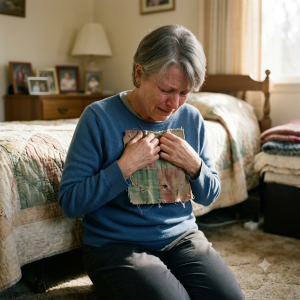
She reached past the headboard with hands that were shaking so badly she could hardly manage it, and she pulled the quilt square into the light.
A cardinal.
Embroidered in red thread, wings spread, one of them slightly uneven — a little crooked, like the bird was caught mid-turn.
And beneath it, in a child’s unsteady stitching:
*Mama Ruth.*
She had made this square on a rainy Tuesday in 1987. She remembered the rain. She remembered the lamp she sat under because the overhead light had burned out. She remembered Danny coming in from the other room and watching her sew, and she had let him hold the hoop, and his little contribution to that crooked wing was that he had bumped her elbow.
She had sewn that imperfect wing herself.
The last night she ever spent in her son’s home.
And all these years, in every room they had moved him through, Danny Calloway had kept it hidden behind his headboard.
He had kept her.
Ruth pressed the quilt square against her chest and her legs stopped holding her —
Cassie caught her before she went down all the way. Got her to the edge of the bed and sat beside her with one arm around her shoulders, this twenty-two-year-old girl who had no idea what she was witnessing, just knowing that something enormous was happening in this room and that her job right now was to hold on.
Ruth cried the way people cry when they have been saving it up for thirty years. Not pretty. Not quiet. Cassie didn’t try to stop her or hush her or tell her it was going to be okay. She just held on.
After a while, Ruth was able to talk.
She told Cassie everything. Or enough of it. The accident. The lawyer’s letter. Eleven years of court filings. The silence that followed. She held the quilt square in both hands while she talked, turning it over, tracing the cardinal’s crooked wing with her thumb the way you touch something you were certain you had lost forever.
Cassie listened to all of it. Then she got up, walked to the doorway, and said quietly, “I’m going to go get Pamela.”
—
Pamela arrived with a box of tissues and a look on her face that said she had heard enough to understand the general shape of the situation. She sat in the chair by the window and she listened to the rest. She asked a few careful questions. She looked at the quilt square.
Then she was quiet for a long moment.
“Connie passed,” she finally said. “Four years ago. Danny has been a ward of the state since then. We petitioned for a permanent placement designation so he could stay with us, and the court granted it. He has a caseworker who checks in quarterly.” She paused. “There is no legal barrier anymore, Ruth. There hasn’t been for four years.”
Ruth heard the words. She understood them individually. It took a few seconds for them to arrange themselves into meaning.
No legal barrier.
No one standing between her and Room 14.
She looked down at the quilt square in her hands. That crooked red wing. That child’s stitching underneath it, *Mama Ruth*, sewn by fingers that were smaller then than they would ever be again.
She pressed her hand flat over it and breathed.
—
They brought Danny back from morning exercises at eleven o’clock.
Pamela had asked Ruth if she wanted to wait somewhere else, come back later, take more time to prepare. Ruth said no. She stood in the hallway just outside the doorway to Room 14, and she waited, and when the aide wheeled Danny around the corner, she saw him from thirty feet away and had to put her hand against the wall.
He was sixty-four years old. His hair had gone fully white. He was thinner than she remembered, and his face had a stillness to it that hadn’t been there before, the particular stillness of a man who has spent decades turning inward. But his eyes were open. Pamela had said he tracked everything, and it was true — she could see it from thirty feet away, the way his gaze moved through the corridor ahead of him, cataloguing, noting.
And then his gaze found her.
He went absolutely still.
Ruth stepped away from the wall. She didn’t trust her voice, so she didn’t try to use it. She just walked toward him, slowly, the way you approach something you are afraid might not be real.
Danny’s hands were in his lap. She watched them as she got closer. His right hand began to open and close. Open and close. A motion she recognized from when he was small, a self-soothing thing he had done since he was four years old when he was overwhelmed or frightened or trying very hard to hold onto something.
She stopped in front of him.
His face was working in a way that was enormous and private and difficult to watch. His eyes were filling.
“Hey, baby,” Ruth said.
That was all she got out.
Danny made a sound she had never heard from him before — or maybe it was a sound she had heard a thousand times before, from when he was small, when he fell off his bike or had a bad dream, except stretched through thirty years of silence and then released all at once. He reached for her with both arms the way a child reaches, the way the body remembers what the brain may not always hold onto, and Ruth went to him and held his head against her and said his name over and over and over, *Danny, Danny, Danny*, like she was checking that he was real, like she was counting him back.
Cassie had to step into the supply closet at the end of the hall.
She said later she had held it together until she heard Ruth say his name the first time, and then that was simply it for her.
—
The quilt square is framed now.
It hangs on the wall of Room 14, between the Johnny Cash poster and the window that catches the afternoon light. Ruth picked out the frame herself — dark wood, simple, nothing fussy. Danny watched her hang it and tracked every movement with those steady eyes of his, and when she stepped back and asked him if that was a good spot, he looked at the frame for a long moment and then back at her, and something in his expression shifted into something that Ruth can only describe, when she tells this part, as relief.
Like it had been hidden long enough.
Like it was all right now for it to be seen.
—
Ruth has been the Activities Director at Ozark Pines for going on two years.
She works the east corridor on Tuesday and Thursday afternoons. She brings the craft cart down to the common room and she sets up the tables and she puts on the country records, and Danny is usually already there when she arrives, already turned toward the door, already waiting.
He doesn’t speak. The doctors say that part isn’t coming back and Ruth has made her peace with it, or she is making her peace with it, which is a different thing but still counts.
But he communicates. Anyone who spends time with him can see it. The way he reaches for her hand when she sits beside him. The way he settles, visibly settles, like a house shifting into its foundation, when she comes into a room. Last spring, during a Tuesday craft session, Ruth put a sewing hoop in his hands just to see what would happen, and Danny looked down at it for a long time, and then he looked up at her, and he smiled.
It was the first time the staff had seen him smile in years.
Cassie took a photo. She asked first, and Ruth said yes, and now the photo lives on Ruth’s phone and also printed out on her kitchen table at home, which is a rental house three miles from the facility, which Ruth chose specifically for the three miles.
She is there every day that the schedule allows. On days it doesn’t allow, she finds a way anyway.
—
I know some of you are going to want to know about Connie.
I’m not going to say much because this isn’t her story and also because Ruth herself doesn’t say much, and Ruth is who I take my lead from here. What I will say is this: Connie was young, and frightened, and almost certainly in over her head with a husband who was never going to recover the way she had imagined, and the worst thing she did — the legal maneuvering, the walls — may have come from a place that was more about fear than cruelty. Ruth has said something like this, quietly, once. She said she had to believe that, because the other version was too heavy to carry.
Ruth is seventy-three years old and she has carried enough.
—
There’s one more thing.
A few months after Ruth started at Ozark Pines, she brought her quilting basket into Danny’s room on a quiet afternoon. She wasn’t sure why, exactly. Muscle memory, maybe. The way you do the thing your hands know how to do when your heart needs steadying.
She sat in the chair by the window and she started working on a new square. Deep red and forest green, cream-colored thread, same as always. Danny was in the bed watching her, and after a while she looked up and caught him looking, and she said, “You want to hold it?” and held out the hoop.
He reached for it.
His right hand went around the hoop. He held it carefully, the way you hold something that matters. And then he raised his eyes to hers and held those too, and the afternoon light came through the window and lay across them both and the pine trees outside were still and the country record had reached the quiet part in the middle, and Ruth Calloway looked at her son across thirty years and a crooked red wing and everything that had been taken and everything that had somehow, by the grace of whatever it is you choose to believe in, found its way back —
And she kept sewing.
—
If this story moved you, please share it. Ruth told me she didn’t know if she wanted it out in the world, and then she said, “If it helps even one person keep praying when they can’t see the reason, then yes.” So share it for her. Share it for every mother who kept going when the law said stop. Share it for every Danny, in every room, holding onto the one thing that told them they were loved.
And the next time you see a cardinal — the little crooked-winged kind, mid-turn, caught in the light — you know what to think of.