Every morning for eleven weeks, Dorothy Halstrom put on her dead husband’s insulated boots and walked down to the boat launch before the sun came up.
Not because anyone asked her to.
Not because she had somewhere to be.
She just couldn’t sleep. And the cold had a way of making her feel less alone.
That’s when she first saw it — the dented navy Jeep Cherokee, fogged windows, idling in the dark at the edge of the icy parking lot. Same spot every time. 5:47 a.m., give or take a minute.
She never saw who was inside.
But she noticed the orange mitten.
Just one. Child-sized. Bright as a flame against the frost. Tucked neatly under the driver’s side windshield wiper like someone had left it there on purpose.
The first time she saw it, she thought someone had lost it. Found it in a parking lot somewhere, maybe, and tucked it up hoping the owner would come back.
But it was there again the next morning.
And the morning after that.
Same mitten. Same wiper. Like a little flag. Like a signal she didn’t know how to read.
Dorothy had spent twenty-two years as a census worker in Duluth. She knew how to notice things other people walked past. She knew that the details people left behind told you everything — if you paid attention.
So she started paying attention.
And one morning, almost without thinking, she filled her old plaid thermos with fresh coffee — dark roast, the way she always made it — tucked a blueberry muffin and a clementine into a folded paper bag, and set them both on the hood of that Jeep before she walked home.
She didn’t leave a note. She didn’t know what she would have said.
The next day, the thermos was back on the hood. Washed clean. Cap screwed on tight.
She filled it again.
That became the thing. Her thing. Their thing — whatever it was.
For eleven weeks, she brought the coffee. For eleven weeks, the thermos came back clean. For eleven weeks, that small orange mitten held its spot under the wiper like it was standing guard over something.
Dorothy’s daughter thought she’d lost her mind.
“Mom, you don’t even know who that is. It could be anybody.”
“I know,” Dorothy said. “That’s sort of the point.”
She couldn’t explain it better than that. Something about the quiet of it. Something about giving without needing to know. Something about the mitten — that stubborn, ridiculous little mitten — that made her feel like whoever was in that Jeep was carrying something heavier than she could see.
She knew what that looked like. She’d carried heavy things herself.
Her granddaughter, Lily, started calling the mystery driver “The Lake Man.” Dorothy would laugh when she said it. But privately, she said a small prayer for him every night.
She didn’t know why she was so sure it was a him.
She just was.
Then one Tuesday morning in February, the temperature dropped to nine below.
Dorothy laced up the boots. Filled the thermos. Tucked the bag.
And walked down to the boat launch.
The parking lot was empty.
No Jeep.
No orange mitten.
Just a flat gray sky and the sound of the ice shifting on Lake Superior, low and groaning, like the lake was trying to say something.
She stood there longer than she should have in that cold. Left the thermos and the bag on the ground where the Jeep always parked, on the off chance it was just late.
It wasn’t late.
She went home. Told herself it was fine. People move on. Situations change. Maybe he was okay. Maybe he’d found somewhere warm to sleep. Maybe she’d just been a small kindness in a long, hard season and that was enough.
She almost believed it.
Three mornings passed. Then four.
On the fifth morning, she was standing at her kitchen window with her own cup of coffee when she heard it.
A knock at the front door.
She wasn’t expecting anyone.
Her heart did something strange and quick.
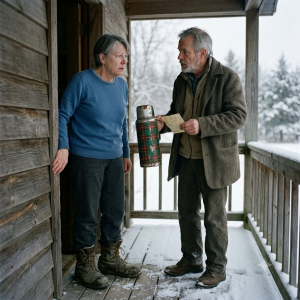
She walked to the door, hand on the knob, and pulled it open.
The man on her porch was not what she expected. He looked like someone who had been through something. Weathered. Quiet. Eyes that had seen a lot of winter.
He was holding her thermos.
And in his other hand — she had to grab the doorframe to steady herself — he was holding a photograph.
A photograph she recognized immediately.
One she hadn’t seen in thirty-one years.
One she didn’t know still existed.
Her mouth went dry. Her vision tunneled. The cold air hit her face and she barely felt it.
Because she knew this man.
She had always known him.
She just hadn’t let herself believe he could still be out there.
“Dorothy,” he said. And his voice broke right down the middle on her name.
His name was Paul Mettler. And thirty-one years ago, he had been her brother’s best friend.
Her brother Gary had died in the winter of 1993. Ice fishing accident, two miles out on Lake Superior. They never recovered his body. The lake just took him, the way the lake sometimes does, and that was that. Dorothy had been twenty-nine years old, already married to Roger, already starting the life that would become her whole life. She had grieved Gary the way you grieve someone whose absence never fully calcifies — always a soft spot, always a place where the floor could give way without warning.
Paul had been twenty-six. He’d taken it harder than anyone outside the family. He and Gary had grown up three houses apart on Ogden Avenue, had played hockey together from the time they could skate, had worked the same cannery summers for four years running. After the accident, Paul had come to the funeral, sat in the back row, and then — quietly, the way some people do when grief overtakes them — he had simply disappeared from their lives.
She had thought about him over the years. In the vague, ambient way you think about people who belonged to a chapter that’s been closed. She’d assumed he’d moved away. Started over somewhere. Built himself a new life far from the lake that had taken his best friend.
She had not assumed he was sleeping in a Jeep in the parking lot at the boat launch.
He seemed to understand that she needed a moment. He didn’t say anything else. He just stood there on the porch, holding the thermos and the photograph, and waited for her the way a person waits when they know they have no right to rush anything.
“Come inside,” she finally said.
She had to say it twice. The second time, he came.
She put the thermos on the counter and got out two mugs. Her hands weren’t entirely steady. She heard him sit down at the kitchen table behind her — the old oak one, the one she and Roger had bought at an estate sale in Cloquet the first year they were married — and she heard him exhale slowly, like a man setting something down after a very long carry.
She put the coffee in front of him and sat across from the photograph.
It was a picture she’d taken herself. That was the thing. She recognized it not just as an image but as a memory of the moment she’d held the camera. It was Gary’s twenty-fifth birthday, August of 1991. They’d had a bonfire down on the point, maybe fifteen people, somebody’s transistor radio playing something she could no longer remember. Gary and Paul were standing with their arms around each other’s shoulders, squinting into the sun, laughing at something that had already been forgotten by the time the shutter clicked. Gary had a bottle of Grain Belt in his hand. Paul’s hair was longer then.
She had that picture in an album somewhere. She knew she did. But the copy in Paul’s hand was different — it was worn soft at the edges, the way a photograph gets when it’s been handled for years, when it’s been taken out and looked at and put back too many times to count.
He’d been carrying it. That was clear. He’d been carrying it for a long time.
“I don’t know how to start,” he said.
“Then start anywhere,” Dorothy said. “That’s what I’d tell my kids.”
He looked at the photo instead of her. “I came back to Duluth in September. I’d been in Eau Claire. Before that, Milwaukee. Before that, a few other places.” He paused. “I wasn’t doing well. For a while. A long while.”
She didn’t ask him to define that. She’d seen enough of life to know that a long while could mean a thousand different things, and none of them needed to be named right now.
“I don’t know why I came back here specifically,” he said. “Except I think I needed to be near the lake. Near where Gary — ” He stopped. Started again. “I’d park out there in the mornings because I couldn’t sleep and I didn’t want to be in the shelter during the days if I didn’t have to be. Easier to think out there. Quieter.”
He wrapped both hands around the mug. His knuckles were chapped raw from the cold.
“The first morning someone left coffee on my hood, I thought I’d imagined it.” A small, careful smile crossed his face and disappeared. “Second morning, I didn’t imagine it.”
“The mitten,” Dorothy said.
He looked up.
“I always wondered about the mitten,” she said. “The orange one. You left it every morning under the wiper.”
He was quiet for a moment.
“It was my daughter’s,” he said.
Dorothy set her mug down.
“Emma. She’d be twelve now. She and her mom are in Duluth — have been for a few years. That’s the other reason I came back. I wanted to try to — ” He stopped again, and this time it took longer to restart. “I wasn’t in a position to be anyone’s father for a long time. I know that. I’m not looking for absolution. But I wanted to try to get to a place where she might not be embarrassed to know me.”
He looked at the mitten in his coat pocket — Dorothy hadn’t noticed until now that he’d carried it with him, tucked in there, its bright edge visible above the pocket’s rim.
“She left it in the Jeep last fall. Before I fell all the way behind on things. She’d been in the backseat and she left it. I kept telling myself I’d return it next time I saw her.” He shrugged, and it was a shrug full of weight. “I put it on the wiper because I could see it from the driver’s seat. Kept me thinking about forward instead of backward. Does that make sense?”
“It makes a lot of sense,” Dorothy said.
“I Googled you,” he said then, almost apologetically. “After a few weeks of the coffee. I didn’t know your last name or your address, so I started thinking about who might walk down to that boat launch every morning, because I’d seen you enough times to know you weren’t just passing by. I remembered your maiden name and I found your husband’s obituary.” He paused. “I’m sorry about Roger.”
“Thank you.”
“I didn’t know if you’d remember me.”
“Of course I remember you,” Dorothy said. “You were his person, Paul. You were the one who knew him best outside this family.”
That was when the man across her kitchen table put his face in his hands. Not loudly. Not dramatically. Just quietly, privately, the way people cry when they’ve been holding something for so long that the mere act of being recognized by name undoes them.
Dorothy sat with it. She didn’t rush to fill the silence. She’d learned, in sixty years of living, that some moments needed room.
After a while, he straightened up. Wiped his face with the back of his hand. Looked at her directly for the first time.
“I wanted to return the thermos myself,” he said. “I could have left it on your porch. I almost did. But I —” He reached into his jacket’s inside pocket and set the photograph on the table between them. “I’ve been wanting to give this back to you for a long time. I borrowed it from Gary the week before he died and I never got the chance to return it and I carried it around thinking someday I’d know what to do with it.”
Dorothy looked at her brother’s face. Twenty-five years old forever, squinting into an August sun, laughing at something neither of them could remember anymore.
“I don’t want it back,” she said.
Paul looked at her.
“You keep it,” she said. “You’ve had it longer than I have. It belongs with you now.”
He pressed his lips together and nodded once, and she understood that was the best he could do in that moment, and it was enough.
They sat at that table for two hours.
She told him about Roger’s last years, the slow difficulty of them, the grace in them too. He told her about Emma — described her the way fathers do when they’re proud and ashamed in equal measure, when love and failure are so tangled together that you can’t speak about one without invoking the other. He told her Emma liked drawing, liked horses, liked a particular YouTube channel about ocean animals that he’d never seen but that she’d described to him in detail during one of their supervised visits in November.
“She sounds like someone worth getting your life together for,” Dorothy said.
“Yeah,” he said. “She really is.”
She sent him home — or wherever was home right now — with the whole pot of coffee in the thermos and a container of chicken soup she’d made two days ago, and she made him write his phone number on the notepad she kept by the landline before she let him leave.
She called her daughter that afternoon. Explained who Paul was, who he had been. Her daughter was quiet for a long time.
“Are you going to help him?” she asked.
“I’m going to try,” Dorothy said.
It wasn’t complicated. Not really. Paul needed a storage unit for the few things still in the Jeep while he stayed at the men’s shelter on Fourth Street. He needed a reference for a job interview at a machine shop in Superior that a woman from his shelter group had mentioned. He needed someone to talk to, occasionally, who had known his best friend and didn’t flinch at the sound of his name.
Dorothy could do all of those things.
She called the women’s auxiliary at her church and got the name of an intake coordinator at the shelter. She called her neighbor Stan, who’d worked trades for forty years, and got the number of someone at the machine shop who might listen. She drove to the storage place on Arrowhead Road and paid for the first two months herself, and when Paul objected, she told him it was not a loan and not a gift but an investment in something she’d decided to believe in, and that was that.
He got the job.
It took him until late April. There were setbacks in between — she won’t pretend otherwise, because that’s not how these things work. There was a week in March when he didn’t return her calls and she drove slowly past the boat launch every morning just to make sure the Jeep was still there and one morning it wasn’t and her stomach dropped, and then he called that evening from a number she didn’t recognize to say he was fine, he’d moved the Jeep closer to the shelter, he was sorry he’d gone quiet.
She told him: don’t disappear on me again.
He said: I won’t.
He mostly didn’t.
He got the job at the machine shop in Superior. Second shift, which wasn’t ideal, but it was steady and it paid enough that he could get a room by the beginning of May. A real room, in a boarding house on Belknap, with a window and a radiator and a door that locked.
The first night he slept there, he texted Dorothy: Got in. Bed’s flat as a board but I’m not complaining.
She texted back: Gary would say something funny right now. I’ll say it for him.
He sent back a single laughing emoji, and she stared at it for a while before she put the phone down, because it was such a small thing and also not small at all.
He reached out to Emma’s mother, carefully, through the family mediator they’d been court-assigned. He wasn’t asking for anything dramatic — just more visits, if Emma wanted them. Emma, it turned out, did want them. Twelve-year-olds are sometimes more ready to extend grace than the adults around them expect.
In June, Dorothy met Emma for the first time. Paul brought her to the boat launch on a Saturday morning — sunny, the lake flat and silver, the kind of June day that almost justifies everything the winter puts you through up here. Emma was tall for her age, with Paul’s quietness and a directness in her eyes that Dorothy liked immediately.
She’d brought her sketch pad. Drew the lake while the adults talked. Showed Dorothy the drawing before they left, matter-of-factly, the way kids do when they trust you without yet knowing why.
Dorothy told her it was beautiful.
Emma said: “The water’s hard to draw because it keeps moving.”
Dorothy thought about that for the rest of the day.
The orange mitten went to Emma that afternoon. Paul produced it from his jacket pocket and handed it to her without ceremony, told her he’d been meaning to return it.
Emma rolled her eyes in the affectionate way of twelve-year-olds. “Dad, that’s from, like, forever ago. It doesn’t even fit me anymore.”
“I know,” he said. “I just wanted