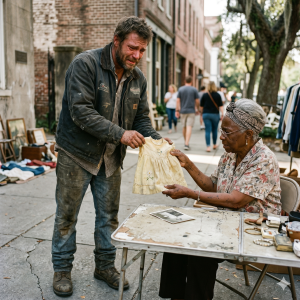
Every Tuesday morning for three years, Marvella Hayes set up her folding table outside the Sunshine Laundromat on Habersham Street.
Just a card table, a tin of needles, and a handwritten sign: *Free Mending. No Job Too Small.*
She’d retired from forty years of alterations work at Forsyth Bridal, and her fingers still needed something to do. So she gave them to strangers.
She’d sewn buttons back onto old men’s dress shirts. Patched the knees of little boys’ Sunday pants. Re-hemmed a wedding dress once, right there on the sidewalk, twenty minutes before the ceremony.
Savannah knew her. And she knew Savannah.
But she did not know him.
—
He first appeared on a rainy Tuesday in March.
Quiet man. Maybe thirty-five. Work boots, clean jeans, a face that looked like it had been through something and come out the other side still standing — barely.
He carried two bags into the laundromat.
One was a regular mesh hamper bag. Socks, work shirts, the ordinary business of living.
The other was a clear zip-lock bag.
And inside it — carefully folded, pressed into a perfect square — was the tiniest yellow dress Marvella had ever seen.
Hand-embroidered daisy on the collar. White thread, delicate as a whisper.
She noticed because she *always* noticed stitching. That daisy had been sewn by someone who loved what they were doing. Every petal placed like it mattered.
He never put the yellow dress in with his other laundry.
He washed it alone, on the gentle cycle, in the machine closest to the window.
Then he folded it himself — didn’t use the folding tables, didn’t rush — and sealed it back into that clear zip-lock bag like he was preserving something sacred.
Marvella watched this the first week and told herself it was none of her business.
—
The second week, he nodded at her as he passed.
The third week, he paused at her table long enough to say, *”That’s a kind thing you do, ma’am.”*
She thanked him and watched him take his usual machine.
The yellow dress went in alone.
She found herself looking for the daisy every Tuesday. Wondering.
She never saw a child with him. Never heard him mention one. He wore no wedding ring — though she’d learned long ago that meant nothing either way.
But the dress was always *pressed*.
You don’t press a dress out of habit. You press a dress because it matters to you that it’s perfect.
—
By October, they were on a first-name basis.
Daniel. He worked construction over on the islands. Lived alone out past Thunderbolt. Didn’t say much but always said *something* — about the weather, about her work, once about a great blue heron he’d seen that morning standing still as a painting in the marsh.
He had kind eyes. Sad ones.
Marvella’s late husband Raymond had eyes like that, toward the end. Like they’d seen the hard thing and decided to keep going anyway.
She never asked about the dress.
Until the Tuesday it came back to her needle.
—
He’d walked over that morning, the zip-lock bag in his hand, and he’d hesitated.
*”I don’t suppose—”* he started. *”The daisy. One of the petals is coming loose. I’ve been putting it off, but—”*
She was already reaching for her reading glasses.
She opened the bag herself — he watched her hands like a man watching a surgeon — and she lifted the dress out gently.
Cotton. Hand-stitched. The embroidery was old, the thread softened by years of washing. One white petal, barely hanging on by a single filament.
She could fix it in four minutes.
But her hands were still.
Because holding it now, up close, she could feel something she hadn’t seen from a distance.
This dress had been altered.
Not recently. A long time ago. The side seams had been taken in — beautifully, by someone who knew exactly what they were doing — to make it smaller.
*It hadn’t started out this size.*
*Someone had made it smaller.*
*Why would you make a child’s dress smaller—*
She looked up at him.
And maybe it was the way she was holding it. Or maybe he’d been carrying this for long enough that one kind face was all it took.
*”Whose dress is this, Daniel?”*
He was quiet for a long moment.
The kind of quiet that has weight.
Then he reached into the inside pocket of his jacket.
And he placed a worn photograph face-up on her sewing table.
Marvella’s hand flew to her mouth.
—
In the photograph, a woman stood in a garden Marvella didn’t recognize. Somewhere with big flat light — not Georgia. Maybe Texas, maybe further west. The woman was laughing at something off-camera, her head thrown back, and she was wearing a yellow dress with a daisy on the collar.
Not the tiny dress in Marvella’s hands.
The original one. Full-sized. On a grown woman in her thirties, laughing in a garden on what looked like a perfect afternoon.
“That’s my mother,” Daniel said. “Rosalie.”
He sat down in the folding chair across from her table — the one she kept for customers — and he put his hands on his knees.
“She passed four years ago. Ovarian cancer. It moved fast.” He cleared his throat. “She wore that dress every Easter Sunday my whole childhood. Every single one. I can’t remember a single Easter morning that dress wasn’t on her.”
Marvella looked at the photograph again. The woman’s face was open and bright and entirely unguarded.
“She was tiny at the end,” Daniel continued. “Lost a lot of weight toward the last few months. My aunt — her sister Patricia — she took the dress in so Mama could still wear it. So she could wear it that last Easter.” He paused. “Patricia was a seamstress. Learned from their grandmother.”
There it was.
The love in those seams. Marvella had felt it and not known what it was.
“Patricia did beautiful work,” Marvella said quietly, not as flattery. As one craftsman acknowledging another across time.
Daniel nodded. “She did.”
He looked at the dress in Marvella’s hands. “I washed it once before I really understood what I had. I panicked when the petal started to go. I’ve just been — putting off dealing with it. Because dealing with it meant—” He stopped.
“Meant trusting somebody else with it,” Marvella finished.
“Yes, ma’am.”
—
She threaded her needle.
She asked him what color white. She kept six whites — warm white, cool white, antique, ivory, natural, and what she called “old cotton white,” which was the color of things that had been loved for decades in Southern humidity. She held four of them against the embroidery thread.
Old cotton white. Perfect match.
She worked slowly, not because the repair was difficult but because it deserved care. The original petals were uneven in that beautiful handmade way — not a flaw but a fingerprint. She matched the tension exactly. Kept her stitches small. When she tied off and snipped the thread, you could not find where the old work ended and the new began.
Daniel had been watching the whole time without speaking.
She held it up in the October light.
“There,” she said.
He took it from her the way you take something you’ve been afraid to hold. He turned it in his hands. Found the repaired petal. Ran his thumb over it once.
He didn’t say anything for a moment.
Then: “She would have liked you.”
Marvella felt that in her chest somewhere deep. “I’d have liked to know her.”
She held the zip-lock bag open and he tucked the dress back in, smoothing it flat, pressing out the air the way he always did. Same ritual. Sacred, like she’d thought.
—
He came back the following Tuesday. And the one after that.
He started bringing her coffee — one cream, no sugar, because he’d noticed how she took it when the woman from the alterations shop down the block brought a cup by in September. He’d been paying attention to her the whole time, same as she’d been paying attention to him.
That February, he mentioned that he’d found a box of his mother’s sewing things while cleaning out a storage unit. Thread, a pincushion in the shape of a tomato, a small pair of silver scissors with a crane etched on the handle.
“I don’t know what to do with them,” he said.
“Bring them by,” Marvella said. “We’ll figure it out.”
He brought them the next week. She looked through everything carefully. The scissors were lovely — old, Japanese, probably a gift.
“These are too good to sit in a box,” she said.
She used them that morning, right there, to trim a loose thread on a little girl’s coat while the girl’s grandmother watched. Daniel watched too, from his usual machine.
He didn’t say anything. But when he left that day, he told Marvella the scissors looked right where they were.
She kept them in her tin after that, alongside her own.
—
In April, he brought someone with him.
A woman named Cora, who worked at the same construction company in a project management role. She had a blazer with a pulled lining and a look on her face like someone who had been talked into something and wasn’t entirely sorry.
“Daniel said you were magic,” she told Marvella.
“Daniel exaggerates,” Marvella said, already examining the lining.
“No ma’am,” Daniel said, from the bench by the window, and he wasn’t smiling but his eyes were.
That was the day Marvella understood he was going to be okay.
Not fixed. You don’t get fixed from losing your mother, not really. But okay. The kind of okay that lets you bring someone new to a place that matters to you. The kind of okay that lets you put a pair of scissors back to work.
—
He still comes every Tuesday.
The yellow dress still comes with him, in its zip-lock bag, still going into the machine by the window on the gentle cycle.
He doesn’t always come to the table. But when he does, they talk. About the herons in the marsh. About the weather coming off the water. About whatever small and worthy thing has happened in a week.
Marvella is seventy-one years old. She has been sewing since she was nine, when her own grandmother put a needle in her hand and said, *this is how you fix what’s broken.*
She has mended a thousand things.
But she will tell you — if you ask her, on a Tuesday morning, with the Spanish moss moving in the Habersham Street light — that some of the most important work she has ever done took four minutes and one length of old cotton white thread.
And had nothing, really, to do with the dress.