She spent fifteen years bringing a dead tomato back to life. Then someone tried to make sure it stayed buried.
—
My name is Patrice Holloway, and I am the seed librarian at Marsh Gate Community Garden in Darien, Georgia.
That sounds like a made-up title. It isn’t.
Every seed that passes through this garden — every packet, every saved cutting, every dried hull folded into a paper envelope — gets catalogued, dated, and stored in my back room. Humidity controlled. Temperature logged. Loved, if you’ll allow me that word.
I have been doing this work for twenty-two years.
But for fifteen of those years, I have been chasing one seed in particular.
My grandmother called it the *Patrice Rose* tomato.
She named it after me.
She told me she’d developed it herself over thirty years of slow breeding — a deep crimson, almost burgundy fruit, sweet enough to eat like an apple, with skin so thin it would split if you looked at it wrong. She grew them on the barrier islands when she was young. She said they tasted like the end of August.
I never got to taste one.
She passed before I could find the seeds.
My cousin Donovan — her other grandchild, the one who handled the estate — told me there was nothing left. No seeds. No notes. No garden records.
He told me our grandmother died with nothing.
So I started from scratch.
Fifteen years of tracking down every related heirloom strain I could find. Ordering from specialty seed banks. Corresponding with old-timers along the Georgia coast who remembered her name, or thought they did. Growing out trial after trial in the back beds, comparing leaf shape and fruit set and blossom count, inching closer each season to something I’d only seen in one faded photograph.
Then last spring, finally, I grew a tomato that made me cry.
Deep crimson. Almost burgundy. Skin so thin it split when I pressed it.
It tasted like the end of August.
I thought I had done it. I thought I had brought her back.
I was already filing the paperwork to register the variety under her original name when Donna Faye, our garden director, called me into her office with a look on her face I didn’t understand at first.
She slid a printout across the desk.
Someone had already trademarked the *Patrice Rose* tomato.
Three years ago.
Under a commercial seed company registered to a holding LLC.
The LLC traced back to my cousin Donovan.
I couldn’t breathe. I sat in that plastic chair and I could not breathe.
I drove home and I went to the one place I always go when I need to think — the back shelf of my seed room, where I keep the oldest materials. The things I inherited when I took over this library from the woman before me, who’d kept them since the 1980s.
And that’s when I found it again.
I’d passed over it a hundred times without understanding what I was looking at.
A small Mason jar. Old, wavy glass, the kind they don’t make anymore. Inside it, folded into a square, was a handwritten index card.
I had always assumed it was hers. My grandmother’s handwriting. Her growing notes, her observations, her dates.
But this time I unfolded it all the way.
And I looked at it the way you look at something when you finally need to know the truth.
The handwriting was not my grandmother’s.
I know her handwriting. I have her letters. I have her birthday cards. I have the recipe she wrote out for me in 1987 in her careful, looping cursive with the little flourishes on the capital letters.
This was different. Smaller. More cramped. The numbers were formed differently. The word *germination* was spelled wrong and then corrected with a tiny caret.
Someone else wrote these notes.
Someone else was there at the beginning of this tomato.
I spent three days cross-referencing everything I could find. Deed records. Old garden club newsletters. A box of photographs someone had donated to the library years ago that I’d never fully sorted.
I found a name I didn’t recognize.
I found a second photograph.
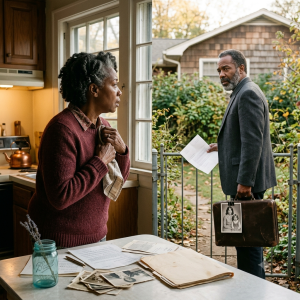
I was still sitting with those papers spread across my kitchen table when I heard the creak of the garden gate at the end of my driveway.
I looked up.
A man was standing at the gate.
He was holding a briefcase.
A cease-and-desist letter was visible in his other hand, folded once.
And clipped to the front of his briefcase — held there by a simple binder clip, like it was nothing, like it was just a piece of paper he carried everywhere — was a faded family photograph.
I could see it from twenty feet away.
I knew that photograph.
I knew every face in it.
Every face except one.
He was still standing at the gate when our eyes met.
And I understood, in the way you understand something that rearranges everything you thought you knew, why looking at him had felt so strange from the moment I saw him.
He had my grandmother’s eyes.
—
I did not move for a long moment.
He did not move either.
The gate between us was wrought iron, old and listing slightly to one side, the kind of gate that closes with a clank you can hear from inside the house. Neither of us reached for it.
Finally I said, “How long have you been standing there?”
He said, “Long enough to know you found something.”
His voice was quiet. A little rough, the way voices get when a person has been holding things in for so long they’ve calcified in the throat. He was older than me by maybe a decade, somewhere in his early sixties, wearing a linen shirt that had been ironed carefully and then sat in badly. Like he’d driven a long way and hadn’t planned to get out of the car but then did.
I said, “Are you here to serve me those papers?”
He looked down at the cease-and-desist like he’d forgotten it was in his hand.
“No,” he said. “I was. That was the plan. But no.”
I unlatched the gate myself.
—
His name was Curtis Beaumont.
He sat at my kitchen table across from the same papers I’d been sitting with for three days — the deed records, the newsletter clippings, the two photographs — and he looked at them the way a person looks at a car accident they caused.
The name I had found in those records was his father’s. Elmore Beaumont, who had grown up one island over from my grandmother, who had been her neighbor and her friend and, as best as I could now piece together, the other half of this tomato’s origin story.
Elmore had died four years ago. His son Curtis had inherited his papers and, among them, a sealed seed tin, a set of growing records, and a long letter my grandmother had written to Elmore sometime in the late 1970s explaining the full breeding history of the variety they had developed together over nearly two decades.
Together.
That was the word I kept turning over in my mouth like a stone.
She had never mentioned Elmore Beaumont to me. Not once. Not by name. Not by implication. She had told me the tomato was hers. She had told me she had developed it herself.
And I had believed her, completely, because she was my grandmother and I loved her and because I was a child and children do not wonder about the things their grandmothers leave out.
Curtis had believed his own version of the same story — that his father had done this work alone, that my grandmother had come along later, that the credit and the rights belonged to the Beaumont side.
Donovan — my cousin, God help him — had gotten wind of the whole thing through an estate attorney three years ago, put two and two together, realized there was commercial value in the variety, and raced to trademark it before either Curtis or I could understand what we were looking at.
He hadn’t told me.
He hadn’t told Curtis.
He had simply taken.
I sat with that for a while without speaking.
Curtis let me.
—
The letter my grandmother had written to Elmore Beaumont was six pages long, handwritten on her good stationery, the cream-colored kind with the tiny violets printed at the top. Curtis had brought it with him. He slid it across the table and I read it the way you read something when your hands are shaking and you’re trying not to let them show.
She wrote about the summer they’d started the breeding project. She wrote about which of them had contributed which parent lines — it was clear and specific, names and dates and characteristics noted with the same careful precision that I had inherited from her without knowing where it came from. She wrote about the argument they’d had when her family moved to the mainland and his family stayed on the island. She wrote about the years of silence afterward.
And then, near the end, she wrote this:
*I keep the seeds because I am afraid of losing them. I keep the notes because I know memory is unreliable and I want to be honest about what was yours and what was mine and what was ours. I named the tomato after Patrice because she is the one I hope will take care of it when I am gone. I did not tell her about you because I did not know how to explain what you were to me. I am sorry for that. I am sorry for more than that. If you are reading this, it means I finally found the courage to send it.*
Elmore had received this letter.
He had kept it for the rest of his life.
And when he died he passed it to Curtis without explanation.
Curtis had found it eight months ago. He’d been trying to figure out what to do with it ever since.
Then Donovan’s cease-and-desist had arrived at his door — the mirror image of the one he’d brought to mine — and something in him had decided that the answer to what to do was not lawyers.
It was to come here.
—
I asked him why he’d brought the cease-and-desist at all if he didn’t intend to serve it.
He said, “I thought I needed something in my hand. I thought if I was just some man walking up to your gate with a photograph and a story about how our grandparents were in love, you’d call the police.”
I told him I still might.
He laughed. It was a short, surprised laugh, and it crinkled around his eyes in a way that was so specifically my grandmother’s expression that I had to look away.
She had a son.
Or near enough.
She had a whole other part of her life that she had folded up and stored somewhere I never looked, like an index card in a Mason jar.
—
I am not going to pretend the next few months were simple.
They weren’t.
There was a lawyer — mine, not Donovan’s — and there were filings, and there was a deposition that I will not describe in detail except to say that my cousin Donovan did not conduct himself with dignity. There was a period of three weeks when I genuinely did not know if the Patrice Rose was going to end up the property of a holding LLC that would sell the seeds through a glossy catalog for fourteen dollars a packet, none of that money going to a single person who had ever actually cared about this tomato.
I am not going to pretend I wasn’t afraid.
But I am also not going to bury the good part in legalese.
The good part is that my grandmother left a paper trail because she was a woman who believed in documentation. The good part is that Curtis Beaumont had kept everything. The good part is that a trademark obtained through deliberate concealment of prior co-development can be challenged, and we challenged it, and we won.
The Patrice Rose tomato is now registered jointly under the names of two families.
Beaumont and Holloway.
The way it always should have been.
—
Curtis came down for the first harvest.
We grew out twelve plants from the seeds in that old wavy-glass Mason jar — the original stock, or near enough to it, the material that had been sitting on my back shelf for twenty years without my understanding what I was holding. Twelve plants in the east beds where the morning light is best.
By August they were heavy.
Deep crimson. Almost burgundy. Skin so thin you’d think twice before touching them.
We stood in the garden on a Tuesday morning, Curtis and me and Donna Faye and two or three of the other regular gardeners who had followed this story with the investment of people who understand what it means to protect something living. Curtis picked the first one. He handed it to me.
I bit into it the way my grandmother must have done when she was young, standing on the barrier island in the heat.
I don’t have the words for what it tasted like.
I have the right words, actually. I’ve had them all along.
It tasted like the end of August.
Curtis took his bite and his eyes went somewhere private for a moment and then came back.
He said, “My father used to say she was the best grower he ever knew.”
I said, “She used to say the same thing about whoever she’d learned from. She never told me who.”
He smiled. “Now you know.”
—
I still have the index card. I had it framed, misspelled *germination* and the little caret and all.
It hangs in my seed room above the shelf where the Mason jar used to sit.
The jar itself I gave to Curtis. Seemed right. He takes care of it. He’s got a garden of his own now, a small plot outside Savannah, and this past spring he grew his first plants from the seeds I shared with him.
He sends me photographs.
They look just right.
My grandmother kept a secret for fifty years because she didn’t know how to explain what a person was to her. I understand that impulse. I am a person who keeps things in controlled conditions because I am afraid of losing them. I know what it is to protect something by hiding it away.
But seeds aren’t meant to stay in jars.
That’s the thing she knew better than anyone.
That’s the thing she was trying to tell me, I think, the only way she could.
She put my name on the tomato.
She left me the library.
She trusted me to figure out the rest.