She found her own obituary.
Not online. Not in some old newspaper clipping. In a memory book she was being *paid* to proofread — for her own hometown’s centennial reunion in Millbrook, Indiana.
Her name. Her birthday. Her photo from the year she left.
And her sister’s name listed as the one who submitted it.
—
Let me back up.
Donna Reeves had been gone from Millbrook for thirty years. She didn’t leave on good terms. She left on a Tuesday night in October with a duffel bag, a tank of gas, and the kind of silence that happens when everything that needed to be said had already been said too loud.
She never looked back.
Or at least, that’s what she told herself.
She built a quiet life in Columbus. Bookkeeping, mostly. A small apartment with good light. A cat named Walter. She was fine. She had made peace with fine.
When the freelance proofreading job came through — *Millbrook Centennial Memory Book, 1924–2024, paid work, remote, no travel required* — she almost passed on it.
The pay was fair. The deadline was tight. She told herself she didn’t feel anything when she saw the town name.
She took the job.
—
The submissions came in a digital folder. Hundreds of them. Old photographs scanned in. Handwritten letters typed up by grandchildren. Recipe cards. Obituaries for people long gone.
That’s when she first noticed the photo.
Tucked into the scan of one submission — a little wallet-sized school picture of two girls in matching green plaid dresses. Maybe eight and ten years old. Big smiles. Gap-toothed. Standing in front of what looked like a gymnasium.
*Cute*, she thought, and moved on.
But then she saw it again.
Same photo. Different submission. Same two girls in the same plaid dresses.
She set down her coffee.
By the fourth time she found it, her hands had gone still on the keyboard.
Because she recognized those dresses now.
Her mother had sewn them. Christmas, 1978. She and her sister wore them for school picture day because their mother was so proud of the fabric she’d found on sale in Indianapolis.
Donna still carried her copy of that photo in her wallet.
Had carried it for thirty years.
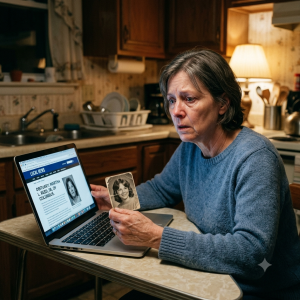
She pulled her wallet out right then, right there at her kitchen table in Columbus, and laid her copy next to the scan on her screen.
Identical.
Same crease on the left corner. Same slightly overexposed background. Same two little girls who used to share a bedroom and then, one October night, became strangers.
Her throat closed.
Who was sending these? The submissions were all from a donor listed only as *Anonymous — Millbrook born, moved away.* No name. No contact information. Just the photo tucked inside, every single time, like a calling card.
Like a message.
—
She almost closed the folder.
She almost sent a polite email saying she had a conflict and couldn’t complete the project.
Instead, she kept reading.
That’s when she found the obituary.
It was filed under *Remembrances — Lost Members of Our Community.* A full paragraph. Her full name. Her birthday — April 3rd, 1968. A photo pulled from a church directory, the last year she was still in Millbrook.
*Donna Lynn Reeves, beloved daughter, is remembered by her family and by this community. She was taken from us too soon.*
Taken from us.
She sat very still for a long time.
At the bottom, in the submission field where a name was required:
*Submitted by: Carol Reeves Hartman.*
Her sister.
Her living, breathing, Christmas-card-sending-to-everyone-else sister had filed her obituary.
The year she left.
Had kept her dead, on paper, for thirty years.
—
Donna’s first thought was rage.
Her second thought — slower, colder, more confusing — was *why.*
Why go to the trouble? Why submit it to a memory book no one would read for decades? Why not just let her disappear quietly the way Donna had always assumed she had?
Unless disappearing quietly wasn’t what happened on Carol’s end.
Unless something else entirely had been going on for thirty years that Donna knew nothing about.
She went back to the anonymous submissions. Back to the photos.
She picked up the last one — the one tucked inside a submission about the old Millbrook grain elevator — and she turned it over.
She had not thought to turn them over before.
On the back, in handwriting she recognized instantly — handwriting she hadn’t seen since the night she walked out of a house on Sycamore Street and swore she never would again — were four words.
Four words that made her knees buckle and her thirty years of *fine* come completely apart.
*She’s been looking too.*
—
Donna sat at her kitchen table until the afternoon light moved all the way across the floor and Walter came and put his paws on her knee and she still didn’t move.
*She’s been looking too.*
The handwriting was Carol’s. She was certain of that. She had spent enough years in the same house with that handwriting — on homework left on the kitchen table, on birthday cards signed with a loopy capital C, on a note slid under a bedroom door the night before Donna left that Donna had not read, had folded and shoved into the duffel bag and driven away with, had never once unfolded in thirty years.
She had not read it because she was afraid of what it said.
She knew that now. Sitting at her kitchen table in Columbus, fifty-six years old, a cat on her knee and a dead woman’s photograph on her screen, she finally knew that.
She went to her bedroom. She went to the closet shelf where she kept the box she had never opened, the one that had moved with her three times and lived on three different closet shelves in three different apartments, always on the highest shelf, always slightly out of reach.
She got the step stool.
She got the box.
The note was still inside, folded in thirds the way Carol always folded things, precise and small.
Donna unfolded it.
—
It was one page. Both sides. Carol’s loopy handwriting, the kind she’d had since sixth grade.
*Donna,*
*I know you’re leaving tonight. I heard you on the phone with Gail. I’m not going to try to stop you because I know what that would look like and I know you’ve already decided and honestly I think maybe you should go. I think you need to go. I think if you stay in this house one more year it’s going to do something to you that I can’t fix.*
*But I need you to know something before you do.*
*What Dad told you about the money — the money from Grandma Perrault’s estate — he lied. He told you I got it all because he needed a reason for why you weren’t getting any. The truth is neither of us got it. He used it. He used it a long time ago and he told me not to tell you and I went along with it because I was scared of him and I have hated myself for that every single day since.*
*I should have told you. I should have told you to your face instead of writing it on a piece of paper I’m not even sure you’ll read. If you don’t read this, if you just go, I’ll spend the rest of my life not knowing if you left thinking I betrayed you.*
*Because I didn’t. I want you to know I didn’t.*
*I’ve been saving money. Not enough. But I have a little put away and when you get somewhere, if you want it, it’s yours. Just call me. Just call me and tell me you’re okay and you can have every cent of it.*
*I love you. I have always been on your side. Even when it didn’t look that way.*
*Don’t be gone forever.*
*— Carol*
—
Donna read it twice.
Then she put it down on the bed and she pressed both hands flat against the quilt and she breathed.
Thirty years.
Thirty years she had driven away believing that her sister had taken the inheritance and said nothing. That the silence between them was Carol’s silence, Carol’s choice, Carol’s loyalty to their father instead of to her.
The man who had lied to both of them.
The man who had been dead for eleven years — she knew that much from distant family gossip she hadn’t been able to entirely avoid — and who had apparently taken his version of the story to a cemetery outside Millbrook while both of his daughters lived separately with the wreckage of it.
She thought about the obituary.
She thought about what it would mean to file your sister’s obituary in a small town in Indiana.
And then she thought about it differently, the way you sometimes have to turn a thing over to see it.
If you lived in a town where everyone knew your family. If your father was the kind of man who needed explanations for things. If your sister had vanished without a trace and people were asking questions you didn’t have answers to and your father was standing right there, watching, needing a story that made him look like a grieving parent instead of what he actually was.
What would you do?
You might write an obituary.
You might write it with the least damning language you could manage — *beloved daughter, taken from us too soon* — words that could mean grief but could also mean something else entirely if the person who read them was looking for another kind of message.
Taken from us.
Not *passed away.* Not *died.* Taken.
And then you might spend thirty years tucking a photograph into submission after submission for every community project and local archive you could find. Millbrook’s historical society records. The county library photo collection. The church newsletter archive.
Leaving copies of yourself in every place your sister might ever look.
Hoping.
—
Donna found Carol on Facebook at nine-thirty that evening. It took forty-five seconds.
Carol Reeves Hartman. Millbrook, Indiana. Profile picture: a woman with gray-streaked hair standing in front of a garden, squinting into the sun, wearing an expression Donna recognized from forty years ago — a little bit cautious, a little bit hopeful, ready to be told something was going to be okay.
She had 214 friends.
She had last posted three weeks ago, a photograph of tomatoes from her garden.
The comments were full of people saying *gorgeous* and *look at those beauties.*
Donna stared at the photo for a long time.
Carol’s hands in the picture were rough-looking. Working hands. Their mother’s hands had looked like that.
She clicked over to Carol’s older posts without really deciding to. She scrolled slowly. There were grandchildren’s birthday parties. There was a post about the church rummage sale. There was a photograph of a grain elevator — the old Millbrook grain elevator — with the caption: *They’re tearing it down next month. Went to say goodbye today. Some things just carry too much to let go without a proper goodbye.*
Posted eight months ago.
The anonymous submission about the grain elevator.
She’s been looking too.
—
Donna opened a message window.
She sat there for twenty minutes without typing anything.
She had lived alone with her version of the story for so long that starting a different version felt like standing at the edge of something without being able to see the bottom. She was a woman who was good at ledgers, good at numbers, good at making things balance. This was not a thing she knew how to make balance. There was too much lost. Too many years. Too much that couldn’t be given back.
She typed: *Carol.*
She deleted it.
She typed: *I found the note.*
She looked at that for a while.
She sent it.
—
The reply came back in eleven minutes.
Just three words.
*Are you okay.*
Not a question mark. Carol had never been much for question marks when she really meant something. It was a question mark kind of question delivered without the punctuation that would make it possible to brush off.
Are you okay.
Donna thought about her apartment with good light. She thought about Walter, currently asleep on the kitchen chair. She thought about the years of bookkeeping and the quiet she had built for herself and whether that quiet was peace or just the sound you get when you stop listening for something.
She typed: *I don’t know yet. I read the obituary.*
Carol: *I’m sorry. I didn’t know how else to make him stop asking where you went. I hated writing it. I’ve hated it every day since.*
Donna: *I know. I think I understand.*
Carol: *I’ve left you pictures everywhere I could think of. In case you ever looked. I know that sounds crazy.*
Donna: *I found them. I was proofreading the memory book.*
A long pause. Several minutes. Donna watched the three dots appear and disappear twice.
Carol: *I submitted those photos because I thought if you ever saw anything from Millbrook — anything at all — that might be the thing you’d see. I didn’t know how else to reach you. I didn’t have an address. I looked. Lord knows I looked.*
Donna: *I didn’t want to be found.*
Carol: *I know.*
Carol: *I kept looking anyway.*
—
They typed back and forth until past midnight. The way people do when they are trying to compress decades into a chat window and keep having to stop because there’s too much and also because some of it requires sitting very still for a moment before continuing.
Carol told her about their father’s last years. She told it plainly and without trying to make it easier than it was.
Donna told Carol about Columbus. About the bookkeeping. About Walter.
Carol said she had a dog named Biscuit who was afraid of the mailman and had been for nine years with no apparent plans to stop.
Donna laughed at that. Actual laughing, alone in her kitchen after midnight. It surprised her.
Carol: *Will you come to the reunion?*
Donna looked at that message for a long time.
She thought about Millbrook. She thought about the way it had felt in her memory for thirty years — compressed and airless, a place that only existed in the October-night version of it, a gas tank and a duffel bag and the dark highway going anywhere else.
She thought about a grain elevator being torn down. About someone going to say goodbye to it because some things carry too much to let go without a proper goodbye.
Donna: *The reunion is in September?*
Carol: *September 14th. I have a guest room.*
Donna: *Let me think about it.*
Carol: *Okay.*
Carol: *I’ve been thinking about it for thirty years so I can wait a little longer.*
—
She went to the reunion.
She drove herself, which felt important — her car, her timeline, the ability to leave if she needed to. She pulled into Millbrook on a Saturday morning in September when the light was still the soft early kind and the corn on both sides of Route 9 was high and heavy and the town looked, from the outskirts, almost exactly the way it had looked in 1994 when she’d last seen it going the other direction.
She sat in her car in a parking lot off Main Street for about ten minutes.
Then she got out.
Carol was waiting in front of the community center. She was wearing a blue cardigan and she looked like their mother and she looked like a stranger and she looked exactly like the girl in the green plaid dress and she started crying the moment Donna came around the corner of the building.
Donna did not cry right away. She was still taking in too many details. The way Carol’s hair had gone gray at the temples. The garden-roughened hands. The way she was standing with her arms slightly out from her sides the way a person stands when they are ready to either hug someone or be turned away, and have made their peace with both possibilities.
Donna closed the distance between them.
The hug was the kind where neither person lets go for a while.
—
The memory book came out later that fall. Donna had finished proofreading it, professionally and thoroughly, which under the circumstances she felt was a remarkable display of personal integrity.
The obituary was not in the final version.
She had flagged it for removal along with a note to the committee that said only: *Confirmed living. Please omit.* She did not elaborate. The committee thanked her and removed it without question, which was probably the most useful thing a centennial committee had ever done.
The photograph of two girls in green plaid dresses — the one that appeared in the grain elevator submission and the church submission and the four others — did make it into the book. It was printed on page 47, in a section called *Millbrook Families Through the Years.*
The caption underneath read: *The Reeves sisters, school picture day, 1979. Submitted anonymously.*
Donna has a copy of the book on her bookshelf in Columbus. Right now it’s between a binder of tax records and a novel she’s been meaning to finish for two months.
She and Carol text most Sundays. Sometimes it’s just a picture of Biscuit or Walter. Sometimes it’s longer.
Last week Carol sent a photo of the empty lot where the grain elevator used to stand. Just bare ground and sky.
Donna wrote back: *Some things carry too much to let go without a proper goodbye.*
Carol sent back a single heart.
It was enough.