They took her sign in front of the whole town.
And twelve years later, she came back to collect.
—
Her name was Della Arceneaux.
If you’d grown up anywhere near Apalachicola, you knew that name. Her grandfather had worked these waters before the roads were paved. Her mother could shuck forty oysters a minute without drawing a single drop of blood. The Arceneaux family hadn’t just fished this bay — they *were* this bay, in the way that quiet people become part of a place without ever asking permission.
Della had inherited all of it. The work ethic. The stubbornness. The hands that never quite got clean no matter how hard she scrubbed.
What she hadn’t inherited was any talent for fighting back out loud.
—
The October she turned thirty-four, Della set up her booth at the Apalachicola Seafood Festival the same way she had every year since she was eleven years old. Same oilcloth tablecloth in blue and white. Same mason jars of pickled peppers lined up like soldiers. Same hand-lettered wooden sign — *Arceneaux Bay Oysters, Est. 1947* — hung with wire from the canopy poles.
She had filed her paperwork in July. Paid her booth fee in August. She had done everything right.
That had never stopped the wrong thing from happening before.
By nine o’clock that Saturday morning, two men from the festival committee were standing in front of her table. Her ex-husband’s uncle was one of them. He had the kind of face that smiled while delivering bad news, which is the worst kind of face there is.
There had been, he explained, an administrative error. Her application had been processed incorrectly. Her spot had been reassigned.
Della didn’t say a word.
She watched them unhook the wire. Watched them lift the sign — her grandfather’s sign, the one he’d painted by hand in 1962 — and carry it away through the crowd.
She stood there in the October heat while the festival went on around her like nothing had happened at all.
People looked. A few looked away quickly. Nobody said anything.
Just before she turned to go, she slipped one hand into her coat pocket. Her fingers found the small brass oyster knife she always carried — her great-grandmother’s, engraved on the handle with a crest nobody in town had ever been able to identify. An unfamiliar family seal. An old secret in brass.
She held it for a moment.
Then she walked to her truck, drove home, and didn’t come back to the festival for twelve years.
—
In those twelve years, a lot of things happened quietly.
Della sold her house and moved to Tallahassee. Then to Atlanta. She took business courses at night. She made a friend who knew something about real estate law. She made another friend who knew something about holding companies. She learned that patience, applied correctly, is not weakness at all.
It is the sharpest tool in the shed.
She also learned, in the way that people learn things they were always going to learn eventually, that the waterfront block where the festival was held — four parcels, two historic buildings, one very long dock — had been owned since 2019 by a private LLC registered in Delaware.
Nobody local had thought much about it.
The previous owners had been happy to sell.
—
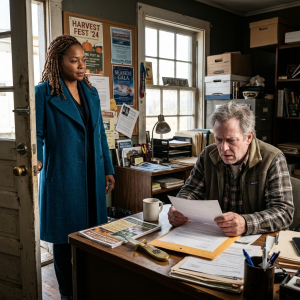
The morning of the festival’s opening ceremony this past October, the festival director — Della’s ex-husband’s cousin, now running things since the uncle retired — arrived at his office to find a sealed envelope on his desk.
He almost didn’t notice the brass oyster knife sitting beside it, borrowed from the display case in the hall, he assumed. Old artifact. Unfamiliar crest on the handle.
He opened the envelope.
It was a letter from an attorney’s office in Atlanta.
It was addressed to the current occupants and operators of the Apalachicola Seafood Festival.
It was regarding the property on which they were standing.
The director read it once. Then he read it again, slower, because the first time through he was certain he had misunderstood something.
He had not misunderstood anything.
He looked up from the letter.
And there, standing in the open doorway of his office in a good wool coat the color of the bay at dusk — hands folded, chin level, wearing the same quiet smile she’d worn the day they carried away her grandfather’s sign — was Della Arceneaux.
She didn’t say anything.
She didn’t need to.
The brass knife was still on his desk, catching the morning light, the unfamiliar crest facing up.
And the director’s face had gone the color of old paper.
Because he had just understood something that Della had known for a very long time.
Some people don’t fight back in the moment.
They fight back when they own the moment.
He opened his mouth.
Della reached into her coat pocket.
—
She set a single sheet of paper on his desk. Unfolded it with two fingers. Smoothed it flat the way her mother used to smooth the oilcloth every morning before the day started.
It was a lease agreement.
Standard terms. Fair market rate. Twelve months, with an option to renew.
She had already signed her name on the landlord line in the same blue ink her grandfather had used to letter that wooden sign sixty years ago. Steady hand. No flourish. Just the name.
The director looked at the lease. He looked at the letter from the attorney. He looked at the brass knife, which was not, it turned out, borrowed from any display case in the hall, because it had never been in any display case in any hall. It had been in Della Arceneaux’s coat pocket for twelve years.
He said, “This isn’t — ” and stopped.
He said, “You can’t just — ” and stopped again.
Della waited. She was very good at waiting.
“The LLC,” he finally managed. “Coastal Meridian Properties.”
“Yes,” she said.
“That’s you.”
“It has been since 2019,” she said. “Since about six months after the previous owners decided waterfront property in a shrinking oyster town wasn’t worth the headache anymore.” She paused. “I thought it was worth the headache.”
He sat down. He hadn’t meant to sit down, but his legs made the decision for him.
Outside the window, Water Street was filling up. Vendor trucks. Canopy frames. The smell of the bay coming in off the wind the way it always did on the first Saturday of October, low tide and salt and something older than anyone could name. The festival was setting up on property it had set up on for thirty years without once asking who actually owned the ground beneath it.
Nobody had ever asked.
Della had counted on that.
“What do you want?” he said.
It was the first honest thing he’d said to her in the entirety of their acquaintance.
She appreciated it enough to answer honestly in return.
“A booth,” she said. “Same spot I had in 2012. Corner of the east row, facing the dock.”
He stared at her.
“And my grandfather’s sign back. I know your uncle kept it. He had it in the garage off Chestnut Street until he moved to Pensacola, and I’m reasonably sure it’s in the storage unit on Route 98 now because that’s where he put everything from the garage.” She said this the way you say something you’ve known for a long time without any particular anger in it, just the plain fact of the thing. “I’d like it returned by end of day Friday.”
He kept staring.
“The lease terms are fair,” she said. “I’m not here to burn anything down. I’m here to sell oysters.”
She let that sit in the air of the small office for a moment.
“That’s all I ever wanted to do.”
—
He signed the lease.
Whether that was because the terms genuinely were fair, or because he’d just understood that the ground beneath the festival tent was no longer a metaphor, nobody could say for certain. Probably both. Most things are probably both.
The sign came back by Thursday. The director’s uncle drove it up from the storage unit himself, which was the first time in twelve years that man had driven more than twenty miles voluntarily, and when he carried it up Della’s front walk he held it the way you hold something that cost you more than you expected, that you don’t fully understand the value of until it’s no longer in your possession.
He didn’t apologize. She didn’t ask him to.
She took the sign. She checked the corners where the wood had dried but not cracked. She ran her thumb over the painted letters, the year, the name.
She said, “Thank you for bringing it.”
He drove away.
—
On Saturday morning, Della set up her booth at the Apalachicola Seafood Festival.
Same oilcloth tablecloth in blue and white. Same mason jars of pickled peppers lined up like soldiers. The sign went up last — hung with new wire from the canopy poles, because the old wire had been lost somewhere in twelve years of storage, and some things you replace without grief.
The sign itself was the same as it had always been.
*Arceneaux Bay Oysters, Est. 1947.*
Her grandfather’s handwriting. Her great-grandmother’s brass knife on the table beside the register, just where customers could see the handle. The unfamiliar crest facing up.
It wasn’t unfamiliar, of course, if you knew what you were looking at.
It was the crest of a French merchant family that had come to the Gulf Coast in the early 1800s, settled into the land so quietly and completely that within two generations nobody remembered they’d arrived from somewhere else. They had simply become part of the place. The way quiet people do.
The crest was a stylized oyster shell, open, with a single line beneath it meant to represent water. Simple. Old. Completely itself.
Della had had it identified by an archivist in New Orleans about eight years ago. She hadn’t done anything with the information except carry it around for a while, the way you carry something that makes you understand yourself a little better.
—
By ten o’clock the line at her booth was twelve people deep.
Some of them were strangers, tourists in the way that October tourists always are, easy in their windbreakers, happy to be somewhere with a story. But a lot of them were locals. People who’d watched from a distance twelve years ago and looked away quickly and hadn’t said anything. People who’d thought about it afterward. People for whom the return of Della Arceneaux to the east row corner, facing the dock, was something they needed to witness in person.
An older woman named Priscilla, who had worked at the festival office for twenty years and had processed Della’s application correctly in 2012 and had been quietly sick about what happened to it ever since, bought three dozen oysters and paid with two twenty-dollar bills and told Della to keep the change.
Della gave her the change back. “Your money’s good here, Miss Priscilla. Same as anybody’s.”
Priscilla held it together until she got back to the oyster bake tent, and then she didn’t.
—
By two in the afternoon, Della had sold out.
She broke down the table. Folded the oilcloth. Wrapped the jars that hadn’t moved in newspaper the way her mother had shown her.
She took the sign down last.
She held it for a moment, reading words she’d read ten thousand times, and then she loaded it carefully into the truck bed in the padded moving blanket she’d brought specifically for that purpose, because she had known she would be loading this sign today, had known it for a while now, the way you know things you’ve been working toward for a very long time.
She drove back along the bay road with the windows down.
The water was flat and dark and the light was going gold at the edges the way it does on October afternoons when the season is turning and the bay smells like itself — salt and depth and something you can’t put a name to, something that was here before you and will be here long after, patient as anything.
Della drove with one hand on the wheel.
Her other hand rested on the seat beside her, open, fingers loose, the brass knife nowhere and everywhere, the old crest and the open shell and the single line of water below it.
She was not smiling exactly.
She was something better than smiling.
She was home.