She found the notebook on a Tuesday.
But let me back up.
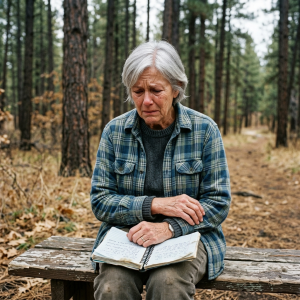
Dorothy Marsh has walked the Elden Lookout Trail every single morning for eleven years. Rain. Snow. That one January week when it was so cold her water bottle froze solid before she reached the first switchback. Didn’t matter. She showed up.
She’s 72 years old, a retired park ranger, and those ponderosa pines are as familiar to her as her own kitchen. She knows which roots are sneaky. She knows where the elk like to bed down in October. She knows the smell of the air before a monsoon rolls in off the Peaks.
And she knows litter.
So every morning, Dorothy walks with a grabber tool in one hand and a paper bag in the other, working her way up the trail, collecting what people leave behind like the mountain belongs to someone else.
She was doing exactly that on a cold October morning when she first saw him.
Young man. Maybe mid-twenties. Standing completely still in the shadows between two big pines like he’d grown there. Thin in a way that worried her. Hollow-eyed. Wearing a gray hoodie that was too light for the temperature.
She raised her hand to wave.
He was gone.
Not walked away. Gone. Like smoke.
Dorothy stood there for a solid minute. Then she looked down at the trail and noticed a granola bar wrapper near the base of the big split ponderosa — the old one she’s always loved, the one struck by lightning years ago that somehow kept growing anyway, its trunk cleaved open into a natural hollow just wide enough to tuck your hand into.
She cleaned up the wrapper.
But that face stayed with her all the way home.
The next morning she packed two lunches.
Peanut butter on wheat, an apple, a handful of pretzels in a zip-lock bag. Nothing fancy. She tucked it down into the hollow of that split pine on her way up the trail, the way you’d set something on a neighbor’s porch.
She told herself she was probably being foolish.
She wasn’t.
By the fourth morning, the food was always gone. Never a crumb left, never the bag — it was like the tree itself had swallowed it. She never saw him take it. Never saw him at all. But some mornings there was a small sign that he’d been there. A pine cone balanced on top of the hollow. A single flat rock placed just so.
And then, about two weeks in, she noticed the notebook.
Small. Spiral-bound. The cover was water-stained and dark, like it had been rained on more than once. Tucked into the hollow of the pine, back behind where she left the lunches. Pushed just far enough in that she could see the edge of it, could see the pale lined pages, but couldn’t quite make out the writing without reaching in and pulling it out.
She didn’t pull it out.
It wasn’t hers.
She left it there. Left his lunch. Went on with her walk.
But the next morning, the notebook was pushed a little deeper in. Like it had been moved. And the morning after that, deeper still. Every day, she’d check. Every day, it was there — a little further back, a little more tucked away, like it was trying to disappear but hadn’t quite decided to yet.
She started talking to it.
Not to the young man — to the notebook. While she tucked in his lunch, she’d say things like, “Cold one today,” or “Saw three mule deer down by the wash,” or once, when she was having a harder morning, “I hope you’re warm enough, honey. I hope somebody’s taking care of you.”
She never saw him.
Four weeks passed that way.
And then one Tuesday morning, Dorothy came around the bend and stopped dead in the trail.
There was something in the hollow that she hadn’t left.
Not the notebook — though the notebook was there too, pushed so far back it was almost invisible now.
It was a small bundle of dried wildflowers. The kind that grow along the upper trail in late summer. Tied with a piece of twine. And propped against them, a folded piece of paper with one word written on the outside in careful handwriting.
Dorothy.
Her name. He knew her name.
Her hands were shaking a little as she unfolded it. Just two lines, written in that same careful hand:
Thank you for seeing me. I left something for you.
She looked at the notebook.
And this time, she reached in and took it.
She carried it all the way to the trailhead bench before she opened it. Sat down. Took a breath. Opened to the first page.
And the world tilted sideways.
Because the handwriting on that first page — she would have known it anywhere. She had stared at it on birthday cards and Christmas letters and one unbearable eulogy for twenty-three years.
It was her son’s handwriting.
Her son, who had died in 2001.
She looked back up the trail. Her heart was slamming against her ribs.
And then she heard footsteps in the pine needles, coming closer.
She didn’t stand up. She couldn’t. Her legs had gone completely useless on her, the way they sometimes did in dreams where you need to run and your body just refuses. She sat on that bench with the notebook open in her lap and the footsteps getting closer and she thought, very clearly: I am either about to understand everything, or I am about to lose my mind entirely.
He came around the bend the same way the deer come — tentative, watching her first, ready to disappear again if she made the wrong move.
He stopped about ten feet away. Hands in the front pocket of that same gray hoodie. He looked even thinner in the full light of morning than he had in the shadows. There were dark circles under his eyes that told her he hadn’t slept in a long time, maybe longer than just last night. But he was looking at her with an expression she recognized in the complicated way you recognize a word you’ve only ever seen written down and never heard spoken aloud.
He looked like he was trying not to hope too hard for something.
“My name is Caleb,” he said. “Caleb Marsh.”
Dorothy pressed her hand flat over the open notebook.
“I know who you are,” she said quietly. “I just don’t know how.”
He came a little closer then, and sat down on the far end of the bench with the careful distance of someone who understands he has no right to assume, and he told her.
His mother was Michael’s daughter.
Michael Marsh — Dorothy’s son — had died in a car accident in October of 2001 at thirty-one years old, nine months before Caleb was born. His mother, a young woman named Renata, had been three months pregnant when it happened. She and Michael had only been together a short time. They weren’t married. Renata had been quietly devastated and privately certain that Dorothy, a grieving mother she’d never met, would not want to hear from a stranger showing up on her doorstep with complicated news in the middle of the worst year of her life.
So she hadn’t reached out. She’d told herself she would, eventually, when the time was right. But the right time never quite arrived, the way it often doesn’t, and then years stacked up on years and the longer she waited the harder it became to imagine beginning.
Caleb had grown up knowing his father’s name and nothing else.
A few months ago, Renata had gotten sick. Not the kind of sick you recover from. And in the way that terminal illness has of clarifying things that had been muddied by time and fear, she’d finally told Caleb everything she knew. She’d given him the notebook — Michael’s notebook, a journal he’d left at her apartment that last week — and she’d told him: your grandmother is still alive. She lives in Flagstaff. She walks a trail called Elden Lookout every single morning. I looked her up. I should have told her about you a long time ago. I’m sorry.
Then Renata had died, eleven days before Caleb found the trail.
Dorothy was very still through all of this. The pine trees made their sound in the wind. A woodpecker knocked at something up the slope, hollow and patient.
When Caleb stopped talking, she looked down at the notebook again.
The handwriting on the first page was a journal entry from August of 2001, two months before Michael died. He’d written about a camping trip he’d taken, somewhere up near Mormon Lake. About how the stars looked from his sleeping bag. About how he was thinking of quitting his job at the hardware store and doing something that scared him more. About how he’d met someone and wasn’t sure yet what it meant but it felt like something real.
The last line of the entry read: I want to be the kind of person who shows up. I’m working on it.
Dorothy pressed the back of her hand to her mouth.
She thought about twenty-three years. She thought about the trail, and all those cold mornings she’d come out here because it was the only place where her grief had enough room to breathe. She thought about the split ponderosa that had been struck by lightning and just kept growing anyway.
She thought about a young man in a gray hoodie, standing in the trees, not quite gone.
“You have his eyes,” she said. Her voice wasn’t entirely steady but it held. “I could see it. Even in the shadows. I couldn’t figure out why your face bothered me.”
Caleb looked down at his hands. His jaw was working.
“I didn’t know how to just walk up to you,” he said. “I didn’t know if you’d want — I mean, I didn’t know what I was to you. I’m nobody, really. I’m just —”
“You’re his,” Dorothy said. Simple. Final. The way she used to say things when she was still a ranger and someone needed to hear a true fact stated plainly. “You’re Michael’s boy. That makes you mine. That’s not a small thing.”
He cried then. Not dramatically — he tried hard not to, you could see that — but it came out of him anyway, the way water comes up through cracked ground after a long rain when the ground finally can’t hold any more. He put his hands over his face. His shoulders shook once, twice.
Dorothy slid down the bench and put her arm around him.
He was tall the way Michael had been tall, and she had to reach up a little, and she felt the bones of him under that thin hoodie and thought: first order of business is getting some weight back on you. Second order of business is finding you a warmer coat. Everything else after that.
They sat that way for a while. The woodpecker kept on. The wind moved through the pines the way it always does, indifferent and steady and somehow, always, like a kind of breathing.
Eventually Caleb straightened up. Rubbed his face with his sleeve. Looked embarrassed and grateful in equal measure.
“I’m sorry I kept hiding,” he said. “Every morning I’d see you coming and I’d think, today. Today I’ll just talk to her. And then I’d — I couldn’t.”
“You left me pine cones,” Dorothy said. “Balanced right on top. I knew those weren’t squirrels.”
He laughed — short and surprised — and she heard Michael in it so clearly that her breath caught. Same laugh. Same little hitch at the end of it.
“I found a place to sleep,” he said, a bit quickly, like he was worried she was about to ask. “I’ve been okay. There’s a hostel in town that does work exchange. I’ve been doing some landscaping work. I just — I didn’t have anywhere to land, really. After my mom. I just needed somewhere to be for a minute.”
“Well,” Dorothy said, “you found somewhere.”
She stood up. Tucked the notebook carefully under her arm. Picked up her grabber tool and her paper bag, because she was still two-thirds of the trail from the summit and she had work to do.
“You eaten today?”
He shook his head.
“I’ve got half a thermos of coffee and an almond butter sandwich in my pack. Come on.”
She started up the trail. After a moment, she heard him fall into step behind her. His footsteps in the pine needles, a little tentative still, but there. Not gone.
She showed him the sneaky roots. She showed him the spot where the elk bed down in October, the flattened grass still holding the ghost of their shapes. She pointed out the way the clouds were stacking up to the northeast and told him what that meant, and what the air smelling like wet copper meant, and how the trail turns slick right at the third switchback when the rain first hits and you have to watch your footing.
She told him about Michael. Small things, mostly. His laugh, which Caleb now had. The way he could never figure out which drawer the spatulas went in no matter how many times she told him. How he used to do this thing when he was proud of himself, this little chin-tuck, trying not to smile too big.
Caleb was quiet, listening in the way people listen when they are storing things up carefully. Like every word was something to be kept.
They reached the summit just as the first cold drops started to fall. The Peaks were swallowed in cloud. The whole valley below was gray and silver and enormous.
“I come up here because it’s the only place big enough,” Dorothy told him. She wasn’t sure she’d ever put it into words before. “When you lose somebody — when you really lose them — you need somewhere that doesn’t try to make it small. This place doesn’t.”
Caleb stood beside her and looked out at all of it.
“Yeah,” he said softly. “I think that’s why I came here too.”
The rain came down harder. Dorothy pulled her hood up and handed him the other half of her sandwich.
They walked back down together, side by side where the trail was wide enough, single file where it narrowed — Dorothy first, because she knew every root, every slick place, every spot where the mountain wanted to trip you up.
She’d walked this trail eleven years in every kind of weather, one foot in front of the other, and the mountain had always given her back something she needed, even on the mornings she wasn’t sure what that was.
This morning she knew.
At the trailhead she stopped and turned to him.
“My house is twelve minutes from here,” she said. “I make real coffee, not thermos coffee, and I’ve got eggs. After that we’re going to talk about what comes next. Not tonight. Just next. One step at a time.”
He looked at her with his father’s eyes.
“Okay,” he said.
And she led him home.