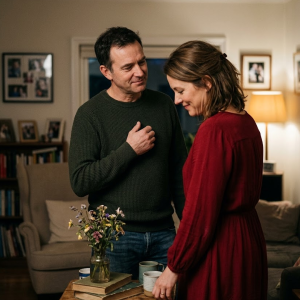
Thirty years ago, they handed Loretta a cardboard box and told her to leave.
Today, she pulled into the driveway of the lakehouse they’d been fighting over for a decade — and she owned it.
But let me back up. Because the way it happened matters more than the fact that it happened.
—
Loretta Beaumont was thirty-four years old when her husband Gerald died.
They’d had eleven years together. A small house in Clarksville. A vegetable garden she tended every summer. A marriage so quiet and steady it embarrassed people who needed noise to feel loved.
Gerald’s family — the Hargroves — had never approved.
His mother, Darlene, made sure Loretta felt that every single Thanksgiving, every Easter, every Fourth of July gathered at the lakehouse on Cedar Bluff. The one Gerald’s grandfather had built by hand. The one everybody wanted.
When Gerald passed, Loretta assumed she’d be taken care of. He’d told her she would be.
Instead, three weeks after the funeral, she sat in a lawyer’s office she’d never been to before and watched a will get read that didn’t sound anything like the man she’d married.
No house. No savings account. Not even the truck.
Just a cardboard box waiting for her by the door. Her name written on it in marker.
*Loretta’s things.*
She carried it to her car alone. Nobody helped. Nobody walked her out.
She drove away from that office telling herself she must have misunderstood the man she shared a bed with for over a decade.
She almost believed it.
—
For thirty years, she lived quietly.
She remarried briefly. It didn’t take. She kept her garden. She worked at the county assessor’s office for twenty-two years, longer than some of her coworkers had been alive.
And somewhere in year three of that job, while pulling deed records for a property dispute that had nothing to do with her — she found something.
She didn’t tell anyone.
She just started making phone calls.
—
The Hargroves still held their Fourth of July reunion every year at the lakehouse on Cedar Bluff. Fireworks over the water. Potato salad from the same recipe since 1987. The same old argument about who was going to buy out who so the deed could finally be settled.
Nobody invited Loretta.
Nobody had to.
She drove herself.
She parked behind the row of pickup trucks and minivans and walked down to the water where the picnic tables were set up under the oaks, wearing a yellow blouse and her good walking sandals, carrying one thing under her arm.
A manila envelope.
Water-stained around the edges. Soft with age. The kind of envelope that had clearly been somewhere damp for a very long time.
She set it on the end of the picnic table.
Just set it there. Didn’t say a word about it.
—
The reunion went the way reunions go when someone unexpected shows up.
Whispers. Stiff hugs from the ones who felt guilty. Cold shoulders from the ones who didn’t. Someone got Loretta a plate of food she didn’t ask for. Someone else asked her, carefully, why she was there.
“Just thought I’d stop by,” she said. “It’s been a while.”
All afternoon, that envelope sat on the table.
She never let it out of her sight.
When Gerald’s nephew, Travis, reached over and slid it toward himself — casual, like he was just moving it out of the way — Loretta’s hand came down on top of it before he got an inch.
She didn’t say anything.
She just looked at him.
He moved his hand.
—
By four o’clock, when the sun was dropping behind the tree line and the fireflies were just starting to come out over the water, Darlene Hargrove finally walked over.
Eighty-one years old. Still sharp. Still wearing the same expression she’d worn the day she watched Loretta carry that cardboard box to her car.
“I don’t know what you think you’re doing here,” Darlene said.
Loretta looked at her for a long moment.
Then she picked up the envelope.
Slid it slowly to the center of the table, so everyone gathered around could see it.
And said, in a voice that didn’t shake even a little —
“Gerald left me something after all.”
She let that sit in the air.
“But it wasn’t in that box.”
Darlene’s face went the color of old chalk.
And Loretta reached for the envelope.
—
Inside was a deed.
Not a copy. The original. Notarized and recorded with Montgomery County on October 14th, 1987 — four years before Gerald died, and eleven years before anyone in the Hargrove family started fighting over who the lakehouse really belonged to.
Gerald Hargrove had transferred sole ownership of the Cedar Bluff property to his wife, Loretta Anne Beaumont Hargrove, in a separate conveyance that nobody had ever mentioned in that lawyer’s office. Possibly because nobody in that lawyer’s office had known about it. Possibly because someone had made sure they didn’t.
Loretta set it on the table face-up and smoothed the crease down the middle with two fingers.
The Hargroves leaned in. Then back. Then in again, like they couldn’t quite make their eyes agree with what they were reading.
Travis said, “That can’t be real.”
Loretta said, “It’s been in the Montgomery County deed index for thirty-three years. I found it on my lunch break.”
She said it the way you’d say you found a good parking spot.
—
Here’s the part that took her the longest to understand.
Gerald hadn’t hidden it from her. He’d recorded it properly, paid the filing fee, kept his copy. He had fully expected her to find it when she needed it.
What he hadn’t counted on was dying at forty-one, before he’d ever told her it existed.
He’d been the kind of man who didn’t explain things he considered settled. The lakehouse was hers. He knew it. He’d made it legal. In his mind, that was that.
What he hadn’t considered — what he couldn’t have — was his mother.
Because the cardboard box they’d handed Loretta that day in the lawyer’s office had contained, among her things, a set of keys. House keys. Car keys. A small tin of buttons she kept in her sewing basket.
And, at the very bottom, under a dish towel she didn’t remember packing, a white envelope with her name on it in Gerald’s handwriting.
She had assumed it was a letter.
She hadn’t opened it for two years.
When she finally did, it was a single index card. Gerald’s block printing, neat as a blueprint.
*Deed recorded Oct. 14, 1987. Montgomery County. My copy is in the green tackle box in the garage. The original is with the county. The lake is yours, Loretta. Don’t let them tell you any different.*
*I love you.*
She had sat in her kitchen and read that card so many times the ink had gone soft at the edges.
And then she’d gone to work.
—
The problem with a properly recorded deed is that there is no undoing it.
You can ignore it. You can pretend it doesn’t exist. You can spend a decade arguing about a property in probate court without ever mentioning that the property was conveyed out of the estate before the man ever died.
But you cannot make it disappear.
When Loretta had found the record that day at the assessor’s office, she hadn’t called a lawyer right away. She’d sat with it. She’d thought about what thirty years meant and what she was still owed and what she even wanted anymore.
She decided she wanted the truth acknowledged, out loud, in front of the people who had let her carry that box to her car alone.
The legal part came after. A quiet filing. An attorney in Nashville who’d done this kind of thing before. A hearing nobody contested once they understood what they were up against.
The lakehouse transferred to Loretta’s name on a Wednesday in March, with the kind of paperwork finality that doesn’t leave room for argument.
The Fourth of July was her chosen moment not for leverage, but for closure.
She’d waited thirty years. She could pick her own timing.
—
Darlene didn’t cry. That wasn’t her nature.
What she did was sit down on the picnic bench slowly, the way people sit when their legs have made a decision their pride hasn’t caught up with yet.
For a while, nobody said anything.
Then one of Gerald’s cousins — a woman named Patrice who had always been decent to Loretta, who had slipped her a casserole after the funeral without being asked — said quietly, “Did you know? About the deed?”
Darlene said nothing for a long moment.
Then she said, “I suspected there might be something.”
It landed on the table like a stone dropped in still water.
Loretta looked at her. “You suspected.”
“Gerald wasn’t as careful as he thought he was,” Darlene said. “He mentioned filing something once. I didn’t ask him to explain himself.”
“But you let me walk out of that office,” Loretta said.
“You walked out on your own two feet,” Darlene said. Which was a very Darlene thing to say.
Loretta nodded slowly. “I did,” she said. “And I walked back in on my own two feet. So I guess we’re even.”
She folded the deed, put it back in the envelope, and tucked it under her arm.
Then she picked up the plate of food someone had gotten her and hadn’t touched, and she walked down to the water’s edge, and she sat on the dock Gerald’s grandfather had built, and she watched the sun finish going down over the lake that had always been hers.
—
She didn’t throw anyone out that night.
She let the reunion continue. She let the kids chase fireflies and the adults make awkward conversation and Travis sulk by the truck until his wife made him come back down and behave. She let them have their potato salad.
But she also let them understand something that didn’t need to be said out loud.
This was her dock. Her water. Her oaks.
She had sat on holidays she wasn’t invited to for thirty years, planting a garden by herself in Clarksville, opening an index card too late, watching her life’s quiet proof get buried under other people’s noise.
That part was over.
—
She lives at the lake full time now.
She has a garden there too. Tomatoes and zucchini and the same stubborn row of marigolds she’s planted every year since 1979 because they were Gerald’s favorite and she sees no reason to stop.
People in town know her as the woman who won the Cedar Bluff place. Some of them know the whole story. Most of them just know she’s the one who shows up at the hardware store in a yellow blouse and seems, for someone her age, deeply unhurried.
She is sixty-four years old.
She drinks her coffee on the dock every morning when the water is still and the light is coming through the trees at that angle that makes you feel like the world is trying to tell you something.
She thinks Gerald would have loved the irony of it. The meticulous man who filed everything correctly and then forgot to say a word.
She has forgiven him for that.
It took a while. But the lake helped.
—
The cardboard box is still in her closet. She kept it.
Not as a wound. Just as a reminder that some things people hand you aren’t what they appear to be.
Loretta’s things, the marker said.
Turns out that was always more true than anyone at that table knew.