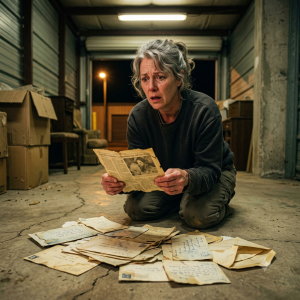
I found my own obituary in my mother’s storage unit.
I was 51 years old, very much alive, and holding a yellowed newspaper clipping that said I had died in 1987.
I was four years old in 1987.
—
My name is Eleanor Marsh. I grew up in Decatur, Illinois, in a house that smelled like Folger’s coffee and cedar closets. My mother, Ruthanne, raised me alone. She never talked about my father. She never talked about much of anything, really — just worked her shifts at the hospital laundry, came home tired, loved me quiet.
She passed in March. Pancreatic cancer. Six weeks from diagnosis to gone.
I didn’t have time to grieve. I had a storage unit to empty.
—
The unit was in one of those orange-doored places off Route 51. Climate-controlled, she’d been paying for it for thirty years. I didn’t even know it existed until the lawyer handed me the key.
Row after row of plastic totes. Christmas ornaments. Old tax returns. A Singer sewing machine I remembered from her bedroom.
And then, near the back, a cardboard box sealed with so much packing tape it looked almost frantic.
Like someone had needed it to stay closed.
Inside: a stack of envelopes, bound in a rubber band that crumbled the moment I touched it.
Thirty-two envelopes.
Birthday cards, I realized. All addressed in the same handwriting — careful, looping cursive — to *my daughter Eleanor.*
Every single one postmarked on April 14th.
My birthday.
From 1987.
To 2019.
None of them had ever been opened.
—
I stood there in that storage unit for a long time.
The handwriting on those envelopes was not my mother’s handwriting.
—
I opened the oldest one first. The card inside was water-stained, the ink bled soft at the edges, but I could still read it.
*Eleanor — you are four today. I think about you every single morning. I hope she is good to you. I hope you never feel the missing. All my love, always — M.*
My hands were shaking.
I opened the one from 1988.
*Eleanor — you are five. I baked a cake today, yellow with chocolate frosting, the kind you always asked for. But you weren’t here to eat it. Someday, my darling. Someday I’ll explain everything.*
I sat down on the concrete floor of that storage unit, right there between the Christmas ornaments and the Singer sewing machine, and I read thirty-two birthday cards from a woman I had never met.
She watched me grow up in her mind. She counted every year.
She never stopped.
And tucked inside the card from 1991 — my eighth birthday — was something else.
A newspaper clipping.
**ELEANOR RUTH CALLOWAY, age 4, of Springfield. Preceded in death by her father, James Calloway. Survived by her mother, Margaret Calloway, and her sister, Diane.**
Eleanor Ruth Calloway.
Not Eleanor Marsh.
A different Eleanor. A dead Eleanor.
But the birthday. April 14th, 1983.
*My* birthday.
—
I Googled the name Margaret Calloway that night until midnight. I found a Margaret Anne Calloway who had lived in Springfield, moved to Bloomington sometime in the nineties, and died in 2019.
The cards had stopped in 2019.
I found a Diane Calloway, age 48, living in Normal, Illinois.
I had a sister.
I had a *sister* and my mother — Ruthanne, my Folger’s-coffee, cedar-closet mother — had known her entire life and never said a single word.
—
I almost let it go.
I am not a woman who chases things. I’m a housekeeper. I clean other people’s homes three days a week, have for years. I find their lost earrings, fold their good towels, and I go home. I am quiet, like Ruthanne made me.
But I couldn’t let this go.
So I pulled out every single envelope again and I looked — really looked — at the return address.
All thirty-two.
The same address, every year.
And I stopped breathing.
Because I knew that address.
I had been walking through that front door every Tuesday and Friday for three years.
I had been cleaning that house.
I had been vacuuming those floors, washing those windows, straightening those picture frames — picture frames with photographs I had never looked at closely enough —
The woman who lived there had never once told me her last name.
I had never thought to ask.
—
I drove there the next morning.
It was a Tuesday anyway. That was my excuse, the one I told myself in the car. I was just going to work. Just doing my job.
I had the key on my ring, same as always. The little brass one with the green rubber cap that she’d pressed into my hand the first day, three years ago, saying she didn’t like to come to the door because of her hip.
I sat in my car in front of that house for twenty minutes.
It was a small ranch house on a street full of small ranch houses, the kind of neighborhood where somebody always has a wind chime and somebody else always has too many garden gnomes. She had roses out front that she tended herself despite the hip, despite being seventy-something, down on her knees in the dirt every May. I’d watched her through the window.
Her name, as far as I knew it, was Diane.
I had never thought about that.
I got out of the car.
—
She answered the door before I could get my key in the lock. She must have seen me sitting out there. She was a small woman, Diane, with silver hair cut practical and short, and she had on the same kind of cardigan she always had on, the kind that looks like it’s been washed three hundred times and become softer for it.
She looked at my face and something shifted in hers.
Not surprise. Something older than surprise.
Something that had been waiting a very long time and had just heard a knock.
“Eleanor,” she said.
Not as a question.
“Come inside.”
—
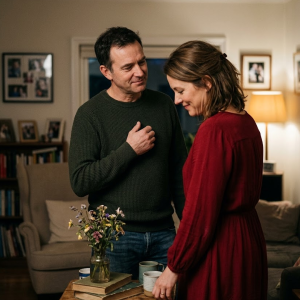
We sat at her kitchen table. She made coffee without asking if I wanted any, and I sat in the chair I always moved back from the wall when I cleaned and never thought to wonder why it was always pushed against the wall to begin with.
She put a mug in front of me and she sat down and she folded her hands on the table like a woman about to give a full accounting of herself.
“How much do you know?” she asked.
I told her about the storage unit. The box. The thirty-two envelopes. I put the obituary on the table between us, that yellowed clipping with my birthday and a dead girl’s name.
She looked at it for a long time.
“My sister cut that out,” she said. “She kept it because she needed to. She needed something to bury.”
—
Here is what Diane told me, there at that kitchen table, over two cups of coffee that went cold before either of us finished them.
My mother — my birth mother — was Margaret Calloway. Maggie. She was twenty-two years old and newly widowed when I was born. James Calloway, my father, had died in a car accident four months before my birth, and Maggie had been left with a toddler — Diane, who was three — and a baby coming, and no money and no family close by and a grief so big she could barely get off the floor some days.
Ruthanne Marsh was her hospital roommate when I was born. They were both at St. John’s in Springfield, Maggie delivering me, Ruthanne recovering from an appendectomy in the next bed. This was 1983. They were there together for three days.
They talked the way you talk to strangers when you’re both scared and tired and the night is long.
Ruthanne had just turned thirty. She’d wanted children her whole life and had been told, that very week, by the doctor who performed her surgery, that she would likely never have them. A complication. Scar tissue. She had not yet told anyone. She hadn’t even finished absorbing it herself.
And Maggie — Maggie was holding a baby she loved with everything she had and didn’t know how she was going to keep.
Diane stopped there for a moment. She pressed her lips together and looked out the window at her rose bushes.
“I was three,” she said. “I don’t remember any of this. I only know what Mama told me. And she told me everything, eventually. She needed someone to tell.”
—
The arrangement was not legal. That was the word Diane used, and she used it simply, without apology, because she was describing something that happened in 1983 between two women who were doing what they believed they had to do.
Ruthanne took me home.
Maggie told the county that her baby had died. A sympathetic doctor — Diane didn’t know his name, didn’t know how that had been managed, suspected money had changed hands, some small amount, didn’t want to speculate beyond that — signed something that shouldn’t have been signed.
Eleanor Ruth Calloway, age four weeks, died of complications following birth.
Eleanor Ruth Calloway became Eleanor Ann Marsh, and Ruthanne drove her home to Decatur, to a house that smelled like Folger’s coffee and cedar closets, and loved her quiet for fifty-one years.
—
“She never stopped thinking about you,” Diane said. “She mailed those cards every year. She never expected Ruthanne to give them to you. I don’t think she expected anything. I think she just needed to do it. Needed you to exist somewhere, even just in an envelope.”
“Did Ruthanne ever respond?” I asked.
Diane nodded. Once.
In 1985. A single photograph. No note. Just a picture of a two-year-old girl sitting on a kitchen floor, banging a wooden spoon on a pot. I was wearing a shirt with a strawberry on it.
Maggie had kept that photograph in her wallet until she died.
Diane went to her bedroom and she came back and she put it on the table.
I recognized the linoleum. I recognized the kitchen. I had mopped that floor a hundred times in Ruthanne’s house.
I looked at that little girl banging her spoon and I didn’t know whether to laugh or cry and I did a little of both, right there at that table, and Diane quietly pushed the box of tissues across to me and didn’t say anything, which was the exact right thing.
—
“How long have you known?” I asked. “About me. About who I was.”
“Mama told me when I was sixteen,” she said. “She said she needed me to know in case anything ever happened to her. In case you ever came looking.”
“She moved to Bloomington,” I said.
“To be closer to Decatur,” Diane said. “To be closer to you. She never approached you. She promised Ruthanne she never would. But she wanted to be near.”
I thought about that for a while.
A woman living thirty miles away, tending her distance like a garden, mailing birthday cards to an address she knew would hold them unopened. Just needing you to exist somewhere.
“And you,” I said. “You moved to Normal.”
Diane looked at me steadily. “Yes.”
“Three years ago.”
“Yes.”
I thought about the client referral app I used. The way Diane’s job listing had shown up. The way she’d interviewed me on the phone in that calm, careful way and asked only one strange question at the end — she’d asked my full name, first and middle, and when I said Eleanor Ann, there had been a pause on the line that I’d taken for a bad connection.
“You hired me on purpose,” I said.
“I needed to see you,” she said. “I needed to know you were all right. That you’d had a good life.” She looked down at her folded hands. “I wasn’t going to say anything. I’d made myself a promise. But then you just kept coming back every Tuesday and Friday, and I kept watching you, and you looked so much like her — so much like Mama — and I—”
She stopped.
“I’m sorry,” she said. “I know that was wrong of me. I know I should have said something immediately or not done it at all. I went back and forth for three years. Every time I was about to tell you, I’d think about what it would mean for you. Whether knowing would be a gift or a wreckage.”
She looked up at me.
“I decided I’d leave it to God or fate or whatever you want to call it. I figured if you were ever meant to know, something would happen to put it in your hands.”
She nodded toward the obituary clipping, still lying between us on the table.
“And something did.”
—
I went home that afternoon and I sat in my car in my own driveway for a long time.
I thought about Ruthanne. My mother. The woman who had taken a stranger’s baby home from a hospital room and raised her without ever once making her feel like anything other than completely, entirely wanted.
I thought about how she’d carried that storage unit key for thirty years. How she’d paid the monthly fee, kept those envelopes safe, and never told me but never destroyed them either. Like she’d been holding them in trust. Like she’d known that someday I would need them more than she needed to keep the secret.
I think that was her apology. Her way of leaving a door open that she’d never quite been able to open herself.
I think she loved me so much she was afraid of losing me to the truth, and I think she was wrong to make that choice, and I think I understand it completely, and I think I’ll be working out how I feel about it for the rest of my life.
That’s the thing nobody tells you about complicated grief. It doesn’t replace the simple grief. It just moves in alongside it.
—
Diane and I have had dinner seven times since that morning.
She showed me photographs of Maggie — a small woman with light eyes and a wide smile, someone who looked like she laughed easily. She looked like someone I would have liked.
She showed me photographs of my father, James Calloway, who died before I was born. He had a gap between his front teeth. So do I. Ruthanne used to say mine came from her side.
We are careful with each other, Diane and I. We are two people building something that doesn’t have a good word for it yet, from the rubble of decisions neither of us made. Some Tuesdays I still bring my supplies to her house, and she still pays me, because we both feel better with some structure to stand on while the rest of it finds its shape.
She gave me the photograph of the little girl on the linoleum floor.
I have it in my wallet now.
—
I am not telling you this story for sympathy, though I appreciate every kind word. I am telling you this story because I spent fifty-one years being a quiet woman, a woman who didn’t chase things, a woman who folded other people’s good towels and went home.
And one afternoon in a storage unit off Route 51, I found out that two women who had never been anything to each other except strangers in a hospital room had loved me so hard and so desperately and so imperfectly that they’d bent the whole shape of my life.
I think about that.
I think about Maggie driving to the post office every April 14th for thirty-two years with a card addressed to a daughter she’d been told, by everyone, to forget.
I think about Ruthanne keeping that box sealed but never throwing it away.
They both chose me. In their own flawed, incomplete, very human ways, they both chose me every single year.
I was a woman who had one mother and no father and no family to speak of.
Now I have two mothers, both gone. A father I know by a gap in his teeth. A sister I’m learning how to have.
And thirty-two birthday cards that were written for me, that traveled all those years, that waited in the dark until I was ready to read them.
I read them all the time now.
*I hope you never feel the missing.*
I feel it. But I also feel everything else — which is more than I had before, and more than I knew to ask for.
That’s enough. That’s more than enough.
Happy birthday to me.