She’d been retired for three years, but old habits don’t die easy.
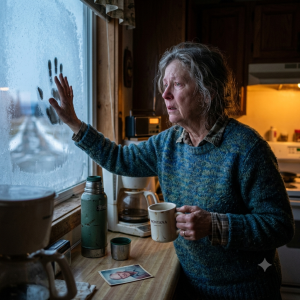
Every morning, Dorothy Kline still woke before the sun, still pulled on her fleece-lined vest, still stood at her kitchen window with her coffee and watched the world come to life on County Road 14.
That’s how she first saw him.
A boy. Maybe fifteen, maybe sixteen. Hard to tell from a distance.
He walked the same gravel road every single morning, appearing out of the dark like he’d been dropped there, heading east toward nothing in particular — just open fields and fence posts and the kind of Montana sky that makes you feel small in a good way.
What caught her eye wasn’t the boy himself.
It was the satchel.
Old. Brown leather, cracked at the corners, with a brass clasp that hung broken and dull in the morning light. Every other kid she’d ever seen carried a backpack slung loose off one shoulder like it weighed nothing.
Not this boy.
He held that satchel pressed tight against his chest with both arms, the way you’d hold something you were terrified of losing. Like it was breathing. Like it was the only thing keeping him warm.
He never set it down.
Not once.
Dorothy had spent thirty-one years delivering mail to people who never knew she noticed them — the widow who left a porch light on all day, the farmer who moved his truck six inches every morning so she could turn around easier. She noticed everything.
She noticed this boy.
By the third morning, she had her thermos filled and waiting on the fence post by six-fifteen.
She didn’t go outside. Didn’t want to spook him. Just watched from the window, breath fogging the glass.
He slowed when he saw it. Stopped. Looked at it for a long moment like it might be a trick.
Then he picked it up — careful, one-handed, the other arm still locked around that satchel — and he kept walking.
Dorothy smiled into her coffee cup.
The next morning, the thermos was back on the post. Clean. Empty.
That became their routine.
She’d leave the thermos. He’d take it, return it by evening. Sometimes she’d add a little something — a biscuit wrapped in foil, a napkin folded around two shortbread cookies. Those disappeared too.
She started looking for him the way she used to look for her regulars on the route. Watching the clock. Putting the thermos out a little earlier. Making sure the coffee was strong, the way she’d learned men in cold climates always wanted it.
She never spoke to him.
He never waved.
But one morning — three weeks in, maybe four — she saw him slow down at the post, and instead of just taking the thermos and walking, he stopped. Stood there. Turned his head toward the house.
She was sure he couldn’t see her behind the frost-edged window.
But he nodded.
Just once. Slow and deliberate.
Dorothy set down her cup and pressed her hand flat against the glass.
Winter deepened. The walks continued.
Every morning, same time, same road, that old leather satchel held tight to his chest like it was stitched to him. She started to wonder what was in it. School papers? Something valuable? Something fragile?
She told herself it wasn’t her business.
She told herself that every single day.
Then came the Tuesday morning in February when the thermos wasn’t gone by afternoon.
It sat on the post all day, cap still on, untouched.
Dorothy checked twice. Three times. Watched the road until the light went flat and gray.
She told herself he’d just had a different day. A ride from someone. A change in routine.
But her stomach said otherwise.
She went out and got the thermos just before dark, carried it inside, set it on the counter.
That’s when she felt it.
Something inside. Something that wasn’t coffee.
She unscrewed the cap slowly.
The coffee was stone cold — untouched, like he’d filled it back up himself — but there was something else. Folded tight. Tucked careful, like it had been placed there by hands that took their time.
A photograph.
She pulled it out.
Her knees went before her mind did.
It was her. Younger — decades younger, maybe thirty years — standing in front of a house she hadn’t thought about since the worst year of her life. A house she’d spent twenty years trying to forget. A house tied to a name she’d buried so deep she thought it was gone.
She was smiling in the photo. She didn’t remember ever smiling that year.
And written on the back, in handwriting she didn’t recognize, were six words.
Six words that made the whole room tilt.
She knew you’d be kind.
Dorothy stood at her kitchen counter for a long time after that. Long enough for the cold to seep in under the back door. Long enough for the last light to leave the window entirely.
She knew you’d be kind.
The house in the photograph was the Alderman house. On Belltower Road, outside a town called Creston that barely existed anymore — two hundred miles east of where she stood now. She had lived in that house for eleven months in 1987. She was twenty-nine years old. She had been newly divorced, broke in the way that isn’t just about money, and she had taken a job with a rural postal route because it was the only thing available and because driving meant she didn’t have to sit still with herself.
The person who had gotten her that job was a woman named Ruth Vanek.
Ruth had been sixty-something, wide-faced, slow-moving, the kind of woman who filled a room without trying. She ran the small post office out of a converted garage and she had taken one look at Dorothy — showed up for an interview in a coat with a broken zipper, holding herself together with both arms the way a boy would one day hold a leather satchel — and said, you’ll do fine, honey. You’re a noticer. I can tell.
Ruth Vanek had died in 2004. Dorothy had seen the obituary in a forwarded email from an old coworker and she had sat with it quietly for an evening and then she had gone on with her life, the way you do.
Ruth had a daughter. Dorothy had never met her. She remembered hearing about her in passing — lived out of state, some kind of trouble, the vague way people talked about adult children they worried over.
She turned the photograph over again. Looked at her own young face.
She knew you’d be kind.
Past tense. Someone was quoting someone who was already gone.
She put the photograph on the counter, went to the window, looked out at the dark road.
In the morning, she put the thermos out early.
She put a note under it, folded once, her handwriting steady the way it always was when she made herself concentrate.
It said: I want to talk, if you’re willing. No pressure. I’ll be on the porch.
She put on her vest and she sat in the cold on her porch steps with her coffee and she waited.
He came at his usual time, materializing from the dark the way he always did. He slowed when he saw her. Stopped at the edge of the gravel, twenty feet out, the satchel against his chest.
She didn’t stand up. Didn’t want to loom.
She just said, “Your grandmother used to do the same thing for me. Leave something out. Let me get used to it.”
The boy went very still.
“Ruth Vanek,” Dorothy said. “She was the one who gave me my start. I don’t know if she ever told you about me. I don’t know if she told you much at all.”
He took one step forward. Then another. His boots crunched slow on the frozen gravel.
He had Ruth’s coloring, she realized. That same wide, honest face.
He sat down on the bottom porch step, not close, but not far. He set the satchel on his knees and kept both hands on it.
“She talked about you,” he said. His voice was lower than she’d expected. He was older up close — maybe seventeen. “Not by name. She just said there was a woman on her route once who needed looking after but wouldn’t have taken it if you’d called it that. So she just left coffee.”
Dorothy looked at her hands.
“She left me coffee,” she said. “Every morning for eleven months. On a fence post, so I could take it or leave it.” She paused. “I always took it.”
“I know,” the boy said.
They sat with that for a minute.
His name was Caleb. He was sixteen, as it turned out. His mother — Ruth’s daughter — was in a treatment facility in Billings, had been since October. He was staying with a family from his mother’s church, the Oldroyds, in a farmhouse two miles west. Good people, he said, but not his people. He walked every morning because walking was the only time he felt like himself.
“What’s in the satchel?” Dorothy asked. She hadn’t planned to ask it. It came out quiet, more wondering than nosy.
He looked down at it. His jaw moved like he was deciding something.
Then he unlatched the broken brass clasp and held it open toward her.
She leaned forward.
Inside, packed careful, wrapped in a dish towel that had bluebirds on it: a thermos — older than hers, dented, olive green, the kind that hadn’t been made since the eighties. A small Bible with a broken spine. Three envelopes held together with a rubber band. And a photograph, face down.
“She gave it to my mom,” he said. “Before she got sick. Mom gave it to me when she went to Billings. She said grandma would’ve wanted me to have it.” He closed the clasp again, latched it carefully. “I don’t really know what I’m supposed to do with it. I just — I don’t want to leave it anywhere.”
“No,” Dorothy said. “Of course you don’t.”
The sky was going pink at the far edge of the fields. One of those slow Montana dawns that builds like a held breath.
“Your grandmother was the first person in a long time who was kind to me when I hadn’t asked for it,” Dorothy said. “I never forgot it. I just didn’t know how to find my way back to it.”
She looked at him.
“I think maybe you did.”
Caleb didn’t say anything to that. But some of the tightness went out of his shoulders, just a little.
Dorothy stood up, and she went inside, and she came back out with a second mug, and she poured from her thermos into it, and she handed it to him.
He took it with one hand. The other stayed on the satchel.
They sat on the porch steps and drank their coffee while the sun came up over the open fields and the fence posts and the long flat stretch of County Road 14. Neither of them said much. They didn’t need to.
The Oldroyds, it turned out, were good people in the practical ways but not the talking ways, and Caleb had been eating a lot of cereal and keeping mostly to himself. Dorothy started leaving more than biscuits. Soup in a jar. Cornbread in foil. The boy had a decent appetite once someone was consistently feeding it.
He’d sit on her porch some mornings if he wasn’t in a hurry. She didn’t push. She’d learned that from Ruth.
In March, his mother called from Billings. She was doing well, the counselors were optimistic, she’d be home by May. Caleb told Dorothy about it standing at the fence post, the satchel on his arm, and his voice was carefully level the way teenage boys keep their voices when they’re feeling too much.
Dorothy said, “May’s not far.”
He nodded and walked on.
May came. His mother came home. Dorothy didn’t meet her right away — that felt like something that needed its own time. But one afternoon a car she didn’t recognize slowed at the end of her drive, and she watched from the window as a woman got out. Thin. Dark-haired. Standing the way people stand when the world has recently been very hard and they are trying to hold themselves upright in it.
She walked to the fence post. She put something on it.
Then she got back in the car and drove west.
Dorothy went out.
It was a jar of honey with a handwritten tag. The tag said: From Caleb’s bees. He didn’t tell me who you were but I figured it out. Thank you for the coffee.
Dorothy held the jar in both hands.
She stood there on the gravel road in the May afternoon — the fields gone green now, the sky enormous in the good way, the way that makes you feel small but not alone — and she thought about Ruth Vanek in a converted garage in Creston, two hundred miles and thirty-five years away, looking at a young woman with a broken coat zipper and seeing something worth tending.
She thought about how kindness doesn’t really end. It just keeps finding its next address.
She carried the honey inside and put it on the counter next to the photograph, which she’d framed in a simple wood frame from the hardware store in town. Her younger face, smiling in front of a house she’d once needed to forget, and didn’t anymore.
That fall, when Caleb’s mother was steady enough and Caleb was back in school and things were looking something close to ordinary, Dorothy went out and bought herself a new thermos. Bright red. Good quality.
She put it on the fence post on a cold October morning, filled, cap on.
Not for Caleb this time.
There was a new family on County Road 14. She’d noticed them the way she noticed everything. A woman who moved through her yard like she was trying not to take up too much space. A little girl who watched from the window.
Dorothy went back inside and stood at her kitchen window with her coffee and watched the road come to life.
She’d learned something, those eleven months in Creston, that she’d somehow let herself half-forget.
Noticing isn’t enough on its own.
You have to do something with what you see.