She built a library for the school that broke her.
And she made sure his name was nowhere on it.
—
Darla Hutchins was sixty-one years old, worth more than she’d ever tell a single soul in Millhaven, Tennessee, and she still kept that tarnished little hall pass clipped to her keychain.
Every day. Rain or shine. Right next to her car fob.
Her assistant had asked about it once. Just once.
Darla smiled and said, “It reminds me where I came from.”
She never said what it reminded her to do.
—
Most people in Millhaven remembered the graduation day incident the way you remember a car accident — in flashes. The smell of the gym floor wax. The creak of the bleachers. Two hundred folding chairs filled with parents holding disposable cameras.
And Darla Hutchins, seventeen years old, dragging a cardboard box down the main hallway while every single one of her classmates watched from their classroom doors.
Principal Gerald Hatch had announced it over the intercom. Something about “unresolved violations” and “school policy.” He used his slow, important voice — the one he reserved for things he wanted people to remember.
She remembered.
She remembered his hands clasped behind his back as she passed her. The way he didn’t look at her. The way the box had a broken corner and she had to keep tilting it so her yearbook wouldn’t fall out.
She remembered thinking: I will never be small again.
—
That was forty-four years ago.
Tonight, Darla stood in the parking lot of the Millhaven Elks Lodge in a navy blazer that cost more than Gerald Hatch’s first car, watching the handmade banner flutter above the entrance.
SURPRISE! 70 YEARS YOUNG, GERRY!
Yellow balloons. Crepe paper. A sheet cake from Publix.
His daughter Linda had called Darla personally to invite her. Linda didn’t know, of course. Nobody in that family knew. They just knew the name Darla Hutchins Foundation from the press release, the one that announced the new library wing at Millhaven High — fully funded, no strings attached.
Well.
Almost no strings.
Darla’s fingers found the keychain in her pocket. The little hall pass was cool against her thumb, the bulldog mascot worn almost smooth after four decades of handling.
Almost time, she thought.
—
The room went quiet the moment Gerald Hatch walked through the door.
Seventy years old. A little thicker through the middle. That same slow, deliberate walk — like every room owed him something for entering it.
For a moment, Darla couldn’t breathe.
Then someone yelled “SURPRISE!” and the whole lodge erupted, and Gerald Hatch laughed the big, booming laugh that had terrified eighth graders for thirty-one years, and Darla watched him work the room like he’d always worked every room — shaking hands, clapping shoulders, never quite looking anyone in the eye long enough to see them.
She waited.
She was good at waiting.
—
Linda tapped the microphone at eight-fifteen.
“We have a very special guest tonight,” Linda said, smiling out at the crowd. “As most of you know, the new library wing at Millhaven High just broke ground last month. And the woman responsible for that gift is here with us. The Darla Hutchins Foundation made it possible — and we just found out this week that Darla herself is a Millhaven girl. Dad, you actually knew her.”
Gerald Hatch looked up from his piece of sheet cake.
The smile was already forming. The gracious, humble smile he’d perfected sometime in his late fifties.
“Darla, will you say a few words?”
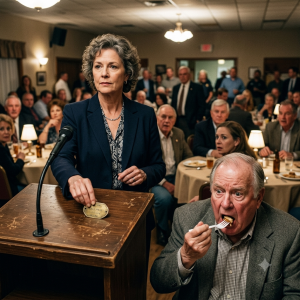
Darla walked to the podium.
She looked out at the room — Linda beaming, strangers lifting their glasses, old neighbors squinting to place her face.
And then she looked at Gerald Hatch.
He was still smiling, fork in hand, head tilting the way it did when he was trying to remember someone.
Then he remembered.
She watched it happen. Watched the color shift in his face. Watched his jaw make a small, almost invisible adjustment.
Darla reached into her blazer pocket.
She unclipped something small from her keychain.
Something tarnished and gold, with a bulldog stamped into the face of it.
She set it on the podium, directly in front of the microphone, so everyone in that room could see it.
Gerald Hatch’s smile went stiff as concrete.
And Darla leaned forward, and she began to speak.
—
“Most of you don’t know me,” she said. “I graduated from Millhaven High in 1981. Or I was supposed to.”
She kept her voice easy. Conversational. The same voice she used when she was about to close a deal that the other side didn’t know was already closed.
“I was third in my class. I’d been accepted to Vanderbilt on a partial academic scholarship. I had a 4.1 GPA, I was editor of the school paper, and I’d already written half my valedictorian speech in a spiral notebook I kept under my mattress.”
A few people in the crowd shifted. Someone set down their plastic cup.
“Two weeks before graduation, I ran an article in the school paper. Nothing inflammatory. Nothing indecent. It was about the fact that the girls’ athletic programs at Millhaven High received eleven percent of the funding that the boys’ programs received. I had the numbers. I’d gotten them through a public records request — which, at sixteen, I was very proud of.”
She paused.
“Principal Hatch killed the article. He had the entire print run of that issue confiscated from the distribution boxes and thrown in the dumpster behind the gym. All four hundred copies.”
The room had gone the particular kind of quiet where you can hear the ice shift in someone’s glass across the room.
“When I complained to the school board, he informed them that the issue had contained obscene material and violated school policy. There was no obscene material. The policy he cited didn’t exist in writing anywhere. I checked. I still have the documentation.”
She tapped the hall pass lightly with one finger. Just once.
“He called me into his office the morning of graduation. He told me I had an ‘unresolved disciplinary matter’ and that I would not be permitted to walk with my class. He handed me a cardboard box and had a staff member escort me to my locker.”
Someone in the back of the room said “Lord” under their breath.
“He announced it on the intercom,” Darla said. “While my classmates were already in their seats in the gym. So they’d all know. So every single person in that building would understand what happened to a girl who asked questions.”
She looked directly at Gerald Hatch now. He had set his fork down. He was very still.
“He gave me this hall pass as I left,” she said. “I don’t know why he did that. Maybe it was just habit — you couldn’t walk those halls without one. Maybe it was something else. But I kept it.”
She picked it up and held it where the light caught it.
“I kept it because I needed to remember exactly how that felt. Not so I could stay angry. Anger is expensive and I’ve never liked waste. I kept it so I would remember the specific feeling of being told that what I had to say didn’t matter. So I would never confuse that feeling with the truth.”
She set it back down.
“I lost the Vanderbilt scholarship because my enrollment was delayed. I ended up at UT Chattanooga on a Pell Grant and two part-time jobs. It took me an extra year to finish because I was working thirty hours a week. None of that stopped me. I want to be clear about that. I’m not here because my life was ruined. My life was not ruined.”
She smiled. It was a real smile. Warm, even.
“I’m here because last spring, my foundation’s education director brought me a report on library resources in rural Tennessee schools. And right there in the middle of it was Millhaven High, with a library that hadn’t been substantially updated since 1987. Seventeen hundred students. Fourteen computers. A periodicals collection that still included a 2009 Farmer’s Almanac.”
A small, uncomfortable laugh moved through the room.
“We fund a lot of libraries,” Darla said. “We’ve funded thirty-one of them in seven states. And we have a policy. I wrote the policy myself, and it’s one sentence long.”
She smoothed the front of her blazer.
“The library will be named for a student.”
A beat.
“Not a donor. Not an administrator. Not a board member or a principal or anyone whose name is already on a building somewhere. A student. Every library we build is named for a student who came from that school, whose potential was real, and whose story the institution failed to tell.”
She reached into her other jacket pocket and removed a folded piece of paper.
“The Millhaven High library wing will be called the Frances Delacroix Memorial Reading Room. Frances graduated from Millhaven in 1974. She wanted to be a literature teacher. She got pregnant at seventeen and the school discouraged her from returning to finish her degree. She got her GED at thirty-two, while raising three kids on her own, and she spent the last twenty years of her life as a reading volunteer at the Millhaven Public Library. She died in 2019. Her granddaughter Kezia is fourteen years old and attends Millhaven High right now.”
Darla looked out at the room until she found the young woman she’d spoken with earlier in the evening, the one Linda had introduced without knowing why Darla had asked specifically to meet her.
Kezia was sitting very straight in her chair, eyes wide and bright.
“Kezia,” Darla said, “your grandmother loved books her whole life, and she passed that on to you, and when you walk into that library next fall, her name is going to be the first thing you see.”
The girl’s chin wobbled once. Then she pressed her lips together and nodded, the way people do when they’re trying to hold something precious very carefully.
Half the room was crying.
The other half was trying not to.
—
Darla looked back at Gerald Hatch one more time.
He had aged considerably in the last eight minutes.
She didn’t say his name. Not once, the whole speech. She hadn’t planned to. There was no version of this moment where saying his name out loud in that room would have added anything worth adding.
She didn’t need him to apologize. She didn’t need him to crumble. She didn’t need anything from him at all, which was the whole point, which was the thing she had spent forty-four years making true.
She just needed him to know that she had been in that hallway, and she had kept walking, and she had never once stopped.
She picked up the hall pass.
She clipped it back onto her keychain.
“Thank you for having me tonight,” she said, and stepped away from the microphone.
—
The applause started slowly, the way applause does when people aren’t sure if they’re allowed, and then it didn’t stop for a long time.
Linda Hatch stood up first. Then the woman next to her. Then the back of the room.
Darla shook hands and accepted embraces from people she’d never met, and she let them, because this part — the part where strangers took something from a story and carried it home with them — this part she had learned to receive gracefully.
An older woman gripped her hand with both of hers and said, “I was in that hallway. I watched you walk out. I never forgot it and I never did a thing and I am so sorry.” Darla held her hand for a moment and said, “You’re here now,” and meant it.
At some point she became aware of Linda Hatch standing nearby, waiting.
Linda was perhaps forty, with her father’s jaw and her mother’s eyes, and she looked like someone who had just been handed a piece of information she was still figuring out where to put.
“I didn’t know,” Linda said.
“I know you didn’t.”
“I wouldn’t have — I mean, if I’d known who you were, what he did —”
“Linda.” Darla kept her voice kind. “You called me because you thought your father deserved to be celebrated. That impulse came from love. There’s nothing wrong with that impulse. The rest of it isn’t yours to carry.”
Linda looked at her father across the room. He was seated now. He hadn’t moved in a while.
“He should say something to you,” Linda said quietly.
“He doesn’t need to,” Darla said. “Not for my sake.”
She meant that too.
—
She left before the cake was finished.
The parking lot was cool and smelled like cut grass and a little bit of rain that had come through earlier in the evening, and Darla stood beside her car for a moment and looked up at the sky the way you do when something has finally been set down after a very long carry.
She thought about Frances Delacroix, who had shelved books at the public library for twenty years and probably never expected anyone to build anything in her name.
She thought about Kezia, fourteen years old, sitting very straight in her chair.
She thought about a cardboard box with a broken corner, and a hallway, and the particular quality of silence that fills a school building when everyone is watching but nobody is willing to say a word.
Then she got in her car.
She had an early flight to Nashville in the morning. There was a school board meeting in Dickson County she’d been asked to attend, something about a proposed budget cut to the reading intervention program, and she had some things she wanted to say about that.
She started the engine.
The hall pass caught the light from the dashboard — that little tarnished gold disk, the bulldog worn down to almost nothing from four decades of her thumb finding it in her pocket on every hard day, every long flight, every room she’d walked into that was supposed to make her feel like she didn’t belong there.
She’d thought, once or twice over the years, about throwing it away. About whether carrying it meant she was still back in that hallway in some way that wasn’t healthy.
But she’d decided no. She’d decided it wasn’t about the hallway at all anymore.
It was about the girl who kept walking.
Darla Hutchins pulled out of the Millhaven Elks Lodge parking lot and drove toward the interstate, and the yellow balloons in the windows got smaller in her rearview mirror, and then they were gone.