Eleven years ago, I put a cassette tape in my purse. Tonight, I finally pressed play.
Let me back up.
My name is Marlene Hutchins. Retired court stenographer. Thirty-one years of typing other people’s worst moments into the official record. Quiet woman. Patient woman. The kind of woman men like Gary stop noticing somewhere around year twelve of a marriage.
Gary noticed me long enough to take the lakehouse, though.
That house on Lake Cassel was mine before I ever met him. My grandmother left it to me. Cedar shake siding, a screened porch that faces the water, a kitchen with avocado-green tiles I always meant to update and never did because I secretly loved them.
Gary’s attorney called it a “marital asset.”
The judge agreed.
I sat in that courtroom and I listened to Gary’s lawyer explain — calmly, with a PowerPoint presentation — how the house had been “jointly maintained” for sixteen years, how Gary had made “substantial improvements,” how it would be a hardship to separate him from the property he loved.
I typed faster than I’d ever typed in my life, just to keep my hands busy.
I walked out with my dignity and a settlement that didn’t cover six months of rent.
And I walked out with something else, too.
A cassette tape. Battered. The kind they used to sell in drugstores, three for a dollar, back when people still recorded things on drugstore tapes. I’d written on the label myself, in black marker that was already going dry: DO NOT OPEN — DR. APPT. 2014.
It went into my purse that afternoon.
It stayed there.
Every purse I carried for eleven years, I moved that tape. Brown leather crossbody for everyday. Black clutch for church. The big canvas tote I take to the farmer’s market. That tape went everywhere I went, tucked in the inside zipper pocket, next to my emergency Tylenol and my AAA card.
People saw it sometimes. My daughter Linda asked once what it was.
“Insurance,” I told her.
She let it go. Linda knows when her mother has made up her mind.
—
Last Saturday, I got an invitation I wasn’t supposed to receive.
Gary is retiring from the commercial real estate firm where he’s been a partner for twenty-two years. His new wife — Pamela, fifty-four, former dental hygienist, married Gary approximately fourteen months after our divorce was finalized — is throwing him a party.
At the lakehouse.
My lakehouse.
The invitation came because Gary’s assistant, a sweet young woman named Becca who has been working for him for only eight months and doesn’t know our history, pulled from the firm’s old contact database. I was still in there under his last name.
I RSVP’d yes before I finished reading.
I wore my good navy dress, the one with the white buttons. Drove the forty minutes to Lake Cassel with the windows down, because it was a beautiful evening and I wanted to feel it.
I checked my purse at the first stoplight. Tape still there.
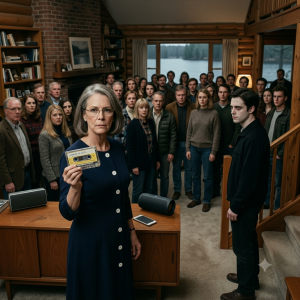
The house was exactly as I remembered it, except for a new dock and some landscaping I didn’t recognize. String lights across the porch. A catering van in the driveway. Sixty, maybe seventy people holding wine glasses and talking too loud, the way people do when they’re performing having a good time.
Gary saw me from across the porch.
I watched the color leave his face like someone had pulled a drain plug.
“Marlene.” He crossed the porch in twelve steps. I counted. Old habit. “How did you—”
“Becca sent me an invitation,” I said pleasantly. “I’d hate to be rude.”
He was trying to figure out what to do when Pamela appeared at his elbow. She was gracious, I’ll give her that. She shook my hand. She offered me a glass of white wine. She smiled the careful smile of a woman who has heard Gary’s version of this story and isn’t entirely sure she believed it.
I accepted the wine.
I stayed for an hour and a half. I ate a stuffed mushroom. I watched Gary give his retirement toast and talk about building a legacy and spoke directly to his new wife when he mentioned how much he loved this house, this beautiful house, this house that meant everything to him.
And then the speeches were done, and the music came back up, and I opened my purse.
My fingers found the tape the way they always do.
I walked to the little Bluetooth speaker on the credenza — the one playing soft jazz — and I did something I learned how to do from my eleven-year-old grandson three Christmases ago.
I connected my phone.
I pressed play on the file I digitized six months ago, just in case. Thirty-one years as a court stenographer teaches you to prepare.
The music stopped.
Gary’s voice came out of that speaker like a ghost walking back into the room.
The room went dead silent.
And then his new wife’s face did something Marlene had never expected to see.
She smiled.
—
Not a polite smile. Not the careful, managed one she’d been wearing all evening like a name tag.
A real one. The kind that starts at the corners of the eyes and arrives at the mouth a half-second later.
I want to tell you what was on that tape. I need you to understand what it meant that she smiled.
In the spring of 2014, Gary and I had what he liked to call a “financial planning conversation” and what I would call an ambush. He sat me down at the kitchen table — this kitchen, the one with the avocado tiles — and explained that he’d been quietly restructuring things. Moving money. Reclassifying the house’s renovation costs as personal loans to the marriage, loans that now, conveniently, offset my equity.
He’d been planning the divorce for two years before he asked for it.
I know because he told someone on the phone that exact thing on a Tuesday afternoon in March, when he thought I was at my book club and I was not.
I was in the bedroom with a chest cold and a baby monitor we’d never gotten around to throwing away, because Gary had put the base unit on his desk years earlier to listen for our daughter during naps and had simply never unplugged it.
I was lying under the covers with a cup of tea getting cold on the nightstand, and Gary’s voice came through that monitor as clearly as if he were in the room with me.
He was talking to his attorney. Laying out the timeline. The improvements he’d been staging. The paper trail he’d been building. He used the word “meticulous.” He sounded proud of himself.
I got up, found a blank cassette, and recorded nineteen minutes of that conversation off the baby monitor.
Then I went back to bed and finished my tea.
I didn’t use it at the divorce. My own attorney told me it was unlikely to be admissible, that it could look vindictive, that I should take the settlement and move forward. I was so hollowed out by that point that I listened.
But I kept the tape.
And what was playing now, through that little Bluetooth speaker on Gary’s credenza at Gary’s retirement party in Gary’s house, was Gary’s voice. Calm and precise and proud. Explaining to his lawyer how he had spent twenty-four months engineering a situation so that a woman who had never done a thing to harm him would walk away from her grandmother’s house with nothing.
Specific. Detailed. Damning in the way that only truly meticulous people can be damning.
It ran for forty-five seconds before Gary lunged for the speaker.
He didn’t make it in time.
Because Pamela stepped in front of him.
Not aggressively. She didn’t raise her hands. She just took one step sideways, the way you’d step in front of a child reaching for something hot, and Gary stopped. I think he stopped because some part of him recognized that whatever was happening, making a scene would only make it worse.
The recording played another thirty seconds.
Then I stopped it myself.
The room was so quiet I could hear the lake.
I looked at Gary. He had gone a color I don’t have a name for, somewhere between gray and the kind of red that lives underneath gray. His mouth was moving without producing anything useful.
I looked at Pamela.
“I’m not trying to blow up your evening,” I said. “I came here to let this go.”
She looked at me for a long moment. She had good eyes. Clear.
“You’ve had that a long time,” she said. It wasn’t really a question.
“Eleven years.”
She nodded slowly, the way someone nods when a thing they suspected has just been confirmed. “He told me you were difficult,” she said. “During the divorce. He said you made things very hard.”
“I typed fast and took the settlement,” I said. “That’s all I did.”
She nodded again. Then she looked at her husband, and I watched something shift in her face — not crumble, not collapse, just shift, the way a foundation shifts when the ground underneath it turns out to be something other than what the inspector said.
“Pamela,” Gary started.
“Not right now,” she said. Very quietly. Very finally.
She turned back to me, and she did something that I still haven’t entirely processed.
She thanked me.
“I’ve been asking him for three years to put the house in both our names,” she said. Her voice didn’t shake. I respected that enormously. “He always had a reason why it wasn’t the right time.”
I hadn’t known that. I hadn’t come there to expose Gary to his wife. I had come, honestly, because some stubborn old grief in me needed to stand in that house one more time and make it mean something other than loss. I’d carried that tape so long it had become part of my weight, and I needed to put it down in the same place I’d picked it up.
But I looked at Pamela and understood that she had needed to hear it. That in some way, she’d been waiting for something like this the way I’d been waiting to play it.
I finished my wine. I said goodnight to a few people who were still standing close enough to be polite about it. I found my purse.
Gary was standing near the door. He looked diminished in a way I hadn’t expected to find satisfying and then found I didn’t, actually. Diminishment isn’t the same as accountability. I’d waited eleven years thinking I wanted the first one, and standing there I realized I’d always needed the second, and nothing about tonight would give me that. That was between him and whatever he could bring himself to face.
“The house was mine,” I said, because I wanted it said plainly, once, in this house, out loud.
He didn’t answer.
That was fine. I wasn’t asking.
I walked out to my car. The string lights were still on behind me. The lake was doing what the lake always does, which is sit there looking beautiful and indifferent and eternal, the way water does, the way my grandmother loved it.
I sat in the parking area for a minute with the windows down.
Then I drove home.
—
My daughter Linda called me Sunday morning. Someone at the party had called someone who knew her, because that is how things travel.
“Mom,” she said, “what did you do?”
“I let something go,” I said.
She was quiet for a second. “Are you okay?”
I thought about it honestly, which is what Linda deserves.
“I think I might be better than okay,” I said. “I think I might be getting there.”
She came over that afternoon and we sat on my little apartment porch and I told her the whole thing, from the baby monitor to the Bluetooth speaker, and she cried a little and then laughed harder than I’ve heard her laugh in years.
“You waited eleven years,” she kept saying.
“Thirty-one years as a court stenographer,” I told her. “Patience is a professional skill.”
—
I don’t know what’s going to happen with Pamela and Gary. That isn’t my story to know.
I do know that the inside zipper pocket of my purse is empty for the first time in eleven years. I keep reaching for the tape and finding nothing there, and every time I do, I feel it: some lightness I’d forgotten was possible.
My grandmother used to say the lake doesn’t care who owns the deed.
I stood on the shore of it one more time on my way out of Gary’s party, just for thirty seconds, just to feel the air off the water.
It smelled exactly like it always did.
Like cedar. Like summer. Like mine.