She walked into that meeting wearing a name tag.
Not a fancy lanyard. Not a printed sticker. A cracked, chipped little piece of plastic — the kind diners used to order in bulk from a catalog, the kind that clips to a polyester uniform and means you matter enough to have a name.
The kind Patrice Monroe hadn’t seen in twenty-three years.
—
Let me back up.
Because this story starts on Christmas Eve, 1999, in a diner called Hattie’s Home Plate in Clover Fork, Kentucky — the kind of place that had the same pie rotating under the same glass dome since 1971, where the coffee was never quite hot enough but nobody complained because Patrice always refilled it before you noticed.
She’d worked there eleven years.
Eleven years of double shifts. Eleven years of learning which regulars took Sweet’N Low, which ones needed the booth by the window, which ones just needed someone to ask how their knee was holding up.
Eleven years of that little plastic name tag clipped above her heart.
*Patrice.*
No last name. Diners don’t do last names. But everyone in Clover Fork knew hers.
—
She was carrying a tray of hot chocolates to the kids’ table — the Delaney family, four kids under eight, Santa hats all crooked — when Gerald Briggs called her name from across the dining room.
Not *hey, Patrice, can I see you a minute.*
Across the room. Full voice. Packed house.
“Monroe. You’re done. Hand over the name tag.”
The whole diner went quiet.
The kind of quiet where you can hear a coffee cup settle.
She stood there with that tray in her hands, in front of the Delaney kids, in front of every regular she’d ever refilled and fussed over and remembered — and she unclipped that little chipped tag and placed it on Gerald’s palm without a single word.
She was too dignified to cry in front of them.
She waited until she got to her car.
—
Gerald sold Hattie’s Home Plate six months later. The new owner raised the prices, changed the menu, never learned anyone’s name.
The place limped along for two decades before it finally closed last spring.
Then word got out: some silent investment group had bought the building and the lot. Demolition scheduled. Condos going up.
Clover Fork went *sideways.*
Hattie’s wasn’t just a diner. It was where people got engaged, where families ate after funerals, where kids got their first job. The community started a petition. The county commissioner called a meeting.
And Patrice — who’d spent twenty-three years building her own catering business, who’d fed half the county’s weddings and church suppers and graduation parties from a kitchen she owned — Patrice showed up.
She sat in the third row. Folded hands. Good posture.
She noticed the folding table at the front of the room had a small item sitting near the edge.
She couldn’t quite make it out from where she was sitting.
—
The commissioner read through the agenda. Talked about zoning variances. Talked about the historical register application. Talked about the number of signatures on the petition.
Then he said the silent investor had agreed to attend in person.
The side door opened.
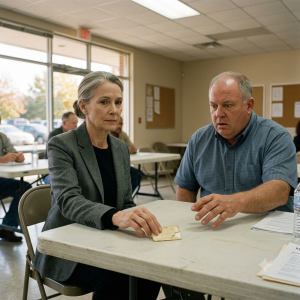
A woman walked in.
She was about sixty. Silver hair pulled back neat. Good blazer — the kind you buy when you finally stop buying cheap ones. She moved like someone who had spent a long time learning how not to rush.
She sat down at the folding table at the front of the room.
And that’s when Patrice saw it.
Clipped to the woman’s lapel, right above her heart.
A chipped piece of plastic.
—
The room didn’t notice. People were whispering, pulling up the investor’s name on their phones, wondering who she was and where the money came from and what it meant for the building.
But Patrice couldn’t hear any of it.
Her eyes were fixed on that little tag.
She knew the exact chip on the lower right corner. She knew the slightly faded font. She had clipped and unclipped that tag ten thousand times without thinking, the way you stop noticing something once it becomes part of who you are.
She hadn’t seen it in twenty-three years.
But she would know it anywhere.
—
Gerald Briggs was sitting two rows ahead of her.
He hadn’t aged well. He was heavier now, grayer, and he was squinting at the woman at the front table like he was trying to place her.
The woman reached into her jacket pocket.
She set something on the table.
She slid it slowly — deliberately — across the wood.
Directly toward Gerald.
And in a room full of people trying to save a diner, everything went so still you could have heard a coffee cup settle.
“I believe this belongs to the building’s new owner,” she said.
And she looked right at him.
“And I’ve been waiting twenty-three years to return it to myself.”
—
What she had slid across the table was a key.
An old brass one, dull from years in someone’s junk drawer, with a strip of masking tape around the bow. Written on the tape in faded blue ballpoint: *H.H.P. — back door.*
Gerald Briggs stared at it.
Then he looked up at the woman.
And you could see the exact moment he recognized her, because the color left his face in one clean pull, the way a tablecloth goes when someone yanks it from underneath the dishes.
“Donna,” he said. It came out barely above a whisper.
“Hello, Gerald.”
—
Donna Briggs.
His younger sister.
The one who had waited tables at Hattie’s Home Plate for three years before Gerald bought the place. The one who had trained half the staff, including — and the whole room was about to learn this — including Patrice Monroe.
The one Gerald had pushed out of the business in 1998, one year before he fired Patrice, when he decided a diner was no place for a woman to have an ownership stake, even if that woman was his own blood.
Donna had left Clover Fork with a settlement check that was an insult and a trunk full of bitterness.
She hadn’t come back. Not once. Not for their mother’s funeral, not for Christmas, not for anything that would require her to set foot in that county and see that building still standing with his decisions inside it.
—
She’d gone to Lexington first. Worked restaurant management. Learned the business from every angle Gerald had never bothered to understand. Watched trends, watched markets, saved carefully and invested smarter.
By 2010 she had a portfolio. By 2015 she had a reputation, quiet and deliberate, for buying distressed properties in small towns that people had given up on and turning them into something worth keeping.
She had followed the story of Hattie’s Home Plate from a distance for years. She knew when it sold. She knew when the menus changed. She knew when it started to fail.
When it closed last spring, she’d already had her attorney on the phone before the week was out.
—
She told all of this to the room slowly, the way someone speaks when they’ve rehearsed a thing so many times it’s finally stopped feeling rehearsed.
The commissioner had stopped shuffling his papers. The petition organizers had forgotten their talking points. Gerald Briggs had not moved.
“I didn’t buy this building to tear it down,” Donna said. “I never had any intention of tearing it down. The demolition filing was a negotiating tactic, and I apologize to this community for the anxiety it caused. That was a cold way to do business, and I’ve spent some time sitting with that.”
She paused.
“I bought it because it should never have left our family in the first place.”
She looked at Gerald for one more moment, long enough for everyone in the room to understand exactly what she meant. Then she looked away from him, deliberately, the way you close a chapter.
—
That’s when Patrice stood up.
She didn’t plan to. She told me later she genuinely didn’t know she was going to do it until she was already on her feet.
“Excuse me,” she said.
Donna looked at her. And something moved across her face — recognition, or something close to it.
“I’m Patrice Monroe. I worked at Hattie’s for eleven years. I don’t know if you remember me. You were gone before I started.”
“I know who you are,” Donna said. “Gerald fired you on Christmas Eve.”
The room murmured.
“He told me about it,” Donna continued, “years later, when he was trying to explain why the place went downhill. He blamed the staff. He said the problem was people who thought a diner job was a career.” She let that sit a moment. “I told him the problem was him.”
—
Patrice sat back down.
She didn’t say anything else. She didn’t have to.
But Donna wasn’t finished.
She reached up and unclipped the name tag from her lapel.
She held it out, and she looked directly at Patrice.
“My brother kept this,” she said. “I found it in a shoebox when I was cleaning out his storage unit last year — he let me do that much, at least. He kept it like a trophy, I think. Or maybe he kept it because somewhere in him he knew what he’d done.” She shook her head once, small and controlled. “Either way. It doesn’t belong in a shoebox. And it doesn’t belong with me.”
The room was absolutely still.
“I’d like to offer you something else, though. If you’re willing to hear it.”
—
What Donna proposed, right there in that folding-chair meeting in the Clover Fork municipal building, was this:
She would restore Hattie’s Home Plate. The original countertop if it could be sourced. The pie dome, if one still existed anywhere. The booths reupholstered in the same red vinyl. She’d already had a preservationist walk the building, and the bones were good.
But she didn’t want to run it.
She was sixty years old. She’d spent twenty-three years running things. She wanted to own a thing she was proud of and then watch someone else make it worth owning.
She was looking for an operator. Someone who understood that place the way it was meant to be understood. Someone who knew the regulars needed Sweet’N Low without being asked, and that the booth by the window was a specific need and not a preference, and that the coffee had to be refilled before anyone noticed it had cooled.
She looked at Patrice when she said all of this.
She didn’t say her name. She didn’t have to do that either.
—
Patrice told me she went home that night and didn’t sleep.
She sat at her kitchen table with a yellow legal pad and she wrote down every reason to say no. The catering business she’d built. The clients who counted on her. The risk of a brick-and-mortar at her age, in an economy that had already swallowed Hattie’s once.
She wrote three pages of reasons.
Then she flipped to a fresh page and wrote the reasons to say yes.
She wrote one sentence.
*I have been making other people’s events feel like home for twenty-three years and I am ready to have a home of my own.*
She underlined it twice.
Then she went to bed.
—
The deal took four months to finalize. Donna’s attorneys, Patrice’s attorney — a woman named Brenda she’d met through a church suppers contract who turned out to be ferociously good — and a lot of back and forth about lease terms and renovation timelines and the question of the pie dome, which was eventually located in the basement of a diner supply liquidator in Bowling Green and was, in fact, the same style and era, possibly the actual one.
Nobody could prove it.
But nobody could prove it wasn’t.
—
Gerald Briggs showed up at the reopening.
Nobody invited him. He just appeared, the way people do when they know they’re not welcome and they’re too proud to stay away.
He stood near the door for about ten minutes. Ordered a coffee he didn’t drink. Left a five dollar bill on the counter, which was twice the price and probably meant as some kind of gesture. No one acknowledged it either way.
Patrice saw him come in.
She didn’t say anything to him. She didn’t go cold, didn’t square her shoulders, didn’t do any of the things you do when someone has hurt you and you want them to see that you survived it.
She just kept moving through the room. Refilling. Remembering.
That was the whole answer, she said later. The refilling and the remembering. That was always the whole answer.
—
The name tag is framed now, behind the counter, right next to the register.
Not the original — that one Patrice keeps at home, in a small wooden box her granddaughter painted for her. What’s in the frame is a new one, same style, same catalog, same plastic. Same chip on the lower right corner, put there deliberately by Patrice herself with the corner of her car key.
It reads: *Patrice.*
Below it, smaller, in a font the frame shop had to special-order: *Owner.*
—
The Delaney kids came in the first week. They’re adults now, with kids of their own — the oldest has a daughter who just turned seven, which is how old she was the Christmas Eve her mother hushed her and told her something sad was happening and she didn’t understand what or why.
She understood now.
She ordered the hot chocolate.
Patrice brought four of them to the table without being asked, because there were four kids, and because some things you just know.
The oldest Delaney, the seven-year-old who grew up, started to say something. A thank you, or maybe an apology on behalf of a night none of them caused. She got about two words in before Patrice waved her hand in the small, specific way that means *we are not going backward.*
“Coffee?” Patrice said.
And just like that, they were going forward.
—
Donna stops in when she’s passing through, which is a few times a year. She always sits at the counter. She always orders the pie. She and Patrice have the kind of friendship that doesn’t require much explanation — built on a shared understanding of what it costs to build something and what it costs to have it taken and what it finally costs, the good kind of costs, to get it back.
They don’t talk about Gerald.
There’s nothing left to say about Gerald.
—
The last time I was in, the pie was still rotating under the glass dome, the coffee was almost hot enough, and a woman at the back booth was telling her daughter about the time she got engaged at that exact table in 1987, right before the food came, and she’d been so nervous she forgot to order and had to ask the server to remind her what she’d wanted.
The daughter laughed.
The mother laughed.
And Patrice, passing by with a fresh pot, smiled at both of them in the way of someone who has heard ten thousand stories in this room and still finds every single one of them worth hearing.
She was wearing her name tag.
*Patrice. Owner.*
The chip on the lower right corner caught the light.
Some things, once they belong to you, have a way of finding their way home.