Dale Mercer drove past the turnoff three times before he finally pulled over.
He’d retired from the Cascade County postal service eleven days ago. The cake had been chocolate. The card had been signed by people he’d worked with for thirty-two years. His supervisor, Brenda, had cried a little. He hadn’t expected that.
He hadn’t expected any of this, either.
The Hollis farmhouse had been off his route since 1994. Road washed out, no forwarding address, family just… gone one winter. He’d been told to stop delivery. So he had. That’s what you did. You followed the route.
Except today, for no reason he could name, he’d turned down Old Larimer Road anyway.
Maybe it was the October light. Maybe it was thirty-two years of muscle memory finally running loose now that nobody was keeping score. Maybe it was the letter.
He’d found it that morning in the bottom drawer of his mail satchel — the old canvas one he’d never turned in, the one that still smelled like pine sap and motor oil. A single envelope, cream-colored, gone stiff with age. A 1994 postmark from Billings. Addressed in careful block letters to a Margaret Hollis, Rural Route 4.
He had no memory of it. No idea how it had lived in that satchel for thirty years without him noticing. That wasn’t possible.
He’d turned it over in his hands at his kitchen table for a long time before driving out here.
Now he was parked at the end of a gravel driveway that, according to every county record he knew of, led to an abandoned property.
The lights in the farmhouse were on.
He sat in his truck for a full minute. A man can talk himself out of anything if he gives himself long enough. Dale had learned that the hard way. So he grabbed the letter, got out, and walked to the porch before his better judgment caught up with him.
He knocked.
The woman who answered was maybe seventy. Silver hair pinned back. Apron dusted with flour. She had the look of someone who’d lived alone long enough to be comfortable with it, but not long enough to be closed off. There was something careful in her eyes when she saw him. Something that flickered.
“Can I help you?”
Dale held up the envelope. “I know this is going to sound strange. I’m — I was — a mail carrier. This was in my bag this morning. It’s addressed to a Margaret Hollis.”
She went very still.
“That’s me,” she said quietly.
He’d half-expected that. He hadn’t expected what came next.
She reached into the front pocket of her apron and pulled out an envelope of her own.
Same cream color. Same stiff, aged paper.
Same 1994 postmark.
“I found this in the mailbox this morning,” she said. “Which is strange, because nobody knows I’m back here. I only came back to the property two weeks ago. First time since we left.”
She held it out so he could see the front.
His name was on it. Dale Mercer. His route number. His old station address in Great Falls.
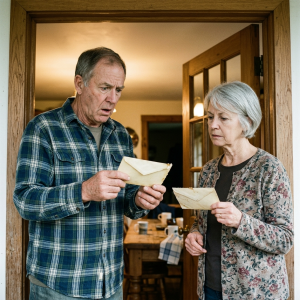
They stood there on either side of the threshold, each holding a letter that shouldn’t exist, addressed to the other person, postmarked from a year they’d both apparently forgotten.
“I haven’t opened mine yet,” she said. “Have you opened yours?”
“No,” he said. And then, because it was true: “I was afraid to.”
Something passed across her face that he recognized. The particular courage of a person who has decided that knowing, even if it hurts, is better than wondering for one more day.
“Come in,” she said. “I just made coffee.”
He sat at her kitchen table — oak, scarred with years, honest — while she poured two mugs without asking how he took it. Black. He didn’t correct her. It felt like the right way to drink it today.
She set his mug down and then, slowly, turned the envelope over in her hands. The one addressed to her. She was looking at the back of it.
Her face changed.
“Mr. Mercer.”
Her voice had gone careful. The way voices go when a person is trying not to tip something over.
“Did you write something on the back of this?”
He looked. There was handwriting there. His handwriting — he knew it the way you know your own face, the particular slope of the M, the way he always crossed his sevens.
Four words.
He leaned closer.
He had absolutely no memory of ever writing them.
The mug of coffee sat between them, going warm, then cool.
Outside, the October wind moved through the Montana grass, and somewhere on the property, a screen door swung on its hinges — open, then shut, then open again, like it was waiting for someone to decide.
The four words were: Don’t let her leave.
He read them twice. Three times. The handwriting was unquestionably his — not just the letterforms, but the pressure, the slight rightward lean he’d had since eighth grade, the way the D came down in a single decisive stroke. He’d written those words. He had no memory of writing them, but some part of him, some animal part that lived below memory, did not feel surprised.
That scared him more than the words themselves.
Margaret was watching him.
“Do you know what it means?” she asked.
“No,” he said. Then he said, “Maybe. I don’t know.” He set the envelope down carefully on the table, as though it might startle. “Can I ask you something first?”
She nodded.
“Why did you come back? After thirty years. Why now?”
She wrapped both hands around her mug. Outside, the screen door swung again. She didn’t look toward it.
“My husband passed in the spring,” she said. “Gerald. We’d been in Billings since we left here. Thirty years in the same house on the same street and I never once stopped thinking about this place.” She paused. “Gerald knew that. He wasn’t — it wasn’t a sore subject between us. He just knew I had unfinished business here and he used to say, someday you’ll go back and close the door on it proper. He said that right up until the end.”
Dale nodded slowly. He understood that kind of unfinished business. He’d had some of his own, once.
“Why did your family leave?” he asked. “In ’94. If you don’t mind.”
She didn’t answer right away. She looked at the envelope on the table. Her envelope, the one addressed to her, the one she still hadn’t opened.
“My son,” she said finally. “Thomas. He was nineteen. He got into some trouble — not bad trouble, not the kind that follows you, just young-man trouble — and Gerald thought a fresh start would do him good. So we packed up and went to Billings before Christmas. It happened fast. Faster than it should have.” She smoothed the front of her apron with one hand, a gesture so habitual she probably didn’t know she was doing it. “We left things behind. You always do, when you go that fast.”
Dale looked at his own envelope. The one with his name on it. The one that had supposedly sat in her mailbox this morning, which made no sense by any logic he trusted.
“Open yours,” he said. “If you want to. I’ll open mine.”
She picked it up. Set it down again. Picked it up.
“I’ve been afraid,” she said, almost to herself, “that it’s from Thomas.”
The word sat between them.
“Is he gone?” Dale asked quietly.
“No,” she said. “But we don’t — there was a falling out, after Gerald passed. Over the property, mostly. Over me coming back here. Thomas thought I should sell. I thought—” She stopped. “I thought Gerald was right. That I needed to close the door properly. Thomas didn’t understand that.”
She slid her finger under the flap.
The paper inside was old, genuinely old, the kind of cream stationery that hadn’t been common since before email made everything disposable. She unfolded it with both hands and Dale watched her eyes move across it, and he watched her face do something complicated and private, and he looked away because it seemed like the right thing to do.
He heard her breath catch.
He looked back.
She had set the letter flat on the table so he could see it too, and she was pressing the tips of her fingers to her mouth, not quite crying, doing the thing people do when they are trying to hold an emotion still long enough to understand it.
The letter was written in the same careful block letters as the envelope. It was short. He read it in the time it takes to read something that matters.
Margaret —
By the time you find this I will be gone or I will have stayed. I haven’t decided. What I have decided is that this place is mine the way breathing is mine, and I think you know that, and I think you’ve known it since before I did. If you’re reading this, it means the house is still standing. I take that as a sign. I am going to try to take better care of signs.
Come home when you’re ready. I’ll be here or I won’t, but the house will be, and the house remembers.
If a man named Mercer brings this to you — and I think he might, I think he’s the kind of man who finishes what he starts — tell him he already did his job. Tell him the route is done.
Thomas
Dale sat back in his chair.
The route is done.
He looked at his envelope. Picked it up. The flap came open easily, as though it had never been sealed, or as though it had been waiting long enough that the waiting itself had loosened it.
One sheet of the same cream stationery. The same block letters. But these weren’t from Thomas Hollis.
These were from himself.
He knew it before he read a word. He knew it in the same wordless way he’d known this morning that he had to drive out Old Larimer Road, that he couldn’t let another day pass, that thirty-two years of following the route had led somewhere and that somewhere was here.
Dale —
You’re going to wonder how this got here. Stop wondering. Some things don’t need a how. You know the ones.
You stopped at the Hollis place in the fall of ’94, the week before they left. Margaret Hollis was on the porch. You’d had a bad year — Carol leaving, the thing with your brother, all of it — and she asked you how you were doing and you told her the truth, which you hadn’t told anyone. You don’t remember this. You were a different man then and different men do things that the later version buries.
She told you something that day. She said: the only way out of a long winter is through it, and you have to believe there’s a field on the other side. You thought that was just something people said. It wasn’t. She meant it specifically for you.
You made it through. You know you did. But you never thanked her.
This is how you thank her.
The letter isn’t the point. You are. You showing up is the point. That’s the whole thing. That’s all it ever was.
You can throw this away. Or you can stay for a second cup of coffee and see what happens when two people who both had a hard winter end up in the same kitchen in October.
The field is right there, Dale. You can see it from the window.
He set the letter down.
He couldn’t have said how long he sat there. Not long, probably. It felt longer.
He looked up and found Margaret watching him, and he could see that she’d read enough of his face to know it was something in the same family as what she’d just read, and neither of them said anything for a moment because there wasn’t anything to say that wouldn’t be smaller than the silence.
Then Dale said, “Do you remember me? From before. The fall of ’94, maybe. I would’ve been on your porch.”
She tilted her head. Something moved in her eyes — not sudden recognition but the slower kind, the kind that has been there a long time in the wrong drawer.
“The carrier who stayed to help me with the storm shutters,” she said slowly. “Gerald was in Billings for work. You drove past and I was up on a ladder.”
“I don’t remember the shutters,” he said.
“You don’t look like you should,” she said. “You looked like you were carrying about three hundred pounds of something invisible.”
He almost laughed. Didn’t quite.
“You told me something,” he said. “About a long winter and a field.”
She was quiet for a moment. “I used to say that to Thomas when he was small and frightened. I suppose I still believe it.” She looked at him steadily. “Did it help? Eventually?”
“Yeah,” he said. “I think it did. I think I just didn’t know who to credit.”
She stood up and got the coffee pot and refilled both mugs without asking. He didn’t correct her. Black was right. It was still the right way to drink it.
The screen door outside had stopped swinging. The wind had settled into something quieter, the kind that moves through grass without insisting on itself.
“Thomas called me last night,” Margaret said, her back still to him as she set the pot down. “First time since the summer. He said he’d been thinking about what Gerald used to say. About closing the door properly.” She turned around. “He’s driving up from Billings on Friday.”
“That’s good,” Dale said.
“It is,” she said. She sat back down across from him. “It really is.”
They drank their coffee. Outside the kitchen window, the October light was doing what October light does in Montana — going gold and then amber and then something between the two that doesn’t have a name but that people who grew up there would recognize instantly, the particular light that means the summer is gone but you survived it, the particular light that makes old farmhouses look like they were built exactly where they were supposed to be.
After a while, Margaret gathered the two letters and folded them together, hers and his, and tucked them back into her envelope and set it on the windowsill.
“I’m going to keep them,” she said. “If that’s all right with you.”
“I think that’s exactly where they belong,” Dale said.
He stayed another hour. She showed him where the roof had started to go soft over the back bedroom and he told her he knew a man in Choteau who did honest work at fair prices. She showed him the kitchen garden, which had gone to seed and weeds but still had the bones of something good. He told her he had more time than he’d ever had in his life and not quite enough to fill it yet, and she laughed at that, a real laugh, the kind that comes from genuine recognition.
When he finally stood to go, she walked him to the door.
“Mr. Mercer,” she said.
“Dale,” he said.
“Dale.” She held out her hand and he shook it, and her grip was firm and warm and unhurried. “The route is done.”
He smiled. “The route is done.”
He drove back down Old Larimer Road as the light went full amber, and he didn’t pass the turnoff once. There was no reason to. He knew where it was now. He thought he’d probably know for a long time to come.
On Friday, Thomas Hollis drove up from Billings and found his mother in the kitchen, and there was a man at the table he didn’t know, drinking black coffee and listening to her talk about the garden. Thomas stood in the doorway for a moment, reading the room the way you learn to read rooms when you’ve spent time being wrong about them.
Then he came in and sat down, and his mother poured him a cup without asking, and nobody mentioned the letters, because some things don’t need a how.
The screen door swung once in the afternoon wind, and then settled, and stayed shut.