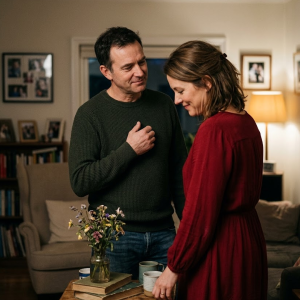
She stood at that podium and said four words that made her husband go white as a sheet — and she hadn’t even opened the box yet.
But let me back up.
Loretta Mae Brandt had worked that Nebraska grain farm since she was twenty-three years old.
She’d driven the combine in August heat that curled the air like ribbon. She’d stayed up through February blizzards worrying about frozen pipes and spring planting. She’d buried Gerald’s parents in the back forty, right where they’d asked, under the two old cottonwoods.
Four hundred and twelve acres.
Her whole life.
And Gerald sold it.
Not to save the farm. Not for medical bills or debt collectors.
He sold it to fund a condo in Scottsdale for a woman named Darlene who was, as Loretta would later learn, twenty-six years younger and had never once touched a piece of farm equipment in her life.
Loretta found out the way betrayed wives usually do — by accident. A forwarded email. A number she didn’t recognize. A closing date that had already passed.
She sat at the kitchen table for three hours and didn’t make a sound.
Then she went to the hall closet.
She stood on her tiptoes and pulled down the green tin box.
She’d had it for forty-four years.
Gerald’s mother, Dorothy — a quiet, sharp-eyed woman who smelled like lavender and kept her opinions close — had pressed it into Loretta’s hands on the morning of the wedding. Not the night before. Not at the reception. That morning, in the church vestibule, while Gerald was laughing with his groomsmen down the hall.
Dorothy had looked at her with an expression Loretta had never quite been able to name.
“Don’t open it until you need to,” she’d said.
That was it. No explanation. No wink. Just that.
Loretta had always assumed it was a letter. Maybe old family recipes. Maybe savings bonds that had long since expired.
She’d never opened it.
For forty-four years, that green tin box sat on the top shelf of her closet, water-stained along one corner, the clasp gone slightly rusty.
She didn’t open it that day either.
Something told her to wait.
Instead, she called her daughter’s college roommate, who had become a property attorney in Lincoln. She asked her to pull the original deed on the farm — not the recent transfer documents, not anything Gerald had filed. The original.
The one from 1947.
It took eleven days to get a copy.
When Loretta read it at the kitchen table with a magnifying glass and a cup of cold coffee, she had to read it three times before she understood what she was holding.
A covenant clause.
Handwritten, right there in the margin of page four, initialed by both her father-in-law and the county recorder of the time.
Specific. Binding. And — according to her attorney — almost certainly still valid.
Gerald had never known it existed.
The buyer didn’t know either.
Then she opened the tin box.
And that’s when Loretta Mae Brandt — sixty-seven years old, gray-haired, soft-spoken, the kind of woman who brought a casserole to every funeral in Cass County — started making very quiet phone calls.
Eight months of them.
She called the county commissioners one at a time. She called the president of the farm bureau. She called the loan officer at First Nebraska who’d handled the closing and was, she’d learned, quietly furious about how the sale had been structured.
And she called Gerald’s buyer’s wife.
Whose name was not Darlene.
Who had, it turned out, some very strong feelings about Scottsdale condos.
Loretta invited them all to the same place.
County hall. Third Tuesday of the month. Public meeting, open record.
She didn’t tell Gerald she was coming. She didn’t need to. He was already there for an unrelated zoning matter, sitting in the third row with that easy, unearned confidence he’d carried his whole life.
He didn’t see her walk in.
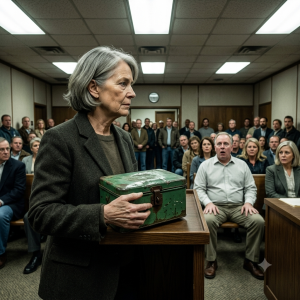
He didn’t see her set the tin box on the podium.
He didn’t see who was sitting in the back row until it was too late to leave without everyone noticing.
The room went quiet the way rooms do when something is about to happen and everybody can feel it.
Loretta adjusted the microphone.
She looked at the deed in her hands. She looked at the faces of every person she’d spent eight months carefully placing in this room.
And then she looked straight across that crowded county hall at Gerald.
She set the green tin box on the podium where everyone could see it.
“Your mother,” she said, “always knew exactly who you were.”
She reached for the clasp.
The clasp gave with a small, dry snap that sounded enormous in that quiet room.
Inside the tin box were two things.
The first was a letter, written in Dorothy’s careful, looping cursive on three sheets of cream stationery, dated June 4th, 1979 — the summer Gerald turned twenty-two. The summer, Loretta would later piece together, when Dorothy had first understood what kind of man her son was going to be.
The second thing was a document. Notarized. Witnessed by two people whose signatures Loretta had come to recognize over eight months of research — the same county recorder who’d initialed the covenant clause, and a lawyer in Plattsmouth who had been dead for eleven years but whose firm was still very much open.
Dorothy Brandt had, in the summer of 1979, transferred her personal one-third interest in the farm — the portion she’d inherited from her own family, the Kellermans, who had broken that ground in 1911 — into a separate land trust.
With Loretta Mae Vickers, her future daughter-in-law, listed as sole beneficiary.
Not Gerald.
Not the Brandt estate.
Loretta.
By name. Before they were even married.
Dorothy had known. She’d watched her son for twenty-two years and she had known, and so on the morning of that wedding, while Gerald laughed down the hall, she had pressed that tin box into Loretta’s hands and said the only thing she could say.
Don’t open it until you need to.
One hundred and thirty-seven acres. The southeast corner of the farm, where the good bottomland was. Where the soil ran dark and deep and the yield had always been highest. Dorothy’s third, held in trust for forty-four years, completely unknown to Gerald because Dorothy had never told him it existed and the trust documents had never appeared in any filing he’d thought to check.
Gerald had sold what he thought was the whole farm.
He had not owned the whole farm.
The sale was, as Loretta’s attorney explained to the county commissioners in a voice so calm it was almost gentle, what you’d call legally complicated.
More specifically, it was void as to the one hundred and thirty-seven acres he hadn’t had the right to sell. The buyer — a land development company out of Omaha — had purchased acreage that was not Gerald’s to transfer. The title was defective. The closing company had failed to surface the trust in their search. The loan officer from First Nebraska, who was indeed quietly furious, had already been in contact with the state banking commission about certain irregularities in how the transaction had been structured.
All of this came out in that county hall meeting. Loretta read portions of the letter — not all of it, she kept some of Dorothy’s words just for herself — and her attorney walked through the trust documents line by line.
Gerald sat in the third row and did not move.
The buyer’s wife sat in the back row. She had driven up from Omaha alone. She had the expression of a woman who had suspected something for a long time and was now watching her suspicion be confirmed in a public record. She did not look at Gerald. She didn’t need to.
When it was over, Loretta closed the tin box.
She didn’t make a speech. She didn’t say another word to Gerald. There was nothing left to say to him that Dorothy hadn’t already said in 1979, in that careful cursive, on three sheets of cream stationery.
The legal process took another fourteen months.
The development company, once they understood they’d closed on a defective title, came to the table fast. They were not interested in litigation. They were interested in resolving a problem quietly and moving on. They recovered what they could from the escrow arrangement and restructured the deal. Loretta’s attorney negotiated the terms.
Loretta got her hundred and thirty-seven acres back. The bottomland. Dorothy’s third.
She sold the mineral rights on forty of it at a price that made her attorney blink. She used the money to hire a farm manager — a young woman named Caitlin from Weeping Water who had grown up on a hog operation and had, in Loretta’s estimation, better instincts than anyone she’d met in years.
The remaining ninety-seven acres she planted in the spring.
Corn on the bottomland, just like always.
Gerald, as best anyone could determine, ended up in Scottsdale anyway. Whether Darlene was still part of that picture, Loretta neither knew nor asked. She had her hundred and thirty-seven acres and her farm manager and her tin box, which she kept now on the kitchen counter, open, holding nothing but a dish towel and a few rubber bands.
It didn’t need to be a secret anymore.
Her daughter drove up from Kansas City that first planting weekend and stood at the edge of the field in borrowed boots, watching Caitlin run the planter down the first long row in the early May light.
“Grandma Dorothy really did all that?” her daughter said.
“She really did,” Loretta said.
“She never told anyone?”
Loretta thought about that expression she’d never quite been able to name. The one Dorothy had worn in the vestibule that morning, pressing the box into her hands. She understood it now. It wasn’t warning. It wasn’t pity.
It was faith.
Dorothy had looked at twenty-three-year-old Loretta Vickers, who was about to marry her son, and she had decided something. She had decided that whatever Gerald turned out to be, Loretta would be equal to it. That she was the kind of woman who would wait forty-four years if she had to, and then walk into a county hall meeting and handle it properly, without cruelty and without rushing, when the time was right.
“She told me,” Loretta said. “She just told me in the only way she could.”
The planter turned at the far end of the field and started back.
Four hundred and twelve acres had once been her whole life.
A hundred and thirty-seven, it turned out, was enough.