They paid her $47,000 to disappear.
She took the money. She disappeared.
And then, twenty-two years later, Patrice Holloway walked into the grandest building Beaumont County had ever seen — and her name was on every single wall.
—
Let me back up.
When Marcus Holloway died — sudden, senseless, a January ice storm on Route 9 — Patrice was twenty-six years old, seven months pregnant, and completely alone in a house that had never really felt like hers.
The Holloways made sure of that.
Margaret and Gerald Holloway had never approved of Marcus’s choice. Patrice was a potter’s daughter from Sutter Creek. She’d grown up behind a roadside stand her father built from salvaged pine and good intentions. The kind of place the Holloways would drive past without slowing down.
After the funeral, Gerald’s attorney called.
The offer was simple. Clean. Almost polite. Sign away any claim to the Holloway estate. Accept a one-time settlement. Leave Beaumont County quietly.
They called it a gesture of goodwill.
Patrice called it what it was.
But she had a baby coming and $214 in her checking account. So she signed. She packed two suitcases and a box of Marcus’s books, and she drove west until Beaumont was nothing but a county line in the rearview mirror.
She took one other thing with her.
A photograph.
Small. Already water-damaged at the edges, curling soft as old skin. A picture of her father’s pottery stand — the hand-painted sign, the crooked shelf of glazed bowls, the way the afternoon light came through the pine slats and turned everything gold.
She never framed it. Never explained it.
But in twenty-two years, she never put it down for long either.
—
People in Beaumont County tonight are dressed in their finest.
The Holloway Cultural Center — that’s what they’d announced it would be called, six months ago, when Gerald’s estate made the lead donation — is lit up like a promise. Local news vans. String quartet. Champagne in real glass.
Margaret Holloway, eighty-one now and still iron-spined, stands near the front with Gerald Junior and his wife. They’ve had their name on things in this county for forty years. Tonight is just another chapter in a long, comfortable story.
Nobody noticed when Patrice arrived.
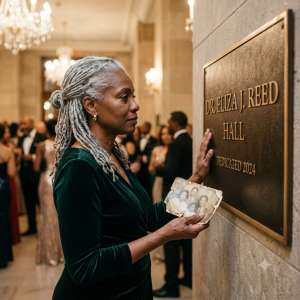
She’s fifty now, and she carries herself differently than the girl who left. Quiet confidence. Silver threading through her locs. A dark green dress that she made no effort to explain to anyone.
In her left hand, a bronze donor plaque.
In her right hand, the photograph. Turning it over once. Twice. The way she always does when her heart is doing something her face won’t show.
—
Here is what the Holloways don’t know yet.
When Patrice left Beaumont, she drove to Albuquerque. Took a ceramics class to feel close to her father. Taught herself to throw larger pieces. Then sculptural work. Then architectural installations — the kind that fill whole rooms, whole buildings, with something that feels like memory made solid.
She started small. She stayed small on purpose for a long time.
And then a museum in Santa Fe noticed her.
And then a collector in Chicago.
And then an anonymous letter arrived in her studio eighteen months ago, from the newly formed Beaumont County Arts Foundation, asking if she would consider becoming the lead donor and namesake for a new cultural institution — one designed to replace a certain planned project that had quietly lost its primary funding after some legal complications with the original estate.
She didn’t answer right away.
She picked up the photograph instead.
Turned it over.
Set it down.
Then she wrote back: Yes. With one condition.
The plaque in her hand is warm from being held so long.
On it, engraved in clean capital letters:
THE PATRICE SUTTER HOLLOWAY FOUNDATION WING
In memory of Ray Sutter, who sold beautiful things from a pine-board stand on Route 9, and taught his daughter that art belongs to everyone.
—
The room is settling into a hush.
The museum director steps up to the microphone, adjusting her glasses, smiling at the crowd of Beaumont’s finest with the particular warmth of someone who knows exactly what is about to happen.
Patrice tucks the photograph into her palm.
Turns it over once.
Holds it still.
“And now,” the director said, her voice carrying clean and clear to every corner of the room, “I’d like to introduce the woman whose name you’ll see on every wing of this building — a woman some of you may already know.”
The applause was just beginning to build.
And right then, from the third row, Patrice heard it.
A sharp intake of breath.
One she would have known anywhere.
After twenty-two years.
—
She didn’t look toward the sound. Not yet.
She’d thought about this moment more times than she could count. Lying awake in her Albuquerque studio with clay still under her fingernails. Standing at museum openings in cities that had no idea where she came from. Watching her daughter, Nora, grow into a young woman who had Marcus’s eyes and Ray Sutter’s hands and none of the smallness that Beaumont County had tried to write into Patrice’s story.
She’d imagined it playing out a dozen different ways.
In some versions she was cold. In some she was gracious. In one version, embarrassingly, she cried.
But now that the moment was here, she felt something quieter than any of those.
She felt finished. The way a piece feels when it’s come out of the kiln and you hold it up to the light and every decision you made — every choice about pressure and heat and how long to let it be — turns out to have been exactly right.
She walked to the microphone.
—
The director stepped aside with a small, knowing nod.
Patrice set the plaque on the podium where everyone could see it. She left the photograph in her hand.
She looked out at the room.
At the local news cameras. At the foundation board members who had written her that careful, anonymous letter and then, when she called their bluff, honored every word of it. At the faces of people she didn’t recognize at all — Beaumont County had grown up while she was gone, filled in with new families and new names, people who had no idea there was supposed to be a different name on these walls tonight.
And at the third row.
Margaret Holloway sat very still.
Eighty-one years old and iron-spined as ever, in a dove-gray suit that Patrice suspected cost more than her father’s car had. Gerald Junior was beside her, already leaning in, already whispering something urgent. His wife had her hand on his arm the way you grip someone when you need them to hold it together.
Margaret’s eyes were locked on Patrice.
Patrice looked back.
She didn’t look away. She didn’t soften it.
But she also — and this surprised her, even as it happened — she also didn’t hate her.
Twenty-two years of building something with your own hands has a way of rearranging what you have room to carry.
—
“I almost didn’t come back,” Patrice said into the microphone.
Her voice was steady. It had always been steady when it counted.
“Not because of anything dramatic. Just because Beaumont County stopped being part of my story for a long time, and I wasn’t sure it needed to be again.”
She paused. Let the room breathe.
“My father sold pottery on Route 9. Right about where they’ve put the second traffic light now, for those of you who know that stretch. He built the stand himself from wood he pulled out of a demolition pile behind the old Richfield mill. He painted the sign himself. He glazed every bowl himself.”
She turned the photograph over in her hand.
“He made beautiful things. He charged fair prices. He gave pieces away to people who needed them and couldn’t pay. He never had money. He never had a name on anything. And he was the finest artist I’ve ever known.”
Nobody in the room was moving.
“I left Beaumont County with $47,000 and a picture of his stand. I want to be honest about that, because I think honesty is the only foundation that holds. I was young and I was scared and I took the money and I left. I’m not here to relitigate that. I’m not here to settle scores.”
She looked at Margaret again.
“I’m here because eighteen months ago, I had a chance to do something with everything my father taught me. And I decided that was worth more than staying away.”
—
She stepped out from behind the podium then, and the museum director quickly adjusted, understanding somehow that the script had gently been set aside.
Patrice walked to the nearest wall.
Built into the east face of the entrance hall, floor to ceiling, was the installation she’d spent fourteen months creating. Hundreds of individually thrown ceramic forms — small bowls, large bowls, vessels of every size — in glazes that moved from the dark clay-red of the New Mexico earth where she’d spent her years all the way to the soft amber gold of afternoon light coming through pine slats.
Every piece was different.
Every piece fit.
It had no title placard yet. That was the one condition she’d written back to the foundation about. She wanted to name it herself, here, tonight, in person.
She pressed her palm flat against one of the larger vessels. Still cool from the climate-controlled air. Perfect.
“My father called it the democracy of beautiful things,” she said, not into a microphone now, just into the room. “The idea that a glazed bowl on a pine shelf on the side of a road belongs to the same world as anything in any museum. That the person who made it matters. That the hands matter.”
She turned around.
“This installation is called Route 9. And it belongs to Beaumont County. All of it.”
—
The applause when it came was the kind that starts in a few pairs of hands and then becomes something a room decides together.
Patrice stood and received it the way her father used to receive a compliment on his work — with a small, genuine nod. Nothing performed. Nothing withheld.
She was walking back toward the podium when she felt a hand on her arm.
Light. Almost tentative.
She turned.
Margaret Holloway was standing close, closer than Patrice had expected, and without Gerald Junior beside her, which surprised her more. The iron-spine was still there, but something else was there too, something that Patrice recognized because she’d felt it herself, in the early years in Albuquerque, when Nora was small and the nights were long and the weight of everything left unsaid pressed down like a second blanket.
It was the look of a woman who had been carrying something heavy for a very long time.
“Your daughter,” Margaret said. Her voice was lower than Patrice expected. “She has his eyes.”
Patrice went still.
“Nora is twenty-two,” Patrice said. Carefully.
“I know.” Margaret’s chin came up just slightly, the old reflex. But her voice didn’t harden. “I’ve followed your career. From a distance. For several years now.”
Patrice looked at her for a long moment.
She thought about a lot of things in that moment. About a January ice storm on Route 9. About an attorney’s phone call, clean and almost polite. About $214 in a checking account and a baby pressing against her ribs and a photograph she picked up every time her heart needed steadying.
She thought about what her father would have done.
Ray Sutter, who gave bowls away to people who needed them and couldn’t pay.
“She’s backstage,” Patrice said finally. “She helped with the installation. I can introduce you. If you want.”
Margaret Holloway blinked.
Just once.
“I would like that,” she said. “Very much.”
—
They didn’t fix everything that night.
You don’t fix twenty-two years in a lobby while a string quartet starts up again and local news cameras sweep the room for B-roll. You don’t unsign a document or unpack two suitcases or give a young woman back the winter she drove away from everything she thought her life was going to be.
Patrice knew that.
She wasn’t looking to fix it.
What she was looking for — what she’d been building toward, piece by piece, bowl by bowl, for twenty-two years without quite admitting it — was something her father had tried to tell her and that she’d only understood by making things with her own hands.
That the shape of something matters more than what it started out as.
That you can take raw material that’s been handled wrong and center it and open it and make something from it that nobody expected.
That the kiln doesn’t care where the clay came from.
—
Later — after the champagne, after the speeches, after Gerald Junior shook her hand with the stiff formality of a man doing the right thing because he’d been cornered into it, which she supposed was fine, some people needed cornering — Patrice found a quiet spot in the gallery.
The installation was lit beautifully. The way the lights hit the glazes, the amber moved through the piece like something alive. Like the afternoon light in her memory, the one she’d been carrying in her left hand for twenty-two years.
Nora found her there.
Twenty-two years old. Marcus’s eyes. Ray Sutter’s hands, blunt-fingered and capable, already marked with clay from helping hang the final pieces that morning.
“She seems sad,” Nora said, meaning Margaret, who they’d left in conversation with the foundation director.
“She is,” Patrice said.
“Are you?”
Patrice looked at her daughter for a moment.
Then she looked at Route 9, all those bowls nested into the wall of a building in the county that had tried to write her out of the story. All those pieces she’d made one at a time, over years, from earth and water and heat and patience.
“No,” she said.
And she meant it the way you mean something when you’ve tested it from every angle and it holds.
She slipped the photograph into her jacket pocket.
For the first time in twenty-two years, she left it there for the rest of the night without once turning it over.