They told her the notebook burned in the fire.
They were wrong.
—
Loretta Pruitt has spent forty-one years on the water.
She knows the Chesapeake the way other women know their own kitchens — the smell of it before a storm rolls in, the particular shade of green the bay turns in late October, the way the crabs go quiet when the water temperature drops two degrees overnight.
She has never stopped knowing Tangier Island the same way.
Even after her brothers sold the house. Even after she swore she’d never go back.
She went back on a Tuesday in September, which felt appropriate. Tuesdays on Tangier have always been the quietest days. Nobody gets married on a Tuesday. Nobody dies on a Tuesday. Things just — happen. Quietly, without ceremony.
She told herself she was just passing through.
She told herself a lot of things.
—
The old Pruitt place sat at the end of Chambers Lane, same as always, but someone had painted it the color of sea glass and hung a wooden sign out front that said **The Cardinal Inn — Bed & Breakfast, Est. 2009.**
Loretta sat in her truck for a long moment.
Her mother had loved cardinals. Called them visits from people who’d gone on ahead.
She almost drove away.
She didn’t.
—
The woman behind the front desk was young — maybe thirty-five — with kind eyes and flour on her apron, and she smiled the way people smile when they’re genuinely happy to see a stranger walk through their door.
“Welcome in,” she said. “You looking for a room?”
“Just looking,” Loretta said, which wasn’t exactly a lie.
The entryway smelled like Old Bay and biscuits and something else underneath — something older. Loretta’s chest went tight before her brain could name what it was.
Her mother’s kitchen. That’s what it smelled like.
Sixty-eight years old and she nearly came apart right there on the welcome mat.
—
She asked if she could look around. Said she used to know this house when she was a girl. The innkeeper — she introduced herself as Melissa — lit up the way history-lovers do and said, “Oh, please. I love hearing stories about this place.”
Loretta walked slowly.
The staircase was the same. The window at the landing still looked out over the same stretch of water. Someone had put a cushion on the sill, and Loretta remembered sitting in that exact spot as a nine-year-old, watching her daddy’s boat come in.
In the kitchen, Melissa was rolling out dough.
And that’s when Loretta saw it.
—
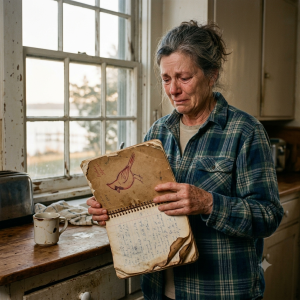
On the counter, half-open, worn at the spine and dark with old water stains along the bottom corner — a spiral notebook.
Small. Unremarkable to anyone who didn’t know.
But on the cover, drawn in red ballpoint pen in the looping, careful hand of a woman who’d never taken an art class but had always loved cardinals —
A bird. Wings out. Head tilted.
Loretta’s mouth went dry.
“That notebook,” she said. Her voice didn’t sound like her own. “Where did you get that?”
Melissa glanced over her shoulder, still working the dough. “Oh, that old thing? It came with the house, actually. Full of recipes, handwritten. I’ve been cooking from it for years.” She smiled. “Whoever wrote it really knew what she was doing. The crab soup alone—”
“It burned,” Loretta said. “In 1987. There was a kitchen fire. My brothers told me it burned.”
Melissa stopped rolling.
She turned around slowly.
“You know this book?”
Loretta couldn’t answer. She was already moving toward it. Her hands were shaking — she noticed that from somewhere far away, the way you notice weather through glass.
The paper was soft with age. The handwriting inside was her mother’s — she would have known it from a thousand miles away, those careful capital letters, those little crosses on the lowercase t’s.
*Mae’s Good Things. Started June 1971.*
Biscuit recipes. Crab cake recipes. A note in the margin about adding a pinch of celery seed. A pressed bay leaf, brown and translucent, tucked between two pages.
All of it exactly as she remembered. All of it alive.
“I thought you should know,” Melissa said quietly, “the man who sold me this house — he left it behind on purpose. Said it wasn’t his to take.” She paused. “He told me it had belonged to a daughter who passed away young. That’s why I kept it. Felt wrong to throw away something like that.”
Loretta looked up from the notebook.
“A daughter who passed away.”
“That’s what he said.”
Loretta’s hands found the inside cover.
And there, in her mother’s handwriting, in red ballpoint pen — the same pen that had drawn the cardinal — was a name.
Not the name of a daughter who had died.
Her own name.
*Loretta Mae Pruitt. This book is hers when I’m gone.*
—
She stood there for a long time.
Melissa had the good sense not to fill the silence.
Outside, a boat horn sounded out on the water — low and distant, the way they always did in September when the skipjacks were heading in. Loretta heard it the way she used to hear it as a girl, before everything happened. Before the fire. Before her brothers sat her down at a folding table in a church fellowship hall and told her the house was sold and the notebook was gone and there was nothing left to sort through.
She had believed them.
For forty-one years, she had believed them.
She turned to the back of the notebook the way you do when you already know something is there and you just need your eyes to confirm it. Past the recipes — the she-crab soup, the corn pudding, the spiced peaches her mother put up every August in old Mason jars lined up on the windowsill like colored glass. Past the pressed flowers and the clipped magazine photograph of a kitchen her mother had admired and never owned.
And there, on the last written page, in handwriting that was shakier than the rest — her mother’s hand in the last years, when the arthritis had gotten into her knuckles — a note.
Not a recipe.
A letter.
*Loretta —*
*If you’re reading this it means the house found you, or you found the house, and either way I’m glad. I know you and your brothers are at odds and I know you think I favored them and maybe I did in some ways, the way mothers do without meaning to. I want you to know that was never my heart.*
*The cardinal on the cover is yours. I drew it the week you were born. You were the loudest baby I ever heard and the reddest, and your daddy laughed and said you looked like a cardinal in a bad temper and we laughed about that for years.*
*The recipes in this book are the ones you asked for and never got around to writing down. I put them all here. The biscuit method you can never remember. The crab cake your grandfather taught me that I never taught anyone else. They’re yours.*
*I’m leaving this book in the house because I know in my bones you’ll come back someday. You always loved this place more than any of the others, even when you were too proud to say so.*
*Don’t be too proud.*
*Come home more than once.*
*All my love always —*
*Mama*
—
Loretta sat down on a kitchen chair.
She didn’t cry right away. She just sat. Held the notebook in both hands the way you hold something you thought was lost forever — carefully, like it might decide to leave again.
Melissa set a glass of water on the table beside her without saying a word, and then went back to her dough, and Loretta loved her for that.
The sun had moved. The kitchen was full of the low gold light that September throws around like it’s trying to make up for leaving. Out the window over the sink, Loretta could see the same stretch of water her mother had looked at for thirty years. The same grasses. The same particular bend of the shoreline.
The water was green. That deep late-October-coming green, even though it was only September. Which meant the temperature had dropped overnight.
She noticed that the way she always noticed things about the bay. Automatically. Without trying.
Her mother would have noticed it too.
—
It took her another hour before she could speak normally again.
Melissa brought her tea and sat across from her and listened while Loretta talked — about her mother, about the fire, about her brothers and the years of silence and the way grief can calcify into a story you stop questioning because questioning it hurts too much.
“The fire was real,” Loretta said. “It took out the back corner of the kitchen. The cabinet above the stove. My brothers cleaned everything out afterward, said there was nothing worth saving.” She looked at the notebook. “I think maybe one of them found this and told himself it was too painful to give to me. Or maybe he just wanted it gone. I don’t know. I’ll never know.”
“Does it matter?” Melissa asked.
Loretta thought about that.
“Not like it used to,” she said. And meant it.
—
Her oldest brother, Garrett, had died in 2011. The middle one, Russell, was in a memory care facility outside of Roanoke. His wife had sent Loretta a Christmas card every year for a decade, a small kindness that Loretta had never fully acknowledged and always intended to.
She would call when she got home. She decided that in the kitchen, looking at the notebook.
There was a woman in Roanoke who had been sending her Christmas cards for ten years, and Loretta had been so busy being estranged from a dead man and a man who no longer remembered the estrangement that she had barely noticed the one person who kept reaching anyway.
Her mother would have had something to say about that.
—
Before she left, she asked Melissa something that had been sitting at the back of her mind since she first walked through the door.
“The name of this place,” she said. “The Cardinal Inn. Did you name it that?”
Melissa smiled. “I did. I found the notebook the first week I moved in, before we’d even decided on a name. I’m not superstitious exactly, but —” She shrugged. “It felt like whoever left it was still attached to this place. The bird on the cover. I just liked the idea of honoring that.”
Loretta looked at her for a moment.
“Her name was Mae,” she said. “Mae Pruitt. She raised four kids in this house and she made the best crab soup on the island and she loved cardinals because she said they were visits from people who’d gone on ahead.”
Melissa’s eyes went soft.
“Mae,” she repeated, like she was committing it to memory. “I’ll remember that.”
—
Loretta drove off Tangier the way she’d come — on the ferry, standing at the rail with the wind off the water and the notebook wrapped in her jacket on the seat behind her.
She didn’t feel the way she’d expected to feel when she finally found something she’d been grieving for decades. She’d always imagined it would be loud somehow. Dramatic. A flood.
It was quieter than that.
It felt like setting something down that she’d been carrying so long she’d forgotten the weight of it. Not an absence. More like — room. Space in her chest she hadn’t known was missing.
The bay was flat in the late afternoon. A great blue heron was standing in the shallows near the far bank, absolutely still, the way herons are — patient to the point of looking carved.
Her mother used to say herons were the bay thinking.
Loretta watched it until it was out of sight.
—
She made the crab soup three weeks later, in her own kitchen on the Eastern Shore, following her mother’s handwriting step by step. A pinch of celery seed. Heavy cream, not milk. The Old Bay goes in at the end.
Her daughter came over for dinner. And her daughter’s husband. And her two grandchildren, who were seven and nine and loud the way Loretta had apparently once been loud, red-faced and opinionated and full of something that needed to get out.
She served the soup in the same heavy bowls her mother had used.
Nobody knew that but her.
After dinner, her granddaughter climbed into her lap and asked her to tell a story, and Loretta thought for a moment and then said, “Did I ever tell you about your great-great-grandmother Mae? She could make a crab soup that would make you want to sit down on the floor and cry, and she drew a cardinal on everything she ever loved.”
“Why a cardinal?” her granddaughter asked.
Loretta thought about it — really thought about it — for the first time.
“Because,” she said, “she believed that the people who love you don’t really go anywhere. They just show up differently.”
Her granddaughter seemed to find this satisfying. She settled in closer and said, “Tell me more.”
So Loretta did.
—
The notebook lives on Loretta’s kitchen counter now, in the same spot Melissa had it — not put away, not preserved behind glass. Used. Flour-dusted and handled.
Mae Pruitt’s good things, still feeding people. Still in the family.
Still finding their way home.