She had been locked away for forty years.
And the woman who put her there was sitting six feet away, ordering shrimp and grits.
—
Della Mae Simmons turned seventy-one last March. She celebrated alone, the way she’d celebrated most things since they let her out — with her hands moving, always moving, pulling sweetgrass into coils on her front porch in Beaufort while the marsh light came in gold off the water.
People said Della was simple.
Her daughter Cheryl had told a judge that forty years ago, and the judge had believed her.
Cheryl had papers. She had a lawyer. She had a story about her mama hearing voices, wandering the road at night, a danger to herself.
What Cheryl really had was her eye on twelve acres of Gullah coastal land that had been in the Simmons family since Reconstruction. Land that three developers had already come knocking about. Land worth nothing in 1983 and a small fortune by the time Della walked out of the institution in 2019, the incompetency ruling finally overturned by a Legal Aid attorney who’d taken her case for free.
Della got out.
She did not get the land back.
But she got her hands back. And her hands remembered everything.
—
The basket sitting in her lap right now was half-finished.
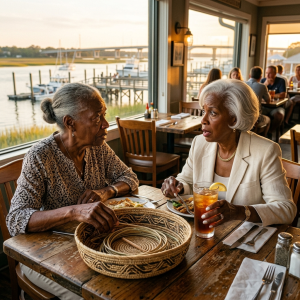
She’d brought it to the restaurant the way she always did — you don’t waste good light, and the waterfront windows at Magnolia’s Grill faced west. The sweetgrass was fragrant and pale, threaded through with bulrush the color of wheat, pulled into a double-coil pattern that looked almost like two rivers running alongside each other without ever quite meeting.
Her grandmother had taught her that pattern.
Her grandmother’s grandmother had invented it.
In three counties, no other weaver had ever gotten it right. The coils had to speak to each other without touching. Most people couldn’t feel where that line was.
Della always could.
She was working the second coil around a tight curve when she heard the voice at the next table.
Low. Measured. The voice of a woman used to being listened to.
*”I’ll have the she-crab soup to start, and can you tell the kitchen to go light on the sherry—”*
Della’s hands went still.
Forty years is a long time. A voice changes. Weight shifts around the jaw, age softens the consonants, years of good living smooth out the hard edges.
But some things don’t change.
Della had heard that voice in a wood-paneled room. She had heard it say *She is not competent to manage her affairs or her property.* She had heard it while she sat in a folding chair in a dress Cheryl had picked out, too confused by what was happening to speak up, too trusting of her own daughter to believe what she was watching unfold in front of her.
She turned her head slowly.
The woman at the next table was perhaps seventy. Silver hair cut close. Good linen blazer, cream colored. A glass of sweet tea leaving a ring on the white tablecloth.
And in the chair beside her handbag—
Della stopped breathing.
It was a sweetgrass basket.
Not a tourist basket. Not one of the pretty ones they sold down on Bay Street for forty dollars to people who didn’t know what they were looking at.
This one had a double-coil pattern.
Two rivers running alongside each other without ever quite meeting.
Della set her own basket down on the table.
Her heart was doing something complicated in her chest.
She had been trying to remember that lawyer’s name for twenty years. Legal Aid had found the original paperwork but the attorney’s name had been partially obscured, water-damaged, and the woman herself had moved her practice twice. Della had let it go. Or she’d tried to.
She looked at the basket again.
Then she looked at the woman’s hands around the sweet tea glass.
Then she did the thing she’d promised herself she would never do — she spoke first.
*”Where did you get that basket?”*
The woman looked up. Just a glance, the polite irritation of someone interrupted mid-thought.
Then the glance stopped.
And something happened to her face that Della had never seen on a stranger.
It was recognition.
Not of a vaguely familiar woman in a restaurant.
Something older. Something that went all the way down.
The sweet tea glass shook very slightly. The woman set it on the table. Her fingers were pressed against the condensation and her knuckles had gone white and the restaurant kept moving around them — silverware, low music, somebody laughing near the bar — but the two of them were in a stillness that had nothing to do with this room.
Della waited.
The woman opened her mouth.
Closed it.
Then, barely above a whisper — barely loud enough to cross the six feet between them — she said the one word that changed everything Della thought she understood about the last forty years of her life.
She whispered:
*”Mama.”*
—
The word landed somewhere below Della’s ribs.
She did not move. She did not breathe. The half-finished basket was warm in her hands from all the hours she’d been working it, and she held on to it the way you hold on to something solid when the ground has gone uncertain under your feet.
The woman was crying. Not loudly. The kind of crying that has been practiced into near-silence over many years — just the jaw working, the eyes going bright and wet, the throat doing all the work.
Della said, very carefully: *”Say that again.”*
*”Mama.”* A second time. And then, like she couldn’t stop it: *”It’s me. It’s Luanne.”*
Luanne.
The name came up from somewhere so deep that Della felt it before she understood it. The way you feel cold water rising around your ankles before you register that you’ve stepped off a dock.
Luanne.
Her baby.
Her second baby, born four years after Cheryl, in a hard July with nobody but a midwife and Della’s own mother in the room because Della’s husband had run off to Savannah with the woman from the cannery and Della had not had time to fall apart over it, not with a four-year-old and a new baby and twelve acres that wanted tending and her hands always moving, always working, making the baskets that kept them all fed.
Luanne had been seventeen years old when the judge signed the papers.
Luanne had been in the room.
Della had looked at her daughter’s face that day and seen something there she hadn’t been able to name — not then, not in forty years of turning the memory over. She had catalogued it as shame. She had decided Luanne was ashamed of her mama. She had carried that like a stone.
*”They said you’d died,”* Della said. Her voice came out strange, like it belonged to someone else.
Luanne shook her head. Her hand was on the tablecloth between them, palm up, fingers open. Not reaching. Just offered.
*”Cheryl told you I died.”*
—
What Luanne had done was run.
She’d been seventeen and she had watched her sister stand up in that wood-paneled room and dismantle their mother with paperwork, and she had understood something in that moment about what Cheryl was capable of. About what would happen to a seventeen-year-old girl who tried to stand up and say *wait, no, that’s not right, my mama is not crazy* — what happened to that girl when her sister had a lawyer and documents and a story that had been prepared over months, and when that girl had nothing but her own voice and the conviction that she knew her mother’s mind better than any piece of paper could say.
She’d understood that she would lose.
And she’d understood something else. Something it had taken her twenty years of therapy and two attempts at getting sober and one very good marriage and eventually a law degree to fully articulate.
She’d understood that Cheryl wasn’t finished.
If Luanne stayed, Cheryl would find a way to neutralize her. That was the word Luanne used, sitting across from her mother in Magnolia’s Grill with the sweetgrass basket between them. Neutralize. Cheryl had already demonstrated what she was willing to do to protect what she wanted. Luanne was seventeen, she had no money, and she had just watched a judge take her mother away without blinking.
So she ran to an aunt in Fayetteville, North Carolina, who had enough distance from the family to not be in Cheryl’s orbit.
And she kept running, in the way people do — further education, further geography, a different name professionally. A marriage that gave her a different name entirely. She became Luanne Beauchamp-Holt. She became a family law attorney in Charleston. She spent thirty years fighting cases that looked, in their bones, like what had been done to her mother.
She had never once stopped thinking about what she’d left behind.
*”If you were a lawyer,”* Della said, slowly, *”why didn’t you—”*
*”I tried.”* Luanne’s voice broke on the second word. She steadied herself. *”In 2004. I filed a motion to reopen. Cheryl found out. She came to my office. She sat across from me, Mama, the same way you’re sitting across from me right now, and she told me that if I kept going she would tell people I had fabricated a legal identity, that I had fraudulently obtained my bar membership, because I had changed my name without properly notifying — it was nonsense, it wouldn’t have held, but disbarment proceedings take years and I had three kids and—”*
She stopped.
*”I stopped,”* she said. *”And I have hated myself for it every day since.”*
Della looked at her daughter’s hands. They were her own hands, almost. The same long fingers. The same broad thumbnail. She had spent forty years believing those hands were gone from the world.
*”The lawyer who got me out,”* Della said. *”In 2019. Water-damaged paperwork. I never could read the name right.”*
Luanne’s chin went down. A small nod.
*”Beauchamp,”* Della said.
*”Beauchamp,”* Luanne confirmed. *”I filed as co-counsel so my name wouldn’t be the primary. I was afraid if Cheryl saw my name as lead she’d find a way to interfere. The young woman from Legal Aid was—”*
*”She was wonderful,”* Della said.
*”She was.”*
The waiter came. Neither of them spoke or looked up. He read the room and vanished.
—
They sat in that restaurant for four hours.
The she-crab soup went cold. The shrimp and grits Luanne had ordered arrived and were cleared away untouched. The west light through the windows moved from gold to orange to the particular flat pink that comes just before dark on the water, and Della kept her hands moving because that was the only way she knew to stay present in a moment that felt like it could shatter.
Luanne talked about the land.
That was the part Della hadn’t known. The part nobody had told her, because nobody thought she needed to know, or because nobody wanted the legal complications that would follow.
Cheryl had sold seven of the twelve acres in 2007 to a development group. The other five she had held, and those five were the ones the marsh touched, and those five were worth more than the seven she’d sold, and she knew it, and she had been in quiet litigation with a different development group for six years over access rights when she died of a stroke in 2021 without a will.
Without a will.
Which meant the land went to her heirs.
Cheryl had two children. Luanne had three. And Della, under South Carolina intestacy law, as the mother of the deceased with no surviving spouse and an overturned incompetency ruling, was herself potentially a primary heir to whatever Cheryl had left.
*”I’ve been working with a probate attorney,”* Luanne said. *”For two years. I didn’t know how to find you. I didn’t know if you’d want to be found. I didn’t know—”* Her voice went careful. *”I didn’t know if you’d be able to forgive me for running.”*
Della set her basket down.
She looked at her daughter — this seventy-year-old stranger with her own hands and her own jaw and forty years of guilt written into the lines around her eyes — and she thought about the double-coil pattern. The two rivers that run alongside each other without ever quite meeting. How the tension between them is what gives the basket its shape. How if you pull them together, you lose the form. How the point was never that they touch. The point was that neither one breaks.
*”You got me out,”* Della said.
*”It wasn’t enough.”*
*”It was enough to be out.”* Della picked up the basket again. Her hands moved without needing instruction. *”Everything else is extra.”*
—
Luanne’s probate attorney — a deliberate, careful woman named Patricia Osei who wore reading glasses on a beaded chain and spoke like she had all the time in the world — laid the situation out over a kitchen table in Luanne’s house in Charleston three weeks later.
It was complicated. These things always are.
Cheryl’s children had contested, naturally. There were valuations to be obtained, liens to be unraveled, the six-year access rights dispute with the development group to be resolved or absorbed. Patricia said the word “timeline” more than once and each time she said it she looked at Della over the top of her glasses with an expression that meant she was sorry about the timeline.
Della was seventy-one. She understood about timelines.
*”What I can tell you,”* Patricia said, *”is that the five acres on the marsh are almost certainly going to come back to your family. The question is how long and in what form.”*
Della asked if she could see them.
They drove out the following Saturday, the four of them — Della, Luanne, Patricia, and Luanne’s oldest daughter, a physical therapist named Rosalie who had driven up from Savannah and who kept looking at her grandmother with an expression she was trying very hard to keep neutral. Trying not to let it show, all the feeling in it.
The land was overgrown. Cheryl had never worked it, never tended it, had let the scrub come in along the upland edge while the marsh side stayed wild the way marsh always does, on its own terms, indifferent to human intention. There were slash pines. Resurrection fern along the live oak limbs. And beyond the tree line, the marsh opened up gold and breathing in the October light, the cordgrass moving in one long slow exhale like something that had been holding its breath and finally didn’t have to.
Della walked to the edge of it.
She stood there a long time.
Rosalie came and stood beside her. She didn’t say anything, which was the right thing.
*”My grandmother’s grandmother picked sweetgrass from this marsh,”* Della said eventually. *”Right here. This exact marsh.”*
Rosalie looked out at it.
*”The pattern in the basket,”* she said. *”The two rivers.”*
*”She said it was this place,”* Della said. *”The Combahee and the salt water coming in. The way they run next to each other.”*
Rosalie was quiet for a moment. Then she said: *”Will you teach me?”*
Della looked at her granddaughter. Forty-three years old. Strong hands, a physical therapist’s hands that knew how to read what the body held. A face that had Della’s own jaw in it, that had Luanne’s eyes, that had something further back than either of them — something that came from before the names they carried now, from the women who had stood in this same marsh light and felt the sweetgrass between their fingers and known that the knowing was the inheritance, not the land.
The land was good to have back.
But the knowing had never left.
*”Yes,”* Della said. *”I’ll teach you.”*
—
The probate settled fourteen months later. Della was awarded a life estate in the five marsh acres, with title passing to Luanne’s and Cheryl’s children jointly at her death, a resolution that required three mediations and one extremely tense Saturday afternoon in Patricia Osei’s conference room that Della did not attend because she’d had a basket order to finish and had said, calmly, that she trusted Luanne to handle it.
Luanne had handled it.
The development group’s access rights claim was rejected. The marsh stayed whole.
On a Thursday in December, with the air sharp off the water and Rosalie beside her and Luanne sitting on a folding chair on the upland edge like she didn’t quite feel she’d earned the right to stand at the water yet, Della walked out onto her family’s land for the first time since 1983.
She had a half-finished basket in her hands.
She stood in the cordgrass in the early light and she pulled a length of sweetgrass from the bank and threaded it in. Not because she needed it. She had plenty. She’d brought a whole bundle in the bag over her shoulder.