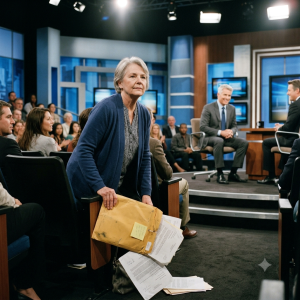
She didn’t stand up to make a scene.
She stood up because sixty-one years of knowing what’s right finally outweighed thirty years of staying quiet.
But I’m getting ahead of myself. Let me take you back to the beginning.
—
Dottie Marsh spent her whole career surrounded by other people’s words.
Thirty-two years as a head librarian in Dayton, Ohio. Thirty-two years of knowing which books changed lives, which authors were the real deal, and which ones were just good at talking about themselves.
When she retired, she finally decided to write her own.
Not fiction. Not a memoir. A self-help book — practical, warm, honest — about rebuilding your life after loss. She’d lived it. She’d watched a thousand patrons live it. She knew exactly what to say and how to say it.
What she didn’t know was how to get anyone to listen.
That’s where Craig Ellison came in.
—
Craig was everything Dottie wasn’t.
Tall. Camera-ready. The kind of man who walked into a room and immediately became the most interesting thing in it. He had a podcast, a following, a publicist named Brent who returned emails within the hour.
He also had no book.
He told Dottie he could give her project the platform it deserved. She had the soul, he said. He had the reach. They’d write it together, split everything down the middle, and help people who genuinely needed it.
She believed him.
She had the emails to prove it.
—
For fourteen months, they worked side by side. Mostly by phone and video call, her in her cozy yellow kitchen in Dayton, him in his sleek Chicago apartment. She wrote the chapters. He polished the language, pushed back on structure, added a framework she’ll admit made it better.
It was real collaboration. She knows that.
What wasn’t real was the contract she thought they’d agreed to.
The first time she noticed the sticky note, she thought it was just her grocery list.
A small square of faded yellow paper, stuck to the side of her monitor. She’d jotted something down during one of their early calls — a phrase Craig had said that struck her as important, something about *whose name goes first* — but when she looked for it later, the ink had blurred in the summer humidity and she couldn’t quite make it out anymore.
She kept it anyway.
Pressed it into the front cover of her notebook. Then later, into her copy of the finished manuscript. Just a habit she couldn’t explain. A small, stubborn instinct.
—
The book came out in March.
*Rebuilt: Finding Your Way Back to Yourself* by Craig Ellison.
Not Craig Ellison and Dottie Marsh.
Just Craig.
She found out the same way everyone else did — seeing the cover on Instagram. Her name wasn’t in the acknowledgments. It wasn’t in the author bio. There was one line buried in the introduction about being “inspired by conversations with a dear friend,” and Dottie had read that sentence four times before she understood she was the friend.
The dear friend.
The invisible one.
—
She called Craig. He said it was a “publisher decision.” She called Brent. Brent stopped returning her emails.
She thought about a lawyer. She thought about going to the local news. She thought about all the things you think about when someone takes something from you and smiles while doing it.
But Dottie Marsh had spent thirty-two years in a library.
She knew how to be patient.
She knew how to wait for the right moment.
And she knew — better than almost anyone — that documentation is everything.
The sticky note had moved again. She found it one morning tucked in the pocket of her blue cardigan, the one she wore on cool mornings. The handwriting still blurry. Still almost readable.
She smoothed it flat and put it in the manila envelope with everything else.
—
The *Good Morning with Vanessa* show announced Craig’s segment six weeks later.
*”The inspiring story of one man’s journey to write the book that’s changing lives.”*
Dottie requested a ticket to the studio audience through the show’s website.
They gave her front section. Row three.
She wore her blue cardigan. She carried the manila envelope. Inside it, fourteen months of emails, a copy of the original co-authorship agreement Craig had apparently forgotten he’d signed, and one other thing she hadn’t shown anyone yet.
She sat in her seat with her hands folded and the envelope on her lap and she watched Craig Ellison settle into the chair across from Vanessa Burke, relaxed as a man who has never once worried about being caught.
The lights were warm. The audience was buzzing.
And then Vanessa leaned forward, laughing that bright, morning-show laugh, and said:
*”So you truly wrote every single word yourself?”*
Dottie stood up.
The envelope fell open.
And every single person in that studio audience reached down to pick up what had just landed at their feet — the same small square of faded yellow paper, reproduced on every single page —
and the handwriting, finally, was perfectly clear.
—
It said: *”Craig — co-author credit, 50/50, non-negotiable. His words. His promise. D.M.”*
Seven words that Dottie had written down in the first week of their partnership, while Craig was still on the phone, while she was still nodding and trusting, because something in her — thirty-two years of cataloguing what’s real and what isn’t — told her to write it down right then.
She hadn’t known the ink would blur.
She hadn’t known she’d need more than a faded note.
That’s why she’d had it forensically examined three months earlier, by a documents specialist at the University of Dayton who could read what the humidity had tried to erase. That’s why she’d had two hundred copies made — one for every seat in the studio audience — and slipped them into the envelope the night before, beneath the emails and the contract, held together with a single rubber band.
She hadn’t planned to stand up. Not exactly. She’d planned to wait and see if the segment left her any choice.
It had not left her any choice.
—
The studio went very quiet.
The kind of quiet that television people hate, because silence on a morning show feels like a technical failure. A PA near the back wall touched his headset. A camera operator looked at another camera operator.
Craig Ellison looked at the paper in the hand of the woman sitting next to Dottie. Then he looked at Dottie herself.
She met his eyes. She didn’t say a word.
Vanessa Burke had been doing live television for nineteen years. She was good at it the way surgeons are good at surgery — not rattled by blood, not rattled by anything she hadn’t seen before. But she looked at the paper in her own hands, the one that had somehow drifted back to the host’s desk, and she read it, and then she looked up at Dottie still standing in row three, and something shifted in her expression. The morning-show brightness didn’t disappear exactly. It just made room for something more serious underneath.
“Ma’am,” Vanessa said. “Would you like to come up here?”
—
Dottie said yes.
She picked up the manila envelope — most of it had scattered across the floor around her, but she had a second copy of everything, because thirty-two years in a library will teach you to always have a second copy — and she walked down to the stage, and a production assistant who looked about twenty-three held out a hand to help her up the steps, and she took it.
She sat in the chair they brought out for her. The one guests sit in when they’re not scheduled guests. Vanessa introduced her to the audience with nothing but her name and the city she’d come from, because that was all she needed.
Craig said very little.
He said it was complicated. He said the publishing process had been complicated. He said there had been a miscommunication he’d always intended to address.
Dottie waited for him to finish.
Then she opened the envelope and handed Vanessa the co-authorship agreement — the one Craig had typed up himself in month two of their collaboration, the one with his email signature at the bottom, sent at 11:47 p.m. on a Tuesday when he was apparently feeling earnest — and she let the camera find it, and she let the audience read whatever they could read of it, and she said, very calmly, that she wasn’t there to humiliate anyone.
She was there because the book was reaching people who needed it.
And those people deserved to know who had actually written it.
—
The segment ran long.
Vanessa’s producer let it run because there are some mornings when you just let the thing breathe.
By the time it was over, Craig had agreed — on camera, in front of a studio audience, with his publicist Brent presumably watching from somewhere and making a sound like a man dropping a phone into a sink — to contact the publisher about a corrected edition. New cover. Both names.
He shook Dottie’s hand.
She shook his back.
She is not a woman who needs the last word. She needed the right word, in the right place, at the right time. That was enough.
—
The clip was online before she landed back in Dayton.
Her daughter called from Portland before the plane touched down. Her former assistant at the library sent a voice message that was mostly crying. Three reporters emailed. A woman in Memphis wrote to say she’d bought the book after her husband passed and it had genuinely helped her, and she just wanted Dottie to know that it had helped her, specifically, that whoever had written those words understood something true.
Dottie wrote back to the woman in Memphis first.
That felt right.
—
The corrected edition came out four months later.
*Rebuilt: Finding Your Way Back to Yourself* by Dottie Marsh and Craig Ellison.
Her name first.
That had been the phrase on the sticky note, the part the humidity had taken. Not just the promise of credit. The specific promise of *whose name goes first.* Craig’s own words, from the very first week, when he was still selling her on the partnership and saying all the right things.
He’d apparently forgotten he’d said it.
She had not forgotten.
—
Dottie still has the original sticky note. The actual one, not the copies.
It lives in the front cover of her personal copy of the book, same place she first put it, same instinct she couldn’t explain back then and doesn’t need to explain now. The ink is still blurry if you hold it under regular light. You have to know what you’re looking at.
She knows what she’s looking at.
She’s spent her whole life knowing exactly what she’s looking at.
She retired to write one book and tell one truth, and she did both.
That’s the whole story.
That’s all there ever was.