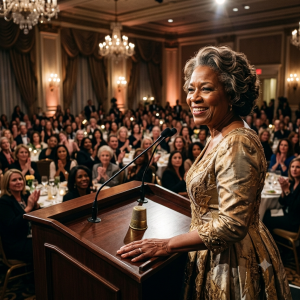
She walked into that ballroom in a dress nobody could name.
Not the brand. Not the fabric. Not even the color — because depending on the light, it shifted from deep champagne to something closer to old gold. Every woman in the room glanced at it. A few leaned over to whisper. None of them knew.
But Noelle Pratt knew.
She’d made it herself. Every stitch. Every seam. The way she’d been making things since she was eleven years old in her grandmother’s back bedroom in Broken Arrow, Oklahoma, with nothing but a hand-me-down Singer and a stubborn streak nobody had managed to cure yet.
She was sixty-one now. The keynote speaker for the National Women’s Auxiliary Conference. Standing in the lobby of a Tulsa Marriott ballroom, checking in with a calm she had spent three decades earning.
And in her right hand, rolling slowly between her fingers, was a small brass thimble.
—
Thirty years ago, she’d been twenty-nine.
Dating a man named Gerald Marsh — tall, charming, the kind of handsome that makes a young woman overlook the way his mother looked at her.
His mother was Eleanor Marsh.
Eleanor ran the Tulsa chapter of the Women’s Auxiliary the way some women run small countries. Guest lists. Dress codes. A particular standard for what belonged and what didn’t.
Noelle had been invited to the auxiliary’s spring luncheon at First Presbyterian — not by Eleanor, but by Gerald, who thought it would go fine.
It did not go fine.
She’d worn something she made herself. A pale green suit, fitted, careful. She was proud of it. She’d worked on it for two weeks.
Eleanor had looked at it the way you look at something you’re about to set outside.
In front of forty women, between the soup course and the salad, Eleanor Marsh had referred to Noelle as “Gerald’s little discount seamstress.” She’d said it with a smile. The kind that dares you to react.
A few women laughed. Most just went quiet in that particular way that means they’re relieved it isn’t them.
Noelle had stood up so fast her elbow caught her place setting.
The brass thimble — she always kept one in her pocket, a habit from her grandmother — flew off the table and skittered across the hardwood floor.
She didn’t pick it up.
She walked out.
Gerald did not follow.
—
She found the thimble three days later. She’d gone back for her coat, left on a hook by the door, and there it was — still on the floor near the table leg, like nobody had bothered.
She picked it up. Slipped it in her pocket.
And she made herself a promise she didn’t say out loud to anyone. Not for thirty years.
—
What happened between that day and this one is a longer story than a lunch can hold.
A business started in a spare bedroom. A line of custom bridal wear that caught the attention of a Dallas boutique, then a magazine, then a buyer in New York who called her work “architectural.” Contracts. A flagship studio in Tulsa — yes, back in Tulsa, on purpose. An apprenticeship program for young women from backgrounds like hers, because she remembered what it felt like to be the only person in the room who made her own clothes because she had to.
She never forgot Eleanor Marsh.
She never contacted her either.
She just worked.
The thimble came with her everywhere. Client meetings where someone questioned her pricing. Trade shows where a buyer talked over her to her assistant. A morning, years ago, when a competitor told a reporter her success was “regional at best.”
Every time, her right hand found her pocket.
Every time, the thimble rolled slow and steady between her fingers.
Every time, she smiled and let the work answer.
—
The program chair had emailed her six months ago.
The Women’s Auxiliary. National convention. Keynote.
Noelle had sat with that email for a full day before she responded.
Then she opened her sewing room, pulled out fabric she’d been saving, and started to cut.
—
She stepped through the ballroom doors to applause she could feel in her sternum.
Six hundred women. A stage with a podium and a microphone and a spotlight that caught the gold in her dress and held it.
The front row was reserved for chapter presidents and founding members.
Eleanor Marsh was in the front row.
Eighty-one years old. Smaller than Noelle remembered. But sitting with the particular posture of a woman who has never once questioned whether she belongs somewhere.
She looked up when Noelle passed.
Something moved across her face. Recognition. Then something harder to name.
Noelle didn’t stop walking.
She climbed the stairs to the stage. She adjusted the microphone. She looked out at six hundred faces looking back at her.
Then she reached into the pocket of the dress she had made herself.
She set the small brass thimble on the lectern.
It caught the light.
The room went quiet in a way rooms almost never do.
And Noelle Pratt smiled like a woman who had been waiting thirty years for exactly this silence.
Then she opened her mouth —
“My grandmother kept her thimble in her apron pocket,” she said. “She told me it was so she could always find it when she needed it. I was eleven before I understood she meant something more than sewing.”
Her voice was even. She’d practiced the opening. Everything after it, she intended to mean.
“I want to tell you about a lunch I attended thirty years ago. A Women’s Auxiliary luncheon, right here in Tulsa. I was twenty-nine. I didn’t belong there and everyone in that room seemed to know it before I’d finished my soup.”
She didn’t look at the front row. Not yet.
“I wore a suit I made myself. I was proud of that suit. I left that lunch without it meaning anything other than a lesson in where I apparently stood.”
A pause. Long enough to let it settle.
“I also left behind this thimble.” She touched it lightly with one finger. “And I went back for it. Three days later, off a hardwood floor, from under a table leg. And I put it in my pocket, and I made myself a promise.”
She finally looked down at the front row.
Eleanor Marsh was very still. Her hands were folded in her lap. Her chin was level. But her eyes — her eyes had not moved from Noelle’s face since Noelle had stepped onto the stage.
“The promise wasn’t about revenge,” Noelle said. “I want to be clear about that, because I know that’s what you’re expecting. It would make a better story, probably. Girl gets humiliated, girl comes back thirty years later and burns the place down.” She let that sit for just a moment. “That’s not what this is.”
Someone in the third row let out a breath that was almost a laugh.
“The promise I made was simpler. I promised myself I would never let someone else’s assessment of my worth become my operating budget.”
She let the room have that one.
“I was a girl from Broken Arrow with a secondhand sewing machine. And someone who had never touched my work, never asked about my training, never spent thirty seconds considering my life — decided in a glance that I was a punchline.”
Her voice didn’t harden. It didn’t need to. It just stayed exactly where it was, clear and level as a ruled line.
“And I want to say something to every woman in this room who has ever been that girl. Not just figuratively. Actually that girl — the one whose clothes weren’t right or whose family wasn’t known or whose accent was a little too much of where she was from. I see you. I was you. And the work is worth doing anyway.”
Applause moved through the room in a wave. She let it crest and fall.
“Now. I also want to say something to the other woman in that story.”
This time she held Eleanor Marsh’s gaze directly. Steadily. Without anger and without performance.
Eleanor did not look away.
“I don’t know what you knew about yourself that morning,” Noelle said. “I don’t know what you were afraid of or protecting or proving. I’m sixty-one years old and I have learned that people who need to establish a room’s hierarchy before the salad course are usually carrying something heavy enough to make them mean. I don’t hold it anymore.”
The room was so quiet that the ventilation system was audible.
“What I hold,” she said, picking up the thimble and turning it once in the light, “is this. Because it reminds me that precision matters. That you have to protect your fingers while you do hard work. And that something very small can keep you from a lot of unnecessary bleeding.”
She set it back on the lectern.
“I built a business. I have forty-three employees. Twenty-two of them came through our apprenticeship program, which serves young women from working-class households in northeast Oklahoma. We have placed work in nine states and two countries. And every bolt of fabric, every seam, every consultation with a young woman who is learning to trust her own eye — all of it started the day I walked out of a Presbyterian fellowship hall and decided that humiliation was information, not prophecy.”
She talked for forty minutes in total. About craft. About capital and how you find it when nobody hands it to you. About the specific loneliness of being competent in a room that has decided not to see you. About the apprentices — she named four of them by name, their stories, where they were now. About her grandmother, who died in 2003 and never saw the flagship studio but who had once told her that a tight seam in the right place was its own kind of argument.
When she finished, the six hundred women in that ballroom stood up.
Noelle waited for the noise to soften.
Then she picked up the thimble, slipped it into her pocket, and walked down off the stage.
—
She almost made it to the lobby.
“Ms. Pratt.”
The voice was thinner than she remembered. Slower. But the posture, even now, even walking with a cane she hadn’t had thirty years ago, was precisely the same.
Noelle turned around.
Eleanor Marsh stopped about four feet away. She seemed to be deciding something. Then she reached up and straightened a cuff that didn’t need straightening, and she said: “That fabric. The dress. What is it?”
Of all the things Noelle had imagined this woman saying to her over thirty years, that was not among them. She almost smiled.
“Silk charmeuse,” she said. “With a matte organza underlayer to hold the structure. The color shift is from the weave angle. I cut each panel on a different grain.”
Eleanor looked at the dress for a long moment. Studying it. Really studying it, the way someone looks at a thing they recognize they’ve underestimated.
“It’s extraordinary work,” she said. It came out like something that cost her.
“I know,” said Noelle.
Not unkindly. Just honestly.
Eleanor’s jaw moved slightly. Then she nodded, once, with a precision that might have been the only kind of grace she knew how to offer.
“I was not kind to you,” she said.
“No.”
“I was not kind to a number of people.” She said it to the middle distance rather than to Noelle’s face, but she said it. “Gerald told me, eventually, that I had cost him something I had no right to cost him. It took him a long time to say so. It took me longer to hear it.”
Noelle waited.
“I don’t expect anything from you,” Eleanor said, and for the first time she sounded like an eighty-one-year-old woman rather than a chapter president. “I only wanted to say that I heard what you said up there. And that I recognize the suit you’re describing. Pale green. Fitted. A welt pocket on the left side.”
Noelle went still.
“I remember it,” Eleanor said quietly. “I remember thinking, when you first walked in, that it was very well made. And then I decided something else instead.” She looked directly at Noelle. “I’ve thought about that decision more than once over the years. More than I would have expected to.”
The lobby was filling up around them. Women moving past, glancing, giving them room without being asked.
Noelle looked at this old woman — smaller, slower, still carrying that posture like a flag she didn’t quite know how to lower — and she felt something she hadn’t fully anticipated.
Not warmth, exactly. Not forgiveness as a grand gesture. Something quieter than that. The particular feeling of a thing that has been held for a very long time finally being set down somewhere that could hold its weight.
“I’m glad you heard it,” Noelle said. And then, because it was true: “The suit was well made. It was some of my best work at the time.”
Something moved across Eleanor’s face that might, in a different woman, have been a laugh.
“Yes,” she said. “It was.”
They stood there for a moment in the noise of the lobby. Two women, thirty years apart from each other in every way that counted, standing close enough to speak quietly.
Then Noelle said: “I have a luncheon myself, in about forty minutes. Program chair wants photos.”
“Of course,” Eleanor said.
She took a step back. Adjusted that cuff again. Then she said, almost as an afterthought: “The thimble. Your grandmother’s?”
“Yes.”
Eleanor nodded slowly, like something was being confirmed. “My mother had one,” she said. “I don’t know what happened to it.”
She turned and moved away through the crowd, cane and posture and all, and was absorbed into it before Noelle could think of anything else to say.
—
The photographs took twenty minutes.
Then there was a luncheon, and a round table, and a program chair who was visibly thrilled with herself for having secured Noelle as the keynote and wanted to make sure Noelle understood that.
Noelle was patient and gracious and ate most of her chicken.
Later, in the car back to her studio — she’d driven herself, she always drove herself — she reached into her pocket and rolled the thimble between her fingers one more time.
She thought about what she wanted to do with it.
For thirty years it had been a reminder. A small, brass, portable piece of evidence that she had survived something, and that surviving it had cost her exactly nothing she couldn’t afford to lose, and had given her everything she’d needed.
She thought about the apprentice who was waiting for her back at the studio. Twenty-three years old. From Muskogee. Insanely talented and just beginning to understand that about herself, which was the most dangerous and necessary moment in any young maker’s development.
She thought about what it might mean to give something like this to someone who still needed it. Versus what it cost to keep it.
She pulled into the studio parking lot. Sat for a moment.
Then she went inside.
The apprentice — her name was Deja — was at her workstation, frowning at a seam that wasn’t lying flat the way she wanted it to. She looked up when Noelle came in. Started to say something about the seam.
“Show me,” Noelle said, and came to look.
It was a tension issue, simple enough to fix. They talked through it. Deja adjusted, ran a test strip, held it up. Better.
“There,” Noelle said.
Deja studied the strip. Nodded. Then she looked at Noelle and said, “How was the speech?”
“Fine,” Noelle said. “It was fine.”
Deja waited, the way young people wait when they sense there’s more.
Noelle reached into her pocket. Held the thimble for a moment in her palm, where they could both see it.
“My grandmother gave me this habit,” she said. “Keeping one close. Not just for the work. For the rest of it too.”
Deja looked at the thimble. Then up at Noelle.
“Keeps you from bleeding,” Noelle said, “when you’re doing something hard.”
She closed her hand around it. Slipped it back into her pocket.
Not today. Deja wasn’t ready for the full weight of that story yet. But she would be. Noelle would know when.
For now there was work to do, and the afternoon light was coming through the studio windows at an angle that made everything it touched look briefly like gold, and Noelle Pratt sat down beside her apprentice and got back to it.