The mountain cowboy took the bride nobody wanted, and by the time Red Bluff realized what he had really offered Emma Carter, the whole town was already too deep in the story to pretend it hadn’t helped create it.
Emma Carter was not the kind of woman Red Bluff knew what to do with.
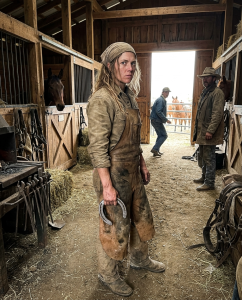
At dawn she was already in the stable, shoulders braced, jaw tight, driving a horseshoe nail into a restless mule while the air still carried the cold of the night. Dust floated through the slanted light. Leather creaked. Somewhere in the back, a gelding kicked once against a stall and settled. Emma barely looked up.
She had worked in that livery long enough to know the sounds of every animal before the sounds of most people. Horses lied less.
The mule jerked when the hammer struck. Emma’s grip tightened instantly, one knee locking the leg in place, her roughened hand smoothing the animal’s shoulder until it stopped trembling. She moved fast, clean, and sure, with the skill of someone who had done difficult work for so long that people had begun resenting the sight of it.
In Red Bluff, Montana, that resentment had become its own kind of tradition.
A woman could be useful in town if she stayed inside the lines. She could sew. She could bake. She could pour coffee into chipped cups and laugh at jokes that weren’t funny. She could stand at a church social with folded hands and act pleased to be evaluated like livestock from behind a fan or bonnet brim.
Emma did none of that. She shoed mules. Loaded feed sacks. Repaired harness leather. Broke up horse fights. Calmed panicked teams. Kept records in careful handwriting in a ledger no one else touched. By sunrise she smelled of hay, sweat, hot iron, and animal breath. By noon she usually had dirt on her jaw and a fresh bruise somewhere on her arms.
The women of Red Bluff called her unfeminine.
The men called her things that were uglier.
They did it when they thought she was too busy to hear.
She always heard.
At twenty-eight, Emma had the kind of face people remembered because she never arranged it to make them comfortable. Her hair was usually pinned back in a hurry. Her skin browned easily under the sun. Her left palm carried a pale scar from the day, at fourteen, when a mare bolted beside a wagon and Emma grabbed a barbed wire fence to stop the animal from crashing into a child in the road. She still remembered the pain, the blood, and the silence afterward.
No one had thanked her.
No one had ever thanked her for anything they thought should have belonged to a man.
That was why, on the July morning Dale Finch stormed into her stable with Aldis Pratt and four ranch hands behind him, Emma did not feel fear first.
She felt annoyance.
“You overcharged me for that mule,” Finch said, loud enough for the whole stable to hear. “I want my money back.”
Emma kept working. One nail. Then another. Her mouth was tight around the iron tack she’d been holding between her lips.
“The mule is sound,” she said at last. “The trouble starts farther up the lead rope.”
The ranch hands laughed before they could stop themselves.
Dale Finch’s face darkened.
He was the sort of man who had grown up being told that size, money, and temper were the same thing as authority. Broad through the chest, sharp through the mouth, used to people stepping aside before he had to say much. He took one step closer.
“Watch how you speak to me.”
Emma lowered the mule’s hoof and finally straightened.
“Then watch how you ride animals you don’t understand.”
The silence after that had weight.
Aldis Pratt smiled into it.
Pratt was worse than Finch in a quieter way. He was a landowner, banker when it suited him, advisor when it profited him, and the kind of man who could destroy a person’s standing with one soft sentence spoken in the right room. His boots never carried mud because he always found someone else to walk through it for him.
“This town is tired,” he said mildly, “of watching you pretend you can do a man’s work, Emma.”
Emma looked at him without blinking.
“That’s strange,” she said. “My books show most of this town still bringing their stock to me when your men can’t manage them.”
The ranch hands looked down.
Dale Finch raised his hand then. Not to strike yet. Just to remind her he might.
And that was when the shadow crossed the stable doorway.
Caleb Morgan stepped inside carrying mountain dust on his coat and a silence heavy enough to stop the room cold.
He wasn’t from town, not exactly. He lived high in the Bitterroot country, trapping and hauling and doing the sort of hard mountain work that kept a man absent long enough for rumors to grow where facts should have been. Red Bluff knew of him. It knew he had once brought down a half-frozen neighbor through a blizzard. It knew he’d buried his wife Ruth two winters before after fever took her fast. It knew he came down only when he needed supplies and left before anybody could decide what to make of him.
He looked at Finch once, then moved between Finch and Emma as though that place had opened for him.
“I need to speak with Miss Carter,” he said.
Finch sneered. “This isn’t your affair.”
“It will be,” Caleb replied, “if you keep standing where I need to.”
That should have started something loud.
Instead it ended everything.
Caleb did not reach for his rifle. He did not puff himself up or bark or threaten. He simply stood there with a calm that was somehow more dangerous than anger, and everyone in that stable understood the same thing at once: forcing him would cost too much.
Finch stepped back first.
“This isn’t over,” he said.
“It is for today,” Emma answered. “And the answer is still no.”
When they were gone, Emma turned to Caleb with no gratitude in her face and no apology in his.
“What do you need?”
“Three mules,” he said. “High elevation. Heavy loads. Bad ground.”
She studied him, then the animals, then him again. He was a tall man with weather in his skin and weariness somewhere behind the eyes, but not weakness. He stood like someone used to cold mornings, rough miles, and grief that had become part of his posture. Not dramatic grief. The older kind. The kind that reshapes a person quietly.
Emma walked the line and picked the animals herself.
A gray with deep lungs. A brown mule with brutal strength through the shoulders. And a black one with hard, knowing eyes that looked as though it distrusted the world on principle.
“The black one lasts longest when things turn ugly,” she said.
Caleb almost smiled. “You think they will?”
She gave him a flat look. “Things always do.”
He paid in full without trying to haggle, which already made him unusual. More unusual still, he waited while she wrote the contract in her own ledger, line by line, including the condition of the animals, the exact amount, the date, and both names.
“You write your own papers,” he said.
“I trust my own hand more than most men’s word.”
He nodded once. “Reasonable.”
As she worked on the brown mule’s shoeing, he mentioned Ruth.
He did not mean to. Emma could tell by the way the name came out, as if it had simply slipped from a place in him where it still lived openly. She expected the moment to close after that, the way most people closed around pain in a room full of strangers.
Instead she said, “Ruth came through here once.”
Caleb looked up sharply.
Emma set the shoe down.
“She said you were as stubborn as the mountain itself. But she also said you gave her the first safe home she ever had.”
For the first time since walking in, Caleb lost his balance slightly—not in his body, but in his face. Not many people spoke of the dead correctly. Most either turned them into saints or handled them like broken glass. Emma did neither. She gave him Ruth back in one sentence as a real woman who had judged him honestly and loved him anyway.
He was still quiet an hour later when the mules were ready.
Then he did something Emma did not expect.
He set the signed sale contract between them and said, “I have a proposal.”
Emma folded her arms.
“It won’t be comfortable,” he continued. “I need a partner for the season. Someone who can manage pack animals, loading lines, bad weather, and worse men. Half the profits from the fur haul. Everything written. Witness before Judge Caldwell.”
Emma stared at him.
She had spent years being denied wages, respect, safety, even ordinary decency. Nobody in Red Bluff offered women partnership. Men offered wages they could control, pity they could withdraw, or marriage if they thought a woman had nowhere else to go.
A partnership was something else entirely.
“Why me?” she asked.
Caleb answered without delay. “Because Finch came at you and you didn’t move. Because you picked the best mule, not the one that made you the most money. And because Ruth didn’t speak well of many people.”
The stable seemed to narrow around the words.
Emma should have refused quickly. A decent woman in Red Bluff did not go into mountain country with a widower. She did not tie her name to a man, a season, and a dangerous operation. She certainly did not do it when half the town was waiting for proof that she was exactly what they already whispered.
But Emma had lived too long under the mercy of people who hated her competence.
She asked for two days.
The very next morning, Aldis Pratt arrived alone.
He found her carrying grain.
“Morgan isn’t right in the head,” he said. “No decent woman goes up a mountain with a widower.”
Emma dropped the sack to the floor hard enough to send dust into the light.
“You’ve spent six years hoping I’d never have better options than this town,” she said.
Pratt’s smile thinned. “This town will talk.”
“This town has talked since I was old enough to lift a bucket.”
He tried to tell her it would ruin her name.
The threat would have landed harder if Red Bluff had ever protected her name in the first place.
At nine o’clock she stood before Judge Caldwell beside Caleb Morgan and signed the contract. Equal partnership. Protected rights. Her livery remained hers alone. The mountain operation would belong to both of them for the season. Caldwell read every line carefully and added his witness seal with the tired expression of a man old enough to know when a town was about to show its worst side and too practical to waste breath pretending otherwise.
When they stepped outside, Caleb said, “They’re going to make it sound dirty.”
Emma buttoned her gloves. “They already do.”
That might have been the end of the trouble if gossip had been all it was.
But that afternoon, while packing coffee, nails, tarps, tools, salt, and winter blankets into travel crates, Emma looked out toward the corrals and saw one of Finch’s ranch hands standing too close to the mule lot.
He wasn’t idle. He wasn’t admiring stock.
He was counting.
His eyes moved from animal to animal, then toward the road, then back again. Calculation. Not curiosity.
Emma went toward him at once.
“What are you doing?” she snapped.
The young man turned, saw her expression, and went pale enough to show the dust on his face. Then he ran.
He didn’t answer. Didn’t bluff. Didn’t even curse on the way out. He simply bolted through the gate like a boy caught trespassing in a graveyard.
Emma stood still in the yard after he was gone, one hand on the gate chain, the other curled into a fist.
A cold thought settled into her chest.
This was no longer about laughter behind curtains.
Someone cared enough about Caleb’s deal to watch the mules.
That night, Emma didn’t trust sleep. She checked every latch herself. Sat in the office in the dark with her ledger open and a shotgun across her knees. The stable breathed around her—snorts, hoof shifts, the comforting dull weight of animals at rest. Sometime before dawn she heard boots outside.
Not sneaking.
Waiting.
By the time she stepped out, whoever had been there was gone.
Only one thing remained tied to her fence post: a bent horseshoe, freshly broken.
A warning.
When Caleb arrived at sunrise with pack rope over one shoulder and folded tarps in his wagon, he saw the horseshoe in her hand and stopped.
“Who?”
“Could be Finch,” Emma said. “Could be someone hoping I blame Finch.”
Caleb crouched by the post and studied the dirt. “Two riders,” he said. “One horse drags its left hind slightly.”
Emma felt her jaw harden. “Finch’s bay does that.”
Caleb looked toward town. “Then they wanted you frightened before you ever left.”
Emma almost laughed at that, but there was no humor in her.
Instead she tied the bent horseshoe to the side of her saddle as if it were a keepsake, not a threat.
“Good,” she said. “Let them know I received it.”
They loaded out under watching eyes.
Red Bluff always seemed busiest when it had scandal to feed on. Storefronts opened. Wagons rattled past. Women paused in conversation and pretended not to stare. Men found reasons to linger near hitching rails. Nobody came close enough to speak plainly. But everyone watched the widower and the stablewoman securing crates together, checking cinches together, reading the road together, and each person watching added their own sentence to the story before the pair had even left the main street.
Emma mounted without ceremony. Caleb checked the rear load and swung up beside the lead mule.
As they turned out of town, Emma noticed something near the wagon ruts by the edge of the yard. A scrap of paper half buried in dust.
She leaned down, caught it, and unfolded it with one gloved hand.
It had been torn from a ledger page.
Only one line was written across it.
Back out now, or the mountain buries more than animals.
Emma recognized the hand at once.
Not Finch’s. Not Pratt’s.
Judge Caldwell’s clerk.
The realization hit her like ice water.
Caleb saw the change in her face. “What is it?”
She handed him the note.
He read it once, then again, slower.
“That’s not a threat from drunk boys,” he said.
“No.”
“It means someone close to the paperwork wants this stopped.”
Emma looked back toward Red Bluff, where the roofs already seemed smaller, meaner, farther away.
“You still want to turn around?” Caleb asked.
She met his eyes.
For the first time, the question between them was not about gossip or pride. It was about whether they understood that whatever waited ahead might have already reached behind them into town offices, account books, and men who preferred to stay invisible.
“No,” Emma said. “I want to know why.”
The first two days on the mountain were hard in all the ways mountain work was supposed to be hard. Narrow trails. Bad footing. Sudden weather. Packs that needed shifting twice before noon. But Emma felt better with each mile. Up there, skill mattered more than opinion. The animals responded to hands, voice, and judgment—not reputation.
Caleb watched her work with increasing respect he never dressed up as flattery.
She corrected a leaning load before it spilled down a shale cut. Talked a skittish mule across a washed-out crossing no ranch hand in Red Bluff would have managed cleanly. Spotted weather change in the cloud line before Caleb did and had the tarps drawn over the packs before the rain hit.
“You’ve done this before,” he said that evening by the fire.
“Not like this.”
“It looks like this knows you.”
Emma stared into the flames. “Work is work. Animals are simpler than people.”
He made a quiet sound that might have been agreement.
Over the next week, they found a rhythm. Caleb handled the rifle and traps, route choices, elevation decisions. Emma managed the strings, packs, supplies, and the endless labor that kept a mountain operation from falling apart. At night they ate near the fire and spoke little, but the silence stopped being awkward. Once, Caleb told her how Ruth had loved the first snow and hated onions. Once, Emma admitted she had not attended her sister’s wedding because she’d overheard the groom call her an embarrassment.
“Did your sister know?” Caleb asked.
“She knew enough not to ask me to stay.”
He looked at her for a long moment. “That was a coward’s way to love you.”
Emma did not answer because the truth of it hurt too much.
Then the sabotage began.
First a pack strap cut almost through, hidden on the underside where a careless eye would miss it. Then bait sacks gone. Then boot prints near camp at dawn when neither of them had left the fire in the night. Someone was following them high enough into the Bitterroot to know their route and bold enough to come close.
Caleb said little after that. His quiet turned sharper.
Emma noticed he slept lighter. Sat where he could see the trees. Checked his rifle twice.
On the ninth day, they found proof that turned suspicion into fact.
One of the traps had been sprung and reset badly. Nearby in the mud was the heel mark of a town-made boot, not mountain wear, and beside it the ash of a cigarette paper sold only in Red Bluff at Pratt’s mercantile.
Emma crouched in the brush and looked up at Caleb. “They came from town.”
“Yes.”
“Why?”
He hesitated.
That was the first time Emma understood there was something Caleb had not told her.
She rose slowly. “What are you keeping from me?”
He looked tired then, not from work, but from deciding whether truth would cost him the one thing in this arrangement he had not expected to value—her trust.
“Ruth’s father died three years ago,” he said. “Left a land claim in the upper valley. Timber, creek access, trapping corridors. On paper it’s worth more now than when he held it. Pratt has wanted it for years.”
Emma felt the pieces begin to align.
“Ruth inherited it.”
“Yes.”
“And after she died?”
“It passed to me.”
Emma stared.
This had never been only a fur season. Never only a job.
“You think they’re trying to push you off the claim.”
“I think they’ve been trying quietly for two years.” He met her eyes. “When you signed on, they got louder.”
Because now there was a witness.
A literate, stubborn, contract-writing witness who could count stock, read boundaries, keep records, and stand in court without folding.
The next days turned dangerous fast.
A mule was driven loose one night but recovered at dawn. Food stores were slashed. A rockslide came down near a narrow pass far too conveniently to feel natural. Then, at last, the men stopped hiding.
Dale Finch and two others rode into their upper camp just before sunset, rifles visible but not raised. Aldis Pratt came on a fourth horse, boots still too clean.
Emma was on her feet before the first horse stopped moving.
Pratt lifted a hand like a preacher about to bless a room.
“Let’s not make this dramatic.”
“You rode six days to interfere with my contract,” Emma said. “Seems dramatic enough.”
Finch’s grin was ugly. “You should’ve stayed in town.”
Caleb stepped beside Emma.
Pratt looked between them with open contempt. “This is simple. Morgan signs over seasonal use of the upper corridor. Temporary. We settle accounts. Everyone rides home.”
Emma laughed once. “You forged threats through court papers, followed us into the mountain, cut our gear, and you want to call that settling accounts?”
Pratt’s eyes narrowed. “Be careful.”
“No,” she said. “You be careful. Judge Caldwell witnessed our contract. My ledgers list stock, dates, losses, and interference. If we go back empty and hurt, I know exactly where to start naming names.”
Finch moved first—too fast, too angry.
He grabbed for the black mule’s lead, maybe thinking he’d startle the camp into chaos.
He had chosen the wrong animal.
The black mule exploded sideways, slammed him with its shoulder, and sent him stumbling into the fire ring. One of the other horses reared. In the confusion Caleb disarmed one rider. Emma swung a shovel handle hard into Finch’s wrist when he lunged toward her, and his pistol dropped into the dirt.
Everything after that happened in a blur of dust, curses, and animals screaming.
Pratt tried to retreat when he saw the balance change, but Emma was already at his bridle.
“Tell me who wrote the note,” she demanded.
Pratt’s face had lost its smoothness.
“The clerk owed me money.”
“So you bought a court hand to threaten us.”
“You don’t understand what land like this is worth.”
Emma leaned closer. “I understand exactly what it’s worth. That’s why you wanted a widow’s husband isolated and easy to bully.”
Caleb had Finch pinned hard enough to make the man gasp.
When Pratt realized bluff had failed, the last of his poise vanished. “You think this ends with town papers? You think they’ll choose you over men like us?”
Emma looked at him, then at Caleb, then at the mules standing wild-eyed around the torn camp, and felt something inside her settle into steel.
“No,” she said. “I think they’ll choose proof.”
They rode back to Red Bluff with four prisoners, one disarmed clerk waiting in town, and enough written evidence to end every whisper that had protected men like Pratt for years.
Judge Caldwell read the accounts in silence. Then he looked at his clerk, who broke before noon. Debt, bribery, forged warnings, false filings prepared in advance in case Caleb “disappeared” on his own claim. Pratt had planned to strip the corridor rights, then take the valley by legal motion once there was no one left capable of contesting the record.
Finch, meanwhile, had done the rougher work because he assumed intimidation had no cost.
For once in his life, he was wrong.
The town that had always enjoyed watching Emma Carter be humiliated discovered it liked watching powerful men exposed even more.
Pratt lost standing first, then business, then credit. Finch lost the easy protection that came from being useful muscle for richer men. The clerk was dismissed in disgrace. Judge Caldwell, grim and furious that his office had been used that way, made sure the depositions were copied, witnessed, and entered so deeply into county record no one could bury them later.
Emma’s name changed in Red Bluff after that, though not in the way people expected.
Not everyone respected her. Some never would. But even those who disliked her stopped speaking as if she were easy to corner. She had ridden into the mountain as a woman people mocked and returned as one who had outworked, outlasted, and outdocumented men who thought force was enough.
As for the partnership, the fur season finished strong.
Very strong.
Emma proved better at the operation than either of them had predicted, and Caleb—who had not expected companionship, much less trust—found himself looking for her at dawn, measuring roads by whether she rode them beside him, and noticing how the camp felt wrong whenever she was out of sight too long.
Love did not come to them like gossip had predicted, sudden and dirty and convenient.
It came carefully.
In shared labor.
In respect earned daily.
In a silence by the fire that no longer felt empty.
The first time Caleb asked whether she might consider staying through winter, he did it badly, staring at the saddle he was oiling as if it had become the most important object in the world.
Emma let him suffer for a full minute before answering.
“Are you offering wages,” she asked, “or a real share?”
He looked up at once. “A real share.”
“In the work?”
“Yes.”
“In the decisions?”
“Yes.”
“In the home?”
That was when he understood she was not teasing him.
He stood.
“Yes,” he said quietly. “In all of it. If you want it.”
Emma had spent years being treated like something men rented from necessity and judged in private.
So she made him say it correctly.
“Then ask me as if you know who I am.”
He did.
And when she accepted, Red Bluff called her Caleb Morgan’s bride with the same hungry surprise it had once used to call her unwanted. But the truth was simpler and stranger than the town could manage:
Caleb had not rescued Emma.
He had recognized her.
That was the difference.
They married in late autumn with Judge Caldwell present and half the town pretending their attendance had nothing to do with curiosity. Emma wore a plain dress and practical boots under it. Caleb looked like he’d rather face winter wolves than stand before spectators, which only pleased her more. Afterward, she went back to the stable to check on a mare before supper because some habits mattered more than ceremony.
Their home in the mountains was not soft, not easy, and never fashionable enough for Red Bluff’s taste. But it was safe. It was honest. It was built on contracts, labor, argument, laughter that came slowly, and the kind of trust that doesn’t appear in a single dramatic moment but accumulates one proven day at a time.
Sometimes town women still lowered their voices when Emma passed.
Sometimes men still looked uncomfortable taking instruction from her when she knew more than they did.
But none of them said unwanted where she could hear it.
Not anymore.
Because the biggest mistake Red Bluff had made was believing Emma Carter needed to be chosen in the first place.
And maybe that was the question that stayed with people long after the scandal was over: whether Caleb Morgan had been the brave one for offering her a place beside him, or whether Emma had been braver for demanding it be an equal one before she ever climbed into the saddle.