By the time Evelyn Hart realized the wagon was gone, she was already standing in the kind of silence that changes a person forever.
Snow had begun drifting into the clearing in thin, needling curtains. The half-filled sack of firewood hung from her hand. Her left hip pulsed with that old, deep ache that never truly left anymore. At first she thought she had turned around wrong. That she had come back to the wrong patch of pines. That the storm had blurred the familiar shapes and made fools of her eyes.
Then she saw the tracks.
Two wagon ruts carved deeply into the fresh snow, heading east. Straight. Controlled. Deliberate.
Beside them were Bessie’s hoofprints, firm and even.
No signs of panic.
No broken lines.
No mess of confusion.
They had not gotten lost.
They had left.
Evelyn slowly let the sack slip from her fingers.
“Papa?”
Her voice sounded too small for the mountain. It vanished among the trees and came back as nothing.
A memory rose instantly, sharp as ice.
Three weeks earlier she had been lying under blankets in the dark, still and quiet, listening through the thin wall while Margaret spoke in the low, poisonous tone she used when she wanted to sound practical.
“That girl won’t make it over the pass with that leg. She’ll get us all killed if we keep dragging her.”
And Caleb Hart, her father, had answered after a long pause, “I’ll think on it.”
She had lain awake for hours after that, staring into the dark, telling herself he would never do it. He had buried her mother with his own hands. He had promised to protect Evelyn. He was weak, yes. Quiet, yes. Too willing to bend to Margaret, yes. But not this.
Not this.
Now she knew exactly what his silence had meant.
He had thought about it.
Then chosen his wife, his sons, his own comfort, and his own fear over his daughter’s life.
A gust of wind sliced through her coat. The sky above the pines had turned the color of old metal. More snow was coming, heavier than this, enough to cover every trace of what had been done. Evelyn gripped a fallen branch and began following the wagon tracks.
The pain started almost immediately.
Two years earlier the family wagon had tipped crossing a rut. Evelyn had been thrown hard and the wheel had struck her left hip. In a town with a proper doctor and money to spare, perhaps the bone would have been set well. But by the time Caleb got her somewhere help could be found, it had already begun healing crooked. She survived. That was the word everyone used, as if survival should have made her grateful enough not to notice what came after.
The limp.
The slow days.
The muttered complaints.
Margaret’s cold looks.
Cole’s laughter.
Thomas’s silence.
Burden became the family name no one spoke in public.
By dusk Evelyn had fallen twice. By full dark she found shelter beneath a wind-dropped spruce, built a miserable little fire, and ate half a stale piece of bread from her pocket. She kept her tears inside because tears spent water and heat. She learned that from hardship, not kindness.
At dawn she rose stiff and shaking and walked again.
By noon the wagon tracks had vanished beneath fresh snow.
There was no east anymore. No road. No certainty. Only white slopes, black trees, and the slow, merciless stealing away of strength.
She walked until walking became lurching.
Lurched until lurching became falling.
Then she fell between two rocks at twilight and stayed there long enough to feel the mountain beginning to claim her.
That was when the shadow appeared.
A shape loomed through the snow, broad and tall, moving with absolute balance over ground that had nearly killed her. Fur collar. Rifle strapped across the back. A frozen fox dangling from one hand. A face half-covered by scarf and winter.
“Are you alive?”
The question was so blunt it was almost absurd. Evelyn’s lips cracked when she answered.
“Yes.”
“Alone?”
“Yes.”
He looked over the slope, then down at her hip. “Can you walk?”
She tried. Pain shot through her so hard that black spots burst behind her eyes.
“No.”
He set the fox down, shifted the rifle, and lifted her in one clean motion. She cried out. His jaw tightened but he didn’t apologize.
“This will hurt.”
“It already does,” she whispered.
He turned into the wind.
“Where are you taking me?”
“My cabin.”
“Who are you?”
A few steps passed before he answered.
“Ronan Creed.”
Then the world faded.
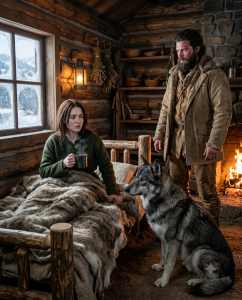
When Evelyn woke, she found herself in a log cabin warmed by a stone hearth. Heavy furs covered her. Smoke and broth scented the air. Shelves held dried herbs, folded cloth, candles, cartridges, jars of beans, and every useful thing that meant the difference between endurance and death in a place like this.
Near the bed sat a gigantic gray dog with yellow eyes.
Evelyn stiffened.
“He won’t touch you unless I tell him to.”
The man from the snow stood by the fireplace, one shoulder against the stone. Without the storm around him, he seemed even more formidable. He wore winter like part of his own body. Nothing about him looked softened by comfort or company. A pale scar ran from his temple down toward his beard. His expression was unreadable in the way of men who had spent too many years depending only on themselves.
“What’s his name?” Evelyn asked.
“Rack.”
“My name is Evelyn Hart.”
He crossed the room and handed her a cup of broth. “Drink slow.”
It was hot enough to sting her cracked lips. She didn’t care. Warmth spread through her in painful waves.
After a few sips, she looked up. “What do you expect from me?”
His eyes rested on her steadily. “Nothing you’re afraid of.”
She hated that he understood the question so quickly.
“You saved me,” she said. “Men don’t usually do that for free.”
“Not for that.”
He said it so flatly that she believed him against her own instincts.
He explained the arrangement simply. She would stay until spring because the pass would be impassable before then. She would cook, mend, and tend the fire as she was able. He would hunt, trap, cut wood, and see to the cabin. In spring she would leave.
Evelyn should have felt relief.
Instead she heard herself say, “My family left me to die.”
Ronan’s expression changed just enough to show he was listening with unusual care.
“I saw the wagon tracks,” she continued. “Straight east. They didn’t lose me. They abandoned me.”
He asked a series of practical questions that somehow felt more compassionate than any comfort could have. Had they left her with food? Had anything about the errand seemed arranged? Had her father spoken? Evelyn answered quietly, and with every answer Ronan’s face grew stiller.
“People who plan a death,” he said at last, “usually plan the story too.”
The words made her stomach turn.
Because of course Margaret would have one. Evelyn wandered off. Evelyn refused to keep pace. Evelyn must have panicked in the storm. Margaret would cry. Caleb would stare at the ground. Thomas would say nothing. Cole would repeat whatever story made him safest.
That night Ronan gave her the bed and took a chair near the hearth. Rack slept between them like a living wall. The wind hammered the cabin. Evelyn drifted in and out of sleep, waking each time to see the orange wash of coals and the shape of Ronan awake, watchful, as though rest itself had become a habit he no longer trusted.
In the morning he examined her hip.
“Lie back,” he said.
She obeyed, every muscle tense.
His hands were warm, careful, and absolutely clinical. He tested the joint, the movement, the place where the old injury caught. When he rotated her leg, pain flashed so violently she grabbed the blanket and nearly bit through her lip.
He stopped at once.
“It healed wrong,” he said. “Partially. There’s scar tissue and misalignment.”
“You talk like a doctor.”
“I don’t.”
“Then how do you know?”
His mouth shifted, not quite a smile. “Because I’ve seen what mountains do to bones.”
There was a history in that answer, one he did not explain.
“Can it be fixed?” she asked.
He hesitated. “Some of it. Not all. But enough that walking may hurt less.”
“And how much will that cost me?”
His eyes flicked up to hers. “You ask that like every kindness comes chained.”
“It usually does.”
Something old and hard moved through his expression then. Not anger at her. Anger at whoever had taught her that.
“It’ll cost you screaming,” he said. “Maybe cursing me. Maybe trying to hit me if I pull too hard.”
She gave a shaky laugh. “Everything hurts already.”
“Not everything has to keep hurting.”
The sentence stayed with her long after he left to chop wood.
By the end of the first week, Evelyn understood that Ronan Creed lived like a man built out of habit, labor, and silence. He rose before dawn, checked the traps, fed Rack, split wood, repaired what winter damaged, and wasted nothing—not words, not food, not motion. He was never unkind, but he was not easy either. He expected work done properly. He did not fuss. He did not hover. Yet every time Evelyn stood too quickly, there he was nearby without making a show of it. Every time she struggled with a kettle or a basket, some adjustment had already been made to make the task easier.
He noticed everything.
He never mentioned that he did.
A storm pinned them inside for two days. On the second evening, while she mended a tear in one of his shirts, Evelyn asked, “Why do you live up here alone?”
Ronan sat by the fire sharpening a hunting knife. “Because people are easier to manage at a distance.”
“That sounds like an answer from someone who used to know too many.”
His blade paused once across the stone. “It is.”
He did not elaborate, and she did not press.
But the mountain has a way of forcing truths into the open.
On the tenth night came the knock.
Three hard strikes against the cabin door.
Ronan was on his feet with the rifle before the third one landed. Rack rose with a low growl, fur bristling. Evelyn’s blood turned to ice.
No one came this deep by accident in winter.
Ronan moved toward the window, lifted the corner of the curtain just enough to see out, and went very still.
“Stay where you are,” he said quietly.
But Evelyn was already trying to rise.
He looked back at her then, and whatever she saw in his face made the room feel colder than the mountain outside.
Not fear.
Recognition.
He opened the door a crack, rifle angled.
A voice came through the wind.
“We’re looking for my daughter.”
Caleb.
Evelyn stopped breathing.
Margaret stood behind him wrapped in a fur-lined coat, eyes wet and wide with the perfect imitation of a grieving mother. Thomas was there too, taller than Evelyn remembered, his mouth set hard. Cole shifted beside the mule, trying to look solemn and failing. Two men from a settlement farther down the range stood behind them.
Margaret put a hand to her chest. “Mr. Creed, thank the Lord. We heard someone up this way may have seen her. She wandered off in the storm.”
Wandered off.
Ronan’s grip on the rifle tightened almost invisibly. “Did she?”
Caleb’s eyes moved past Ronan, into the room, and landed on Evelyn.
For a second the whole world narrowed to that look.
Shock.
Then relief.
Then something uglier.
Calculation.
“Evelyn,” he said hoarsely.
She had dreamed of this moment in two different ways. In one, she broke apart with grief and ran into his arms like a child. In the other, she screamed the truth so hard the walls shook.
What came instead was colder than either.
“You found your way here quickly,” she said.
Margaret stepped forward. “Oh, sweetheart, we’ve been frantic.”
“No,” Evelyn said. “You weren’t.”
The two men behind Caleb exchanged a glance. Thomas looked at the floor. Cole frowned like he didn’t understand why the script had changed.
Margaret’s face trembled beautifully. “You’re confused, poor thing. We lost sight of you when the storm—”
“I saw the tracks.”
Silence slammed down.
Ronan opened the door wider then, not in welcome but in challenge.
Evelyn held Margaret’s gaze. “Straight east. Steady mule prints. No panic. No searching. You left before I came back.”
Caleb’s mouth opened, then closed.
Margaret recovered first, because of course she did. “She’s upset. Fevered. Mr. Creed, with respect, she took a terrible blow years ago. Sometimes when she’s frightened, she—”
“Finish that sentence,” Ronan said softly.
Margaret looked at him and stopped.
It was the first time Evelyn had seen anyone silence her.
One of the settlement men frowned. “Mr. Hart said the girl wandered.”
“She didn’t wander,” Ronan said. “I found her half buried between rock faces three miles north of the pass with no horse, no bedroll, and barely enough bread for a child.”
Thomas’s head snapped up.
Margaret’s eyes flashed. “You have no right to meddle in family matters.”
That was when Ronan gave a short, humorless laugh.
“Leaving your daughter to freeze isn’t a family matter. It’s an act.”
Caleb flinched as if struck.
Evelyn had spent so long believing her father’s worst quality was weakness that the truth took another moment to settle: weakness could be cruelty when it chose silence over a life.
Thomas finally spoke. His voice came out raw. “I told you this would happen.”
Margaret turned on him. “Be quiet.”
But he didn’t. “I told you we should go back. I told him too.” He pointed at Caleb with a shaking hand. “I said if we left her there, she’d die.”
Cole went pale. “Thomas—”
“You laughed,” Thomas snapped. “You laughed.”
Everything seemed to tilt.
Margaret tried once more, reaching for tears, outrage, anything she could still control. “This is monstrous. Caleb, say something.”
Caleb looked at Evelyn, and for the first time in years she saw not fatherhood in his face, but cowardice stripped bare.
“We couldn’t make the pass with the storm coming,” he said weakly. “Your leg… Margaret said…”
Margaret said.
He had found a way, even now, to step back from his own choice.
Evelyn felt something inside her go calm.
“You promised my mother you’d keep me safe,” she said.
Caleb had no answer.
The settlement men exchanged another look, grim now. One of them said, “This needs telling below.”
Margaret rounded on Ronan. “You’ve poisoned her against us.”
Ronan stood like the mountain itself—immovable, cold, and impossible to argue with.
“No,” he said. “You did that yourselves.”
In the end, there was no dramatic dragging away in chains. Frontier justice was uglier and slower than stories liked to admit. But the two men insisted Caleb and Margaret come down to answer questions before the settlement council, and suddenly Margaret’s confidence cracked. She began talking too fast, denying too much, blaming weather, fear, Evelyn’s limp, the boys, chance, anything but herself.
Thomas wouldn’t look at either parent.
Cole started crying.
Caleb looked once at Evelyn, perhaps hoping for mercy he had not shown her.
She gave him none.
When they left, the cabin seemed strangely larger.
Ronan closed the door. Rack settled. The wind moved around the walls in a long, low moan.
Evelyn sat back slowly, shaking with delayed force. Not from fear. Not entirely. From the sheer violence of surviving both the mountain and the people who had fed her to it.
Ronan knelt in front of her, keeping just enough distance to let her choose.
“It’s over,” he said.
She looked at him and realized he was wrong.
“It isn’t,” she whispered. “Because they’re still my family.”
A long silence passed.
Then he said, “Blood is an accident. Choice is what makes people yours.”
The words entered her like warmth.
Spring came late that year.
By then Evelyn could walk farther and with less pain. Ronan had helped reset what could be reset. The work had been brutal. She had screamed, cursed him, and once nearly struck his shoulder exactly as he predicted. He had endured all of it without offense, then brewed willow-bark tea and sat beside the fire until the worst passed.
She learned the rhythms of the cabin. He learned the shape of her silences. She laughed more than she had in years, and each time it seemed to surprise them both. There were still difficult mornings, still shadows, still the ache of betrayal that came without warning. But there was also bread rising near the hearth, Rack sleeping with his head on her boots, and the sound of Ronan outside splitting wood while snowmelt ran off the roof in silver threads.
Neither of them spoke of spring much.
Then one evening, while the mountains turned blue with thaw and sunset, Evelyn said quietly, “When the pass opens, I suppose I should go.”
Ronan stood by the doorway, one hand on the frame. “If that’s what you want.”
She waited. “And if it isn’t?”
For the first time since finding her in the snow, Ronan Creed looked uncertain.
“Then stay.”
Her heart beat hard once. “As what?”
He crossed the room slowly, as if approaching something more dangerous than any winter storm.
“As my wife,” he said. “Only if it’s your choosing. I won’t take gratitude and call it love. I won’t offer rescue and turn it into debt. But if you stay, stay because you want this place. Because you want Rack underfoot and smoke in your hair and me bringing in too much venison. Stay because when you look at me, you don’t see another cage.”
Evelyn felt tears rise then—the hot kind she had denied herself on the mountain because survival gave no room for them.
“My family left me to die,” she said.
“I know.”
“And you’re asking me to build a life with a man I met the same night I was supposed to disappear.”
“I’m asking nothing,” Ronan replied. “I’m offering.”
That was the difference.
That was everything.
She stepped closer, hip aching, heart raw, and laid her hand against the center of his chest, where his heartbeat moved steady beneath wool and skin and all the guardedness he had worn for too long.
“I choose to stay,” she whispered.
He closed his eyes briefly, as if the words struck deeper than he’d expected. When he opened them again, all that iron restraint was still there, but warmer now, less lonely.
Rack gave a huff from the hearth as though settling a matter that had taken the humans far too long.
They were married two weeks after the pass opened, with a preacher from the settlement and exactly three witnesses, one of whom was Thomas.
He came alone.
Thinner. Older in the face. Ashamed.
“I should have gone back for you,” he told Evelyn before the ceremony, voice unsteady. “I was afraid of her. Of both of them. But I should have gone.”
Evelyn looked at him for a long time. Fear had made him weak too. But unlike Caleb, Thomas did not hide from it.
“You should have,” she said.
He nodded, accepting it.
Forgiveness did not come all at once. Maybe it never really does. But truth was at least a beginning.
Margaret and Caleb were not welcomed kindly in the settlement after what came out. People could survive many harsh things on the frontier, but abandoning your own blood in a storm was the sort of act that stained every handshake after. They moved on before winter returned. Few asked where.
Evelyn never did.
Years later, people still told the story wrong sometimes. They said Ronan Creed found a girl freezing in the mountains and made her his bride, as if the romance began with rescue.
But that was never the real story.
The real story was that one family looked at a wounded woman and decided she was too inconvenient to keep alive.
And one man looked at that same woman and saw someone worth choosing only if she could choose him back.
That was the red flag she never forgot. Not the storm. Not even the abandonment. It was how easily cruelty could dress itself up as necessity, and how long silence could pretend not to be guilt.
Sometimes, on the coldest nights, Evelyn still woke remembering the clearing, the wagon tracks, the horrible emptiness where love should have been.
Then she would hear the fire crackle, feel Rack breathing near the bed, and turn toward the steady warmth of the man who had never once mistaken possession for devotion.
And she would think that the mountain had nearly buried her—
but it had also shown her, with merciless clarity, exactly who deserved to keep a place in her life.