For ten years, Arturo had worked on the estate of the most respected man in town. He knew the gardens better than he knew his own neighborhood. He knew which rosebushes needed trimming before sunrise, which fruit trees attracted insects in the rainy season, and which corners of the property were never to be disturbed without permission.
He also knew something else: powerful families buried their dirt deeper than anyone else.
That was why Arturo kept his head down.
Don Roberto had not become rich by being gentle. He was the kind of man people greeted with both admiration and fear. He owned warehouses, transport companies, a chain of hardware stores, and enough land outside town that no one could say exactly where his property ended. He was generous in public and severe in private. He donated to schools, funded repairs at the church, and paid for medicine for families who could not afford it. People called him honorable. Strong. A pillar of the community.
Inside his own home, he ruled with the same certainty he used in business. No raised voice lasted long around him. No argument remained unresolved unless he chose it to. Employees moved carefully. Relatives measured their words. Even laughter had a way of shrinking when he entered a room.
And yet for all his power, there was one thing he had never been able to command: a child.
For five years, he and his wife Elena had tried. Doctors. Specialists in the city. Private clinics no one talked about. Religious promises. Quiet tears. Public smiles. Arturo had never asked questions, but people in a house that size always heard pieces of a story. He knew there had been failed attempts. He knew Elena had locked herself in her room for entire afternoons more than once. He knew Don Roberto had grown harsher after every disappointment, then strangely softer toward her for a few days before becoming hard again.
So when the pregnancy was finally confirmed, the estate transformed overnight.
Flowers arrived in crates. Bottles were uncorked. The cook cried in the kitchen. Elena walked through the house with a glow that made the staff stare. Don Roberto, a man who looked carved out of stone, stood in the dining room with tears in his eyes and both hands lifted toward heaven as if a verdict had finally gone in his favor.
“My heir,” he said more than once, as though testing the sound of it.
Arturo watched all of this from the edges, carrying tools, hauling cut branches, pruning hedges that framed the pool terrace. He had no love for rich men, but joy like that was difficult not to feel. For a few days, even the estate seemed lighter.
Then one humid afternoon, that feeling ended.
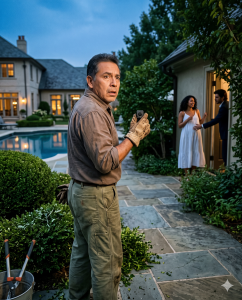
Arturo was trimming the thick shrubs beside the pool wall, the ones that bordered the path to the guest house. The rain had made them grow dense and wild. He pushed his gloved hand into the branches to clear dead leaves near the roots when his fingers touched something smooth and hard.
Plastic.
He thought at first it was trash, perhaps a cracked sprinkler cover or a forgotten toy. But when he parted the branches, he saw a small security camera tucked into the foliage, angled with precision through a narrow gap in the leaves.
It faced the guest house.
Arturo frowned. He knew the estate’s security layout better than most people because gardeners were always warned where not to stand, where not to leave equipment, which walls were monitored. This device did not belong to the official system. It was too small, too carefully hidden, too specifically aimed.
He glanced toward the main house. Nothing moved behind the terrace glass. The pool water reflected a pale sky. The guest house door was closed.
His pulse quickened.
He should have called security. He should have left it alone. But something about its placement told him that whoever installed it did not want security to find it.
Arturo removed the memory card and walked behind the tool shed. There, sheltered from view, he slid the card into his old phone.
The first files were harmless. A maid carrying linens. A gardener from the other shift sweeping the path. Shadows crossing the patio. Hours of nothing.
Then Arturo skipped ahead.
The guest house door opened.
Elena entered laughing.
Not smiling. Laughing. Deep, loose, careless laughter. She looked behind her shoulder before slipping inside, not with fear exactly, but with the thrill of someone doing something forbidden.
Arturo felt his stomach tighten.
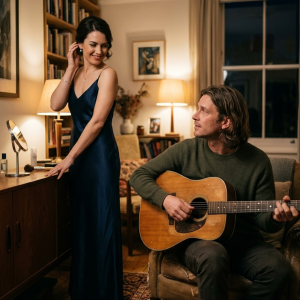
Seconds later, another figure appeared. A man. Tall. Familiar in build, though the angle hid his face beneath the roofline. He opened the door without knocking and walked in as if he had every right in the world.
Arturo kept watching, though every instinct told him to stop.
More clips followed. Different days. Different times. The same pattern. Elena arriving in secret. The same man meeting her inside. Once she paused at the threshold and let him pull her in by the waist. Another time she covered her mouth to stifle her laughter. In another video, she kissed him before the door closed.
Arturo lowered the phone and stared at the ground.
A lie had taken shape right in the center of the estate.
He tried to reason with himself. A hidden affair did not prove the baby belonged to another man. Timelines could overlap. Marriages survived uglier things among the rich. This was not his business. If he got involved, he would lose his job. Perhaps worse. Don Roberto was not known for forgiving humiliations, especially when delivered by a servant.
But each time Arturo thought of walking away, he remembered Don Roberto’s face in the dining room when the pregnancy was announced. The man had cried like someone rescued from drowning.
And Elena had laughed in secret behind another door.
By evening, Arturo could not carry the truth alone.
He found Don Roberto on the terrace reviewing contracts. The millionaire looked annoyed the moment Arturo interrupted him.
“Boss,” Arturo said, his mouth dry, “I have to tell you something. It’s not easy.”
“Speak at once,” Don Roberto replied sharply. “What is wrong?”
There was no way to soften it.
“That child your wife is expecting is not yours,” Arturo said. “I found this.”
Roberto shot to his feet so suddenly the chair scraped across the stone. Rage surged through him at once. He lifted his hand as if to strike Arturo where he stood.
Arturo did not move. He simply held out the camera.
Something about the object stopped Roberto’s hand in midair. He seized it, looked from the camera to Arturo’s face, then turned and strode into the house without another word.
He locked himself inside his office.
Arturo stood outside in the corridor with his heart pounding. Staff passed by and then vanished as soon as they sensed the danger in the air. Minutes stretched. No one dared knock.
Inside, on a large monitor, Don Roberto watched his world split open.
The affair itself hit him hard. Elena’s secrecy. Her laughter. The intimacy. The recklessness of using the guest house on his own property. Each image stripped away another layer of the life he thought he controlled.
But none of that was what finally broke him.
It happened when he paused one of the videos and zoomed in. The man turned just enough. The camera caught his profile, then his full face.
Don Roberto went still.
No.
He rewound. Played it again. Zoomed in further.
No.
The room seemed to tilt around him.
The man with Elena in the guest house was not a stranger, not a rival businessman, not a chauffeur, not a bodyguard.
It was his son, Gabriel.
Gabriel was twenty-seven, the child from Roberto’s first marriage. He had grown up partly in boarding schools, partly in his mother’s house after the divorce, drifting in and out of Roberto’s world with a simmering resentment that everyone in the family pretended not to notice. Roberto had paid his tuition, bought his cars, given him a management title he had not earned, and still complained that the young man lacked discipline. Gabriel, for his part, had always looked at his father with a smile that never quite reached respect.
Elena was only twelve years older than Gabriel.
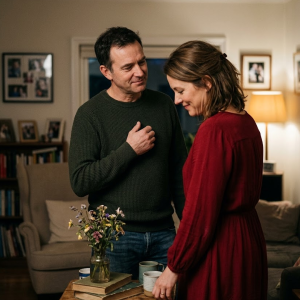
When Roberto married her, town gossip had buzzed for months. Some said she loved him. Others said she loved his power. Roberto ignored all of it. He had chosen beauty, grace, and youth after a bitter divorce, and he carried Elena on his arm like proof that he still won at life.
Now, in the guest house on a hidden camera, his son was touching that same woman as if she belonged to him.
Roberto sat at his desk unable to breathe properly. Memories rushed back and rearranged themselves into something poisonous. Gabriel lingering too long at family dinners. Elena laughing at comments that were not funny. The way they sometimes avoided each other too theatrically, as if overacting innocence. Times Elena had defended Gabriel when Roberto criticized him. Times Gabriel had mysteriously appeared at the estate when Roberto was away on business.
He had seen every warning sign and called it coincidence.
When Roberto finally opened the office door, Arturo barely recognized him. The man looked emptied out, like someone whose bones were still standing but whose spirit had stepped away.
“Call no one,” Roberto said quietly. “No one leaves this house.”
Arturo nodded.
From upstairs came Elena’s voice, humming.
Roberto flinched at the sound.
“She didn’t go outside the family,” he said, almost choking on the words.
Arturo felt confusion give way to horror.
Before either man could say more, Elena appeared at the top of the staircase wearing a loose white dress, one hand resting on her stomach. She smiled automatically, then noticed Roberto’s face. The smile flickered.
“What happened?” she asked.
Roberto lifted the camera.
All color drained from Elena’s face.
For a second she tried to recover. “I don’t know what that is.”
Roberto’s voice cut through the hallway. “I know who was in the guest house.”
Silence.
Then he said the name.
“Gabriel.”
Elena’s hand dropped from her stomach.
She did not deny it immediately, which was answer enough. But she gathered herself quickly and descended the stairs with careful dignity, as though control might still save her.
“You should calm down,” she said.
Roberto laughed once, a jagged sound with no humor in it. “Calm down?”
“I can explain.”
“Then explain why my wife is carrying a child that may belong to my son.”
Her eyes hardened. The softness vanished. Arturo had never seen her like that. Not frightened now. Cornered, yes, but also defiant.
Before she could answer, headlights swept across the front windows. A car had entered the driveway.
Roberto turned.
Gabriel stepped into the house minutes later wearing a linen shirt, expensive watch, and the confident posture of someone accustomed to landing on his feet no matter the mess. He smiled at first, then saw the three faces waiting for him in the hall and stopped.
“What happened?” he asked.
Roberto crossed the room in two strides and hit him so hard he slammed into the console table. A vase crashed to the floor.
“Elena!” Gabriel shouted, but she did not move toward him.
Roberto grabbed his shirt and shoved him against the wall. “You filthy animal,” he hissed. “You came into my house.”
Gabriel wiped blood from his mouth and looked from his father to Elena to the camera in Roberto’s hand. Understanding settled over his face. There was fear there now, but not surprise. That hurt Roberto almost more than anything. The betrayal had not been impulsive. It had been ongoing. Managed. Hidden.
“How long?” Roberto demanded.
Gabriel said nothing.
Roberto struck him again.
“Enough,” Elena snapped, stepping forward at last. “You don’t get to act innocent in this.”
All three men looked at her.
She straightened her shoulders. “You want the truth? Then hear all of it.”
What followed shattered the remaining pieces of the family.
Elena admitted the affair had begun nearly a year earlier. At first, she said, it was accidental—long conversations when Gabriel visited, a drink too many one night after an argument with Roberto, attention she had not felt from her husband in years. Roberto shouted that she was lying, but she kept speaking.
“You wanted an heir,” Elena said. “That was all you cared about in the end. Not me. Not us. Just a child with your name.”
Roberto stared at her.
Then she delivered the second blow.
“You were never going to give me one.”
The hall went silent.
Elena looked at Arturo briefly, then back at Roberto. “I found your medical report months ago. The specialist from the city. You hid it in the office safe, but you forgot I know the code. You are sterile, Roberto. You have been for years.”
Arturo saw the shock on Roberto’s face and knew instantly she was telling the truth—or at least a truth he had hidden.
Roberto’s mouth opened, but no words came.
Elena went on. “You kept dragging me through treatments, appointments, prayers, and public pity while you knew. You let everyone think the failure was mine.”
Roberto’s anger faltered under something uglier: exposure.
Gabriel pushed himself away from the wall, breathing hard. “She didn’t seduce me alone, Father. I hated you. She hated you. You built this.”
Roberto lunged again, but Arturo and a houseman who had arrived at the noise stepped between them.
The accusations poured out after that. Elena said she had been lonely, humiliated, treated like a display item expected to produce an heir. Gabriel said he had spent his life being bought off instead of loved. Roberto shouted that both of them were parasites. Gabriel shouted back that Roberto had married a woman closer to his own age than to his father’s and expected loyalty without affection.
Then came the final question.
“Whose child is it?” Roberto asked, his voice suddenly weak.
Elena looked at Gabriel.
That look was enough.
Roberto sank into a chair as if his legs had stopped working. For the first time, Arturo did not see a feared businessman or a powerful patriarch. He saw an old man crushed under the ruins of his own authority.
The scandal never stayed inside the walls for long.
By morning, lawyers had been called. By afternoon, Elena had moved to an apartment in the city under security. Gabriel’s mother arrived screaming threats about lawsuits, inheritance, and disgrace. Staff members were questioned one by one. Phones were checked. One maid quit on the spot. Another cried through her entire interview. Arturo expected to be blamed, but Roberto never touched him. In fact, days later he handed Arturo an envelope with more money than the gardener had ever held at one time and said only, “You told me the truth.”
Divorce proceedings began almost immediately.
The legal battle was vicious. Elena demanded financial support, claiming emotional abuse and public humiliation. Roberto’s attorneys fought to strip her of everything tied to the marriage contract. Gabriel was removed from the family businesses and cut out of Roberto’s will. In retaliation, he threatened to reveal Roberto’s hidden medical records and several financial maneuvers that would have brought dangerous scrutiny if made public. The newspapers never printed the full story, but gossip traveled faster than ink. By the end of the month, everyone in town knew enough to whisper.
The baby was born seven months later.
A boy.
Gabriel signed the birth certificate.
Roberto never saw the child.
He sold the guest house first. Then he had the poolside shrubs ripped out completely, roots and all, as if the earth itself had betrayed him. He stopped attending public celebrations. Donations continued through accountants, but he no longer appeared in photographs. People still called him respected, but now they said it more softly, with that cautious tone reserved for fallen men who still have money.
Elena moved on in the only way she knew how: outwardly polished, inwardly impossible to read. Some said she regretted everything. Others said she did not regret enough. Gabriel left town twice and came back twice, unable to escape the shadow of what he had done or the money he had lost.
As for Arturo, he stayed only another six months.
The estate no longer felt like a workplace. It felt like a grave dressed in marble. Every corner held an echo. One morning he resigned, packed his tools, and went to work for a family with a smaller garden and far fewer locked doors.
Still, he never forgot that afternoon by the pool. All he had done was push his hands into a patch of overgrown bushes.
That was it.
One careless reach into the leaves, one hidden camera, one decision to speak.
And a family that had spent years protecting its image collapsed not because of a rumor, not because of an enemy, but because the truth had been waiting quietly in the garden the whole time.
Sometimes Arturo still wondered who was most guilty. Elena, for the betrayal. Gabriel, for crossing a line no decent son should ever approach. Roberto, for building a house so full of pride, secrecy, and control that everyone inside it learned to lie just to breathe.
Maybe the ugliest red flag had appeared long before the camera did.
Maybe the real destruction began the moment love became ownership, and family became something people used to wound each other.