When Loretta Pruitt received the wedding invitation, she thought it had to be a joke.
The envelope was thick, cream-colored, and addressed in elegant black script to Ms. Loretta Pruitt, exactly the way people wrote your name when they wanted to sound respectful after years of treating you like a rumor. She had just finished the lunch rush at the Bluebell Diner and was still standing behind the register in her pale blue uniform when she slit it open with a butter knife.
Inside was a formal invitation to the wedding of Wade Mercer and Camille Hart.
At first, she thought Wade was being cruel.
That would have fit him.
He had always preferred his meanness polished, subtle enough that he could deny it later. Never a slap if a smile would do. Never an insult if a story could do more damage. By the time he left her, he had turned her into a version of herself other people pitied without ever asking what had actually happened.
Then Loretta saw the handwritten note tucked behind the invitation.
Please come. I know who owns the vineyard. Bring the mug.
—Camille
Loretta sat down so fast the stool behind the counter knocked into the pie case.
Doris, who had worked beside her at Bluebell for fourteen years and knew Wade’s name only as a curse, took one look at Loretta’s face and asked, “What did he do now?”
Loretta handed her the note.
Doris read it twice. “Who is Camille?”
“His fiancée.”
Doris barked out a laugh. “Well. She either has a death wish or excellent instincts.”
Loretta looked toward the kitchen, where the coffee machine hissed and the plates clattered and life went on the way it always did. But inside her, something old had started moving again.
The mug sat on the shelf above the pie cooler, exactly where she kept it every day after washing it by hand and drying it herself. Plain white ceramic. Bluebell logo by the handle. Hairline crack down one side. No one else used it. Nobody else was allowed to.
The last time Wade had touched it, he had destroyed his own life and just hadn’t known it yet.
Years earlier, before the vineyard became a wedding venue people fought to book, it had been fifty rough acres of bad soil, collapsing trellises, and one stubborn patch of vines everyone said should be ripped up and replaced. Loretta’s grandmother had owned the land before anyone imagined it could be valuable. The Bluebell Diner had kept the family afloat; the vineyard land had just sat there outside town, too sentimental to sell and too difficult to fix.
Loretta loved it anyway.
Wade loved what it could become.
When they were married, they spent weekends out there with borrowed tools and blistered hands. Loretta drove from the diner after double shifts and met Wade in the fields with sandwiches wrapped in wax paper. She handled county paperwork, tax notices, vendor calls, irrigation permits, and every ugly little task Wade found boring. He handled charm. Investors liked him. Sales reps liked him. People who preferred a handsome man with a vision to a tired woman with a ledger liked him best of all.
Because Wade had credit problems and one lawsuit hanging over him from a failed business deal, the lawyer handling their purchase and restructuring told them the vineyard should remain solely in Loretta’s name until the mess was cleaned up.
Wade had smiled and agreed.
“Temporary,” he said.
Loretta believed him.
For years, she believed a lot.
She believed him when he said the long nights in town were for networking.
She believed him when he said the debts were under control.
She believed him when he said she should leave the tasting-room events to him because she looked “too much like work” after diner shifts.
By the time the vineyard finally started making real money, Wade had already begun editing Loretta out of the story.
At first it was small. “My team did this.” “My vineyard manager handled that.” “You know how Loretta is, she hates the spotlight.”
Then it turned uglier.
He stopped coming home some nights. He opened accounts she couldn’t see. He began treating the land like it was his by natural law, as if saying something often enough could rewrite a deed.
The day he left her was a Thursday.
Loretta remembered because Thursday was meatloaf special at Bluebell and the lunch rush had been brutal. She was in the same blue uniform she still wore years later, hair pinned back, feet aching, coffee stains on one cuff. Wade walked in carrying a leather folder and the kind of expression men wear when they want to look tragic while doing something cruel.
He sat in booth seven, the one near the pie carousel.
“Can we do this at home?” Loretta had asked.
“No,” he said. “Now is cleaner.”
Cleaner for who, she should have asked.
Instead, she slid into the booth across from him as Doris brought coffee and then wisely disappeared. Wade told Loretta he was unhappy. He told her she had become dead weight. He told her he needed a partner who understood his future. Then he slid papers across the table and tapped the signature lines.
Divorce documents.
And beneath them, mixed into the stack, a quitclaim transfer and business assignment that would have moved the land and operating rights fully into his control.
He had expected her to be too shocked to notice.
Loretta was devastated, but she wasn’t stupid.
“What is this?” she asked, lifting the extra pages.
“Just cleanup,” Wade said. “Standard.”
“It says transfer.”
“It’s to make everything smoother. You don’t want to be responsible for any of this anyway.”
He said it so easily, as if he were doing her a favor by erasing her.
Loretta remembered staring down at the papers while her coffee went cold. She remembered the feel of the mug in her hands and the way the crack in the side caught her thumb. She remembered Wade’s impatience sharpening because she wasn’t collapsing in the useful way he had hoped.
“I’ll sign the divorce,” she said finally. “Not this.”
His face changed.
That was the moment she saw the truth clearly, maybe for the first time. He had not come to end a marriage. He had come to take something.
He leaned across the table and lowered his voice. “Don’t do this publicly.”
The irony of that sentence would make her laugh years later.
Loretta signed only what was required, folded the unsigned transfer pages, and slipped them into her mug because she had no purse and refused to leave the papers in front of him. He reached for them once. She moved the mug out of his reach. He stood, hissed something about how she’d regret making this difficult, and walked out of the diner.
He left her there with the smell of coffee and meatloaf and betrayal.
He also left the one thing he needed most: proof she had never signed away the vineyard.
But proof and power were not the same thing.
Wade spent the next several years acting like owner because most people never checked the paper if a man stood confidently enough in front of the building. He managed the business through the operating company, charmed investors, bullied staff, and let the town repeat his version until it hardened into fact. Loretta, still working at Bluebell, didn’t have the money for a prolonged legal war. She kept paying the property taxes when notices found their way to her. She kept copies. She kept the mug. She told herself one day there would be a moment.
Then Camille Hart sent the invitation.
Loretta met her two nights before the wedding, after closing, in a back booth at Bluebell.
Camille arrived in jeans and no makeup, looking younger and far more tired than she did in magazine-worthy engagement photos. She ordered black coffee, noticed Loretta’s expression, and said, “I deserve that look.”
Loretta sat across from her without smiling. “You invited your fiancé’s ex-wife to your wedding. I’m not sure what look you expected.”
Camille gave a strained little laugh. “Fair.”
She reached into her bag and placed a county records printout on the table. The deed showed the vineyard land still in Loretta Pruitt’s name.
“I found this while finalizing insurance,” Camille said. “The venue required owner authorization. Wade gave me documents that looked… wrong. Too new. Too neat. So I checked.”
Loretta studied the printout, then looked up. “And?”
“And I asked him about you.” Camille’s mouth tightened. “He said you’d signed everything over years ago, took a payout, and then started lurking around when you needed money.”
Loretta did smile then, but it was not warm. “That sound like me?”
“It sounded rehearsed.” Camille leaned forward. “I kept digging.”
She had found unpaid lease irregularities, tax notices, and one old email from a vendor thanking Loretta for approving a contract long after Wade claimed she’d been bought out. She had confronted Wade carefully and watched him dodge every detail.
“I’m not marrying a man who lies when cornered,” Camille said. “Especially not on land he might not even own.”
Loretta rested her hand on the mug between them. “Might?”
Camille’s eyes went to it. “What’s in there?”
Loretta looked at the cup for a long moment. “The day he left me, he tried to trick me into signing the vineyard over. I kept the papers.”
Camille exhaled slowly. “Bring them.”
Loretta almost said no. She had spent years surviving the smaller humiliation, the private one. Public reckoning felt dangerous. But then she remembered Wade telling people she was pathetic. Forgettable. A woman whose life started and ended behind a diner counter.
“All right,” she said.
On the wedding day, Loretta came straight from the lunch shift in the same style of uniform she had worn the day Wade left. She could have changed. That was the point.
Let him see exactly what he thought he’d discarded.
The ceremony was beautiful in the way expensive things often are: polished enough to almost hide the rot underneath. Guests admired the vines, the stone terraces, the sunset over the rows. Wade basked in it. He had tailored himself into a man who looked like ownership.
Then he saw the mug.
Loretta watched his face tighten from across the lawn and knew he remembered everything. Not just the papers. The booth. The coffee. The moment she didn’t give him what he wanted.
Camille, to her credit, played her role perfectly. She smiled, posed, floated through the day, and all the while kept the schedule moving toward the collision she had chosen.
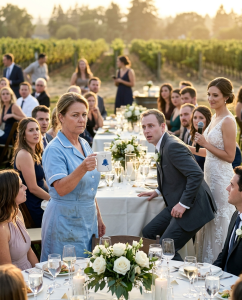
At dinner, when she lifted the microphone and announced, “I’d like to introduce the woman who actually owns this vineyard,” the entire reception went still.
Loretta walked to the head table carrying the mug.
Wade rose so fast his chair screeched backward.
“Camille,” he said, voice clipped and sharp, “stop this.”
Camille didn’t even turn her head. “No.”
Loretta set the mug on the table between the wedding cake and the floral centerpiece. Up close, guests could see folded documents tucked inside, the edges stained brown from old coffee. The room shifted with murmurs.
“You remember this, Wade?” Loretta asked.
He stared at her with open hatred now, all polish gone. “This is insane.”
“No,” Camille said into the microphone. “Fraud is insane. This is paperwork.”
A few people laughed nervously, then stopped when Wade didn’t.
Loretta reached into the mug and drew out the packet. Her hands were steady. Years of waitressing had taught her how to carry hot plates through chaos without spilling anything. This felt easier.
Wade took a step forward. “Don’t.”
“There it is again,” Loretta said quietly. “You always liked giving orders right before the truth came out.”
She unfolded the first page and held it toward the room, then toward Camille, who passed it to the officiant and one of the bride’s attorneys—yes, attorneys; Camille had come prepared. The unsigned quitclaim deed was plain enough for anyone to understand once the lawyer explained it. Loretta had signed the divorce. She had never transferred ownership of the property.
Wade tried to talk over him.
“This proves nothing. We had later agreements. She knows that.”
“Then produce them,” Camille said.
He couldn’t.
Because there weren’t any.
The attorney then held up the county printout confirming the land deed remained in Loretta’s name. Camille followed with copies of tax records showing Loretta had continued paying key property taxes. Finally, Loretta pulled out one more document from the bottom of the mug: a lease amendment Wade himself had signed years after the divorce, acknowledging use of the land through the operating company. He had signed it carelessly during a refinancing scramble, assuming no one would connect it later.
The guests understood all at once.
A hiss of whispers moved through the room. Wade wasn’t the owner. He was a man who had built his reputation on occupying something that legally belonged to the woman he’d tried to humiliate.
One of his investors stood up, face drained of blood. “Are you telling me we put money into facilities on land you don’t own?”
Wade turned toward him, then toward Camille, then Loretta, searching for a version of reality he could still control.
Camille removed her engagement ring and placed it gently on the table beside the mug.
“I nearly married a man who thought confidence was a substitute for truth,” she said. “That’s on me for getting close enough to need the lesson. But not close enough to ignore it.”
Wade reached for her arm. She stepped back before he made contact.
The bride’s father, who had financed much of the wedding and had likely expected to gain social capital from the match, walked forward with two security men from the venue staff. “That’s enough,” he said.
Wade blustered. Threatened lawsuits. Claimed misunderstanding. Claimed shared marital property. Claimed bitterness. Each explanation made him sound smaller. The attorney asked him one devastating question in front of everyone: “Did Ms. Pruitt ever sign a transfer of title?”
Wade said nothing.
That was answer enough.
He was escorted out of his own reception while guests moved aside to let him pass. No one touched him. No one defended him. The vineyard lights glowed warmly over a scene that had gone cold.
After he was gone, there was an odd, suspended silence.
Then Camille turned to Loretta and asked, without the microphone this time, “Do you want everyone to leave?”
Loretta looked around the reception space. The linens. The flowers. The candles. The vines beyond them, silver-green in the falling dusk. For years she had avoided this place unless paperwork forced her near it, because seeing Wade inhabit her family land like a king in borrowed clothes had felt like swallowing broken glass.
Now he was gone.
And everyone knew.
Loretta surprised herself by saying, “No. The caterer’s been paid.”
Camille laughed first, short and startled, and the sound cracked the whole room open. A few guests joined in. Then more. Not because it was funny, exactly, but because tension had to go somewhere.
The band, unsure what else to do, quietly started playing again.
People who had spent the day admiring Wade now found reasons to apologize to Loretta, or at least to stand near her respectfully. Some meant it more than others. Loretta accepted none of it too easily. But she also didn’t waste energy on revenge where silence would wound better.
Camille’s father covered the legal consultation that followed. Within weeks, Wade lost operational control of the venue. His investors turned on him. Staff members who had long endured his arrogance began telling stories he could no longer smother. There were audits. Claims. A settlement process so ugly even Wade’s best suits could not make him look untarnished.
Loretta leased the property to a new management team after consulting people who understood both hospitality and boundaries. She kept oversight. She kept the land. She renamed the venue Bluebell Ridge, which annoyed exactly the people she intended to annoy.
As for Camille, she and Loretta never became best friends, but something steadier formed between them. Respect, maybe. The kind built when two women realize the same man counted on both of them staying quiet in different ways.
A month after the wedding-that-wasn’t, Camille came to Bluebell Diner for breakfast. Loretta poured her coffee into a clean mug and set it down without comment.
Camille glanced toward the shelf where the cracked white cup still sat by itself. “You keeping that one forever?”
Loretta looked at it, at the thin line in the ceramic, at the stain time had left around the handle.
“Probably,” she said. “Reminds me not to sign things when I’m angry.”
Camille smiled. “That the only lesson?”
Loretta thought about Wade, about all the years he had mistaken her silence for weakness and her plainness for invisibility. She thought about how close she had come to letting his version of her become permanent.
“No,” she said. “It reminds me that some people build entire lives on what they think nobody will check.”
Camille lifted her coffee. “To checking.”
Loretta clinked her own mug lightly against it.
The vineyard was quieter after that, and somehow more honest. Weddings resumed under new management. People still took sunset photos between the vines. They still called it beautiful. But now, when someone asked who owned the place, there was a real answer.
Loretta Pruitt.
The waitress in sensible shoes. The woman in the diner uniform. The one Wade had tried to leave behind with a stack of papers and a cup of cold coffee.
In the end, the biggest red flag wasn’t that he lied. It was that he believed he was entitled to be believed. And depending on who tells the story, the most shocking part wasn’t that Loretta exposed him at his own wedding.
It was that she let him think he’d won for long enough to choose the exact room where she would take everything back.