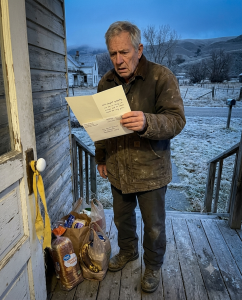
Every morning for three weeks, Walt Mercer left a little paper sack on the porch next door.
He never knocked more than once. He never waited for anyone to answer. He simply set down the groceries, straightened up slowly because his knees were not what they used to be, and walked back across the narrow strip of yellowing grass that separated his property from the rental house beside it.
By noon, the bag would be gone.
That was enough to keep him going.
Dry Creek, Montana, was the kind of place where privacy existed, but not invisibility. People didn’t spy exactly. They just noticed. They noticed whose truck started before dawn, whose dog barked every night at the same time, which curtains stayed drawn too long. Walt had carried mail through this town for thirty-two years. Retirement had taken away his uniform and his route satchel, but not the habit of reading lives through the small evidence they left behind.
That was why the woman next door unsettled him.
The rental had sat empty all winter, a square little one-story place with peeling white trim and a porch that leaned slightly to the left. Then one raw evening in early March, a salt-caked gray sedan appeared in the driveway. By dark, a lamp glowed in the front room. The next morning there was an envelope in the mailbox and tire tracks in the slush.
A new tenant.
Normally, Walt would have walked over with a plate of oatmeal cookies and an introduction. His late wife, Ruth, had always said that if he didn’t know every soul within a mile radius, it wasn’t for lack of trying. But the first day passed without a sighting. Then the second. Then the first week.
Nobody came out.
Nobody came in.
The woman was there. Walt knew it. At dusk the kitchen curtain shifted. The bathroom window fogged around seven each evening. The porch light clicked on at 5:43 and off at 10:12 with such consistency he wondered whether she set alarms. But the front door never opened while he watched. No package was retrieved in daylight. No groceries were brought in from a car. No footprints led from the porch after fresh snow except one faint set he could never quite line up with a body.
At first he told himself not to be ridiculous. Some people kept to themselves. Some people were sick. Some people simply didn’t like neighbors.
Then came the ribbon.
He saw it on a Wednesday afternoon while replacing the hinge on his back gate. A yellow hair ribbon, faded and frayed along one edge, was tied around the mailbox post next door in a careful bow. Not tangled there by wind. Tied.
He glanced around the yard. No toys. No tiny boots by the steps. No plastic tricycle tipped in the dirt. No chalk drawings, no dolls, no proof of a child.
The next morning the ribbon was gone.
That evening it reappeared on the porch rail.
Two days later it was looped around the fence post near the side yard. After that it seemed to migrate every day or so: the screen-door handle, the rusted shepherd’s hook by the flower bed, the latch on the side gate. Always visible. Always deliberate.
Walt tried to dismiss it.
By the second week, he couldn’t.
His concern sharpened the one stormy night he saw the woman clearly for the first time. He had been closing his own curtains when lightning lit the neighboring front window. A figure stood in the hallway beyond the glass. Young, with dark hair pulled back badly, loose strands hanging around a thin face. She wore a pale blue sweatshirt and moved with a weary sway, as though comforting something against her chest.
But her arms were empty.
The image clung to him long after the thunder passed.
The following morning he drove into town and bought groceries he could afford but didn’t exactly need: bread, bananas, canned soup, a jar of peanut butter, eggs, tea bags. He set them on her porch and knocked once.
No answer.
By lunch, the bag was gone.
The next day he brought milk and apples. The day after that, paper towels and crackers. When a late freeze cut through the valley, he left kindling under the awning. Each time the offering disappeared after he walked away. No note. No thanks. Just absence.
Then small replies began appearing on his side of the property line.
An empty paper sack folded into a perfect square and placed by his fence. A mason jar washed clean and left on his back step. A clipped bundle of wild mint wrapped in string. Once, the exact number of soup cans he’d delivered were lined in a row on her porch as if someone had counted them before bringing them inside.
She knew he was helping. She simply could not meet him in the open.
His daughter, Elaine, called from Billings on a Sunday evening and caught him watching the neighboring porch through his kitchen window.
“You’re doing it again,” she said after he told her the story.
“Doing what?”
“Adopting someone from a distance.”
Walt frowned into the receiver. “That’s not fair.”
“It’s exactly fair. You did this with the old Kessler place too. And the widower down by the feed store. You decide someone needs rescuing and then refuse to admit there may be boundaries.”
Walt almost argued, then let the silence sit.
Since Ruth died two years earlier, every kindness of his had apparently become evidence of loneliness. People treated his attention as if it were a hobby masking grief instead of the same instinct he’d used his entire life. He had delivered pension checks to houses where the curtains never opened, certified letters to men who’d lost jobs they hadn’t told their wives about, condolence cards to mothers whose hands shook too badly to sign for them. He knew the shape of private distress. It had contours.
This next-door silence had contours.
“You don’t know anything about her,” Elaine said more gently.
“I know she doesn’t go out.”
“That’s not the same as needing your help.”
Walt looked through the dark kitchen window at the house next door. “Maybe not,” he said. “But someone’s eating the food.”
He did not mention the ribbon. That part sounded strange even to him.
A few mornings later, he stepped outside to fetch his newspaper and stopped dead.
The yellow ribbon was tied around his own mailbox flag.
The knot was neat. Intentional. Fresh.
He touched it with two fingers, feeling the soft satin gone rough at the edge. The sight unsettled him more than he wanted to admit. It was not merely a sign now. It was communication.
That night he slept badly, waking twice to imagined noises. At 3:17 a.m. he stood at his bedroom window and stared across at the dark rental. No porch light. No movement. Only the silver line of frost forming on the rail.
Sunday before sunrise, he saw her outside.
Walt had gone out in his slippers to chase the lid of his trash can, which a gust had rolled halfway down the drive. The sky was still the deep blue of approaching dawn. When he straightened, she was standing in the side yard by the fence.
For a heartbeat, neither of them moved.
Up close, even in weak light, she looked worse than he expected. Younger, yes, but also worn down in a way youth should have resisted. Her face was pale and drawn. Her dark hair was unbrushed, dragged into a loose knot. She wore a gray coat over pajama pants and held the yellow ribbon in one hand.
Walt lifted a hand in a tentative greeting. “Morning.”
She did not answer.
She bent, tied the ribbon to the top wire of the fence, then looked directly at him. Not through him. At him. Her eyes were red-rimmed with exhaustion, but alert. Pleading, almost. Then she turned and went back inside.
Only after the door closed did Walt notice the porch.
Three paper grocery bags still sat there untouched.
His stomach dropped.
Something had changed.
He waited until midafternoon before going over, trying to balance concern against caution. When he climbed her steps, a medicinal smell seeped through the door, mixed with stale air and something sour beneath it. He knocked.
No answer.
He knocked harder. “Miss? It’s Walt from next door.”
Nothing.
A shadow seemed to move behind the front curtain, but it was gone before he could trust his eyes. Uneasy, he left another bag and returned home.
It remained there all day.
And the next.
By the fourth morning, Walt woke with a certainty too solid to ignore. Before the coffee finished brewing, he looked out his kitchen window and saw something tucked beneath her welcome mat.
He crossed the yard in his coat and boots, each step loud in the frost. The object was a sympathy card, cream-colored with embossed lilies on the front. Cheap drugstore stock. The envelope had already been opened.
His name was written on it.
Walt.
Just that. No last name. No return address.
His pulse kicked hard enough to make his fingertips tingle. He looked at the windows. The untouched bags sagged with dew. A bruised banana had rolled halfway out of one. The porch light, usually so exact, had not been on for two nights.
Then he saw the ribbon.
It was tied to the doorknob now, pulled tight enough to crease the satin.
Walt picked up the card. The paper felt damp and cold in his hands. Inside, written in neat script, was a single sentence.
I’m sorry I waited too long.
That was all.
No explanation. No signature. No plea for help.
Walt read it again and felt an old carrier’s dread settle over him. Condolence mail had always had a weight to it, even before it was opened. This had the same heaviness. Worse, maybe, because of the apology.
His eyes went to the yard.
There, in the frost beside the side fence, he finally noticed the tracks. One narrow set, likely hers, leading to the fence and back. Beside them, much smaller prints. Child-sized. They crossed only part of the yard before vanishing near the foundation where the house sat low over a crawl space.
No return tracks.
No adult prints overlapping them.
No reason that made sense.
Walt turned the card over.
The handwriting on the back wasn’t hers.
The letters were bigger, pressed hard, almost gouged into the cardstock.
CHECK THE CRAWL SPACE.
For a long moment he could only stare.
Then a sound came from inside the house. A dull, heavy thud. Not from the rooms above him, but from lower down, as if something had struck wood under the floor.
Walt dropped the card and banged on the door with the heel of his hand. “Open up!”
Silence.
He shouted again, louder, his voice cracking in the cold. No answer.
The side yard suddenly seemed very far from the road. He pulled out his phone and dialed 911 as he circled the house, breath saw-toothed in his throat. The dispatcher answered just as he reached the line of loose lattice skirting the foundation.
“My name’s Walt Mercer,” he said. “I’m at 417 Willow Lane. I think—” He swallowed. “I think there’s a child under the house.”
The dispatcher kept him talking while he crouched at the vent opening. One corner of the lattice panel had been pried loose and pushed back into place badly enough to leave a narrow gap. He aimed his phone’s flashlight through it.
At first, all he saw were dirt, cinder blocks, and the silver web of old insulation hanging down in strips.
Then something pale shifted in the dark.
A hand.
Small. Dirty. Trembling.
Walt sucked in a breath so sharply it hurt. He dropped to both knees in the frost and leaned toward the gap. “Hello?”
There was a pause. Then a voice, hoarse and paper-thin, whispered, “Mr. Walt?”
Every muscle in his body locked.
The child knew his name.
“Yeah,” he said, forcing calm into his voice. “Yeah, that’s me. Are you hurt?”
A tiny face edged into the beam. A little girl, no older than five. Tangled blond hair. Hollow cheeks. One eye swollen from crying, not injury. Around one wrist was a strip of yellow satin.
Walt’s stomach turned over.
The ribbon.
The same ribbon, cut and tied and moved from place to place.
“I’m sending help,” he said. “Can you get to the opening?”
She shook her head. “Door locked.”
“What door?”
“The floor door.” Her lower lip trembled. “Mama said stay quiet.”
“Is your mama in the house?”
The little girl hesitated so long he thought she might not answer. Then she whispered, “Not my mama.”
The dispatcher was still speaking in his ear, asking questions, but Walt could barely process them. Red and blue lights were already turning onto Willow Lane in the distance.
He told the girl his name again. Told her the sheriff was coming. Told her not to be afraid. It felt useless, every word of it, but she kept staring at him like he was the first steady thing she had seen in a very long time.
Sheriff Dugan arrived first with one deputy behind him. They forced the front door within seconds.
What they found inside only deepened the horror.
The young woman next door was alive, barely. She was in the bathroom, collapsed between the sink and tub, dehydrated, feverish, and heavily sedated. Beside her lay an orange prescription bottle with someone else’s name scratched off. She was taken out on a stretcher while EMTs worked over her, and for one terrible instant her half-open eyes met Walt’s.
Relief. Shame. Fear.
All of it passed through that single glance.
The sheriff’s men found the crawl-space hatch beneath a rug in the hall closet. It had been secured from above with a slide bolt and a toolbox dragged over it. When they opened it, the little girl was lifted out shivering, dusty, and clutching that yellow ribbon around her wrist like a lifeline.
Her name was Junie.
She was four years old.
And she did belong to the young woman, whose name was Mara Bell.
The truth emerged in pieces over the next two days, then all at once.
Mara had fled Idaho six weeks earlier after separating from a man named Travis Keene, who was not Junie’s father but had moved into their lives the year before. He had a temper people described as “controlling” when they were being polite. Police later called it escalating coercive abuse. He monitored Mara’s phone, hid car keys, controlled bank access, and threatened to take Junie if Mara tried to leave. When Mara finally ran, she used cash, an old car, and the rental in Dry Creek arranged under a cousin’s name.
For a short time, she had managed.
Then Travis found them.
Not by tracking technology, as everyone first assumed, but through the most ordinary cruelty imaginable: forwarding mail and a loose-tongued acquaintance who mentioned seeing Mara’s car in Montana.
According to investigators, Travis had appeared at the rental late one night nearly two weeks before Walt found the card. He had not moved back in. That would have been visible. Instead, he came and went in darkness, sleeping elsewhere, controlling the house like a shadow. He took Mara’s phone. He threatened Junie whenever Mara resisted. And because he knew no child had been seen there, he began hiding Junie in the crawl space whenever he left during daylight hours.
He told Mara that if she made noise, if she went to the police, if she tried to run again, he would disappear with the little girl for good.
The ribbon was Junie’s.
When Mara had to send her below, she tied the yellow ribbon around her daughter’s hair or wrist so Junie would “have something bright,” as Mara later said through tears. Somehow, in those brief moments when Travis was gone and Mara dared crack open the hatch, Junie began leaving the ribbon at places she could reach near vents and floor gaps, passing it up for her mother to place outside. A signal. A reminder. A desperate little breadcrumb proving she existed.
Mara had tried to get Walt’s attention without bringing immediate danger down on them. She saw him notice the ribbon. Saw him keep coming. Saw him as the safest witness in reach, a man from next door who moved predictably and looked at details other people missed.
But fear kept defeating timing.
She had started writing the sympathy card the night before Walt found it. Investigators believed Travis had returned unexpectedly, drugged her with crushed pills in tea, and left before dawn after bolting the hatch. Junie, hearing her mother collapse, had used a broom handle from below to push the card partly under the mat through a warped seam near the threshold. She could not write well, but she had seen Walt’s name on envelopes in his mailbox when he stood outside sorting junk mail. She copied it the best she could on the front.
The sentence inside—I’m sorry I waited too long—was Mara’s.
The warning on the back—CHECK THE CRAWL SPACE—was not.
Junie had written it herself.
Block letters. Pressed hard. Spelling imperfect in the first draft found crumpled near the hatch, but carefully corrected on the card by copying the words from labels on storage boxes in the dirt beneath the house.
When Sheriff Dugan told Walt that part, the old man sat down hard in his kitchen chair and covered his face with both hands.
He had spent weeks wondering whether grief lived next door. Wondering whether a lonely woman was unraveling. Wondering what the ribbon meant.
It had meant a child.
Travis Keene was arrested the following evening at a motel outside Missoula after trying to withdraw cash with Mara’s bank card. The charges mounted fast: unlawful imprisonment, child endangerment, assault, coercion, possession of controlled substances, and more expected. Dry Creek talked of little else for a month.
Mara and Junie did not return to the rental house.
After a hospital stay, Mara entered a protected shelter program in another county. Through the sheriff’s office, she sent Walt a letter handwritten in steadier lines than before. She thanked him for the groceries first. Then for noticing the ribbon. Then, in a sentence that made him fold the paper and set it down for a while, she wrote: You were the first person who made me believe we were still visible.
A week later, another envelope came.
Inside was a child’s drawing in waxy crayon. A crooked house. A stick-figure man with gray hair standing beside a mailbox. A little girl with a yellow bow bigger than her head. Above them, in uncertain block letters, were the words THANK YOU MR WALT.
He pinned that drawing to his refrigerator and left it there.
Summer came late that year. The grass greened. The rental house was cleaned out and repainted. New tenants eventually moved in, a retired teacher and her collie, and the porch stopped looking haunted. But Walt still found himself glancing at the fence post some mornings, remembering the bright flicker of ribbon against weathered wood.
Elaine drove down from Billings in July and stood in his kitchen reading Junie’s drawing.
“You were right,” she said quietly.
Walt did not answer right away. He looked out the window at the narrow side yard, at the place where the frost had once preserved those tiny prints. “I was almost too late,” he said.
Elaine touched his shoulder. “But you weren’t.”
That was true. Barely, but true.
And for the rest of his life, Walt would never see a yellow hair ribbon without thinking of how close silence had come to winning, how easy it would have been to call the whole thing none of his business, and how sometimes the smallest strange detail in the world is not a decoration, not a coincidence, not a neighbor’s private eccentricity—
but a child trying to be found.
Even years later, people in Dry Creek still disagreed about the hardest part of the story. Some said the worst thing was what Travis had done. Some said it was Mara being trapped long enough to believe she had no safe move. Some said the most chilling detail was that Junie knew to hide evidence in plain sight, as if she had already learned that adults often look without seeing.
Walt never argued with any of them.
But deep down, he knew the detail he would never shake was simpler than all the rest:
a sympathy card on a cold porch, his own name written on the front, and on the back, in the hand of a four-year-old girl no one even knew was there, the words that finally made the invisible visible.