When Patrice Odom was told she would not be attending her own daughter’s cotillion, she understood two things immediately.
The first was that Margaret Aldridge had finally said in public what she had been trying to say in private for years.
The second was that if Patrice let that insult stand, it would not stop with her.
It would settle onto Ava.
That was the part Patrice could not allow.
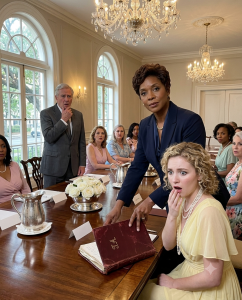
The meeting was held in the Aldridge ballroom, though everyone in Savannah still referred to it that way with the kind of reverence usually reserved for church sanctuaries and old scandals. The room was as flawless as ever: crystal chandeliers, silver bowls of white roses, long windows throwing pale afternoon light across polished floors. Every committee member had a folder, a glass of water, and the expression of a woman prepared to witness drama as long as she would not be asked to interfere.
Patrice arrived on time and took her seat halfway down the table. She had spent months helping plan the winter cotillion where her daughter Ava would be presented, and even after years of divorce politics and social maneuvering, she had still believed there were lines people would not cross in front of witnesses.
Then Margaret Aldridge crossed one.
Margaret entered in dove-gray silk with a smile so polished it almost looked kind. She sat at the head of the table, folded her hands, and announced that due to “family sensitivities,” Patrice would not be seated at the family table and would not take part in the formal presentation of Ava.
Patrice asked for plain English.
Margaret gave it to her.
“For everyone who still considers you an embarrassment to the Aldridge name.”
The sentence landed with a kind of clean brutality. Several women at the table looked away at once. One dropped her pen. Another stared fixedly at her water glass as if she could disappear inside it.
Patrice did not raise her voice. She did not defend herself. She simply stood, gathered her papers, took the burgundy leather appointment book she always carried, and walked out.
The humiliation itself was ugly enough. The speed with which the city reshaped it into gossip was uglier.
By that evening, three versions of the story were circulating. In one, Patrice had caused a scene. In another, she had refused to cooperate with “reasonable adjustments.” In the cruelest version, she had embarrassed her daughter by showing up where she was no longer wanted. The words changed depending on who was speaking, but the lesson remained the same: Savannah preferred a woman dignified only after she had accepted mistreatment in silence.
Patrice went home, placed the appointment book on her kitchen counter, and stood looking at it for a long time.
It was old, burgundy leather rubbed soft with age. The gold monogram on the front was not hers.
T.A.
Most people assumed the initials belonged to some dead relative or old family friend. A few had asked. Patrice had always smiled and changed the subject.
The truth was simpler and far more dangerous.
The book belonged to Theodore Aldridge.
Her ex-husband.
She had found it eleven years earlier, four months before their divorce, in the back compartment of the glove box in Theo’s car. She had not been searching for evidence. She had been looking for a church envelope she needed for Ava’s school fundraiser. The book had slipped forward when she opened the compartment, falling into her lap like something impatient to be found.
At first it looked ordinary enough. Appointments. Lunches. Club meetings. Calls to return. But the entries grew stranger the further she read. Thursdays marked only with initials. Hotel room numbers instead of names. Cash reminders. Repeated meetings at the Hamilton House, a boutique inn off Lafayette Square where Theo had never once admitted to going.
And then, on one page, a name she recognized.
Margaret Bell.
At the time, Margaret had not yet become Margaret Aldridge. She was simply a younger woman who floated at charity luncheons and leaned too close when Theo spoke. Patrice had noticed her before, but only with the vague irritation women are trained to dismiss as insecurity. Seeing her name in Theo’s own hand beside a room number and the words “Keep her calm” had turned that irritation into something harder.
Patrice had confronted him that night.
Theo’s talent had always been composure. Even caught, he tried to manage the temperature of the room rather than tell the truth. He said the meetings were “complicated.” He said Margaret was “going through something difficult.” He said Patrice was jumping to conclusions.
Then Patrice turned to the final pages.
There, between legitimate appointments, were notes that were neither romantic nor innocent. Dates. Consultations. A physician’s name. A payment schedule. One entry circled twice: “M.B. sure. Do it before P suspects.”
Patrice had looked up so slowly she still remembered the feeling in her neck.
“Before I suspect what?”
Theo had stopped speaking.
What came out over the next hour was not a confession so much as a collapse. Theo and Margaret had been involved for longer than Patrice had imagined. There had been at least one pregnancy. There had been pressure, money, panic, arrangements Patrice was never meant to know about. There had also been a second secret threaded through the first, one Theo seemed almost more desperate to hide.
He knew something about Patrice’s father.
Specifically, he knew that the debt crisis that nearly destroyed Patrice’s family years earlier had not been an accident. Theo’s own father, Thomas Aldridge, had used leverage, timing, and a quiet call to a bank director to force the sale of Odom land the Aldridges later acquired at a fraction of its value. Theo had learned the details from his father, written some of them down after a late-night argument, and then apparently kept them in the same appointment book as if secrets were safest when buried under ordinary errands.
When Patrice realized what she was holding, the room changed.
This was no longer just a cheating husband.
This was a family system built on concealment, cruelty, and the confidence that the right surname could survive anything.
Theo’s fear became immediate. He begged her not to tell anyone, not to drag his father’s name through town, not to ruin Ava’s future with scandal. He promised an efficient divorce. He promised generous terms. He promised Ava would be protected, cared for, and never made to suffer for adult mistakes.
“You can destroy all of us with that book,” he told her.
Patrice had stared at him for a very long time.
Then she said the one thing he did not expect.
“I’m not interested in destroying everyone. I’m interested in raising my daughter.”
In the divorce, she did not use the book.
Many people later assumed that meant she was weak. The truth was harder. Patrice knew exactly what Savannah did to girls caught between warring adults, and Ava was only seven. If Patrice detonated every secret at once, Ava would spend her childhood walking through whispers thick enough to choke on. So Patrice made a private decision. She would keep the appointment book. She would never lie for Theo if pressed directly. But she would not fire the first shot.
For eleven years, that uneasy truce held.
Theo married Margaret two years after the divorce. Margaret entered the Aldridge world as if she had won something. Perhaps she believed she had. Perhaps she told herself Patrice’s marriage had already been dead and she had merely arrived after the collapse. People are often most committed to the lies that permit them to live comfortably.
Patrice said little. She attended school events, birthdays, and holidays with careful civility. She learned how to remain in a room without giving anyone the satisfaction of seeing what it cost. The burgundy book came with her almost everywhere, tucked into her handbag not as a threat but as a reminder. If they ever tried to rewrite her life completely, she still had the original draft.
Then came Ava’s cotillion season.
Ava was seventeen, tall and bright-eyed, with Patrice’s steadiness and Theo’s ability to read a room before others knew what it contained. She wanted the cotillion partly because her friends were doing it and partly because she sensed refusing would create more drama than agreeing. She tried to navigate the split family with good humor, but Patrice could see the strain in the way her daughter overprepared for every interaction, as if grace could prevent damage.
Patrice volunteered for the committee because she wanted one undeniable truth established in public: she was Ava’s mother, fully present, not a shadow to be tolerated at the edges.
Margaret, Patrice now understood, had interpreted that presence as a challenge.
After the insult at the committee meeting, Theo called and asked Patrice to “let things cool down.” His voice had the same calm lacquer it had worn the night she found the book.
“Margaret didn’t mean it the way it sounded,” he said.
“There is no second meaning to embarrassment,” Patrice replied.
“This doesn’t need to become a war.”
Patrice looked at the appointment book on her counter and thought: men like Theo always called it war when consequences arrived at their own door.
Two days later, the committee held its final review in the ballroom. Patrice had not been invited. Theo had been summoned by Margaret to support “family unity,” a phrase that would have been funny if it had not been so obscene.
When Patrice entered through the side doors, conversations stopped so abruptly the silence felt staged.
She was dressed in cream, calm as still water. In her hand was the burgundy appointment book.
Margaret recovered first. “This is highly inappropriate.”
Patrice crossed the room. “You should have considered that before your speech.”
Theo saw the book and visibly blanched.
That alone changed the atmosphere. People trusted panic more than rumors. Panic meant there was something real under the floorboards.
Patrice stopped at the head of the table and placed the book down in front of Margaret. She opened the cover so the old gold initials were visible.
T.A.
A murmur traveled around the room.
Margaret frowned, but there was uncertainty beneath it now. “What is this?”
Patrice turned to a page near the middle and flattened it with her hand.
Margaret looked down.
Her face changed.
It was not merely surprise. It was recognition so complete it bordered on terror.
Theo stepped forward. “Patrice, close that book.”
She did not look at him. “Why? You spent eleven years depending on my silence.”
The committee chair, an older woman named Eleanor Finch who had known all the principal families for decades, stood slowly from her seat. “Theodore,” she said, “what are we looking at?”
Patrice rotated the book enough for Eleanor and the women nearest her to see the date and the line written beneath it.
Hamilton House. Rm 214. M.B. upset. Says she may keep it. Handle before P suspects.
The room seemed to contract.
One of the women whispered, “That was before the divorce.”
No one corrected her.
Margaret’s lips trembled once before she mastered them. “This is private.”
Patrice’s voice remained quiet. “It stopped being private when you made me a public target.”
Then she turned another page.
This one held the physician’s name, the appointment date, and a notation in Theo’s handwriting confirming payment. Margaret stared at it as if the paper might burn through the table.
“You told me you destroyed everything,” she whispered to Theo before she seemed to remember there were witnesses.
That sentence did more damage than any accusation could have.
Theo’s face hardened, then crumpled at the edges. “Margaret—”
“No,” she snapped, the first truly uncontrolled sound anyone in the room had heard from her. “You told me there was nothing left. You said no one could ever prove—”
She cut herself off too late.
Eleanor Finch sat down very carefully. Several women were no longer pretending not to understand. In a city built on implication, explicitness was devastating.
Patrice placed one finger on the open page. “Ask him why he begged me to keep quiet. Ask him why he said Ava could never know what he was doing the week she was born.”
Margaret looked from the page to Theo, and for one naked second Patrice saw the truth strike her in stages. Not only had Theo lied to his first wife. He had lied to his second one too. Whatever arrangement Margaret thought she had entered, whatever version of herself she had constructed as the chosen woman, the winner, the secure Mrs. Aldridge—Theo had fed her that fiction as carelessly as he fed Patrice his polished excuses.
But Patrice was not there to save Margaret from humiliation. She was there to stop the lie from reaching Ava.
So she opened to the final set of pages.
“These,” she said, “are the notes your husband kept after the affair became dangerous. Not emotionally dangerous. Socially dangerous.”
Theo moved around the table. “That’s enough.”
Patrice lifted her eyes to him. “Not until the right people hear the right thing.”
She read aloud one entry concerning the doctor. Then another, naming a transfer of money through one of Thomas Aldridge’s business accounts. Then, finally, she turned to a page Theo had likely forgotten even existed: notes from a drunken conversation with his father, names, dates, a bank director’s number, and a single line that explained the Odom land sale as coldly as a recipe.
Pressure note due early. Odom can’t cover. Dad says take parcel through Warren before they regroup.
Patrice did not need to embellish it. The words were enough.
Eleanor Finch shut her eyes briefly. She had known Patrice’s father. Everyone over fifty in that room had.
Theo’s voice came out ragged now. “That’s not what you think.”
Patrice let the silence answer for her.
Margaret sat perfectly still. The social insult that had brought Patrice there had already been obliterated by something larger. This was no longer about which woman belonged at which table. This was about fraud wrapped in lineage, coercion wrapped in charm, and a decade of women being manipulated with different versions of the same male cowardice.
At last Margaret said, without looking up, “Did your father know?”
Theo said nothing.
That was answer enough.
Patrice closed the book.
The sound of the cover meeting leather seemed louder than it should have been.
“I did not come here to destroy my daughter’s night,” she said. “I came so there would be no confusion about who has been lying, and who will not be called an embarrassment again.”
Then she turned to Eleanor. “Ava deserves her cotillion. She deserves it without being used to polish anybody’s reputation. If that cannot happen, I will remove her from this entire production myself before I let this family use her as decoration.”
For the first time since Patrice had entered, someone in the room chose a side out loud.
“You won’t need to remove her,” Eleanor said.
Her tone was soft, but it carried. The other committee members, once mute with discomfort, seemed to find their spines by borrowing hers. One after another, they made it clear that Ava’s place would not be touched and that Patrice would be seated exactly where a mother belonged. More than that, the committee would be conducting a “thorough review” of whether the Aldridges would continue to host any league events in the future.
Savannah could forgive nearly anything except the embarrassment of being fooled publicly.
Margaret stood, but the glitter had gone out of her. She looked at Patrice, and what showed in her face was not only hatred. It was realization. She had tried to humiliate a woman who had already survived the worst thing in the room.
Theo made one last attempt as Patrice gathered the book. “Please,” he said. “For Ava.”
Patrice stopped.
Then she gave him the mercy of truth.
“For Ava,” she said, “I kept your secrets when she was seven. For Ava, I’m done keeping them now that she’s old enough to know which adults failed her.”
She walked out of the ballroom the same way she had days earlier—straight-backed, measured, unhurried. This time, no one watched in silence. Women moved aside for her. One touched her arm as she passed. Another said her name softly, as if apology might still matter.
That evening, Patrice sat with Ava on the back porch and told her everything that belonged to her and nothing that did not. She told her that adults had lied, that pride had made people cruel, and that none of it had ever had anything to do with Ava’s worth. Ava cried, then grew quiet, then asked the hardest question of all: “Why did you stay quiet so long?”
Patrice answered honestly.
“Because I thought protecting you meant carrying it alone.”
Ava leaned against her shoulder. “Maybe protecting me means letting me know the truth.”
The cotillion went ahead three weeks later.
Patrice was seated at the family table.
Margaret did not attend. Word spread that she had left the Aldridge house temporarily, though no one could say whether the separation would hold. Theo appeared gaunter, older, his confidence permanently nicked. Thomas Aldridge, for the first time in anyone’s memory, skipped a public charity event and claimed illness.
Ava walked into the ballroom in white satin and gloves, her posture elegant, her chin lifted. She smiled at her mother before the music began, and it was a look that held gratitude, sorrow, and a new understanding that childhood had ended not with one revelation but with the choice to face it.
The burgundy appointment book remained in Patrice’s handbag that night, but she never had to open it again.
Some secrets rot the people who keep them. Others become proof that someone was not crazy, not bitter, not imagining what polished rooms insisted on denying.
Years later, people in Savannah still disagreed about the scandal. Some blamed Theo. Some blamed Margaret. Some said Patrice should have exposed everything sooner. Others said she should never have exposed it at all. But almost everyone agreed on one thing, whether they admitted it publicly or not.
The biggest mistake Margaret made was not the insult.
It was assuming the quiet woman at the table had come unarmed.
And maybe that is what lingers after stories like this are over: not just who lied, or who betrayed whom, or even who finally paid the price, but the uneasy question left behind for anyone who has ever mistaken silence for weakness.
Because sometimes the person saying the least is the one holding the only record that matters.