When Nadine Burkhart drove through the wrought-iron gate and onto the Weller property for the first time in twelve years, she expected to feel anger.
She expected the old humiliation to come back sharp enough to make her hands shake on the steering wheel. She expected bitterness, maybe even regret. What she did not expect was the strange, hollow calm that settled over her the moment the house came into view, as if some part of her had exhausted itself years ago and now had room only for clarity.
The place looked bigger than she remembered. Not because the house had changed much, but because as a younger woman she had once looked at it the way everybody in town did: as proof of power. The white columns, the wraparound porch, the long trimmed lawn stretching into old oaks and curated flower beds. The Wellers had built their identity into this property so completely that people spoke of the family and the land as if they were the same thing.
But time had a way of exposing what admiration used to blur.
Now Nadine saw chipped paint under the porch rail. A gutter that sagged slightly on the west side. Brick steps repaired in a shade that didn’t quite match. The place was still beautiful, but no longer untouchable. That felt right.
She parked near the row of sponsor signs and sat for one final second with both hands on the wheel. On the passenger seat beside her rested the new pie carrier, avocado green and gleaming softly in the afternoon light. It looked almost absurdly cheerful for the reason she had brought it, but that had been the point. She hadn’t wanted a dramatic prop. She wanted an echo. A mirror. Something impossible to ignore.
The brass nameplate on the front caught the sun when she lifted it.
NADINE BURKHART.
Twelve years earlier she had entered this same property carrying her grandmother’s pie in a dented aluminum carrier with a broken latch. She had been engaged then. Hopeful enough to mistake politeness for acceptance. She’d thought all she had to do was keep showing up with grace and good intentions until the Wellers realized she belonged.
That fantasy had died before dessert.
The reunion that summer had been loud and crowded, all cousins and casseroles and old stories repeated as if they were scripture. Nadine remembered balancing paper plates while Everett promised his mother was “just traditional” and “not as bad as people say.” She remembered the ache in her cheeks from smiling too hard. She remembered setting her grandmother’s peach pie on a long picnic table and feeling briefly relieved to have completed one small task correctly.
Then Vivian Weller had tapped a spoon to a glass, taken a microphone, and turned private cruelty into public theater.
Even now, years later, Nadine could hear the exact cadence of her voice.
Before this family goes any further, some things need to be clarified.
Vivian had dressed the attack in the language of refinement. She spoke about values, histories, backgrounds, standards. She never raised her voice. That was what made it worse. Every word was chosen with the precision of someone who believed breeding and power gave her ownership over dignity itself.
Then she looked directly at Nadine.
“She is not the caliber of woman this family builds its legacy with.”
The yard had gone still.
Nadine had looked at Everett and watched the future leave his face one cowardly second at a time. He should have walked to her. Should have taken the microphone, or taken her hand, or at least said one sentence clear enough for everyone to hear.
He said nothing.
So she had walked out alone.
She remembered getting to her car, fumbling with the door, and only then realizing she had left the pie carrier behind on the table. In another life she might have marched back for it. In that moment, with two hundred people watching and humiliation burning through her like fever, she simply could not.
She drove away and cried so hard on the county road that she had to pull over twice.
When she reached her grandmother’s house, Mavis Burkhart took one look at her face and didn’t ask for details right away. She just sat Nadine at the kitchen table, made tea, and waited. By the time the story came out in fragments, the tea had gone cold.
“The pie carrier,” Nadine said finally, wiping her face. “I left it there.”
Mavis was quiet for a few seconds too long.
“It’s only a thing,” she said at last.
But her tone told Nadine it wasn’t.
That carrier had belonged to Mavis for years. Avocado-green aluminum, slightly dented on one side, broken latch that never closed right unless you nudged it with your thumb. She had carried pies and cobblers and casseroles in it through every season of Nadine’s life. Church suppers, funerals, baby showers, harvest dinners, charity auctions. It was an object worn smooth by usefulness and memory.
Nadine offered to replace it, but Mavis only shook her head.
“You don’t replace history,” she said.
At the time Nadine thought her grandmother meant sentiment. She did not realize how literal she was being.
Life after Everett looked nothing like what Nadine had once planned, but eventually it looked better.
She moved out of the little rental they had almost shared. She built a bookkeeping business from scratch, first with two clients, then five, then enough to rent a second-floor office above a florist. She learned the pleasure of earning every quiet thing in her life herself. She bought a small house with crooked floors, planted tomatoes in the backyard, fixed what she could, hired out what she couldn’t, and gradually became the kind of woman who didn’t need anyone’s family legacy to validate her own.
Still, the pie carrier returned in odd, unsettling ways.
A cousin of Everett’s posted reunion photos online one year, and in the corner of one image sat the familiar green aluminum shape. Another winter, at a holiday bake sale, Nadine saw what looked unmistakably like the same carrier being used by a Weller aunt. When Nadine stared too long, the woman smiled vaguely and said, “This old thing’s been with us forever.”
With us.
Nadine went home sick with anger she couldn’t fully explain. It wasn’t the metal. It wasn’t even the theft, not exactly. It was the casual absorption of something that had belonged to her grandmother, as if the Wellers had the right to pull it into their mythology and rename it theirs.
When Nadine mentioned the bake sale to Mavis, her grandmother looked toward the window instead of at her.
“Some people keep what they didn’t earn,” she said.
It was one of those sentences that sounds small when you first hear it and enormous years later.
Mavis died the following spring.
Grief rearranged the house down to its smallest sounds. Nadine packed recipe cards, church bulletins, costume jewelry, dish towels worn soft at the center. She tried not to cry over every object. Mostly she failed.
One rainy afternoon, while sorting through a rusted recipe tin, she found a Polaroid tucked beneath a card for chess pie. In it, a much younger Mavis stood beside a picnic table smiling at the camera, one hand resting on that avocado-green pie carrier. Next to her, half cut off by the frame, stood a younger Vivian Weller.
Nadine turned the photo over.
On the back, in Mavis’s careful handwriting, were four words:
She knew exactly whose.
The words lodged in Nadine like a burr.
She wanted answers, but there was no one left to ask who would tell the story honestly. Vivian Weller wasn’t a source; she was the problem. Nadine put the photograph away and went on with her life, yet the question never fully loosened its grip.
Years passed.
Then one spring morning, Nadine stopped into the county museum to kill time before an oil change. A temporary exhibit on town history had taken over the main hall, all enlarged photographs and donor plaques and carefully curated nostalgia. The old local families were represented in generous proportions, the Wellers most of all.
Nadine moved along the wall without much interest until she stopped short in front of a photograph labeled Weller Family Reunion, 1989.
There was the pie carrier again.
This time, though, something else caught her eye. At the edge of the frame, partly obscured by another person’s shoulder, a hand gripped the handle. Around the wrist was a thick silver cuff etched with dogwood flowers.
Mavis had worn that bracelet almost every Sunday for as long as Nadine could remember.
Her pulse began to pound.
The museum volunteer asked if she was alright. Nadine murmured yes and stepped closer to the photo until she was nearly nose-to-glass. The carrier was there, her grandmother’s bracelet was there, and the date on the placard was decades before Nadine had ever brought a pie to a Weller gathering.
That changed everything.
It meant the carrier had not entered the Weller world through Nadine’s engagement to Everett. It had been connected to the family much earlier. Which meant either there was a story everyone had failed to tell her, or the Wellers had been taking liberties with Burkhart property for a very long time.
Nadine left the museum and began asking questions.
She did it carefully. Small towns were archives disguised as gossip networks. She visited older women at church potlucks and let them reminisce. She stopped by the county records office on the pretense of helping a client with a land map issue. She listened more than she spoke. Piece by piece a picture emerged.
Decades earlier, before Vivian married into the Weller family and before the reunion became the polished annual institution it was now, there had been a joint community fundraiser hosted on land partly associated with the Burkharts and partly with the Wellers. The exact ownership line had always been messier than the official family stories suggested. Mavis’s father had contributed use of an adjoining parcel and produce from his orchard. The Wellers provided the larger house and most of the public-facing organization. Over time, as often happened, the family with more money, more visibility, and more confidence in its own entitlement had absorbed the entire narrative.
Burkhart contributions became footnotes. Then they became omissions. Then, eventually, they became invisible.
At the county office, an elderly clerk who enjoyed helping with old-paper mysteries unearthed a brittle event program from a fundraiser forty years earlier. Several names were listed under dessert donations. One of them was Mavis Burkhart. In the margin, written by hand, was a practical note meant for no one’s eyes but the kitchen volunteers:
Green carrier — return to M.B.
Nadine sat down because her knees no longer felt reliable.
There it was. Not memory. Not inference. Proof.
Her grandmother’s carrier had been identified. Labeled. Known.
Someone had kept it anyway.
The final piece came from a church widow named Lenore Fisk, who had little patience left for respectable lies.
“Oh, Vivian knew,” Lenore said, lowering herself into a folding chair with the satisfaction of someone about to improve a story. “Back then she was still trying to prove herself to the old Weller women. Real eager. Real sharp. There was always talk of who belonged at the main table and who didn’t. Mavis brought that beautiful peach pie in her green carrier. Later there was some fuss over dishes. Somebody said the carrier needed to go back. Vivian laughed and said, ‘Nobody will miss one pie tin if they’re too small to sit with the family.’ We all heard it.”
Lenore sniffed.
“Some of us remembered.”
After that, attending the Weller reunion was no longer a dramatic idea. It was simply the next honest step.
The invitation arrived indirectly through Nadine’s business, asking local companies to sponsor the Weller Family Legacy Reunion and Scholarship Picnic. The wording alone nearly made her smile.
Legacy.
The same word Vivian had once used like a weapon.
Nadine prepared with more care than anger. She ordered a near-identical pie carrier from an antique cookware dealer three states away. When it arrived, she cleaned it, polished it, and had a brass nameplate engraved with her full name. She chose a dark blue dress that fit beautifully and gave nothing for anyone to criticize. Then she baked a blackberry pie from her grandmother’s recipe file, not the peach pie connected to old humiliation but something deeper, darker, and slightly sharper.
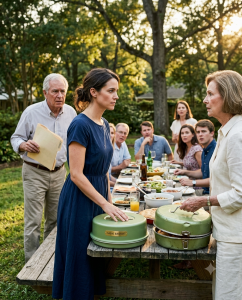
The day of the reunion dawned thick with heat and bright enough to make every leaf seem outlined. Cars lined the drive. Tents had been set up on the lawn. A banner near the porch read Weller Family Legacy Reunion & Scholarship Picnic.
Nadine carried the new pie carrier through the gate and felt eyes land on her almost immediately. Recognition traveled in whispers. Some people looked startled. Some looked thrilled in the mean little way that certain families reserve for the possibility of fresh scandal. A few older faces looked ashamed before she had said a word.
Vivian Weller, now in her seventies and dressed in cream linen with pearl earrings, still moved like the center of the event. A wireless microphone rested in one manicured hand as she circulated between tables thanking donors and directing grandchildren where to stand for photographs.
Nadine ignored her at first.
She walked straight toward the main picnic table.
And there it was.
Her grandmother’s pie carrier sat among the platters as casually as if it had grown there from the wood. The broken latch hung crooked. The dent on the left side caught the light exactly as she remembered. Someone had even polished the metal, but not well enough to erase the history pressed into it.
For one disorienting second Nadine saw both timelines at once: herself at twenty-six walking away in tears, and herself now, older and steadier, standing right where that younger woman had not been able to stand.
Then Vivian approached carrying a serving knife and stopped dead at the sight of Nadine.
The crowd nearest the table quieted without meaning to.
Nadine set her new pie carrier beside the old one.
The resemblance was striking. Same shape, same color, same era. But the new one was whole, its latch straight, its surface clean. And on the front, impossible to miss, was the brass plate:
NADINE BURKHART.
Vivian’s gaze dropped to the plate, then slid to the older carrier. Her expression flickered through recognition, annoyance, and something darker.
Nadine met her eyes.
“I believe that one’s mine,” she said.
She had imagined many possible reactions—dismissal, mockery, public confusion—but not what happened next.
Behind her, a male voice said, “It is.”
Every head turned.
Amos Weller, Everett’s father, stood a few feet away holding a flat weathered file. He had aged heavily in the last decade, shoulders bowed by a life of saying too little, but there was a steadiness in him Nadine had never seen before.
Vivian went pale beneath her makeup.
“Amos,” she said warningly, but the microphone in her hand amplified the name across half the lawn.
He ignored her. “I told you years ago to return it.”
The nearest tables fell silent. Farther back, conversations died one by one as people sensed a fracture opening.
Everett pushed through the crowd then, older too, still handsome in a weaker, wearier way. He looked from Nadine to his mother to the file in his father’s hand and seemed to understand, all at once, that whatever protected version of family history he had always lived inside was about to rupture in public.
Vivian recovered enough to summon a laugh. “This is ridiculous,” she said. “Over an old pie carrier?”
“No,” Nadine said calmly. “Not over an old pie carrier.”
Amos stepped beside her and opened the file. Inside were copies of the donor program, photographs, handwritten notes, and a yellowed index card. He held up the program first. “Mavis Burkhart. Dessert donor. Green carrier—return to M.B.”
A murmur spread through the crowd.
Then he lifted an old note, folded and unfolded too many times. “My mother kept this,” he said. “She wrote down things she wanted remembered. Including what Vivian said that day. She wrote: Vivian refused to send Mavis’s carrier back. Said nobody would miss one pie carrier if they were too small to sit at the main table.”
The silence that followed was the kind that physically changes a space.
Vivian’s mouth tightened. “Your mother despised me.”
“She distrusted you,” Amos said quietly. “She was right.”
Everett looked sick. “Mom?”
Vivian turned on him with that same polished fury Nadine remembered from years ago. “Do not embarrass me by performing confusion. This family has hosted half this county for generations. Things get left, mixed up, forgotten—”
“Then why was her name on it?” Nadine asked.
Vivian stopped.
Amos reached for the old carrier, turned it carefully, and tipped the base toward the light. There, faint but visible when the sun struck at an angle, were scratched initials: M.B.
A few people gasped, absurd as that sound would have seemed over cookware. But it wasn’t about cookware anymore. It was about what the object proved: that the Wellers had carried someone else’s property through their gatherings for decades while presenting themselves as guardians of tradition and propriety.
Lenore Fisk, bless her relentless old voice, called from the back, “Told you all she stole it.”
That broke the paralysis.
Questions burst from every direction. Cousins craned for a look. An aunt demanded to know whether the scholarship story about the land donation was also incomplete. Someone asked why Burkhart names had never been included on any donor plaque. Another person said they remembered hearing Mavis’s orchard supplied the first fundraising dinners. A younger family member, one of the college-aged grandchildren, looked around in disbelief and asked, “Wait, did we build this whole legacy on taking credit for other people’s things?”
Vivian tried to reassert control. She lifted the microphone, but this time her voice lacked the effortless authority it once had. “Families survive by moving forward, not by indulging old resentments—”
“Families survive by telling the truth,” Amos said.
He took the microphone gently from her hand.
Nadine would remember that moment for the rest of her life. Not because Amos had finally found courage, though he had. Not because Vivian had finally been contradicted in public, though she had. But because for the first time, in the exact space where she had once been publicly diminished, the room—or in this case the yard—tilted toward honesty instead of power.
Amos spoke plainly. He admitted he had known, years ago, that the pie carrier was Mavis Burkhart’s. He admitted he had failed to force the issue because peace in the family had always come at the price of someone else swallowing the insult. He apologized to Nadine, directly and without excuse, for his silence during the engagement and for every year after.
Then he did something no one expected.
He announced that the family’s scholarship committee would be suspended until the original land records and donor histories were reviewed, corrected, and publicly amended to include the Burkhart contributions that had been erased. If legal ownership issues remained unresolved, they would be addressed openly.
Several relatives protested. Others looked grimly relieved. Everett stood frozen, as if his entire inheritance had shifted shape beneath him.
Vivian did not cry. Nadine almost respected that. What she did instead was worse and sadder: she looked around at the faces of people no longer willing to protect her version of events and seemed genuinely stunned that performance had finally failed.
“After everything I have done for this family,” she said.
It was such a revealing sentence that nobody needed anything else.
Nadine reached for her grandmother’s carrier. Vivian’s hand tightened reflexively on the handle, then loosened. For one charged second the two women stood on opposite sides of the same object, years of insult and entitlement compressed into the space between their fingers.
Then Vivian let go.
The carrier was lighter than Nadine expected.
She set it beside her new one and ran her thumb over the dent. Memory rose instantly—her grandmother’s kitchen, Sunday flour dust, the smell of peach syrup bubbling over. For a second grief hit so cleanly it nearly stole her breath. She wished Mavis were standing there to see this. She wished, selfishly and fiercely, that the woman who had taught her dignity could witness dignity being returned.
Amos cleared his throat. “Mavis should have had credit. And respect.”
“Yes,” Nadine said. “She should have.”
Everett stepped closer, his face stripped of every easy charm she had once mistaken for character. “Nadine, I—”
She looked at him and knew whatever apology he had come to offer would be more about his own discomfort than her pain.
“You had your chance twelve years ago,” she said.
He flinched because there was nothing to argue with.
Later, after the crowd had fractured into angry conversations and stunned huddles, after the caterers awkwardly resumed serving food no one was eager to eat, Nadine carried both pie carriers to her car. Amos followed with the file and asked if she wanted copies of everything. She said yes. He promised to bring them by her office the next week.
Before he stepped away, he said, “I should have spoken then.”
Nadine did not offer absolution he hadn’t earned. She only said, “You’re speaking now.”
On the drive home, the old carrier sat in the passenger seat and the new one in the back. At a red light she glanced over and laughed softly through tears she had not expected. After all those years, the thing had come home not because the Wellers had suddenly found decency, but because they had finally lost control of the story.
That evening she placed the old carrier on her kitchen table and cleaned it carefully, not too much. She did not want to polish away the marks that proved it had lived a real life. Beneath the base, when the light hit right, the scratched initials appeared again.
M.B.
She traced them once.
A month later the town paper ran a piece about the Weller scholarship fund being “temporarily reorganized” after historical discrepancies came to light. Two weeks after that, new plaques were commissioned for the county museum and the community center, acknowledging the Burkhart family’s original land and food contributions to the fundraiser that eventually became the annual scholarship event. The corrected version was not as elegant as the old lie, but it had the advantage of being true.
Vivian stopped appearing at public functions for a while.
Everett sent one letter Nadine never answered.
As for the pie carrier, she used it the first chance she got. Church supper, early fall. Apple this time. When she walked in carrying it, Lenore Fisk cackled loud enough for everyone to hear and said, “Now that’s where it belongs.”
Nadine smiled and set it on the table.
Objects were never just objects in families like these. They were claims. They were proof. They were ways of deciding whose labor counted, whose memory mattered, whose hands got written into the story and whose got cropped out.
For years the Wellers had carried that green aluminum carrier as if possession itself made them rightful owners. But all it had really done was wait—through photographs, through holidays, through polished performances—for the one person who could name it properly and refuse to be shamed into silence again.
The strangest part was this: getting it back did not feel like triumph as much as restoration. Something small and practical had returned to its rightful place, and in doing so had exposed everything built on pretending it never belonged there in the first place.
Nadine sometimes wondered which mattered more in the end: the public humiliation she had survived or the public truth that finally answered it. She never quite decided.
But whenever she lifted the carrier now and felt the old dent under her palm, she thought of her grandmother’s sentence.
Some people keep what they didn’t earn.
That had been true.
What Mavis hadn’t said was that sometimes they keep it only until someone strong enough comes back for it.
And maybe that was the real red flag all along—not the theft itself, but the kind of family that could look at what another woman had carried, cooked, built, and contributed, then call her too small to sit at their table.