Twelve years before the ribbon-cutting, Bev Sutter stood in the blazing June sun on the lawn of the Millhaven Garden Club and tried not to shake.
The annual competition was one of those small-town traditions that carried far more power than it deserved. Officially, it was about flowers, horticulture, and civic pride. Unofficially, it was about lineage. The right families sat in the front rows, chaired the committees, and handed down influence through volunteer boards and luncheon tables the way other people handed down china.
Millhaven, Ohio, liked to imagine itself as warm and community-minded. Sometimes it was. But it was also a town with a long memory and a sharp instinct for hierarchy. Everybody knew where they stood. Everybody knew who had always stood above them.
Bev had never belonged to the upper layer of Millhaven life. She rented a modest duplex on Elm Street, worked hard, kept mostly to herself, and spent what little spare money she had on plants most people failed to appreciate until they were arranged by someone rich enough to make them look fashionable. She was not a social gardener. She was a real one. She knew how roots behaved in bad soil, how to coax exhausted plants back to life, and how to build something beautiful out of castoffs and patience.
Her competition entry that year reflected exactly who she was.
Instead of imported urns and fussy symmetry, she built a living display with climbing roses, foxglove, native grasses, black-eyed Susans, salvaged clay pots, and a hand-repaired trellis. It wasn’t formal, but it moved in the breeze like it had a pulse. It looked less like an arrangement and more like a fragment of a living landscape. Bev loved it.
She had one other thing with her that day: a worn packet of heirloom seeds in the pocket of her light coat. The packet had been saved by her grandmother, Eleanor Vale, a woman whose garden had once been quietly admired all over the county by people who never quite gave her public credit. Eleanor had saved seeds by hand, labeled them carefully, and told Bev stories about every variety as if each carried a little piece of the family’s memory.
Bev had brought the packet because one of the older judges had once mentioned wanting to see heritage varieties if anyone in town still had them. Bev thought maybe, after the judging, she would show it to her. She never got the chance.
Carol Fenholt did not allow that kind of day to belong to someone else.
Carol was the daughter of the Garden Club’s founding family, and she wore that status like a second skin. She was elegant, practiced, and fully aware that in Millhaven, the Fenholt name still moved people a fraction of an inch off balance. Her mother had founded the competition. Her aunt still helped control the judging. Carol herself chaired galas, signed donor boards, and spoke at public events with the kind of confidence that came from never having had a microphone taken away.
When she approached Bev’s display that afternoon, she smiled first.
Then she laughed.
“I’m sorry,” Carol said into the microphone, loud enough for the whole lawn to hear, “but this looks like something from a gas station parking lot.”
There are humiliations that happen so fast they barely feel real until later. Bev felt the laughter ripple around her before she properly understood the words. Some women gasped. Others laughed because the crowd was laughing. A few looked away in embarrassment. Nobody stepped forward.
Bev stood there with her face burning and looked at the thing she had made with her own hands. A moment earlier it had seemed bold and alive. Under the heat of public mockery, it suddenly looked crude. That was the trick of humiliation. It made you see yourself through the least generous eyes in the room.
Without saying a word, Bev bent down, picked up her trowel, and started taking her display apart.
No one stopped her. No one apologized. No one said Carol had gone too far.
By the time the judges awarded the blue ribbon to a polished arrangement of hybrid tea roses in imported stone planters, Bev was already loading her things into the back of her truck.
She thought the worst part of the day was over.
It wasn’t.
As she reached into the truck bed for a crate, Carol approached from behind. Her heels clicked on the pavement, deliberate and unhurried. Bev turned, still holding the crate, and found Carol watching her with the cool satisfaction of someone who believed she had made a point.
“You shouldn’t take it personally,” Carol said. “These events have standards.”
Bev was too stunned to answer.
Then Carol’s gaze dropped to the packet peeking from Bev’s coat pocket.
“What’s that?”
Bev instinctively covered it with her hand. “Nothing.”
Carol gave a little laugh. “You brought seeds?”
“They were my grandmother’s.”
Something changed in Carol’s face. The smugness flickered, replaced by a brief, sharp interest. “Your grandmother was Eleanor Vale?”
Bev frowned. “Yes.”
Carol stepped closer. “Let me see.”
Bev should have refused. Later, she would replay that second over and over. But Carol spoke with such certainty, such entitlement, that Bev’s hand moved before her judgment caught up. She drew out the packet and let Carol look.
The packet was old, folded, and soft at the corners. Eleanor’s handwriting ran across the front. On the back were notes in pencil: planting conditions, bloom color, seed-saving instructions. Carol stared at it too long.
Then she smiled in a completely different way.
“That’s interesting,” she said.
Bev took it back and tucked it into her pocket. “I need to go.”
By the time she got home, the humiliation of the stage had blurred into something stranger. Why had Carol reacted that way to the packet? Why had Eleanor’s name mattered? Bev asked her mother that night, and her mother—who had spent years avoiding town politics whenever possible—went quiet.
Then she told Bev a story she had never fully shared.
Years earlier, before the Garden Club became a polished social institution, Eleanor Vale’s garden had been the one serious gardeners whispered about. Eleanor had grown rare and heirloom varieties with astonishing success, especially flowers nearly impossible to source commercially at the time. The Fenholts had courted her briefly when they were forming the club. They wanted her involved, wanted her garden featured, wanted her name attached. But Eleanor had refused to become anyone’s ornament. She agreed to share advice and occasionally donate cuttings, but she would not let the Fenholts present her work as their discovery.
After that, according to Bev’s mother, the relationship cooled.
There had been one especially ugly disagreement over seeds Eleanor believed had been borrowed and never returned. She could never prove it. People dismissed it as misunderstanding. The Fenholts kept their standing. Eleanor kept her distance.
Bev sat at her kitchen table that night turning the packet over in her hands and thinking about Carol’s expression in the parking lot. The next morning, the shame of the competition was still there, but now it had fused with something harder.
She never returned to the Garden Club.
Instead, she went to work.
The next years were lean, difficult, and unsentimental. Bev took extra shifts at a regional nursery, then labor work with a landscaping contractor whose methods she often despised but studied anyway. She learned irrigation systems, grading, greenhouse timing, procurement, restoration planning, and commercial bidding. She spent evenings reading technical manuals and weekends experimenting on borrowed ground. She made mistakes, learned from them, and got better.
The heirloom packet stayed with her.
It lived in coat pockets, desk drawers, glove compartments, and the inner pocket of her field jacket. She did not plant those seeds. Not yet. They meant too much, and she had begun to suspect they meant more than she understood.
On a rough piece of land behind an old feed store, she started a small nursery. At first it looked hopeless. The soil was compacted, the location unappealing, and her budget laughable. But Bev knew how to see possibility where other people saw waste. She rebuilt the ground one season at a time. She propagated cuttings, sold starts, designed containers, and accepted jobs no one glamorous wanted.
Slowly, people noticed.
Then they started talking.
A restaurant owner praised her instinct for combining native plants with visual drama. A county park manager hired her for a difficult restoration. Historic homeowners sought her out when ordinary landscapers kept giving them generic, lifeless results. School administrators liked that she could speak to children as easily as she could design a site plan. Regional publications began featuring her work. What had started as hustle became expertise; what became expertise grew into reputation.
Millhaven heard about her only in pieces at first. Then all at once.
The turning point was the Hartwell estate.
The property had once been one of the showplaces of town, famous for its grounds and an old glass conservatory that had long since fallen to ruin. For decades, nobody knew what to do with it. Too expensive to restore, too politically complicated to sell, it decayed behind fencing while every election cycle produced fresh speeches and no action.
Then Bev began buying adjacent parcels through an LLC no one in Millhaven bothered to scrutinize until she controlled enough land to make the plan irreversible.
When the proposal became public, the town was stunned. Bev Sutter—the woman Carol Fenholt had once mocked off the Garden Club lawn—was building a botanical conservatory in Millhaven.
Not a vanity greenhouse. A real institution.
Her proposal included public gardens, educational programming, apprenticeship opportunities, native habitat restoration, a seed library, and a long-term endowment to keep the place open and maintained. It was visionary, but it was also meticulously practical. She had funding. She had experts. She had designs, environmental approvals, and a board structure strong enough to survive civic meddling.
At the first major public meeting, the room was packed.
Carol Fenholt arrived dressed perfectly and wearing an expression of civic concern polished to a gleam. During the public comment period, she praised the idea in theory, then questioned traffic, aesthetics, neighborhood fit, and whether the project would preserve “the standards Millhaven has always cherished.”
The room understood the insult beneath the wording.
Bev, seated at the front beside architects and planners, answered every question with calm specificity. Her confidence came not from social power but from competence, and there is nothing more destabilizing to people who mistake status for superiority than encountering someone they can no longer dismiss.
“I’m building it for what Millhaven could be,” she said at one point.
It was the kind of sentence people repeat for years.
Construction began the following spring. Steel frames rose. New glass reflected the sky where brambles had stood. Children pressed against the perimeter fence to watch progress. The local paper covered every milestone, and in photograph after photograph Bev appeared in the same weathered coat, the shape of a small rectangular packet visible in her pocket.
At the groundbreaking, she touched that pocket just before the first shovel hit the ground.
At the winter beam-raising, she touched it again.
At a donor dinner months later, when the town learned that the anonymous lead funder behind nearly every major phase of the project was Bev herself, she arrived in a dark coat with the packet still tucked near her heart.
Speculation swirled. How much money had she made? How extensive were her contracts? Was this generosity or vindication?
The answer was complicated. It was certainly generosity. Millhaven was getting something extraordinary because Bev wanted children and families to have access to beauty, education, and living knowledge. But it was also, undeniably, a correction. The town had judged her cheaply once. Now it would walk through doors she built.
As the conservatory neared completion, Bev finally solved the mystery of the seeds.
It happened while sorting old family papers after her mother downsized. In a box of letters, Bev found correspondence between Eleanor Vale and one of the original Garden Club organizers. The letters confirmed what had once sounded like rumor. Eleanor had shared trial samples of an heirloom strain with the Fenholts for exhibition planning. The seeds were rare, adapted over generations, and associated with a line no commercial supplier could authentically reproduce. Eleanor later accused the Fenholts of claiming them as part of a “club discovery” while quietly excluding her from credit. One letter mentioned missing packets. Another contained a note in a second hand—Eleanor’s, but written later—identifying which packet had been returned and which never came back.
The packet Bev had carried for years was the returned one.
And on the back, under old pencil instructions, was a notation Bev had never fully deciphered until then: a Fenholt family inventory mark.
Carol had recognized it instantly in the parking lot twelve years before. That was why she had gone cold.
But the letters revealed something even uglier. After publicly mocking Bev, Carol had followed her to the parking lot not just out of cruelty but out of panic. She had wanted to know how much Bev knew about the seeds, Eleanor, and the old dispute. According to a note Eleanor had left unfinished among her papers, the Fenholts had once built part of their horticultural reputation on material that originated in Eleanor’s garden.
They had borrowed prestige and never returned it.
Bev said nothing publicly. Not then.
Instead, she incorporated the truth into the place she was building. At the conservatory, she designed a heritage bed dedicated to local seed stewardship. The first protected variety listed in the founding archive was Eleanor Vale’s line. And when the cornerstone for the new entrance was set, Bev placed the old packet beneath it—a symbolic return to the ground, a record sealed where the future would stand on top of the past rather than erase it.
Ribbon-cutting day arrived almost exactly twelve years after the humiliation on the lawn.
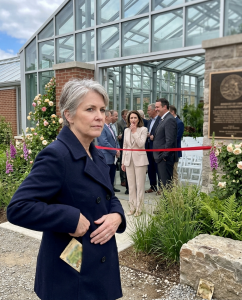
The ceremony drew everyone who mattered and everyone who once believed they mattered. Politicians, donors, club members, reporters, former skeptics, curious neighbors—they filled rows of white chairs outside the shining entrance. The bronze plaque at the front did not bear a Fenholt name, or a Hartwell one, or the name of any old Millhaven dynasty.
It read: The Eleanor Vale Conservatory, gifted to the people of Millhaven by Beverly Sutter.
That name hit the crowd first. Then came the mayor’s speech praising the project, the public good it would do, and the vision behind it.
“And of course,” he said, leaning toward the microphone, “none of this exists without the woman who funded every square foot of it—the woman some of you may remember from a very different day on this very same lawn.”
The crowd shifted. They all understood.
Bev turned toward Carol Fenholt and smiled.
Not sweetly. Not viciously. Simply with the composure of someone who had waited until the truth no longer needed permission.
Then she reached into her coat and withdrew a second packet sealed in archival plastic. The crowd fell into complete silence.
“My grandmother saved these seeds by hand,” Bev said. “Some of you knew her. Some of you used her work. A few of you used it more than you admitted.”
Carol’s face changed visibly.
Bev continued, calm and clear, explaining that the heritage collection at the conservatory honored Eleanor Vale, whose cultivation and seed stewardship had influenced Millhaven’s gardening history long before the Garden Club polished that history into something more convenient. She held up the packet so the front rows could see Eleanor’s handwriting.
Then she turned it over.
There, beneath Eleanor’s notes, was an inventory mark tying the packet to the original Fenholt borrowing. A local historian in attendance stepped forward, stunned, and confirmed what several older residents had already begun whispering. Eleanor’s seeds had been part of the early club’s private exhibition materials. Her credit had faded from public memory. The Fenholts’ had not.
Carol tried to interrupt. “This is not appropriate.”
“It wasn’t appropriate to mock what you knew you recognized,” Bev said.
That line broke the room open.
An older woman rose from her chair and, voice shaking, recalled Eleanor’s garden and the dispute everyone had dismissed because the Fenholts were too established to challenge. A former club volunteer admitted she remembered being told not to mention where certain varieties came from. Two reporters moved closer. Cameras flashed.
Carol’s mother, seated farther back, closed her eyes.
Bev did not rant. She did not dramatize. She simply laid out the truth: the old borrowing, the lost credit, the parking-lot confrontation twelve years earlier when Carol had realized exactly whose seeds Bev carried, and the years of silence that followed while Bev built something no one could take from her.
Then she said the sentence that settled everything.
“My grandmother grew beauty without needing applause. I built this place so her name—and the work behind it—would finally have somewhere permanent to live.”
No one applauded immediately. The emotion in the air was too dense for that. What followed was stranger and more powerful: recognition. You could feel a town revising itself in real time.
The plaque at the entrance was unveiled in full. The heritage garden was dedicated to Eleanor Vale. The mayor, looking both uncomfortable and relieved, invited Bev to cut the ribbon. She did, one clean motion through the satin, and the doors opened to the public.
Inside, the conservatory glowed.
Moist warm air carried the scent of earth and leaves. Curving paths led through layered plantings and bright displays. Glass overhead turned sunlight into something almost cathedral-like. Children pointed at orchids. Older residents paused at the heritage seed exhibit, reading Eleanor’s name again and again as if trying to place a memory they had been taught to forget.
In the central bed near the entrance, under careful glass protection, were the first living descendants of Eleanor Vale’s preserved line.
Bev had finally planted the seeds.
Not all of them—only enough to begin. Enough to prove they were real. Enough to restore a story to the land that had once denied it.
Carol left before the afternoon reception ended.
She was not publicly ruined in the theatrical sense. Millhaven was too mannered for that. But the social certainty around her fractured. People who had once laughed with her now lowered their voices when she approached. Her family’s version of history no longer stood unchallenged. The Garden Club itself, embarrassed by the exposure, announced reforms, archival review, and a scholarship in Eleanor Vale’s name—belated gestures, but still admissions.
Bev accepted none of their apologies immediately.
Forgiveness, she understood, was not the same thing as pretending the wound never happened. She had built a conservatory, not a revision of memory.
By evening, after the crowd thinned and the last local reporter packed away a camera, Bev walked alone to the entrance stone. A grounds worker who had noticed the edge of the old packet beneath the cornerstone earlier asked quietly if she wanted it removed and archived.
“No,” Bev said.
“Are you sure?”
She looked at the bronze plaque, the glass beyond it, the first visitors still moving through the warmth inside. “That’s where it belongs.”
The packet had begun as inheritance, become evidence, and ended as foundation. That felt right.
Before locking up, Bev stepped into the heritage wing and paused beside the young plants grown from Eleanor’s seeds. They were not flashy. Not yet. Their beauty would arrive the way true things often do—steadily, without begging to be noticed, impossible to dismiss once established.
She touched one leaf lightly and thought about the day she had been laughed off a lawn for bringing something real into a room full of performance.
Twelve years ago, Millhaven saw a woman packing up in silence and assumed she had been put in her place.
What it had actually witnessed was a beginning.
And that was the part that would trouble people longest after the gossip died down: not that Bev came back richer, stronger, and impossible to humiliate, but that she had used every insult, every closed door, every swallowed humiliation to build something generous enough to share even with the people who did not deserve her kindness.
Some would say that made her better than the town that wronged her.
Others would say kindness was not the right word for opening a public garden with the truth engraved into its foundations.
Maybe both were true.
Maybe the biggest red flag had been there from the start, hidden in plain sight, in a woman who mocked what she instantly recognized as valuable because she could not bear for anyone else to possess it openly.
Or maybe the real lesson was simpler than Millhaven wanted it to be.
Never laugh at someone holding seeds.
You have no idea what they are capable of growing.