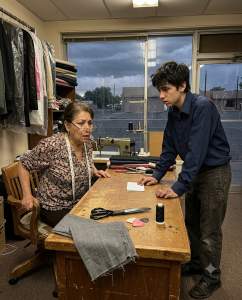
Every afternoon, just as the New Mexico heat settled into the bricks and sidewalks like it meant to stay there forever, Arlene Gutierrez noticed the same boy sitting outside her alterations shop.
At first, she did not think much of him.
Her little store on the edge of old Route 66 attracted all kinds of people who did not intend to become customers. Men waiting on rides. Women escaping loud houses for ten quiet minutes. Teenagers hiding from the sun beneath the narrow shade of her faded awning. Arlene had been in business too long to chase anybody off unless they gave her a reason.
This boy never did.
He was there around three each afternoon, sitting on the cracked wooden bench beside the front window, reading a dog-eared library book with the concentration of someone trying to hold his whole world together with his eyes. He was thin, dark-haired, long-limbed in the awkward unfinished way of teenage boys. His church pants were too short at the ankle and fraying badly at the hem. The same right cuff dragged against the sidewalk every time he crossed one foot over the other.
Arlene noticed details. That was what a lifetime of sewing had trained her to do.
Loose threads. Weak seams. Tiny tears that turned into bigger ones if no one caught them in time.
She was sixty-eight and officially semi-retired, though nobody in town believed that. Her daughter in Albuquerque called twice a week to tell her she had earned the right to rest. Arlene always said the same thing: “I’m resting enough.”
What she never admitted was that the shop had become quieter than she liked. Her husband Mateo had been gone four years. Her son lived in Colorado. Most days the only voices in the store came from the old radio on the shelf and the muttering she did at stubborn zippers. She kept the business open partly for money, mostly for company, and partly because she did not know who she would be if she stopped fixing things.
So she noticed the boy.
She noticed that he read the same worn book every day but never seemed to make progress in it. She noticed that he never came in to enjoy the air-conditioning, even when the heat outside shimmered hard enough to bend the street. She noticed the way his eyes lifted whenever a pickup truck slowed nearby, then dropped quickly again. She noticed his shirt pocket bulging with a neatly folded index card that he touched now and then without ever taking it out.
On the twelfth day, she stepped outside with a glass of iced tea and decided enough was enough.
“Son,” she said, nodding toward the ragged hem on his pants, “if you keep stepping on that, you’re going to lose the whole cuff.”
The boy looked up so abruptly that Arlene almost apologized. He had the alert, frightened expression of someone who had learned to expect trouble first and kindness second.
“I’m sorry,” he said quickly. “I can move.”
That answer settled somewhere heavy in her chest.
“I didn’t ask you to move,” Arlene said. “I asked whether you want me to show you how to fix it.”
He blinked.
She jerked her thumb toward the door. “Come on. I’ll teach you to hem your own pants. You look like you could use the skill.”
He hesitated so long she thought he would refuse. Then his fingers brushed the folded card in his pocket, and something in his face changed. Not trust exactly. More like a decision made under pressure.
“Yes, ma’am,” he said.
Inside, the shop was dim and cool, with the rattle of the swamp cooler in the window and rows of fabric glowing softly under fluorescent lights. Arlene motioned him to the cutting table.
“What’s your name?” she asked.
“Eli.”
“Arlene,” she said. “Though around here it’s mostly Miss Arlene.”
He nodded like he was storing the information carefully.
She showed him how to turn the frayed fabric inward, how to pin it, how to thread a needle. He was clumsy for all of three minutes. After that, he watched with a level of concentration that made her think he was learning more than sewing. He was memorizing.
He apologized every time he made a mistake. He thanked her twice for a single glass of water. He sat upright on the chair as if he did not believe he had earned the right to lean back.
The first session lasted twenty minutes.
The next day he came back.
He said the hem had held but one of his shirt buttons was loose. Arlene pretended not to notice that the shirt itself had been washed so many times the fabric had gone almost thin enough to see through. She found him a button from her extras jar, one close enough in color not to matter, and taught him how to anchor it properly.
By the end of that week, he had learned to repair a torn pocket, reinforce a belt loop, and stitch from the inside so the mend barely showed. Arlene had also learned a dozen things he never said directly.
He knew which churches gave out food boxes on which days. He knew the least busy hours at the laundromat. He knew how to rinse a shirt in a sink and dry it overnight. He knew how to answer questions without actually answering them.
“You live nearby?” she asked once.
“Sort of.”
“You in school?”
His pause was too long. “Not right now.”
“Your mama know where you are after school hours?”
“She works late.”
Arlene let that one sit in the air between them. She had raised children. She knew the shape of incomplete truths.
The thing that bothered her most was not that he was hiding something. It was that he seemed exhausted from hiding it.
Then one afternoon, after he had gone, she noticed dust on the chair where he had been sitting. Fine gray-white dust with reddish flakes mixed through it. Concrete and rust. Not the kind boys picked up from ball fields or dirt roads. This was indoor dust, closed-space dust.
She stepped outside and watched him walk away.
He cut across the alley instead of heading toward any of the nearby houses. He went behind the old feed store and disappeared in the direction of the storage units three blocks west.
Arlene stood in the doorway with her hand gripping the frame until the wood pressed into her palm.
The storage facility sat behind a chain-link fence at the edge of a lot where weeds grew through cracked asphalt. Most of the units were rented by people with too much stuff and not enough room. But Arlene had lived in town long enough to hear things. Runaways sleeping in empty ones. Cousins “staying temporary” in them. Men doing deals they did not want watched.
She told herself not to jump to conclusions.
She also began paying closer attention.
Eli came back every day. The same book. The same careful manners. The same folded index card in his pocket. Sometimes he looked almost like a regular kid when Arlene corrected his stitches and he gave a tiny embarrassed smile. But then the smile would disappear if a truck passed too slowly outside, or if someone mentioned family, and that frightened look would return.
One Thursday she gave him half her roast beef sandwich and pretended she had made too much lunch.
He ate with the swift, controlled focus of someone trying not to seem hungry.
That night Arlene lay awake listening to the desert wind tap a branch against her bedroom window. She thought of her own son at sixteen, all elbows and appetite and loud opinions. She thought of what it would mean for a child to sleep among boxes and rusted padlocks while the rest of the town carried on around him.
The next afternoon, thunderheads gathered in the west, dark purple against the pale sky. Eli arrived late, windblown and distracted, his shirt sticking to his back with sweat.
“You okay?” Arlene asked.
“Yes, ma’am.”
That answer had become meaningless.
She watched him sit at the cutting table and pull out the pants she had helped him fix. One hem was holding. Another seam near the pocket had split.
“You got somewhere dry for the storm?” she asked.
“I’ll be fine.”
Arlene set down her scissors. “Anybody expecting you home for dinner?”
It was as if she had pressed on a bruise he could no longer hide.
Eli’s face changed completely. Fear rose in it first. Then grief. Then a kind of trapped panic that made him look younger than he had before.
Slowly, he reached into his pocket and took out the folded index card.
His hands shook.
He stared at it for a long second before smoothing it flat on her cutting table.
Arlene leaned closer.
On one side was a printed list of rules from a storage facility. Rent dates. Access hours. Late fees.
On the other side, written in careful black handwriting, were words that made the room tilt beneath her feet.
If anything happens and you have to leave, Unit 118. Three blocks west. Key in the coffee can. Do not trust your uncle Ray. Do not call anyone from my phone. Find Mrs. Arlene at the alterations shop. She sews for everybody. She will know what to do.
Arlene sat down hard in the chair behind her.
Eli stared at the tabletop.
“Your mother wrote this?” she asked quietly.
He nodded.
“Where is she?”
“She left to get money,” he said after a moment. “She said she’d be back in two days.”
“When was that?”
“Nineteen days ago.”
The storm cracked overhead, thunder so sudden and violent it rattled the front glass. Arlene looked at the boy in front of her and felt a pulse of anger so sharp it surprised her. Not at him. At every adult who had failed him long before he ever found her bench.
“How long have you been in that storage unit?” she asked.
“Since that night.”
“Alone?”
He nodded again.
He looked ashamed. Ashamed, Arlene thought wildly, as if any of this had been his doing.
She stood and locked the front door.
That finally made him look up in alarm. “I didn’t mean—”
“I know what you meant,” she said. “Sit down.”
She went to the back room, opened the little refrigerator where she kept sodas and customer cakes that needed cool air, and came back with leftover enchiladas she had packed for herself. She heated them in the microwave while Eli sat frozen, as if moving might break whatever mercy had landed in his life.
He ate because she told him to. Halfway through, she slid the library book toward herself. “What’s this one?”
He hesitated. “Just something I borrowed.”
The cover was damaged and the due-date slip gone. When she opened it, a second note fell loose from inside the front cover.
This one was written in the same hand, but fast and uneven, as if the writer had not had much time.
If I don’t make it back by Monday, it means he found us first.
Arlene’s blood ran cold.
“Who found you?” she asked.
Eli swallowed. “My uncle Ray.”
“Your mother’s brother?”
He gave a tiny shake of his head. “My dad’s.”
That answer told her enough.
She had seen Ray Bledsoe around town over the years. Loud voice. Hard face. Always smelling faintly of motor oil and stale cigarettes. A man who stood too close when he talked and acted like every favor came with invisible strings. Arlene had never liked him, but dislike was one thing. This was another.
“Why does she say not to trust him?”
Eli’s eyes fixed on the table. “Because after my dad died, he said he’d help us. He moved in for a while. He took my mom’s car whenever he wanted. Borrowed money. Went through our stuff. When she told him to leave, he got mean.”
“How mean?”
Eli said nothing.
Arlene did not push. Not yet.
“What about the police?” she asked carefully.
His laugh was small and joyless. “He said nobody would believe us. And one time when Mom almost called, he smashed her phone.”
Arlene felt her hands curl into fists.
“He knew about the storage unit?” she asked.
“No. I don’t think so. Mom rented it after we left the apartment. She said it was just until she got things straightened out.”
But she had not come back.
And nineteen days was not late. Nineteen days was danger.
Before Arlene could think what to do next, headlights swept across the front window.
Eli jolted so violently his chair legs scraped the floor.
Outside, a pickup truck had slowed in front of the shop.
Arlene stepped toward the glass and peered through the slats of the blinds. White pickup. Rust around the wheel wells. Driver sitting too still, looking directly at the storefront.
“Do you know that truck?” she asked.
Eli did not answer at first.
Then, in a voice so thin it barely sounded like his, he said, “That’s him.”
Arlene’s whole body went cold.
The truck idled for three seconds. Five. Then rolled forward and turned the corner.
Arlene did not waste another second. She picked up the phone and called the one person in town who still treated old-fashioned worry like a real emergency: Rosa Mendez, owner of the diner two blocks over and former dispatcher before she married out of the job.
“Rosa,” Arlene said when she answered, “I need Sheriff Tomlin and I need him now. Quietly.”
Within fifteen minutes, Sheriff Tomlin came through the back door, broad-shouldered and serious, rain beginning to speckle his hat brim. Rosa came with him carrying two takeaway bags and the expression of a woman prepared to fight God if needed.
Eli nearly bolted until Arlene put a hand on his shoulder and said, “They’re here to help.”
Tomlin did not crowd him. He sat down across the room, took off his hat, and spoke like a man coaxing a frightened animal out from under a porch. Little by little, Eli told them enough.
His father had died the year before. Uncle Ray had inserted himself afterward, saying family had to stick together. He offered rides, then opinions, then control. He drank. He watched Eli’s mother too closely. He demanded access to her bank card. When she refused, he started showing up at odd hours, pounding on the apartment door, threatening to “straighten things out.” She moved them in secret. The storage unit was supposed to be temporary while she lined up work in Amarillo with a friend. Then she left one morning to meet someone who owed her money and never returned.
“Why didn’t you go to anyone sooner?” Tomlin asked gently.
Eli stared at his hands. “Because the note said find Mrs. Arlene if something happened. But I didn’t know if it was bad enough yet.”
The room went silent after that.
Bad enough yet.
Tomlin sent a deputy to check Unit 118 immediately. Rosa took Eli home with her for the night despite his protests. Arlene rode with the sheriff to the storage facility in the rain.
The unit was small. Metal walls, concrete floor, one camping pad, a backpack, a grocery sack of canned food, two bottles of water, a flashlight, and a coffee can with a spare key exactly where the note said it would be. There were also three church bulletins, a second pair of pants, and a framed photo wrapped carefully in a T-shirt: Eli with his mother, both squinting into sunlight, both smiling like life had not yet turned on them.
Tomlin found more than that.
In a box shoved against the back wall were copies of paperwork Eli’s mother had apparently been gathering—bank statements, a property title that did not match Ray’s story, and a handwritten list of items missing from her apartment after Ray moved in. Names. Dates. Amounts. Enough to suggest not just harassment, but theft and fraud.
The next morning, the sheriff’s office put out a missing-person notice for Dana Mercer, Eli’s mother.
By noon they had their first break.
A motel owner outside Santa Rosa recognized her photo. Dana had checked in eighteen days earlier under her own name, bruised and frightened, asking to use the office fax machine. She had left before dawn in a hurry after receiving a phone call. The owner remembered because she had abandoned a tote bag.
Inside the tote were copies of the same documents found in the storage unit and a receipt from a mechanic’s shop near Clovis.
By evening, Tomlin had enough to obtain a warrant related to Ray Bledsoe’s property. They found Dana’s car hidden in a shed behind one of Ray’s outbuildings, the license plate removed.
Dana herself was not there.
But now the search widened fast.
It was a county road deputy who finally found her two days later at a trailer outside Portales, where she had been staying under another woman’s name after fleeing again. She was alive. Exhausted, underweight, terrified—but alive.
When she saw Eli at the sheriff’s office, she made a sound Arlene would never forget. Not a cry exactly. More like a body breaking open under the weight of relief.
She had gone to collect money from a former employer who owed her wages. Ray intercepted her in the parking lot. He threatened her, took her phone, and said if she went back for Eli, he would find them both. She managed to escape later that night with help from a stranger at a gas station, but by then she was convinced Ray was watching every place she might return to. She had tried to circle back twice and seen his truck near the storage facility both times. Terrified of leading him straight to Eli, she kept moving while trying to find a safe way to contact authorities without using any account or phone Ray could trace.
The tote bag and paperwork had been her attempt to leave a trail.
She had written Arlene’s name on the card because Arlene really did sew for everybody. Dana had seen her mend clothes for half the town, comfort grieving widows in fitting rooms, and slip free repairs to kids whose parents were short on money. “You were the only person I could think of who still notices people,” she told Arlene later, voice shaking.
Ray was arrested three days after that on charges tied to fraud, theft, intimidation, and unlawful restraint while the investigation continued. More came out once Dana spoke. Then more after other people realized someone was finally listening.
Months passed.
Eli and his mother moved into a small rental on the other side of town through a church housing fund and a quiet miracle of community help that nobody bragged about. Rosa organized meals without calling it charity. Sheriff Tomlin made sure Eli was connected with a counselor. Arlene pretended not to notice when Dana left envelopes of cash on the counter for sewing lessons she insisted on paying for.
Eli still came by the shop.
At first it was to fix his own clothes. Then to help with simple mending. Then, one Saturday, Arlene found him showing an elderly customer how to sew a button back on with the same patience she had shown him.
“You’re doing my job now,” she said.
He smiled, and this time the smile stayed.
The library book was returned at last, though not before Arlene noticed he had finally reached the final pages.
Some wounds did not close neatly. Dana still startled at certain trucks. Eli still checked windows when doors opened unexpectedly. There were days when both of them looked tired in ways sleep could not fix. Healing, Arlene learned, was not a clean hem. It was patchwork. Reinforcement. Going back over weak places again and again until they held.
One evening near closing, Eli brought in a new pair of black slacks for Sunday service.
“Think these will last?” he asked.
Arlene examined the hem, then handed them back to him with a snort. “Not unless you stop growing.”
He laughed. She liked that sound.
After he left, Arlene stood alone in the quiet shop, looking at the cutting table where the folded card had once lain under her scissors and tailor’s chalk. She thought about how close the whole thing had come to going unseen. A boy on a bench. A frayed hem. Dust on a chair. Tiny signs most people would have dismissed as none of their business.
Maybe that was the part that stayed with her most.
Not just that danger could hide in plain sight, but that rescue sometimes began there too. In noticing. In asking one more question. In refusing to let a careful, frightened child keep saying “I’m fine” until the lie hardened around him.
Arlene still did not know whether she had truly known what to do. Not at first. All she had really done was open the door and pay attention.
But sometimes that is where saving starts.
And if you asked her now who was right, she would tell you Dana had made mistakes born of fear, Eli had carried burdens no child should know, and Ray had worn the ordinary face evil often wears in small towns: familiar, tolerated, excused too long.
The biggest red flag had not been his threats. It had been how easily everyone could imagine them and still look away.