Loretta Bell had spent most of her life waking before sunrise.
At sixty-one, her body still moved by bakery time even though her world had been split open more than a year earlier. She woke in darkness, padded into the kitchen in wool socks, and moved by instinct. Kettle. Mug. Spoon. Light over the sink. Some mornings her hands ached before she even touched anything. Some mornings she stood still for a moment and listened to the old refrigerator humming like it had something private to say.
Then she always did the same thing.
Before the coffee. Before the cat. Before the weather.
She opened her late mother’s ceramic bread box.
It was heavy and cream-colored with faded blue flowers painted around the rim, the kind of kitchen piece no one bought anymore because it was too sentimental for modern countertops. Her mother had kept yeast packets in it once, then handwritten recipes, then spare buttons and church envelopes when age made her practical in strange ways. After the funeral, Loretta brought it home and set it in the same corner of the kitchen where sunlight hit around eight in the morning.
For fourteen months, one thing had lived inside it.
A water-stained manila envelope.
Loretta checked it every day with the same steady hand. Never in front of anyone. Never with an audience. She lifted the lid, looked down, made sure it was still there, and closed it again.
That ritual was the only thing in her life that still felt fully under her control.
Because everything else had been stolen in pieces.
The bakery first.
Then the savings.
Then her reputation.
Then, slowly and more cruelly than anything else, her place in the town where she had spent twenty-two years making things people brought to birthdays, funerals, anniversaries, and Sunday dinners.
The bakery had once belonged to two people.
Loretta and Gary Thorne met when she was thirty-nine and he was thirty-six, both too old for foolish risk according to everyone who loved them and too stubborn to listen. She had recipes, discipline, and a knack for making customers feel seen. He had salesmanship, connections, and a confidence that made landlords agree to things they had no business agreeing to. Together they rented a narrow storefront with chipped paint and one display case that leaned slightly left. They painted the walls themselves. They bought a used mixer from a restaurant auction. They took turns sleeping on a cot in the back office the week before opening because there was too much to do and not enough money to do it.
Those first years had been hard enough to weld people together.
They hauled flour sacks in freezing rain. They survived one oven breakdown three days before Christmas by borrowing time in a church kitchen overnight. They made payroll by skipping their own for nearly two months during a flood season that nearly wiped out half the downtown district. Loretta refinanced the little house her mother had left her and poured the money into repairs, inventory, and a new proofing cabinet. Gary cried when she told him. He put both hands over his face and said he would never forget what she had done.
For years, Loretta believed him.
Their partnership was never romantic. People asked early on, then stopped. They were something quieter and, in some ways, more intimate: two people whose survival became braided. He knew which supplier she trusted and which one she couldn’t stand. She knew he lied too easily to sales reps but never to children. He could read her expression across the prep room and know whether she had enough dough mixed for the lunch rush. She could hear the change in his footsteps and tell if a landlord meeting had gone badly.
At least, she thought she could.
Then Vanessa Cline appeared.
The first time Loretta saw her, Vanessa came in around noon wearing a cream coat too fine for flour dust and high boots that clicked sharply across the bakery floor. She was young, maybe late twenties, all polished teeth and smooth compliments. Gary introduced her as someone helping with branding strategy. Loretta did not even know they were looking for branding strategy.
Vanessa smiled and said, “You have such incredible legacy value here.”
Legacy value.
Loretta had spent decades rolling dough before dawn, and somehow that was now a phrase.
Vanessa started showing up more often. She moved quickly, spoke in neat little bursts, and took photos of everything. The seeded loaves on cooling racks. The old handwritten menu board. Gary laughing in the front display area. The brick wall by the window. Loretta noticed Vanessa took fewer photos when the flour settled, when the aprons stained, when the garbage bins overflowed after a holiday rush.
“Modern customers love authenticity,” Vanessa said once.
Loretta had looked at her and replied, “Funny. Most of mine just love bread.”
Gary laughed too hard at that. Vanessa smiled too long.
Small things changed first. The bakery’s social media got louder. There were talks of rebranding, premium lines, luxury packaging. Words started showing up that Loretta had never used in her life: artisanal positioning, brand elevation, curated seasonal identity. Gary handled more meetings alone. The office door stayed shut more often. He told Loretta not to worry about it. He said she should focus on what she was best at.
Baking.
It was not insulting the first time he said it.
By the tenth, it was.
Then came the bank.
Loretta went because a supplier called to ask why a flour payment had bounced. That had never happened. Not in twenty-two years. She assumed there had been some routine error, a number entered wrong, a delay, a hold.
The teller’s face changed when she pulled up the account. That was the first sign.
The second was when the bank manager came out to speak to Loretta privately.
The third was when Loretta heard the phrase full balance transfer and still did not understand it because the words were too absurd to arrange into meaning.
She asked the only question that mattered.
“Whose name?”
The manager hesitated.
Then she answered.
“Gary Thorne and Vanessa Cline.”
Loretta felt something cold move through her body so completely that she later could not remember how she drove home. She parked crooked in her own driveway and sat with both hands on the steering wheel until the silence started roaring.
That evening she confronted Gary at the bakery.
He did not deny it.
That was the part she replayed the most in the months that followed. Not a shouting match. Not a dramatic confession. Just Gary leaning against the stainless prep table they had bought secondhand in year three, arms folded, expression already prepared.
He told her the business needed fresh leadership. He said the market was changing. He said she was resistant, emotional, outdated. He said he had made the moves necessary to save what they built. He said Vanessa understood growth in a way Loretta never would.
Then he offered her a job.
Part-time.
Early mornings only.
No management. No accounts. No public-facing decisions.
“Just bake,” he said.
As if he were being generous.
Loretta stared at him until even he could not hold her eyes.
He had not only stolen the bakery. He had stolen the story of the bakery. In his version, he was the visionary forced to act. She was the tired woman who could not keep up. And because he was smooth and smiling and still knew exactly how to charm people on Main Street, far too many believed him.
Within weeks, the town had rearranged itself around his narrative. Some people avoided Loretta because pity made them uncomfortable. Others treated her with performative gentleness that felt worse than cruelty. A local blogger wrote about the “exciting evolution” of the bakery brand. Gary let people believe Loretta had stepped back willingly. Then, when that version wore thin, uglier ones appeared. She had become unstable. She had signed everything and regretted it. She drank. She forgot orders. She could not handle change.
Loretta stopped defending herself.
That choice made people underestimate her, which turned out to be useful.
She packed her office things in one cardboard box while Vanessa stood nearby with the expression of someone pretending to witness a regrettable but necessary transition. Loretta took her mother’s recipe cards, her own apron, a framed thank-you note from a family whose wedding cake she had made fifteen years earlier, and a ceramic pig timer that no longer worked. She left the brass cash bell, the old display diagrams, and the photo of her and Gary on opening day in borrowed aprons because suddenly she could not bear to look at it.
A week later it rained hard.
Gary had been clearing old files from the office, shredding papers, bagging records, dragging things toward the bins out back. Loretta had gone by after closing to collect one tray she believed still belonged to her. The alley behind the bakery was slick with runoff, and one garbage bag had split open under the back steps.
That was where she saw the manila envelope.
Half in a puddle.
Water-stained. Bent at the corner. Sealed.
She almost left it. Then something about the carelessness of it stopped her. Gary was many things, but he was rarely careless unless he believed he was untouchable.
She took the envelope home, dried it gently with dish towels, and opened it over the kitchen sink.
Inside was not the kind of dramatic evidence television had taught people to expect. No confession. No photograph. No love letter. What she found was better because it was dull.
A draft operating agreement addendum, signed and notarized, laying out an altered ownership structure and revised percentages tied to the business and its collateral interests. There was a cover sheet for county submission. There were notes in the margin. There was language requiring final consent from both original partners for the adjustment to become valid.
One signature was there.
Gary’s.
One was not.
Loretta’s.
At first, the paper looked like a mess of technical words. Then she saw the line that mattered. Any subsequent transfer based on those altered percentages would be invalid if the original consent had not been properly executed or had been falsely represented in a later filing.
Loretta read it six times.
Then she began asking careful questions.
Not locally. Not where everyone knew everyone. She drove to the next county and paid for records copies from a clerk who never asked why her hands shook. She took the papers to a retired bookkeeper who had once handled commercial filings and still enjoyed finding mistakes. He read them over his glasses and made a low sound in his throat.
“Well,” he said, “someone got ambitious before they got legal.”
Eventually she found a legal aid attorney willing to review the packet. He read every page twice, then looked at Loretta with the kind of focus that strips all emotion from a room.
“Do they know you have this?”
“No.”
“Keep it that way.”
He explained that if later ownership transfers, bank authorizations, and county filings rested on a defective or falsely represented amendment, Gary’s whole structure might not hold. There were layers to untangle. Civil questions. Fraud questions. Filing questions. Maybe more, depending on who signed what and what was submitted under seal or affirmation.
Loretta asked what she should do.
He said, “Wait until the right official is standing right there with nowhere to pretend this is private.”
So she waited.
Waiting became its own form of labor.
She watched Gary and Vanessa transform the bakery into something sleek and expensive. They changed the logo, replaced the warm painted menu boards with matte black signage, hung plants from iron hooks, and started wrapping loaves in branded paper tied with satin ribbon. Vanessa posted glossy videos online calling it a rebirth. Gary gave interviews about resilience and innovation. The local chamber of commerce praised him for adapting to changing consumer trends.
Loretta said almost nothing.
She let people think she was broken.
Christmas came and went. Tax season passed. Spring dragged in. The envelope stayed inside the ceramic bread box every morning, checked but never shown. Some nights Loretta lay awake imagining all the ways this could fail. Maybe the paper would not matter. Maybe Gary had covered himself better than it seemed. Maybe everyone would still prefer his version. Maybe truth did not win. Maybe it simply arrived and got ignored.
Then the chamber of commerce announced the ribbon-cutting for Gary and Vanessa’s new flagship storefront.
The county clerk would attend.
So would local press.
That was when Loretta knew.
On the morning of the event, she opened the bread box before dawn and took out the envelope. The stain in the lower corner had dried into a shape that looked like a thumbprint. She smoothed the edges, dressed carefully in navy slacks and a white blouse, and put in the pearl studs her mother left her.
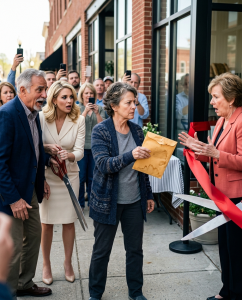
Main Street was buzzing by nine-thirty. People gathered under a balloon arch pretending they were there for pastries and not drama. Gary stood near the oversized ribbon in a blazer too new to be comfortable. Vanessa held the ceremonial scissors and smiled for everyone at once. The county clerk stood beside them in a coral jacket with a practiced expression that said she had done this dozens of times.
Loretta watched from across the street for one minute.
Then she walked over.
Gary saw her and faltered. Barely. A flicker. Then the grin snapped back in place.
“Loretta,” he said loudly, as if friendliness could control the scene. “Glad you came.”
Vanessa looked her up and down, surprise flickering behind polished manners. Loretta noticed the tension around her mouth. Fear often reveals itself first in people who are trying hardest to look composed.
“I wouldn’t miss it,” Loretta replied.
Gary started his speech. He thanked the community. Thanked Vanessa for believing in the vision. Thanked supporters who had embraced the next chapter. He was halfway through a sentence about preserving tradition while building toward the future when Loretta stepped closer.
“Before you cut that ribbon, ma’am,” she said to the county clerk, “I believe you need to see something that concerns the ownership filing for this property.”
Silence moved across the sidewalk as tangibly as shade.
Gary lowered his voice. “Loretta, this isn’t the time.”
She did not look at him.
“I think it is.”
She held out the envelope.
The county clerk took it, opened it, and began reading.
The crowd leaned in without meaning to. Vanessa’s smile stiffened. Gary kept his expression in place for several seconds longer than any normal human being would have. Then the clerk turned the second page, and something in her face changed.
Her smile vanished.
Her hand froze in midair, just above the ribbon.
Then she turned to Gary and said, “We need to pause this.”
A murmur rippled through the crowd.
Gary laughed too quickly. “There must be some misunderstanding.”
The clerk angled the papers away from him. “Did you submit ownership documents based on an amendment lacking the required consent signature?”
He blinked once. “That’s a legal interpretation issue.”
“No,” she replied. “It is not.”
Loretta watched Vanessa then, and that was when she understood something new. Vanessa was not confused. She recognized the document. Whether Gary had lied about its meaning or minimized the risk, Loretta could not yet tell, but Vanessa had seen it before. Her color drained anyway.
The clerk turned one more page and stopped.
“Who notarized this preliminary addendum?” she asked.
No one answered.
From the crowd, a man muttered, “Is that Dale Mercer’s seal?”
Dale Mercer was a notary with a reputation for sloppy shortcuts and a friendship with Gary that suddenly looked less harmless than it once had.
Phones rose in the air like metal flowers.
The mayor’s assistant quietly stepped away from the ribbon. A reporter who had been smiling over a pastry box lowered it and started recording.
Then Vanessa reached for Gary’s arm and whispered something. He jerked away from her with such visible irritation that several people gasped. For the first time, his face was no longer charming or wounded or misunderstood.
It was scared.
The clerk took out her phone.
“I’m contacting the county office,” she said. “No documents tied to this opening move forward until this is reviewed.”
Gary stepped toward her. “Now wait a second—”
“No,” the clerk said sharply. “You wait.”
That was the moment the story turned in public. Not when Loretta handed over the envelope. Not when the clerk paused the ribbon-cutting. It turned when Gary realized he was no longer controlling the room.
Vanessa took one step backward, then another. Her eyes found Loretta’s across the space between them.
When she spoke, her voice was barely audible.
“He told me you were already dead.”
The words struck the crowd like shattered glass.
Loretta did not react right away because her mind refused to process them. Gary had told Vanessa what? That Loretta was dead emotionally? Dead to the business? No. Vanessa’s expression made it plain. Gary had built an entire version of the past so distorted he had erased Loretta from it altogether when convenient.
“Vanessa,” Gary snapped.
But it was too late.
The sheriff’s deputy arrived before the ribbon ever fell. Not for handcuffs or drama, at least not then, but for statements. The county clerk retained the document and documented the interruption. Questions started multiplying faster than Gary could answer them: who filed what, when, under what authority, with which signatures, under which notary seal, attached to which transfer documents and bank instruments.
Over the next several weeks, the layers came apart.
County filings were reviewed. The operating transfer that had shifted control depended on ownership percentages Gary had no unilateral authority to alter. Bank authorizations were examined. The leasehold assignment and equipment collateral transfer were challenged. The notary’s records did not match the dates submitted. Dale Mercer claimed memory problems until confronted with logs that exposed inconsistencies. Vanessa admitted Gary told her Loretta had retired, then later that Loretta was incapacitated, then, in one conversation meant to stop her from asking questions, that Loretta had “passed on years ago” and that any old records naming her were administrative leftovers from the original business.
That lie, bizarre as it was, helped expose the larger pattern. Gary told whatever version the listener needed in order to get past the next obstacle.
Once the legal process started, his confidence collapsed fast. He tried outrage, then indignation, then blame. He claimed Vanessa misunderstood. He claimed Loretta had informally agreed to changes. He claimed paperwork delays were normal. He claimed everyone was overreacting to technicalities.
But paper does not care about charm.
In the end, the storefront opening was voided, the disputed transfers were frozen, and control over the bakery assets was pulled into formal review. Gary faced civil liability and, eventually, criminal scrutiny over fraudulent representations in filings connected to ownership and financial transfers. Vanessa, who had believed she was joining a successful reinvention, found herself publicly humiliated and privately furious. She cooperated once she realized just how many lies she had been living inside.
The old bakery never returned exactly as it had been. Too much had happened for that. But Loretta did regain what was hers in the only way that mattered: officially, publicly, on the record. Her ownership interest was recognized. Her claims were validated. Her name was put back where it had always belonged.
Months later, when the storefront reopened, the satin ribbons were gone. So were the matte black signs with Gary and Vanessa’s names.
The new sign was simple.
Bell Street Bakery.
Inside, the menu board was handwritten again. The display case still leaned a little to the left because Loretta decided some flaws earned the right to stay. There were no launch photographers, no balloon arch, no luxury packaging strategy. Just warm bread, butter cookies, cinnamon rolls, and the kind of line that forms when people want something real.
On opening morning, Elise from the diner came in first and cried before she even reached the counter. The retired bookkeeper arrived with flowers. Two teachers from the elementary school bought three loaves each. Even the county clerk stopped by around ten-thirty and purchased a rye loaf and lemon bars with a smile that this time did not hide anything.
Loretta kept the ceramic bread box in the kitchen at home.
Empty now, except for recipe cards and spare twine.
Sometimes she lifted the lid and looked inside anyway.
Not because she missed the fear.
Because she respected the woman she had become while carrying it.
People in town still argued over the whole story. Some said Gary had always been a fraud and they should have seen it. Others insisted ambition had simply curdled into greed. A few felt sorry for Vanessa. Many felt ashamed for how easily they had believed the smoother voice in the room. Loretta never spent much time sorting who deserved what. She had work to do. Dough to rise. Orders to fill. A life to keep living.
But every so often, usually near closing, someone new would glance around the bakery and say, “I heard there was some big scandal here.”
Loretta would smile a little and answer, “There was paperwork.”
Then she would turn back to the counter and let them wonder.
Because in the end, that was the part nobody in town forgot.
Not the speeches.
Not the rumor.
Not even the paused ribbon.
It was the image of a sixty-one-year-old woman standing on a sunny sidewalk, holding out a water-stained envelope she had protected in her mother’s bread box for fourteen months, while the man who stole from her finally discovered that the one thing he failed to shred was the one thing that could bring his entire story down.
And maybe that is what stayed with people most afterward: not just that Gary was wrong, but how ordinary the warning signs had been before the worst of him surfaced. The private meetings. The small exclusions. The polished explanations. The way charm kept getting mistaken for character.
Some said Loretta should never forgive him.
Some said bitterness would only poison her.
Loretta herself never announced a position on forgiveness, and maybe that was its own answer. Justice had not given her back the lost months, the humiliation, or the nights she sat awake trying to figure out how someone could erase her so cleanly. But it had done something else.
It had forced the truth into daylight.
And for Loretta, that turned out to be enough.