Mave Callahan had learned that hunger had a sound.
It wasn’t loud. It wasn’t dramatic. It didn’t announce itself with cries or breaking dishes or the kind of misery people in towns liked to imagine happened only in stories. Hunger in winter was quieter than that. It was the scratch of a flour sack being lifted and knowing by the weight of it that there were only a few days left. It was a child chewing slowly to make a bite last longer. It was a mother pretending she had already eaten.
That morning, the sound of hunger was the wooden scoop tapping the bottom of the barrel.
Three days of flour.
Maybe four, if she stretched it hard enough and Thomas and Clara kept doing what they had been doing for weeks now—smiling too quickly and saying they were full before they were. Mave hated that most of all. Children should not know how to lie kindly to their mother.
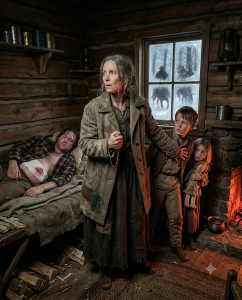
The cabin creaked under the Colorado wind as if the whole thing were cold and tired clear through its bones. Daniel had built it himself before pneumonia took him two winters earlier. He’d felled the pine, notched the beams, laid the stones for the hearth, and promised her that no matter what happened, the cabin would stand. It had stood. Barely. The roof held. The chimney drew most days. But every winter storm found a new crack to whistle through, and every season without Daniel felt like one more nail coming loose from the life they had planned.
Thomas sat by the fire, his knees drawn up, trying to warm hands gone red from the cold. At nine years old, he had Daniel’s steady eyes and none of the softness left that belonged in a boy his age. Clara sat wrapped in a blanket with her rag doll, Marie, pressed to her chest. The doll was missing one button eye, and Clara loved her all the more for it.
Mave tied her scarf, pulled on Daniel’s old coat, and reached for the trap line basket.
“I’m coming,” Thomas said immediately.
“No.”
“I can help.”
“You can help by staying here. Keep the fire alive. Watch your sister.”
Thomas opened his mouth to argue. Then he looked at the shelf, at the flour sack, at the little jar of pickled beets they had been eating too often lately, and he said nothing at all.
That silence followed her out into the snow.
The world was a white emptiness broken only by black trunks and the knife-thin creek frozen under thick, blue-white ice. Mave checked each trap one by one, already braced for disappointment and still somehow wounded by it each time. Empty. Empty. Sprung and empty. The kind of winter that left no tracks and no mistakes.
She went farther than she meant to, past the usual line of aspens near the bend, because mothers with children to feed did not turn around simply because the world had told them no ten times already.
That was when she saw the shape in the snow.
At first it looked like a pile of dark brush half buried by drift. Then the wind shifted, and she saw the outline of a shoulder. A boot. A hand.
Mave ran.
The man was huge, broad through the chest and shoulders, dressed in a fur coat that was expensive even beneath the ice caked into it. One boot was missing. Blood had frozen at his temple and matted darkly in his hair. When she knelt and touched his neck, she found a pulse that seemed determined to disappear under her fingers.
He was alive.
Just barely.
She sat back on her heels and looked around the silent woods. No one. Nothing. No sound but wind moving through the aspens like dry whispering.
Then she did what desperation forced honest people to do. She searched his pockets.
A knife. A few .44 cartridges. And then a gold watch so heavy and fine that for a moment it almost did not feel real in her hand. She opened it.
For Silas, who makes things worth building.
Her throat tightened.
People did not engrave watches like that for ordinary men. Men who carried things like that came from bigger worlds than hers—towns, deals, money, power, promises written on paper instead of cut into timber by hand.
That watch could buy flour, sugar, coffee, lamp oil, medicine, boots for Thomas that fit instead of being stuffed at the toes with rags. It could buy meat. It could buy time. In winter, time was the most valuable thing there was.
She looked at the stranger. He made a rough sound in his throat. His breath came thin and ragged, misting weakly into the air.
“My children first,” she whispered to no one.
The words should have settled it.
Instead they shamed her.
“Damn you,” she muttered, gripping the watch so tightly its edges pressed into her palm.
Then, with a kind of anger that felt easier than mercy, she jammed the watch into her pocket, caught the man under the arms, and began dragging him through the snow.
She made it less than forty feet.
He was too heavy, and she was too tired, and the cold bit so hard into her hands that her fingers stopped feeling like her own. She nearly fell with him, panting, knees sunk into the drift, breath burning her lungs. For a wild instant she thought of leaving him where he lay while she still could.
Then she saw Thomas’s face in her mind.
Not his hungry face.
His watching face. The one that had already learned too much about what grown people chose when life got ugly.
Mave stood up and ran for the cabin.
Thomas was at the window before she had even reached the porch.
“What happened?”
“I need the big sled.”
His eyes widened. “Why?”
“There’s a man out there. Hurt bad.”
Thomas glanced at the shelves, the empty hooks, the little room that had no room for trouble. “We’re helping him?”
Mave met his eyes. “Yes.”
That was all. No complaint. No protest. Only a quick nod and then movement, fast and practical. He was Daniel’s boy all over again.
They dragged out the old wooden sled Daniel had built for hauling logs. In the trees, Mave found the stranger where she had left him, half covered in fresh snow already, and together she and Thomas somehow managed to get him onto the sled. Thomas’s jaw clenched so hard she thought his teeth might crack with the effort. Mave pulled from the front, Thomas shoved from behind, and inch by inch they hauled the stranger home.
When they got inside, Clara stared with enormous frightened eyes.
“Is he dead?”
“Not yet,” Mave said.
Clara looked at the bed. “Then I’ll move Marie.”
That nearly undid Mave. In a house with so little, even the doll’s place on the bed mattered.
She set to work. The stranger had a head wound, but that was not what would kill him first. When she cut open the coat and shirt with her kitchen knife, she found a stab wound in his side. Clean entry. Deep. Deliberate.
Not an accident.
Someone had wanted him dead.
Mave heated water, cleaned blood away, and stitched the wound with thread she had once meant to save for mending clothes. Seven stitches. Her hands were steady because they had to be. The stranger drifted in and out of fever, muttering broken words. Once he cursed somebody named Garrison. Once he gasped, “Not the papers.” Once he grabbed her wrist with surprising strength and whispered, “Mine.”
Then he fell back again.
That night cost them dearly. Extra wood. Their last willow bark. Time. Energy. Food. The children ate pickled beets and dry crusts while Mave sat by the bed changing cloths and listening to the stranger breathe. More than once, she thought of the watch still in Daniel’s coat pocket, and each time she hated herself in a different way.
Just before dawn, the fever broke.
The stranger lived.
Mave stood by the weak morning light and took the watch from her pocket. She could have hidden it. She could have told herself she had earned it. She could have told herself survival made its own law.
Instead she set it on the mantel in plain sight.
Not mine, she thought.
Not while he can still ask for it back.
When the man finally woke for good, his gaze moved slowly around the cabin. The patched blanket. The narrow bed. The children’s thin faces. The pot over the fire that held more water than meal. Mave watched understanding gather in him piece by piece, and with it came something like guilt.
“You should have left me there,” he said.
Mave looked into the pot, stirring what little there was. “I thought about it.”
Thomas took a cautious step forward. “Who hurt you?”
The man’s jaw tightened. He looked at Thomas, then at Clara, then at the frosted window. “Name’s Silas.”
“That not what he asked,” Mave said.
A tired flicker crossed his mouth, not quite a smile. “No. It isn’t.”
He pushed himself upright too quickly and sucked in a painful breath. Mave moved on instinct to steady him, then stopped herself. She did not know this man. She had sewn him together, that was all.
“Who stabbed you?” she asked.
Silas leaned back against the wall and closed his eyes briefly. “Men I used to trust.”
“Why?”
“For refusing to hand something over.”
Thomas’s eyes moved to the gold watch on the mantel. Silas noticed.
His expression changed at once.
He stared at the watch, then at Mave, and there was a kind of disbelief in his face that seemed almost as strong as the pain. “You didn’t take it.”
Mave gave a dry laugh. “I took it.”
That surprised him.
She nodded toward the mantel. “Then I put it back.”
Something in Silas’s shoulders lowered, just barely. He let out a breath that sounded older than the rest of him. “You should have sold it.”
“No.”
“It would have fed them.”
She turned to face him fully. “Maybe. But then I would have had to know why I had it.”
For a moment he said nothing. Then he looked again toward the window, and the relief on his face vanished as quickly as it had come.
“They may still be looking,” he said.
Mave felt the room change around that sentence.
“Who?”
Silas hesitated. “Men from the company.”
“What company?”
He rubbed a hand over his face. “Mining. Timber. Land. Depends what lie they’re telling this month.”
Mave went still.
There had been men passing through the territory more often these last years. Surveyors, speculators, riders with polished boots and clean fingernails who looked at rivers and trees the way butchers looked at cattle. Daniel had cursed them more than once. Said land stopped being home the minute some rich man found a way to measure profit under it.
Silas saw the realization on her face.
“You’ve heard of Barrow Ridge Development?”
She had. Not well, but enough. Enough to know they bought land cheap from men in debt and pushed harder where people wouldn’t sell.
“They sent men out here?” she asked.
Silas did not answer directly. “They sent men to settle a matter.”
Thomas frowned. “What matter?”
Silas looked at the boy, then at Mave. “Your husband. Daniel Callahan. He ever mention a man named Ezra Vale?”
The name meant nothing to her.
“No.”
Silas nodded once, as if that was an answer too. “Then Daniel may not have known what he had.”
A terrible suspicion opened inside her. “What are you talking about?”
Silas leaned forward despite the pain. “The land your cabin sits on. And the slope east of the creek. It’s worth more than you’ve been told.”
Mave just stared.
He continued. “Months ago I was asked to inspect parcels before purchase. Quiet work. Quiet numbers. Your property was on a list. Small widow’s claim, remote, easy to pressure. But the ridge beneath it shows silver trace. Timber too. Not enough to make a city, but more than enough to make ruthless men interested.”
The room seemed suddenly smaller, the walls less solid.
Mave thought of the tax notice that had arrived in the fall, higher than expected. Thought of the rider who had come before the snow asking strange questions about boundary markers Daniel had set himself. Thought of how he had smiled without warmth when she said she wasn’t selling.
“You knew that?” she asked.
Silas looked ashamed. “Not at first. I was hired because I know land and I know how to read the reports. By the time I realized they meant to force people out using debt, forged claims, anything that worked—” He broke off. “I took papers.”
“What papers?”
“Copies of surveys. Signatures. Payment records. Enough to prove they’ve been stealing land from people who can’t fight back.”
“And that’s why they stabbed you.”
He nodded.
Thomas, pale but intent, said, “Then why come here?”
“I didn’t mean to.” Silas swallowed. “I was trying to reach the railroad line south. They caught me before dusk. I got away, but not clean. I rode until my horse went lame, then walked. I must have crossed onto your land in the dark.”
Your land.
The words should have comforted her. Instead they sounded fragile.
Clara, who had been listening with her doll under her chin, asked in a tiny voice, “Are they going to take our house?”
No one answered.
That was answer enough.
Silas saw it too. He pressed his lips together, then said, “If they know where I fell, if they track prints, if they connect this cabin to the ridge survey… they may try.”
Mave’s blood ran cold. “Try how?”
“In any way that gives them cover. Debt. Claim dispute. Trespass. Accusation. Men like that do not always need the law. They only need enough force to make poor people step aside.”
The wind scraped over the roof. Then all four of them heard it.
A horse.
Far off, but real.
Thomas turned toward the window. Mave caught his shoulder and pulled him back.
Then came another horse. Closer.
Silas swung his legs off the bed.
“You need to hide,” Mave said.
He gave her a look. “If they find me hidden, it gets worse.”
“If they find you in my bed, it gets worse faster.”
There was no time to argue. Mave shoved the table aside and lifted the narrow trapdoor Daniel had once built into the floor for storing cured meat before the hard years came. The pit beneath was low, cold, and half empty.
Silas stared at it. “That won’t fool anyone who searches.”
“It may buy us one minute.”
He slid in with obvious pain, clutching his side. Before Mave lowered the trapdoor, he caught her wrist.
“The watch,” he said.
She frowned. “What about it?”
“Open the back plate.”
There was no time, but something in his voice made her listen. She snatched the watch from the mantel and pressed at the edge with her thumbnail. The inner back sprang open.
Folded behind the works was a tiny oilskin packet.
Mave looked at him sharply.
“The names,” Silas whispered. “If they take me, don’t let them take that.”
She slipped the packet into her bodice, closed the watch, and set it back on the mantel just as bootsteps sounded on the porch.
Three hard knocks.
Clara began to cry. Thomas moved in front of his sister without thinking.
Mave opened the door only an inch.
Two men stood outside with snow on their coats and cold purpose in their faces. Behind them were horses and a third rider hanging back among the trees. The nearer man smiled as though this were a social call.
“Morning, ma’am,” he said. “We’re looking for an injured traveler.”
“No traveler here.”
His gaze moved past her shoulder. Took in the single bed. The children. The room. The fire. Then settled again on her face.
“You mind if we warm ourselves a minute?”
“Yes,” Mave said.
The smile thinned. “Harsh weather to deny hospitality.”
“Harsh weather to bring trouble to a widow’s door.”
The second man’s eyes flicked to the mantel.
To the watch.
He said nothing, but Mave saw the recognition.
So did the first man.
Everything changed in that instant.
His expression did not harden exactly. It emptied. The friendliness had never been real, and now he saw no reason to keep pretending.
“That’s a fine watch,” he said.
“It’s not yours.”
“No,” he replied softly. “But I believe it belongs to a friend of ours.”
Mave did not move.
Behind her, Thomas had gone very still.
The man placed one gloved hand on the door, not pushing yet, only letting her feel how easily he could.
“We don’t want difficulty,” he said. “We just want what was taken. A man, and a packet of papers that do not concern you.”
Mave heard the floorboards under her feet, Daniel’s floorboards, the house he had built log by log. She thought of three days of flour. Of Clara’s doll on the chair. Of Thomas standing too straight for a child. Of the watch she could have kept and the man she could have left to die. She thought of how close she had come to doing the selfish thing, and how even now it might have been safer if she had.
Instead she opened the door wider just enough to step onto the porch, pulling it behind her.
“It concerns me,” she said, “the moment armed men start talking about what belongs inside my house.”
The first man looked almost amused. “Your house?”
He reached into his coat and drew out a folded paper.
Mave’s stomach dropped before he even opened it.
“Funny thing about that,” he said. “According to a filing made in Denver six weeks ago, this property is already under dispute.”
The blood drained from her face.
He held the paper where she could see the seal, the signature line, the neat cruel confidence of official ink. She could not read every word from where she stood, but she saw enough. Callahan. Claim. Review. Temporary hold.
Her house.
Her land.
Someone had already started taking it.
He tucked the paper away again and leaned a little closer.
“So now,” he said, his voice almost gentle, “you can hand over the man and the papers… or we can settle all of this at once.”
Mave stared at him, the wind cutting across the porch, her children only a wall away behind her, and understood with terrifying clarity that saving Silas had not brought danger to her door.
It had only revealed the danger that had already been on its way.
What happened next spread through the ridge by spring and was told in three different ways depending on who wanted to sound brave. But the truth was simpler and sharper.
Mave laughed.
It wasn’t because anything was funny. It was because fear had pushed her so far that it had nowhere left to go.
The man on the porch frowned. “What is amusing?”
“You think paper makes this yours.”
“It makes it disputable.”
“My husband cut these trees. Buried our stillborn son on that hill. Nearly died hauling stone for this chimney. Then he did die, just slower, in that bed you were about to step into with your boots on.” Her voice had gone low and deadly calm. “So no. A paper in your pocket does not make this yours.”
He looked past her toward the cabin. “We’re done talking.”
He reached for the door.
And Mave moved first.
She slammed the iron kettle from beside the porch into his wrist with all her strength. He cursed and stumbled. The second man lunged, but Thomas—God help her, Thomas—shoved the door hard from inside, pinning him half a second against the frame. It was enough. Mave grabbed the first man’s dropped revolver and pointed it with both hands, not steady but determined.
“Back away.”
The men froze.
From inside the cabin, Silas’s voice came hoarse and loud from beneath the floorboards. “Ride now, Mave! The packet names Judge Harlan. They won’t risk gunfire carrying that to trial!”
The men’s faces changed.
There it was. The thing they were truly afraid of.
Not Silas. Not the watch. Not even the land.
Proof.
The first man straightened slowly, flexing his injured wrist. He looked from the gun in Mave’s shaking hands to the cabin window where Thomas’s pale face was visible and then toward the trees, calculating.
“You can’t hold this place forever,” he said.
“Don’t need forever,” Mave replied. “Only long enough.”
“For what?”
She lifted the watch slightly with the hand not holding the gun. “For everybody named in these papers to learn how much this little widow already knows.”
It was a bluff. Or half of one. But he didn’t know that.
Silas had chosen his words carefully. Judge Harlan. Trial. Names.
Respectable men feared scandal even more than bullets.
The third rider in the trees called out, uneasy now. “We need to go.”
The first man backed away one slow step, then another. “This isn’t finished.”
“No,” Mave said. “Now it’s started.”
They rode out without another word, though not in panic. Men like that never liked to look defeated. But they left.
The moment they disappeared among the trees, Mave nearly dropped the gun from shaking.
What followed was faster and harder than she would have believed possible from the life she had been living just an hour earlier. Silas came out white-faced and bleeding through his bandage. He knew where to go, which magistrate still cared about evidence, which rail clerk owed him a favor, which minister in town hated Barrow Ridge enough to spread the story before anyone could bury it. Mave harnessed the mule. Thomas rode with Silas south despite her fear, because there was no safer place for him than beside the evidence once the chase had begun. Mave stayed with Clara through the longest day of her life, expecting riders to return any minute.
They did not.
By nightfall, the packet had reached Judge Harlan.
By the next afternoon, warrants were being drafted.
The papers hidden inside the watch did exactly what Silas had promised. Surveys had been altered. Widow claims had been targeted. Pressure had been applied through taxes, forged liens, and false filings. Men with clean collars and expensive pens had built a business out of stripping land from people too isolated to fight back.
And Mave Callahan’s cabin was not an accident in that scheme. It was a prize waiting to be taken.
The case dragged on for months, because men with money always believed time belonged to them. But the evidence was too specific, the names too clear, and the attempted murder of Silas too closely tied to the missing packet. Barrow Ridge Development did not collapse all at once. Businesses like that rarely did. They splintered, denied, blamed subordinates, paid settlements, vanished behind new names. But enough came out to stop the seizure of Mave’s property, clear the false dispute, and bring charges against two of the men involved.
One of them was the man who had stood on her porch with the paper in his hand.
The gold watch was returned to Silas, though he tried more than once to press it back on her.
She refused every time.
He stayed through the thaw, first because he was too injured to travel, then because there were hearings, then because leaving became less simple than either of them expected. He repaired the fence line in spring, chopped wood without being asked, and taught Thomas how to clean and oil a rifle properly. Clara decided he was acceptable only after he fixed Marie’s missing button eye with a small polished bead from his coat.
He told them, little by little, about the life he had come from. He had been good at building value for other men and slow to notice the damage being done beneath the numbers. By the time he saw it clearly, he was already part of the machine. Stealing the papers had been the first honest thing he had done in years, he said once. Mave did not answer right away. Then she told him honesty that comes late still counts, though it has more to repay.
When summer reached the ridge, the claim on her land was settled for good. It was hers. Truly hers. No temporary hold. No review. No dispute. Just her name, recorded cleanly.
The day the confirmation arrived, Mave stood on the porch with the paper in her hands and cried harder than she had when Daniel died. That grief had been too deep and stunned for tears at first. This was different. This was the release of months, maybe years, of living as if one strong wind could blow away everything she had left.
Thomas pretended not to wipe his eyes.
Clara asked if that meant nobody could take Marie’s bed anymore.
Mave laughed and said no, nobody could take Marie’s bed.
Silas watched her from the yard, hat in his hand, and for once had nothing clever to say.
Later that evening, after the children were asleep and the mountain air had softened into blue dusk, he handed her the gold watch one final time.
“Keep it,” he said.
She shook her head. “No.”
“I owe you my life.”
“You owe your life to a bad decision I almost didn’t make.”
He looked at her for a long moment. “Then keep it to remember you made the right one.”
Mave turned the watch over in her hand. It was still too fine for her life, too heavy with another world’s history. But when she opened it, she no longer saw only what it could have bought. She saw Thomas pulling the sled. Clara moving her doll from the bed. A trapdoor in the floor. A porch under winter wind. A moment when choosing mercy had nearly cost everything—and then saved more than she knew.
She closed the watch gently.
This time, she kept it.
People who heard the story later liked to ask the same question. Would you save a dying stranger if your own children were hungry?
Mave never answered that the way they wanted.
Because the hardest part had not been dragging Silas home.
The hardest part had been learning that sometimes the choice between survival and decency is a lie made by desperate times. Sometimes mercy is not the foolish thing that ruins you. Sometimes it is the only thing standing between your family and the people who have already decided your suffering is convenient.
Still, on certain winter mornings when the pantry ran low and the wind scraped the walls just right, she would look at the watch on the mantel and remember how close she had come to walking away.
And she would wonder, not for the last time, whether that made her strong—
or simply lucky enough that kindness paid off before starvation taught her a different lesson.