She stood in her ex-husband’s kitchen — the one she’d tiled herself in 1998 — and smiled at every single person who hadn’t recognized her yet.
That part wouldn’t last long.
—
Patsy Beaumont had spent twenty-two years at Cloverfield Farm before the divorce papers made it someone else’s address. She’d planted the wisteria along the fence. She’d painted the porch ceiling that particular shade of blue — haint blue, her grandmother called it, the color that keeps bad spirits away.
Lot of good it had done her.
When the settlement came down, her ex Dale got the farm. Dale’s girlfriend — now wife — got Dale. And Patsy got a one-bedroom apartment above a dry cleaner in Macon, Georgia, and every dish she’d ever owned still smelled like rosemary for a year.
That smell was the worst part.
She had planted rosemary the day she moved into Cloverfield. A little clay pot, nothing fancy. Something her mother always said: *plant rosemary at your threshold and your home will never forget you.*
She wasn’t sure she believed that anymore.
—
The call came eight weeks ago.
A catering inquiry — large event, private property, Beaumont County. Patsy had built her catering business out of pure stubbornness over the last four years. Small at first. Church lunches. Retirement parties. Then word got around that the woman could *cook*, and suddenly she had a staff of three and a van with her name on the side.
She almost didn’t take the job when she saw the address.
She took it anyway.
—
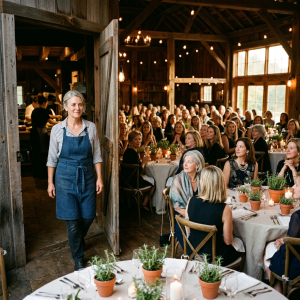
The Beaumont County Garden Club’s 50th Anniversary Gala was, by any measure, a beautiful event.
Sixty women in their finest, seated under string lights in the very barn Patsy had helped Dale reroof in 2011. The centerpieces were elegant. The linens were crisp. The passed hors d’oeuvres were — well, everyone kept stopping the servers to ask what *was* in that pastry because they needed the recipe immediately.
But the thing people kept noticing — the thing nobody could quite explain — were the little clay pots.
One on every table.
Rosemary. Fresh, fragrant, the old-fashioned trailing kind you don’t see much anymore, not at florists or garden centers.
*Arp* variety, if you knew your herbs. Originated in Texas. Hardy as anything. And planted, twenty-two years ago, in a single clay pot by a woman who believed a house should know who loved it.
“Where did these come from?” Patsy heard one woman ask her server.
“Part of the tablescape,” the server said pleasantly, and moved on.
A woman near the window leaned over and rubbed a sprig between her fingers and closed her eyes for just a second, the way people do when a smell takes them somewhere they forgot they’d been.
—
Patsy stayed in the kitchen.
That was the plan. That had always been the plan.
She didn’t need a scene. She didn’t need confrontation. She needed to plate forty portions of her mother’s bourbon peach cake without her hands shaking, which was proving harder than expected because the kitchen still had the same window over the sink, and the light came through it the same way it always had, gold and sideways at six o’clock, and for a moment she was thirty-four years old and everything was still possible.
She steadied herself on the counter.
*This is just a job*, she told herself. *You cooked. They ate. That’s all this was.*
Except.
She had carried a clay pot of rosemary through this door herself, the morning of the gala, and placed it on every single table.
Not because the new wife requested it.
Because Patsy Beaumont had decided, quiet as the haint-blue porch ceiling and twice as deliberate, that this house was going to remember her tonight.
—
The dinner had gone perfectly.
The salmon: perfect. The herb salad: perfect. The bourbon peach cake had made a woman in the back row audibly say *”oh my Lord”* and that was the highest honor Patsy knew.
She was wrapping the last of the serving trays when she heard the champagne glass ring.
The new wife’s voice — bright, practiced, the voice of a woman who had always moved through rooms like she owned them, and now literally did — rose above the crowd.
“Ladies, what a night.”
Applause.
“I want to say that this gala would not have been possible without the extraordinary talent behind every single bite you enjoyed this evening.”
More applause.
“And I’ve asked her to come out so we can all thank her properly.”
Patsy heard her own name.
She heard sixty women in the barn go still.
The kitchen door swung open.
And the new wife tapped her champagne glass again and said, with a hostess smile that had no idea what it was smiling at:
“I’d like to introduce the woman who made tonight possible —”
Every head in the room turned toward the kitchen door.
And Patsy Beaumont stepped into the light she had lived by for twenty-two years.
—
The silence lasted exactly three seconds.
She counted them.
Then Donna Frasier — president of the garden club, seventy-one years old, who had eaten at Patsy’s table approximately forty times over twenty-two years and sent flowers when the divorce finalized — stood up from her chair.
Just stood up. Didn’t say anything yet. Just rose to her feet the way you do in church when something true is happening.
Two women at the next table followed. Then three more. Then the whole right side of the barn was standing, and the left side was standing because they felt the pull of it, and sixty women were on their feet before the new wife — whose name was Kristen, Kristen with a K, Dale had mentioned her for the first time at a Thanksgiving Patsy spent crying in her car — before Kristen understood what was happening in her own barn.
She was still smiling when she understood.
The smile went the particular way smiles go when the room has shifted and there’s nothing to do but let it shift.
Patsy kept her hands loose at her sides. She had practiced this, too — not what she would say, because she’d decided she wouldn’t say anything — just the way she’d hold her body. Open. Unhurried. The way her grandmother stood in a room, like the room was glad she was in it.
Donna Frasier crossed the barn floor in her good heels and took both of Patsy’s hands in hers.
“We didn’t know,” Donna said quietly.
“I know you didn’t,” Patsy said. “That was up to me.”
—
She hadn’t told anyone.
Not her staff, who had loaded the van that morning thinking it was just another county job. Not her sister in Augusta, who would have driven three hours just to witness it. Not her mother, God rest her, who had given her the rosemary proverb and would have appreciated the poetry of it enormously.
Patsy had kept it the way she kept most things that mattered: close, private, turned over in her hands in the dark until she understood what it was.
What she understood was this.
She had spent four years being angry in an apartment that smelled like rosemary, and the anger was fair, and the sadness was fair, and all of it was fair — but fair doesn’t fix anything and she knew it. She had also spent four years building something real and hers, with her name on a van and her mother’s recipes written in a notebook she carried everywhere, and she had gotten good at the thing she loved, genuinely and measurably good at it, and she had started to feel like herself again in a way that had nothing to do with Dale or Cloverfield Farm or the haint-blue porch ceiling.
And then the inquiry came.
She could have said no. She almost did.
But somewhere in the almost, she realized what she actually wanted. Not revenge — she was specific about this when she examined herself, because she believed in being honest with yourself even when it was complicated. She didn’t want Kristen to feel small. She didn’t want Dale to feel anything in particular. She wasn’t doing this for them or at them.
She wanted to walk back into the house she had loved and fill every room with something beautiful that she had made with her own hands.
She wanted the house to remember her.
She wanted to remember herself in it, too, for just one evening — and then she wanted to leave clean.
That was all.
—
The applause had faded to the warm low noise of sixty women talking at once, and Patsy moved through the barn the way she always had at parties she’d hosted here — touching a shoulder, accepting a hug, answering questions about the pastry with the recipe committed to memory and freely shared, because a recipe is only yours until you give it away and then it’s everyone’s and that’s the point.
She ended up near the table by the window.
The woman who had rubbed the rosemary sprig between her fingers earlier was still sitting there, a little separate from the conversation around her, watching Patsy with an expression that was hard to read.
Her name was Margaret Elaine Stuckey, and she had been Patsy’s closest friend for eleven of the twenty-two years, and then the divorce had done what divorces do to friendships when people feel like they have to pick a side, and Margaret Elaine had picked wrong, or maybe just picked carefully in a way Patsy had eventually come to understand even if it still cost her something to think about.
Patsy sat down across from her.
Neither of them said anything for a moment. The string lights buzzed softly overhead. The rosemary sat between them in its clay pot.
“I have thought about calling you,” Margaret Elaine said, “approximately nine thousand times.”
“I know,” Patsy said. “Me too.”
“The food was extraordinary.”
“Thank you.”
“The rosemary was not an accident.”
“No.”
Margaret Elaine reached out and straightened the little clay pot, which didn’t need straightening. “Your mother’s thing.”
“My mother’s thing.”
Another quiet moment. Outside, through the barn door, Patsy could see the corner of the porch — the haint-blue ceiling just visible in the dusk, the color holding in the last of the light the way good paint does for twenty years if you prime it right.
“I owe you more than a phone call,” Margaret Elaine said.
“You owe me dinner,” Patsy said. “Somewhere that isn’t this barn.”
Margaret Elaine laughed. It was the same laugh as always, and Patsy felt something loosen in her chest that she hadn’t known was still pulled tight.
—
She found Kristen at the edge of the room near the bar cart, holding her champagne flute with both hands and watching the party continue without her running it.
Patsy could have slipped past her. She considered it. The evening had already given her everything she came for, and more besides, and she was not in the habit of pushing things past where they needed to go.
But Kristen saw her.
They looked at each other for a moment across the good linens and the candlelight and the small clay pots of rosemary.
Kristen was younger than Patsy had expected — she’d only ever seen her from a distance, through the particular distortion of secondhand information and her own grief. In person she looked tired around the eyes in a way that Patsy recognized, having spent a fair amount of time tired around the eyes herself.
“I didn’t know who you were when I hired you,” Kristen said. “I want you to know that.”
“I know,” Patsy said. “Your coordinator found me. I knew the address.”
“Why did you take it?”
Patsy thought about how to answer that honestly. “Because I wanted to do it,” she said. “Because I’m good at it. And because I needed to come back here one time and just — be good at something, in a place that used to make me feel like I wasn’t.”
Kristen looked at her for a long moment.
“He’s not kind,” Kristen said quietly. Not bitterly — just the way you state a thing you’ve finished being surprised by. “I think you probably know that.”
“I suspected it eventually had less to do with me than I thought,” Patsy said.
Something passed across Kristen’s face — a recognition, and behind it, something lonelier. Patsy didn’t push at it. That wasn’t her business and it wasn’t her night to fix.
“The food was the best food I’ve ever served at this house,” Kristen said. “In six years.”
“Good tiles, too,” Patsy said. “If they ever start to lift at the grout, the ones by the stove — use a heat-safe epoxy, not the standard stuff.”
Kristen blinked.
Then she laughed — a real one, surprised out of her.
Patsy nodded, picked up a clean napkin from the nearest table, and folded it out of habit.
“Take care of the wisteria,” she said. “It’ll fight you on it but you have to cut it back every year or it’ll eat the fence.”
She meant it as practical advice. She suspected Kristen heard it as something larger, and maybe it was. Maybe all practical advice about tending things you inherited is larger than it appears.
—
She was the last one out of the barn.
Her staff had loaded the van, bless them — three young women who had stopped asking why their boss drove past certain exits with a particular look on her face, because they trusted that she knew where she was going. Patsy had given them each a bonus that week, and not explained it, because some gratitude just has to live in the gesture.
She stood on the gravel drive for a moment in the dark.
The farm was quiet the way farms are at night — not silent, but full of the kind of sounds that have nothing to do with people. Insects. A cow somewhere. The wisteria moving against the fence in the light June wind, its fragrance coming and going.
She looked at the porch.
The haint-blue ceiling had faded some since she’d painted it. Needed another coat. She almost made a mental note to do it, the way you do with a house you live in, and caught herself, and almost laughed.
She did not need to repaint that porch ceiling.
She had done it once and she had done it well and that was enough.
She turned back to the van. On the passenger seat, where she’d set it that morning, was the one clay pot she hadn’t left inside. She’d told herself it was a spare, miscounted. That wasn’t true. She’d kept it because she’d planted the rosemary herself, in her kitchen in Macon, three weeks ago, from a cutting she’d taken off the original plant.
Her mother’s proverb — *plant rosemary at your threshold and your home will never forget you* — she had thought about it differently lately. Maybe the point wasn’t the house. Maybe the point was the person doing the planting. Maybe what her mother meant was: *make something living and put it somewhere that matters, and you won’t forget yourself either.*
She’d been thinking about the apartment above the dry cleaner. The kitchen there was small, but the light in the morning was actually quite good. She hadn’t planted anything on the windowsill, all these years. She’d been waiting, she realized now, for somewhere worth planting in.
That was over.
She put the van in drive and pulled down the gravel road, past the fence with the wisteria, past the gate with the bent post that had always been bent and probably always would be.
She did not look in the rearview mirror.
She didn’t need to.
—
Three weeks later, she put the rosemary on her kitchen windowsill.
A week after that, Margaret Elaine came to dinner — Patsy’s kitchen, Patsy’s table, Patsy’s food, which was the natural order of things. They talked for four hours and cried twice and laughed more than that and agreed without saying so that the lost years were a closed account and this was a new ledger.
The catering business took on two more staff before the end of the summer. The bourbon peach cake ended up on a food blog that someone forwarded to Patsy in a text with seventeen exclamation points. She took a weekend job at a culinary school teaching herb cookery, and the first thing she brought to that classroom was a clay pot.
*Arp* rosemary. Hardy as anything.
“This,” she told twelve people who were watching her hands, “is what you plant when you want to remember that a place belongs to you. Or that you belong to yourself. Sometimes those are the same thing.”
She rubbed a sprig between her fingers.
It smelled like every kitchen she had ever loved.
It smelled like the thing that stays.