Earl Munson had been retired for six years, but he still woke up at 4:47 every morning.
Old habits from thirty-one years on the rural route don’t die easy.
So when the headlights cut through the white wall of snow outside his window at just past midnight, he was already in his kitchen with the coffee on.
He almost didn’t go out.
Almost.
—
She was maybe twenty-four, twenty-five. Standing in the ditch off Route 9 with a car that had slid clean off the road, holding a toddler wrapped in a green blanket against her chest like the boy was the only warm thing left in Montana.
Earl pulled over without thinking twice.
“Come on,” he said. That was it. No questions.
Her name was Cassie. The little one was Milo. She’d been driving from Billings to her mother’s place in Havre — eight hours in good weather, and this was anything but good weather.
Earl got them inside. Got the boy dry. Made soup from a can because Dorothy always said canned tomato soup was God’s answer to bad days, and Earl had never found reason to argue with Dorothy about much of anything.
Cassie sat at the kitchen table with both hands wrapped around her mug, still shaking a little.
“I don’t know how to thank you,” she said.
“You don’t need to,” Earl said. “Dorothy would’ve wanted me to.”
He didn’t explain who Dorothy was. Cassie didn’t ask.
But she noticed the photographs on the wall. The woman with the silver braid and the wide laugh. She noticed them the way people do when they understand without being told.
—
It was when Earl hung up Cassie’s coat by the door that he felt it.
A thickness in the lining. Something stiff.
He thought maybe it was cardboard. A reinforcement somebody had sewn in.
But it shifted when he touched it.
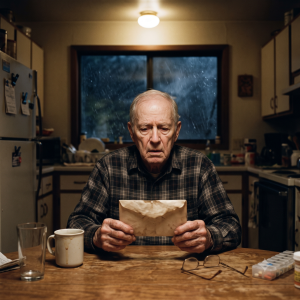
He reached two fingers into the small tear along the inner seam — the kind of tear you don’t bother fixing because you keep meaning to and never do — and pulled out an envelope.
Water-stained. Soft at the edges. The kind of worn that comes from years, not weeks.
He turned it over.
And the blood drained from his face.
His name. His address. Written in handwriting he would know in his sleep, would know at the bottom of the ocean, would know at the end of the world.
Dorothy’s handwriting.
—
“Where did you get this coat?”
His voice came out quieter than he intended.
Cassie looked up. Saw his face. Set down her mug.
“It was my aunt’s,” she said slowly. “She passed last spring. My mom went through her things and mailed me a box. The coat was in it.” She paused. “I didn’t even know your name until tonight. I’ve never been to this part of the state in my life.”
Earl looked down at the envelope.
The postmark read 2019.
Dorothy had been gone since March of 2019.
“Have you ever opened it?” he asked.
“I didn’t even know it was there,” Cassie said. And the look on her face — steady, a little frightened, completely honest — told him that was the truth.
He sat down at the table.
The boy, Milo, had fallen asleep on Earl’s old couch under the quilt Dorothy made the winter she was sick. The storm pressed against the windows. The whole house felt like it was holding its breath.
Earl held the envelope in both hands for a long moment.
Six years. Six years of mornings without her. Six years of coffee for one and soup from a can and photographs on the wall and thirty-one years of muscle memory that kept him waking at 4:47 like she still needed him to.
He had never stopped wondering if she’d left him something.
A note. A word. Anything.
He turned the envelope over with trembling hands, and there, in the bottom left corner, was the one phrase Dorothy always wrote on letters she meant for him to read only after she was gone.
“When you need this most.”
—
Cassie said, quietly, “Do you want me to give you a minute?”
Earl shook his head. He wasn’t sure he could be alone with it.
He slid one finger under the flap. The glue had long since given up. The envelope opened like it had been waiting to.
Inside was a single folded piece of Dorothy’s cream stationery, the kind she kept in the rollaway desk in the bedroom that Earl had never been able to bring himself to move.
He unfolded it. His hands were not steady. He didn’t try to make them steady.
He read it once. Then he set it flat on the table and pressed both palms down on top of it, like a man trying to keep something from blowing away in a wind only he could feel.
Cassie didn’t move. Didn’t speak. She was good at stillness, this young woman, in the way that people are when they have survived things that required it.
After a while, Earl picked it up and read it again.
—
Dorothy had written it in January of 2019. Two months before she died, while she could still hold a pen steady.
She had not written about her illness. She had not written about regret, or fear, or the particular cruelty of a diagnosis that gives you just enough time to think about everything you’re leaving.
She had written about him.
She wrote about the way he used to bring the mail inside and read her every postcard that came through, even the ones addressed to strangers, because he said everyone deserved to have their good news read out loud. She wrote about the morning he’d driven forty minutes in a July thunderstorm to deliver a birthday card to a ninety-one-year-old woman on Sawmill Road because he didn’t want her to wait another day for it. She wrote about the time he’d found a litter of kittens in a mailbox on the Dearing property and driven them home in his shirt pocket and told Dorothy about it with such wonder in his voice that she’d had to turn away so he wouldn’t see her cry from the sheer goodness of him.
She wrote: I have loved you since the second Tuesday of October, 1987, when you knocked on my door with a package and stayed for forty-one years. I am not afraid of what is coming. What I am is grateful, down to the last atom of me, that it was you.
She wrote: You are going to be lonely, Earl. I know you. You will be lonely and you will be stubborn about it and you will wake up at 4:47 because that is what you do. And that is all right. I am not writing this to tell you to stop grieving. I am writing this to tell you that when this letter finds you — and it will find you, I have to believe that, I am sending it out into the world on faith — it will mean you were exactly where you needed to be. Doing exactly what you always did. Stopping when someone needed stopping for.
She wrote: That is who you are. That is the whole of you. And I need you to know that I knew it. Every day. I knew it.
At the bottom, underneath her name, she had added one more line in handwriting that was smaller and a little shakier, like it had been added later, on a different day:
Don’t you dare apologize to anyone for still loving me. It was always the best thing about you.
—
Earl sat with it for a long time.
Cassie had gotten up at some point and refilled both their mugs without asking. The coffee was too strong the way Earl always made it. She drank it anyway.
The storm had eased a little. The wind had pulled back from a howl to a moan. Snow still fell but softer now, the way snow falls when it has made its point and is willing to be reasonable about things.
Milo shifted on the couch and made a small sound and was still again.
Finally Earl looked up.
“Her name was Dorothy,” he said. “We were married forty-one years. She died in the spring of 2019 and I have thought about her every single day since.”
Cassie nodded. She didn’t say she was sorry. Earl appreciated that. He’d had six years of people telling him they were sorry, and he understood what they meant by it and it had never once helped.
“Your aunt,” Earl said. “What was her name?”
“Helen,” Cassie said. “Helen Marsh. She lived up in Chinook most of her life. Worked at the post office there for thirty years.” She paused, turning something over in her mind. “She and my mom weren’t close, the last few years. I don’t think I’d seen her since I was maybe twelve. When she died and left us some things, it was — it was a surprise.”
Earl thought about that. A woman who worked at a post office for thirty years, in a small town ninety miles east. A coat that might have been donated or sold or passed through a dozen hands before it landed in a box and got mailed to a daughter in Billings.
He would probably never know the full path of it. How the coat traveled from wherever Dorothy had given it away — she had always given things away, warm things especially, to people who needed them — to Helen Marsh’s closet in Chinook. He would probably never know whether Dorothy had tucked the letter in deliberately, meaning to send it some other way and running out of time, or whether she’d slipped it in there to keep it safe and then forgotten, the way the very sick sometimes forget the small careful things they’ve done.
It didn’t matter. It had found him.
On a night when he was standing in his kitchen at midnight in a snowstorm, the same way he stood there every other morning at 4:47, because that was what he did. Because that was who he was.
—
In the morning the storm had passed entirely and the sky was the hard bright blue that Montana does after a hard snow, the kind of blue that makes your eyes ache and your chest ache in equal measure.
Earl called Ray Pilcher, who ran a tow out of Shelby and owed Earl approximately eleven years of favors, and had Cassie’s car pulled from the ditch and checked over by nine o’clock.
The car was fine. A little bruised. Nothing that would keep.
Cassie stood by the door with Milo on her hip, the green blanket trailing. She’d offered to pay Earl for the tow and for the soup and for the use of Dorothy’s quilt, and Earl had looked at her with the particular patience of a man who has spent decades dealing with people who don’t listen the first time.
“No,” he said, pleasantly but completely.
Cassie had laughed a little at that.
She was quiet for a moment. Then she said, “I’m glad it was your coat. That it ended up mine, I mean. That I was in the ditch outside your house.”
“I’m glad you were wearing it,” Earl said.
Milo reached out and grabbed Earl’s finger with his whole fist the way small children do, not for any reason, just because a hand was there. Earl let him hold it.
“You have a safe trip,” Earl said. “Call your mother when you get close.”
“I will.”
“Roads’ll be fine by noon.”
“Okay.”
She didn’t go right away. She stood there one more second in the clean cold morning light, the boy on her hip and the green blanket and the mended coat, looking at Earl the way people look at places they think they might want to remember.
“Thank you,” she said. “For stopping.”
“Old habit,” Earl said.
—
He watched them drive away until the car was a small dark shape on the long white road, and then he went inside.
The letter was on the kitchen table where he’d left it. He picked it up. Read the last line one more time.
Don’t you dare apologize to anyone for still loving me. It was always the best thing about you.
He folded it carefully and put it in the inside pocket of his flannel shirt, close.
Then he washed the mugs. Put the soup pot to soak. Folded Dorothy’s quilt the way she’d taught him, edges first, then thirds, smooth.
Outside the window the snow lay over everything, clean and even and very bright.
It was 9:22 in the morning.
He had the whole day in front of him.
For the first time in six years, that felt like enough.