I told Gerald Hutchins I forgave him three years ago.
I meant every word.
What I didn’t tell him was *what* I planned to do about it.
—
My daughter Marisol made that pottery studio with her own two hands. Twelve years old when she started hauling cinder blocks with her daddy. Twenty-nine when she died. And in the seventeen years between, she turned that little outbuilding on Clover Street into something that mattered to this town more than Gerald ever did.
She taught kids there. Kids in wheelchairs. Kids who’d never held anything beautiful in their own hands before they held a piece of clay.
When Marisol got sick, Gerald sat across from me at our attorney’s desk and signed a document. The studio would become a permanent community art center for children with disabilities. His signature. His promise.
I watched him sign it.
I still have the paper.
What I didn’t know — what nobody told me until fourteen months after the funeral — was that Gerald had already been talking to a developer named Crane out of Columbus. Talking long before Marisol passed. Talking while I was still washing her hair in the hospital sink and telling her everything was going to be fine.
The studio sold three weeks after the obituary ran.
Crane broke ground on luxury condos in the spring.
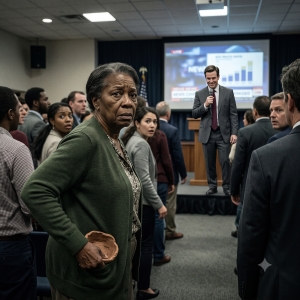
I went to Gerald’s house on a Tuesday morning. I stood on his porch for a long time before I knocked. My hand was in my cardigan pocket, wrapped around a small clay bowl — lopsided, the way beginners make things — with a child’s thumbprint pressed deep into the rim.
Marisol made it when she was twelve.
The first thing she ever finished.
I touched that thumbprint and I knocked.
Gerald answered in his bathrobe. He looked surprised to see me. Then he looked relieved, the way guilty people do when the person they’ve wronged shows up *calm*.
I told him I forgave him.
I told him I meant it.
And then I asked if he needed volunteers for his city council re-election campaign, because I had eighteen months and nothing but time.
He laughed. He actually laughed.
Said he’d never understand me but he was grateful.
I smiled, touched the little bowl in my pocket, and told him there was nothing to understand.
—
For eighteen months, I was the best volunteer Gerald Hutchins had ever seen.
I stuffed envelopes. I made phone calls. I set up folding tables at every community event from the Fourth of July picnic to the Harvest Festival. I learned the names of every donor, every precinct captain, every reporter who covered local politics in this county.
People on the campaign adored me. They called me Miss Loretta. They brought me coffee without being asked.
Gerald would see me across a room and wave, and I would reach into my pocket, touch the little bowl, and wave back.
His campaign manager, a sweet, exhausted young woman named Deanna, told me once that I made Gerald look good just by being there.
“That’s very kind,” I said.
Deanna had no idea I was the one who’d quietly suggested the venue for election night. No idea I’d offered to handle the AV setup, or that I’d spent three Saturdays learning exactly how the projection system worked.
She thought I was just a cheerful old woman who liked to help.
I am a cheerful old woman who likes to help.
I just had a specific kind of help in mind.
—
Election night was loud and warm and smelled like bad coffee and someone’s too-sweet perfume.
Gerald won. Of course he won — I’d worked hard to make sure he did.
The room erupted. Balloons. Cheering. A country song I don’t know the name of.
I stood near the back, my hand in my pocket.
I touched the thumbprint one last time.
And I thought about Marisol. About her hands. About the forty-seven children who had written letters to the city when the studio was demolished, letters that were never read into the record because Gerald had rescheduled that particular council meeting three times until the parents gave up.
I had every one of those letters.
Scanned. High resolution. Every single one.
Gerald straightened his tie and walked to the podium, grinning like a man who believes consequences are something that happen to other people.
The room quieted.
He gripped the microphone — already live, already carrying his voice into every corner of that hall.
He said, “This town chose integrity tonight—”
And that’s when the projection screen behind him flickered on.
The one his own campaign manager had queued up for his victory speech slideshow.
The one I’d helped her load.
Gerald didn’t see it yet.
But every single person facing him did.
—
The first image was the signed agreement.
Full screen. High resolution. Every line legible from the back of the room, including the letterhead, including the date, including Gerald’s signature looping across the bottom in the confident hand of a man who never expected to be held to it.
The second image was a photograph of the studio on Clover Street. Marisol standing in the doorway, twenty-four years old, laughing at something off-camera, clay dust on her forearms.
Then the third image appeared, and the room went very quiet.
It was a photograph of the Columbus Dispatch business section. Dated eleven weeks before Marisol died. Gerald’s name was in the second paragraph of a story about Crane Development’s expansion into the county. I had drawn a yellow box around it with a highlighter, the way a schoolteacher marks something important for her students.
Gerald had stopped speaking.
He turned around.
He saw it.
I watched his face do several things in quick succession — confusion, then recognition, then something white and airless that I think was the first real fear he had felt in years.
“What—” he started.
But the slideshow kept moving.
Because I had built in a timer. Twelve seconds per image. Plenty of time to read. Plenty of time to understand.
The fourth image was a letter. Not one of the forty-seven children’s letters — not yet. This one was from an attorney. My attorney. Filed with the county clerk’s office four days earlier, contesting the legality of the property transfer on the grounds that the signed agreement constituted a binding charitable pledge under state law, and that the sale to Crane had occurred in violation of that pledge.
The fifth image was a letter from the Ohio Disability Rights Coalition, co-signed by three other organizations, announcing their support for the legal challenge and their intent to make the story available to any news outlet that wanted it.
The sixth image was a photograph of forty-seven envelopes, fanned out like a hand of cards.
I had written, in clean block letters beneath them: FORTY-SEVEN CHILDREN WROTE TO THIS COUNCIL. THEIR LETTERS WERE NEVER READ.
Gerald’s campaign manager Deanna was standing to my left, and I heard her make a sound like the air going out of something.
“Miss Loretta,” she whispered. “Did you—”
“I’m sorry, sweetheart,” I said. “I truly am. You did good work. This isn’t about you.”
She looked at me for a long moment. Then she looked at Gerald, still frozen at the podium with his hand on the microphone and his face the color of old putty.
Then she stepped back, and she didn’t stop the slideshow.
—
I want to be clear about something.
I did not destroy Gerald Hutchins that night. That was never what I was there to do.
What I did was make sure that the next two years of his city council term happened in full view of people who now knew exactly who they were watching. The reporters in the room had smartphones. The story was on two local news websites before midnight. By morning it had been picked up by the Columbus paper — the same one that had run the item about Crane Development, which I found poetic.
The legal challenge my attorney filed is ongoing. I won’t pretend I know how it ends. Gerald has lawyers too, and the law around charitable pledges is complicated, and I am seventy-one years old and I am not naive.
But three weeks after election night, the city council voted to require that all citizen correspondence be formally entered into the public record within thirty days of receipt. No more rescheduling. No more letters disappearing into a drawer.
Gerald voted for that measure.
He voted for it because he knew every person in that chamber was watching him, and because he is, at his core, a man who wants to be liked, and liking had to be earned back from scratch now.
It was a small thing. But Marisol always said small things were the ones that lasted.
—
Crane’s condos are still there. I won’t lie to you. The building went up and it’s standing and there are people living in it and I drive past it sometimes and feel the particular cold of something that cannot be undone.
But two months ago, a woman named Patricia Osei — a physical therapist who had brought her son to Marisol’s classes for three years running — started a nonprofit. She found a building on Merchant Street, a former insurance office with good natural light and wide doorways. She named it after the street where the original studio stood.
The Clover Street Collective.
They had their first clay workshop last month. Eleven kids. Three of them in wheelchairs.
I was not there. I stayed home on purpose, because it wasn’t mine to be at. Marisol’s work was always for them, not for me.
But Patricia sent me a photograph. One of the children — a little boy, maybe nine years old — holding up a small bowl. Lopsided. The way beginners make things.
I have it on my refrigerator now, next to a photograph of Marisol at twelve.
I think about what forgiveness actually is. People talk about it like it’s a door you close. Like it seals something off.
I don’t think that’s right.
I think forgiveness is the decision to stop letting someone else’s worst act be the biggest thing in the room. To refuse to let what they did take up so much space that there’s no room left for anything else.
I forgave Gerald Hutchins because I needed my hands free.
I needed them free to scan forty-seven letters. To spend three Saturdays learning a projection system. To hold a small clay bowl in my cardigan pocket for eighteen months without letting it make me into someone my daughter wouldn’t recognize.
I am still a cheerful old woman who likes to help.
I helped Patricia find her building. I helped her write her first grant application. I showed her how to set up a table at the Harvest Festival, because I know every inch of that event by now, and I know which corner gets the most foot traffic, and I know which volunteers will show up early and which ones will need to be called twice.
I know a lot of things after eighteen months.
—
The little bowl is on my windowsill now. I don’t carry it anymore.
I don’t need to.
I took it out of my pocket the morning after election night and I set it in the light, and I looked at that thumbprint — Marisol’s thumb, pressed into the clay when she was twelve years old, before she knew what she would build, before any of us knew what we would lose — and I let myself cry for a while.
Not for Gerald. Not even for the studio.
For her. Just for her.
That’s what forgiveness gave me back, in the end.
Not justice, exactly. Not the building. Not the years.
Just the ability to cry for the right thing.
I think she would have called that a pretty good return.