Dottie Marchetti had driven that same stretch of Highway 12 for thirty-one years, rain or shine, January ice or August dust.
Old habits die hard.
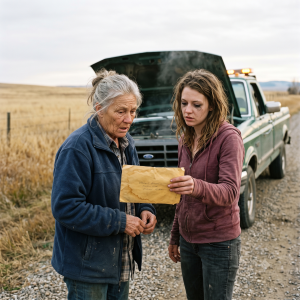
So when she spotted the battered green Silverado sitting crooked on the shoulder of Miller Creek Road — hood up, hazards blinking slow like a tired heartbeat — she didn’t even think twice.
She just pulled over.
—
The girl couldn’t have been more than twenty-five.
Dark circles under her eyes. Jacket too thin for October in Montana. Hair pulled back in a messy ponytail the wind kept trying to undo.
She was standing at the front of the truck, staring at the engine like it owed her an apology, when Dottie rolled down her window.
“You got somebody coming, honey?”
The girl looked up. And something in her face — not quite relief, not quite something else — made Dottie put the Buick in park.
“No, ma’am. I think I’m on my own.”
—
Dottie had a thermos of coffee in the passenger seat. She always did.
Thirty-one years of rural routes will do that to a person.
She poured two cups from the little red plaid thermos her late husband Earl had given her back in 1987, and they stood together in the gravel and the cold, watching the wind move through the larch trees on the ridge.
That’s when she noticed the girl’s hands.
Shaking. Not just a little.
*That’s not the cold*, Dottie thought.
—
The girl’s name was Shelby.
She said she’d driven up from Billings. Didn’t say why. Didn’t say where she was headed.
She kept one hand wrapped around her coffee cup, warming it.
The other hand kept drifting back to her coat pocket.
Pressing flat against something there. Smoothing it. Over and over, like a woman telling rosary beads, like she was trying to keep something from crumpling — or from getting away.
Dottie noticed, but she didn’t ask.
Not yet.
—
Instead she told Shelby about the valley.
About the Hendersons up on the north ridge who’d been there since 1932. About the way the creek floods every spring, right around the third week of April, and which culverts to avoid. About the little Lutheran church in Granger that unlocks its doors for anyone who needs a warm place, no questions asked.
Shelby listened like she was memorizing every word.
Her hand never left that pocket.
—
“You from around here originally?” Dottie asked.
Shelby shook her head.
But something flickered across her face when Dottie said the word *Granger*.
Just for a second.
Like a light turning on in a room you thought was empty.
—
They waited together for the tow truck — forty minutes, out there on that dirt road with the mountains going purple in the afternoon light and the coffee getting cold.
Shelby didn’t say much. But she didn’t seem to want Dottie to leave, either.
She kept smoothing that envelope in her pocket.
Press. Flatten. Press. Flatten.
The corner of it was visible now, peeking just above the fabric. Water-stained. Worn soft at the edges, like it had been folded and unfolded a hundred times.
Like it had been carried a long, long way.
—
Dottie had raised three kids and buried one husband and delivered mail to people in the worst moments of their lives — foreclosure notices, draft letters, the thin envelopes from the VA that nobody wanted to open.
She knew what it looked like when a person was carrying something heavy.
She also knew when to wait.
—
The tow truck was five minutes out when Shelby finally went quiet in a different way.
Not peaceful quiet.
*Gathering herself* quiet.
Her hand pressed flat against that pocket one more time. Stayed there.
“Ma’am,” she said. “Can I ask you something?”
“Of course you can.”
Shelby looked at her. Those tired eyes. That thin jacket. That shaking hand held still by sheer force of will.
“Did you ever carry mail for a town called Granger? A long time ago? There used to be a house out on the Elk Fork Road — gray with a green door?”
Dottie felt something shift in her chest.
“Honey,” she said slowly, “I delivered to that house for twenty-two years.”
Shelby nodded. Like she already knew.
Then she reached into her pocket.
Pulled out the envelope.
It was old. Water-stained. The handwriting on the front was faded but careful — the kind of careful that means someone was choosing every letter.
She held it out.
And when Dottie finally looked down to see whose name was written there —
Her own.
Shelby’s eyes filled with tears.
“It’s yours,” she whispered. “It was always meant to be yours. She just never knew how to find you.”
The tow truck came around the bend.
Neither of them moved.
—
Dottie stood there with the envelope in both hands.
Her name. Her actual name, Dorothy Jean Marchetti, written in handwriting she didn’t recognize. But careful. So careful. Every letter like a small decision.
The tow truck pulled up behind them, gravel popping under the tires, headlights sweeping across the brush. The driver, a young guy in a Carhartt vest, climbed out and started toward them.
“You the one who called about the Silverado?”
Shelby turned to him. “Yes. Just — give us one minute.”
He stopped. Looked at the two of them standing there in the shoulder gravel, this older woman in her mail carrier’s habit of practical shoes and this young woman with the wet eyes and the thin jacket. He read the room the way country people learn to.
“Take your time,” he said, and went to look at the truck.
—
“Who wrote this?” Dottie asked.
Her voice came out steadier than she expected.
“Her name was Ruth,” Shelby said. “Ruth Patton. She lived in that gray house on Elk Fork Road until about 2019. Then her health got bad and she moved down to Billings to be near family.” Shelby paused. “Near me. She was my grandmother.”
Dottie looked up.
“I don’t remember a Ruth Patton.”
“You wouldn’t have known her by that name,” Shelby said. “She’d been remarried twenty years by the time you were delivering out there. Before that she was Ruth Collier.”
The larch trees moved on the ridge.
A meadowlark called once from somewhere in the brush and went quiet.
Ruth Collier.
Dottie said the name out loud, just barely, like she was testing whether it still had weight.
It did.
—
Ruth Collier had lived in the little blue rental house on the far end of Dottie’s route back in 1989. Back when Dottie was brand new to the job, twenty-nine years old, Earl still alive, her youngest not yet walking.
Ruth had been going through something that winter. Anyone could see it. Lights on at odd hours. Car gone for days, then back. A stillness around that house that wasn’t the good kind.
Dottie had started leaving small things with the mail when she could manage it. Nothing much. Once a packet of flower seeds from her own garden — zinnias, because they were nearly impossible to kill. Once a card she’d found at the drug store in Livingston that said simply, *Thinking of you today*, and signed it with no name, because she wasn’t sure it was her place.
She’d never known if Ruth had seen them. She’d transferred routes in the spring and lost track.
She had not thought about Ruth Collier in years.
—
“She kept that card,” Shelby said. “The one you didn’t sign. She kept it in her Bible until the day she died.”
Dottie pressed her fingers hard against the envelope.
“She knew it was you,” Shelby continued. “She asked around. Somebody at the post office eventually confirmed the carrier’s name. She always meant to write to you. Always meant to thank you.” Shelby wiped her eyes with the back of her hand. “She wrote this letter in 2018. Then she moved, and her health got complicated, and she kept saying she’d send it when she felt stronger. When she felt like she had the right words.”
“She never sent it.”
“No. She never sent it.”
The tow truck driver had the Silverado’s hood up now, wasn’t looking at them.
“She passed in March,” Shelby said. “This past March. And when we were going through her things, I found the letter in her nightstand. With a sticky note on it in her handwriting.” Shelby’s voice went thin for just a moment. “It said, *Give this to the mail lady from Granger. She saved my life and she doesn’t know it.*”
—
Dottie looked down at the envelope for a long time.
The wind came through and the larch trees answered.
“I left her some seeds,” Dottie said. “And a card I bought for a dollar twenty-five.”
“I know,” Shelby said. “That’s what she said, too. She said you left a handful of nothing and it turned out to be everything.” Shelby pulled her jacket tighter around herself. “She said that winter, she wasn’t doing well. She said she’d been carrying something very dark around for a long time. And one day she went out to the mailbox and there were zinnias, from a stranger who had no reason to give her anything. She said she sat down right there in the driveway and just — cried. She said it broke something open that needed to be broken open.”
She stopped.
“She said she planted them. And every year after that, when the zinnias came up, she thought about the fact that someone had seen her. That was all. Just that someone had looked at her and seen her.”
—
Dottie didn’t cry. Not right then.
That was something she did later, at home, sitting at her kitchen table with the letter finally opened in front of her, Earl’s thermos sitting on the counter where it always sat.
Ruth’s handwriting was slow and deliberate and covered four pages, and it covered thirty years — the bad winter, the slow climb out, the second marriage to a good man named Gerald Patton, the garden she’d kept every single year after 1989, always with zinnias in it, always, the grandchildren, and finally, near the end, the only thing she still wanted to do before she ran out of time.
Tell the mail lady.
Just tell her.
*You did something small and it was everything. I need you to know that. I need you to carry that.*
—
Shelby got her truck towed to a shop in Livingston. The repair turned out to be a cracked radiator hose, nothing worse. She was back on the road by six o’clock.
But before she left, she and Dottie sat in the Buick together for a little while with the engine running and the heat on.
Dottie had given her the rest of the coffee.
“She wanted to find you herself,” Shelby said. “When she got too sick for that, she made me promise. I drove up twice before and lost my nerve. Figured I’d never actually find you.” She laughed a little, the first laugh Dottie had heard from her. “Didn’t figure my truck would break down on the exact road.”
Dottie thought about thirty-one years of the same stretch of highway.
About Earl’s thermos.
About how the things you do without thinking are sometimes the truest things about you.
“You tell me something,” Dottie said. “Those zinnias. She planted them every year?”
“Every year,” Shelby said. “Full border along the back fence.” She reached into her bag — her actual bag this time, not her coat pocket — and pulled out a small paper envelope, the kind you get at a seed store. “I brought you some. I saved them from her last garden. From this summer.”
She set them in Dottie’s hand.
Dottie looked at the little packet for a moment.
Then she closed her fingers around it.
—
The following May, Dottie planted zinnias along the fence line at the house on Elk Fork Road, which had long since changed hands and was now owned by a young couple who’d moved up from Bozeman. She knocked on their door first and asked, and they said yes without hesitation, because that’s still how it goes in places like that valley.
She drove out on a Saturday morning with a flat of seedlings she’d started on her kitchen windowsill in February.
She dug each hole herself.
It took her most of the morning.
She wasn’t as fast as she used to be.
That was all right.
—
Shelby texts her sometimes. She moved to Missoula in the spring. She got a job she likes. She sends pictures in July when her own zinnias come up — she’d saved enough seed from Ruth’s garden to start her own border.
Dottie keeps Ruth’s letter folded in the small wooden box where she keeps Earl’s watch and the kids’ baby teeth and the things that are too important for drawers.
She doesn’t take it out often.
She doesn’t have to.
She knows what it says.
She just needed, after all those years of delivering other people’s words, to finally have someone deliver something to her.
Something that said: you were seen, too.
You were seen, too.