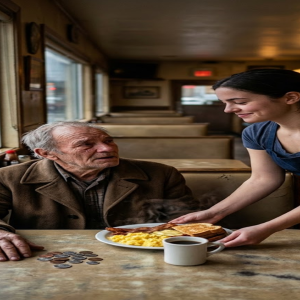
Every Sunday morning, just after church let out, an elderly veteran walked through the front door of the same neighborhood diner.
He never called ahead.
He never made a reservation.
He didn’t have to.
Everyone knew exactly where he would sit.
The booth beside the front window had become his place long before many of the younger servers had even been born.
He would remove his weathered military cap, smooth the sleeves of an old service jacket, and settle into the seat facing the entrance.
Then, before opening the menu he no longer needed to read, he would gently pull out the chair across from him.
Not too far.
Not too close.
Just enough to make it look as though someone would be arriving any minute.
The order never changed.
Two coffees.
One breakfast.
An extra plate.
The second meal was never touched.
The second coffee slowly cooled until it was taken away.
Week after week.
Year after year.
At first, new employees asked questions.
“Is your guest running late?”
He would smile politely.
“No.”
“Will they still be coming?”
A pause.
“They’re already here.”
The answer puzzled people, but no one wanted to press him further.
Eventually, the diner accepted it as one of those small mysteries that belonged to the building itself.
Regular customers developed their own explanations.
Some believed the empty chair honored a late wife.
Others assumed it was a child who had passed away.
One man insisted it was simply habit born from years of eating with someone who was gone.
None of them came close.
The truth reached back half a century.
Back to a battlefield where mud swallowed boots and artillery erased the difference between day and night.
The veteran had been barely twenty years old.
Across from him, huddled inside a rain-soaked foxhole, was another young soldier.
The two hadn’t grown up together.
They hadn’t even known each other before the war.
Yet weeks of surviving impossible circumstances had created a friendship stronger than many formed over entire lifetimes.
When fear became unbearable, they talked about home.
One dreamed of opening a repair shop.
The other wanted a quiet life where the loudest sound on Sundays would be dishes clinking in a family kitchen.
They spoke about wives they hoped to marry.
Children they wanted.
Fishing trips.
Backyard cookouts.
Ordinary dreams suddenly felt extraordinary because they were no longer guaranteed.
Late one miserable evening, convinced another attack might be their last, one soldier laughed quietly.
“If one of us gets home,” he said, “promise me something.”
“Anything.”
“Never eat a Sunday meal alone.”
The request sounded oddly specific.
The young man smiled.
“That’s it?”
“That’s it.”
They shook hands.
It wasn’t dramatic.
No speeches.
No witnesses.
Just two frightened friends refusing to surrender hope.
Before sunrise, their position came under heavy attack.
When the fighting finally stopped, only one of them stood up.
The survivor carried many things home.
Memories.
Scars.
Nightmares.
And one promise.
Returning home wasn’t the joyful ending everyone imagined.
People celebrated victory.
Families reunited.
Life resumed.
But for many veterans, part of them remained overseas.
Every Sunday reminded him of the friend who never got the chance to grow older.
So he kept the promise exactly as it had been made.
He found a local diner.
Ordered breakfast for two.
Talked across the table.
At first, it felt strange.
Then necessary.
He spoke about his new job.
About meeting the woman who would become his wife.
About buying a small house.
When children arrived, he described every milestone.
First steps.
First words.
Graduations.
Later, he spoke through tears about burying his parents.
Years afterward, he spoke about losing his wife.
There were joyful Sundays.
There were lonely Sundays.
Some Sundays he laughed so hard nearby customers smiled without knowing why.
Other Sundays he couldn’t finish breakfast.
Still, he came.
He never broke the promise.
Time transformed everything else.
The town expanded.
The old hardware store disappeared.
The movie theater became apartments.
The diner remodeled twice.
Owners retired.
Waitresses came and went.
Only one tradition remained untouched.
The empty chair.
Eventually, people stopped asking about it.
It simply belonged there.
One rainy Sunday morning, shortly after another overseas deployment had ended, a young soldier wandered into the diner.
He was home on leave and searching for somewhere quiet.
He noticed the elderly veteran almost immediately.
Not because of the jacket.
Not because of the medals.
Because of the untouched second cup of coffee.
Military service had taught him to notice unusual details.
Something about the scene felt deeply familiar.
He ordered coffee at the counter but couldn’t stop glancing toward the old man.
Finally, curiosity won.
He approached the booth carefully.
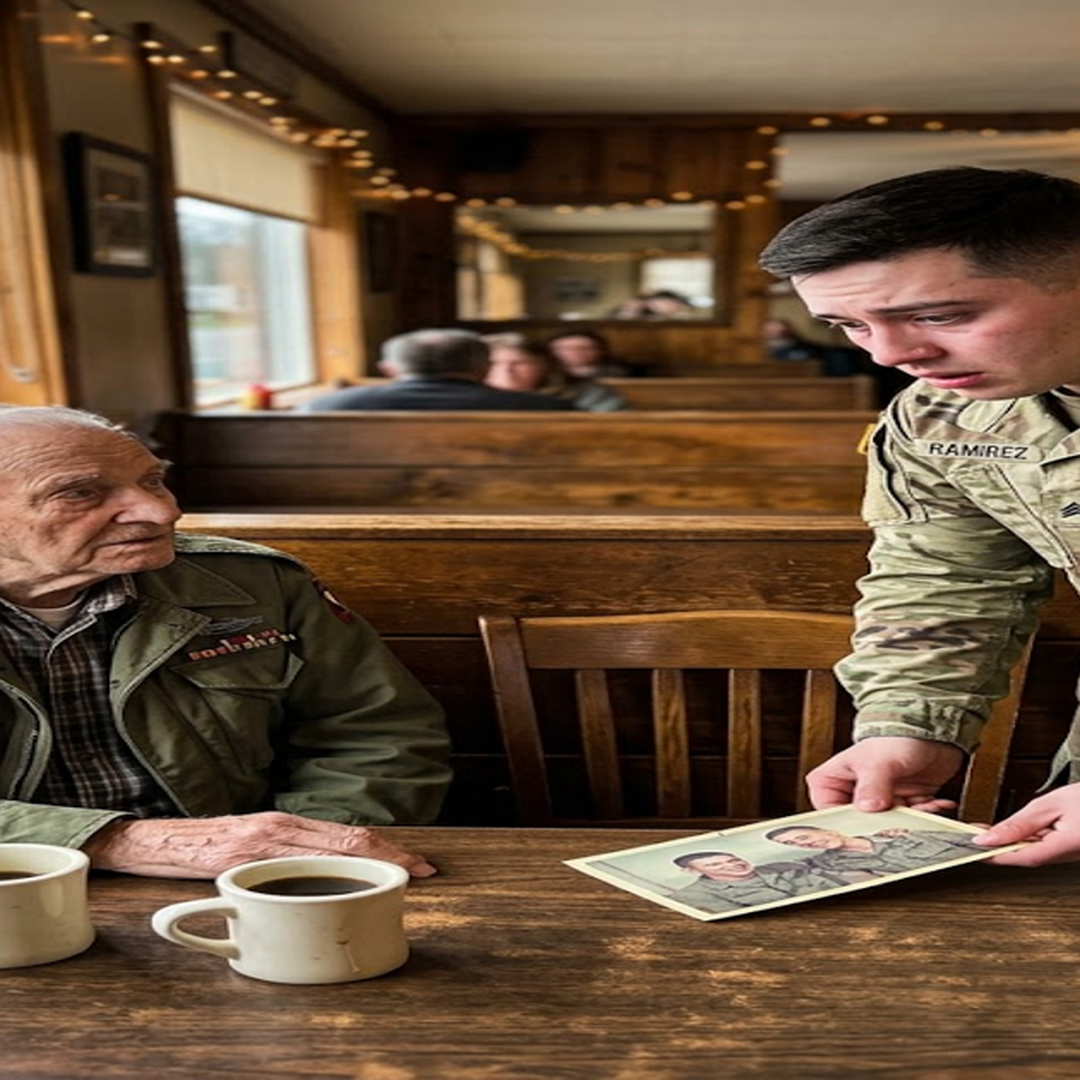
“Sir,” he said respectfully, “would you mind if I asked about the second cup?”
The veteran looked up.
Most people asked from curiosity.
This young man’s question sounded different.
Gentler.
Instead of answering directly, the veteran reached into his jacket pocket.
Inside was a photograph folded so many times the corners had become soft.
He unfolded it with extraordinary care.
The picture showed two impossibly young soldiers standing shoulder to shoulder, smiling despite the war surrounding them.
He slid it across the table.
The young soldier picked it up.
Everything changed.
His breathing caught.
His eyes widened.
He stared at one face.
Then the other.
Again.
Again.
His hands trembled.
Finally he whispered, “That’s my grandfather.”
The veteran frowned.
“What did you say?”
“My grandfather.”
He pointed to one of the smiling men.
“He kept this exact picture.”
The veteran leaned closer.
“You’ve seen this before?”
The younger man nodded slowly.
“My grandfather told this story all my life.”
The diner suddenly seemed silent.
“He always talked about the friend who survived.”
The old man’s eyes filled instantly.
“He said if that man kept his promise, somewhere there would be an empty chair every Sunday.”
Neither man spoke for several moments.
The years between them seemed to disappear.
The young soldier continued.
“My grandfather never stopped wondering what became of you.”
The veteran swallowed hard.
“I never knew whether anyone remembered.”
“Oh, we remembered.”
The younger man smiled through tears.
“My family grew up hearing your story.”
He explained that every Memorial Day his grandfather spoke not about medals or victories but about friendship.
About promises.
About the soldier who had lived.
About hope surviving impossible circumstances.
The veteran lowered his head.
For fifty years he had believed those conversations existed only inside his own heart.
Now he realized they had lived inside another family as well.
They spent hours talking.
Names were exchanged.
Places.
Dates.
Old memories.
Each detail confirmed what both already knew.
The impossible coincidence was real.
Before leaving, the young soldier looked toward the empty chair.
“May I ask something?”
The veteran nodded.
“Has anyone ever sat there?”
“No.”
“Not once?”
“Never.”
The younger man hesitated.
“I understand.”
He reached for his jacket.
The veteran stopped him.
Slowly, almost ceremonially, he rested one hand on the back of the empty chair.
For fifty years he had protected that space.
It represented loyalty.
Grief.
Love.
Memory.
Nothing could replace the friend who had earned it.
But perhaps that had never been the point.
He looked into the young soldier’s eyes and saw not a stranger, but the living continuation of someone he had loved like a brother.
“You aren’t taking his place,” the veteran said softly.
“No one ever will.”
The younger man nodded.
“I know.”
A long silence followed.
Then the veteran gently pushed the chair toward him.
“Sit.”
The young soldier sat carefully, almost reverently.
The old man smiled.
For the first time in half a century, the empty chair was no longer empty.
The following week, both families gathered together.
Children who had never heard the complete story listened beside grandchildren who had grown up hearing fragments of it.
Old photographs covered the table.
Letters were shared.
Stories once separated by distance became one history.
The veteran discovered that his fallen friend’s kindness had echoed through generations.
The younger family discovered that one forgotten promise had quietly shaped another man’s entire life.
From that Sunday forward, the veteran still visited the diner.
He still ordered two coffees.
But now, some Sundays, one of his friend’s descendants joined him.
Other Sundays, grandchildren came.
Occasionally, the booth filled with laughter instead of silence.
The promise had never really been about refusing to sit alone.
It had been about making sure friendship survived death.
When the veteran eventually passed away years later, the diner kept the booth exactly as it had been.
Not because of an empty chair.
But because one simple promise had reminded everyone who heard it that loyalty can outlive wars, distance, and even time itself.
Those who learned the story often disagreed about one thing. Some believed the veteran should have allowed someone to sit there years earlier so he wouldn’t carry his grief alone. Others believed the empty chair was the purest expression of love and loyalty they had ever seen. Perhaps neither answer was completely right. Perhaps the real lesson was that promises matter, but so does knowing when it’s finally time to let someone else help carry them.