The accident changed everything in an instant.
Before it happened, she had been the kind of child who asked endless questions, laughed loudly, and never hesitated to tell a story. Her family couldn’t remember a quiet dinner because she always had something new to share.
Then came the accident.
The physical injuries slowly healed, but something far more difficult remained. Speaking became exhausting. Words refused to come out the way she intended. Sentences broke apart. Sounds blurred together. Each attempt reminded her that life had become different.
The specialists were honest with the family.
Recovery was possible, but no one could promise how much.
One doctor’s words lingered longer than the others.
“She may never speak clearly again.”
No one wanted to believe it, yet everyone carried that possibility home.
Her parents encouraged her every day. Therapists celebrated the smallest improvements. Still, progress came painfully slowly.
The hardest part wasn’t the difficulty itself.
It was the embarrassment.
Children rarely mean to be cruel, but impatience can feel just as painful. When classmates couldn’t understand her, they guessed what she meant or moved on to someone else. Teachers tried to help, but she noticed every sympathetic smile.
Eventually she stopped volunteering answers.
Then she stopped starting conversations.
Finally, she stopped trying unless absolutely necessary.
Silence became easier than disappointment.
Her mother began answering questions for her during appointments because it saved time. Family members finished her sentences without realizing they were taking away opportunities to practice.
Everyone believed they were helping.
Instead, her confidence quietly disappeared.
At school she always chose a seat near the back of the classroom. She hoped not to be noticed. When group projects were assigned, she accepted whatever role required the least speaking.
Many students barely knew what her voice sounded like anymore.
Yet there was one place where something different happened.
Music class.
She never volunteered there either, but she listened carefully whenever songs were played. Something about melody felt safer than ordinary conversation.
One afternoon, long after classes had ended, the music teacher returned to collect forgotten papers. As he passed the practice room, he heard a faint melody.
Someone was humming.
He gently opened the door.
The girl sat alone at the piano, pressing tentative keys while quietly following the tune. She immediately stopped when she realized she wasn’t alone.
“I’m sorry,” she whispered.
The words were difficult, but the melody she’d been humming had sounded effortless.
He smiled.
“You don’t have to apologize.”
She looked down.
“I heard something beautiful,” he continued. “Would you come back tomorrow after school?”
She hesitated.
Then nodded.
The following afternoon there were no expectations waiting for her.
No performance.
No audience.
Only a piano.
The teacher didn’t ask her to sing.
Instead, they spent the first session listening.
He played simple melodies. She matched rhythms by tapping the piano bench. Eventually he encouraged her to hum again.
The humming came naturally.
Days later, he asked her to hold a single vowel sound.
Then another.
Eventually those sounds blended into words hidden inside songs.
He noticed something remarkable.
When she sang, her breathing slowed naturally. The rhythm organized sounds that ordinary speech scattered. Music gave structure where fear had created confusion.
Progress remained slow.
Some afternoons ended with tears because nothing seemed to improve.
Whenever frustration appeared, he closed the piano lid.
“That’s enough for today,” he’d say. “Tomorrow is another chance.”
He never measured success by perfection.
Instead, he celebrated tiny victories.
One clear word.
One complete phrase.
One song sung slightly more confidently than the week before.
Months passed.
Few people noticed any difference because she still spoke very little outside those sessions.
The practice room became a place where she didn’t feel broken.
Eventually she smiled again.
Not often.
But enough.
By the second year, songs became more challenging.
Her confidence grew quietly, almost invisibly.
The teacher suggested she consider joining the spring recital.
She immediately shook her head.
“No.”
He didn’t argue.
Instead, they kept practicing.
When recital night arrived, parents filled every seat. Students nervously waited backstage for their scheduled performances.
Her name wasn’t listed anywhere in the printed program.
She sat with the audience beside her mother.
Halfway through the evening she kept glancing toward the stage.
The teacher noticed.
He gave a small encouraging nod.
Nothing more.
She looked down.
Several performances later, something changed inside her.
Before she could talk herself out of it, she stood.
Her mother reached toward her.
“What are you doing?”
She didn’t answer.
Slowly she walked toward the stage.
The audience murmured with confusion because no one expected another performer.
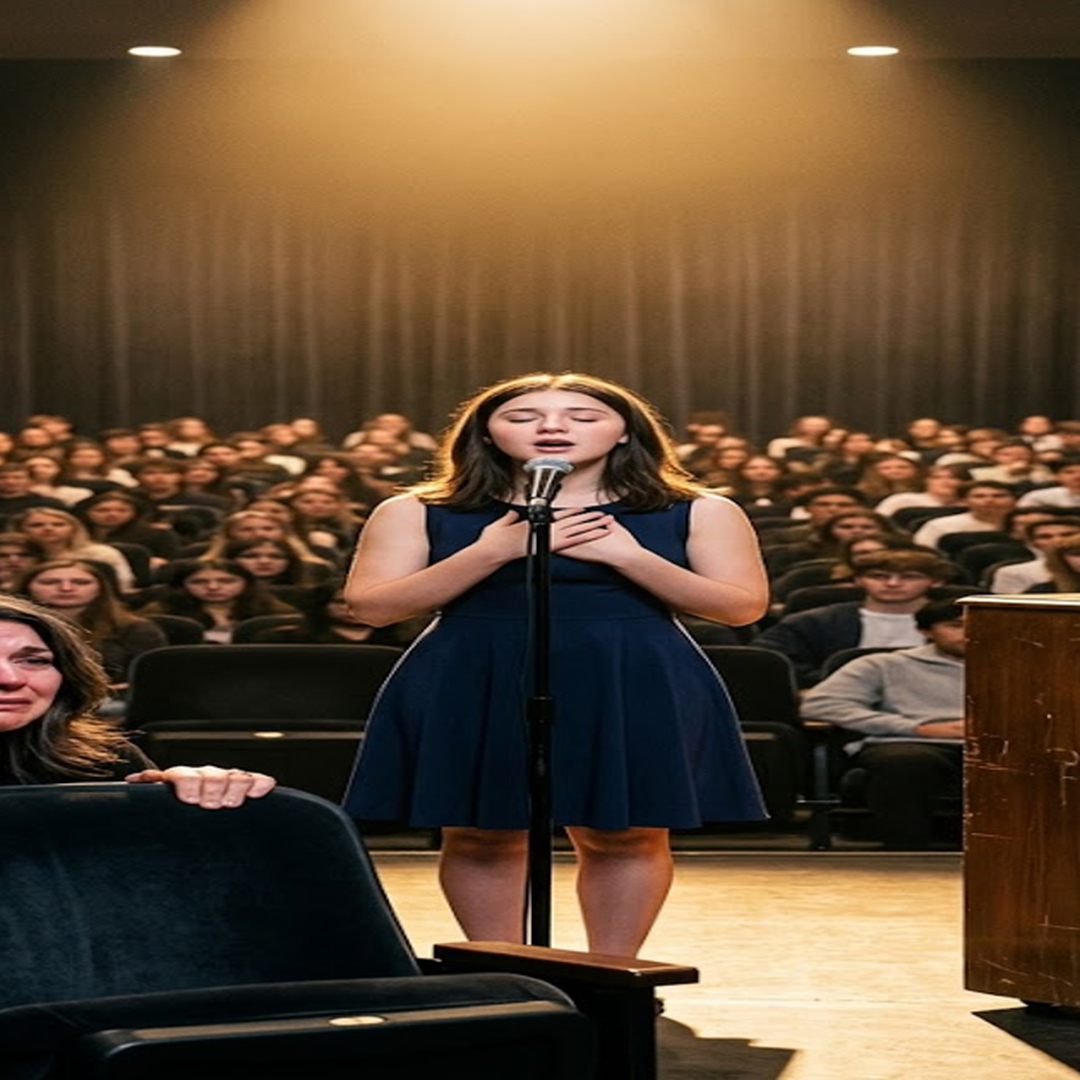
She stepped into the spotlight.
For a moment she almost turned around.
Then she remembered every quiet afternoon.
Every patient lesson.
Every time someone had believed in her before she believed in herself.
The pianist played the opening chord.
She inhaled.
The first note rang across the auditorium.
It was clear.
Strong.
Beautiful.
Every fear she’d carried for two years seemed to disappear inside that single note.
People stopped breathing.
Teachers stared.
Students exchanged shocked glances.
Her mother gripped the chair in front of her, tears streaming uncontrollably before the first verse had ended.
The music teacher simply watched from the side of the stage.
He wasn’t surprised.
He had heard that voice long before anyone else.
By the final chorus the audience wasn’t applauding because no one wanted to interrupt.
They listened until the last note faded naturally into silence.
Then the room erupted.
The standing ovation seemed endless.
She covered her face, overwhelmed.
For the first time since the accident, attention no longer frightened her.
It reminded her how far she had come.
Within weeks she accepted an invitation to join the school choir.
At first she stood near the back.
Gradually she moved forward.
She learned harmonies.
She encouraged younger students who lacked confidence.
When someone apologized for making mistakes, she smiled because she understood that feeling better than anyone.
A year later graduation arrived.
The choir director made an announcement that surprised everyone.
The closing solo would be hers.
Some students wondered if the pressure would be too much.
The music teacher wasn’t worried.
As graduation day began, she looked across the audience and found her mother sitting in the front row.
The woman who had once spoken for her now simply smiled.
No words were necessary.
She stepped toward the microphone.
The first note floated effortlessly across the auditorium.
The song ended with complete confidence.
When the applause faded, she did something even more meaningful.
She thanked her music teacher.
Not through a written note.
Not through someone else’s voice.
With her own.
Every word was clear.
Every sentence carried gratitude built over years of persistence.
There wasn’t a dry eye in the room.
After the ceremony, parents approached the teacher to congratulate him.
He accepted their thanks politely but quietly corrected each of them.
“I didn’t give her a voice,” he said. “She always had one. She just needed someone willing to wait until she believed it herself.”
Years later, people still remembered that unexpected recital.
Some remembered the beautiful singing.
Others remembered the tears.
Many remembered the standing ovation.
But those closest to the story remembered something deeper.
Recovery hadn’t happened because of one miraculous night.
It happened through hundreds of ordinary afternoons when no audience existed, no applause followed, and no one could see the progress except two people sitting beside an old piano.
In the end, the performance everyone celebrated was only the visible result of invisible perseverance.
And perhaps that remains the hardest lesson to forget.
When someone seems silent, defeated, or broken, we rarely know how much courage they’re gathering behind the scenes. Sometimes all it takes to change a life isn’t extraordinary talent or dramatic speeches. Sometimes it’s one patient person who refuses to give up when everyone else quietly accepts defeat.