The slowest runner on the team was never supposed to become the story everyone remembered.
For years, she was known only as the athlete who always finished behind everyone else. At every meet, spectators cheered for the leaders while she struggled through the final stretch alone. By the time she crossed the finish line, many people had already packed up their bags and left.
Some coaches kept her on the roster because they believed every team needed enough athletes to fill lanes at competitions. They appreciated her attendance and her willingness to help during practice, but very few believed she had any realistic chance of winning.
She heard whispers she pretended not to hear.
She saw sympathetic smiles that felt worse than open criticism.
Still, she never missed practice whenever she could.
The problem was that she couldn’t always be there.
Her family depended on every hour she could work after school. While her teammates attended organized afternoon training sessions with coaches, timers, and specialized workouts, she spent those same hours earning money. She couldn’t afford to lose the income, and she couldn’t afford the extra training fees either.
Most people assumed she simply lacked commitment.
The truth was exactly the opposite.
Determined not to fall further behind, she began training before sunrise.
The campus was silent at that hour. Mist hung above the track, and the stadium lights were usually dark. She stretched beneath the fading stars before beginning workouts she had pieced together from library books, old race videos, and advice she remembered from previous practices.
At first, she trained in near darkness.
Then someone noticed.
The school janitor arrived every morning before anyone else. His job was to prepare the campus for another day, but one morning he found a young runner waiting patiently outside the locked gate.
He unlocked it.
The next morning she returned.
Then the next.
After several weeks, he stopped waiting for her to knock.
Instead, he unlocked the gate early and switched on the stadium lights before she arrived.
He never announced what he was doing.
He never asked for recognition.
He simply understood that if someone was willing to work that hard before dawn, the least he could do was make sure she could see the lane in front of her.
Their conversations were brief.
He sometimes reminded her to drink water.
Occasionally he handed her a forgotten towel from the equipment room.
When winter mornings became especially cold, he left a thermos of hot tea on a bench without saying where it came from.
She always knew.
Instead of thanking him with speeches, she thanked him by returning every morning.
Months passed.
Her improvement was almost invisible because nobody compared her current self with the exhausted runner she had once been.
She was still slower than the stars on the team.
She still finished near the back during practice races.
But she was becoming stronger.
More importantly, she was learning how to endure discomfort long after others expected her to quit.
Regional finals arrived with little attention focused on her.
The favorites had impressive records and polished reputations. Some had personal trainers. Others had sponsorship opportunities waiting if they performed well.
She simply wanted to run her best race.
When the lane assignments appeared, she received lane eight.
Some competitors disliked the outside lane because it felt isolated. Others believed it made pacing more difficult.
She accepted it without complaint.
She had spent months running alone.
One more lonely lane wasn’t going to frighten her.
The stadium filled with spectators.
Families waved homemade signs.
Coaches reviewed strategies one last time.
The athletes settled into their starting blocks.
The starting pistol echoed through the stadium.
The favorites surged ahead immediately.
Exactly as predicted.
The crowd followed their movement while the runner in lane eight seemed to disappear from everyone’s attention.
She focused only on her breathing.
One stride.
Then another.
She refused to panic.
She had repeated this feeling hundreds of times before dawn when there was nobody to impress and nobody to rescue her.
Halfway through the race she still trailed.
Then something changed.
Her breathing stayed steady while others began to tighten.
Her months of lonely conditioning suddenly mattered.
She accelerated.
The distance between herself and the leaders slowly disappeared.
The crowd noticed.
Commentators stumbled over their words as they searched for information about the unexpected challenger flying down the outside lane.
Two hundred meters remained.
She passed one runner.
Then another.
Parents stood.
Teammates shouted in disbelief.
One hundred meters remained.
Every sacrifice she had carried in silence seemed to appear in her stride.
She reached the leaders.
The finish line approached.
The runners leaned forward together.
The difference was almost impossible to see.
Everyone waited for the scoreboard.
Seconds felt endless.
Finally, the official result appeared.
Lane eight.
First place.
By inches.
For a moment, the stadium stood perfectly still before erupting into celebration.
Teammates hugged one another.
Coaches stared at the scoreboard as though expecting it to change.
Reporters rushed toward the newest champion.
Officials invited the medalists to the podium.
She accepted the gold medal with a quiet smile.
Then, before anyone understood what she was doing, she stepped away.
Instead of posing for photographs, she walked toward the bleachers.
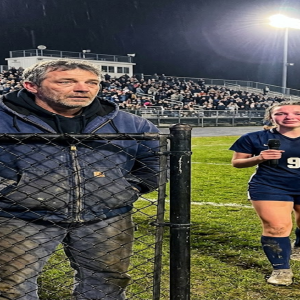
The janitor sat alone in the stands, applauding softly.
He looked surprised as she approached.
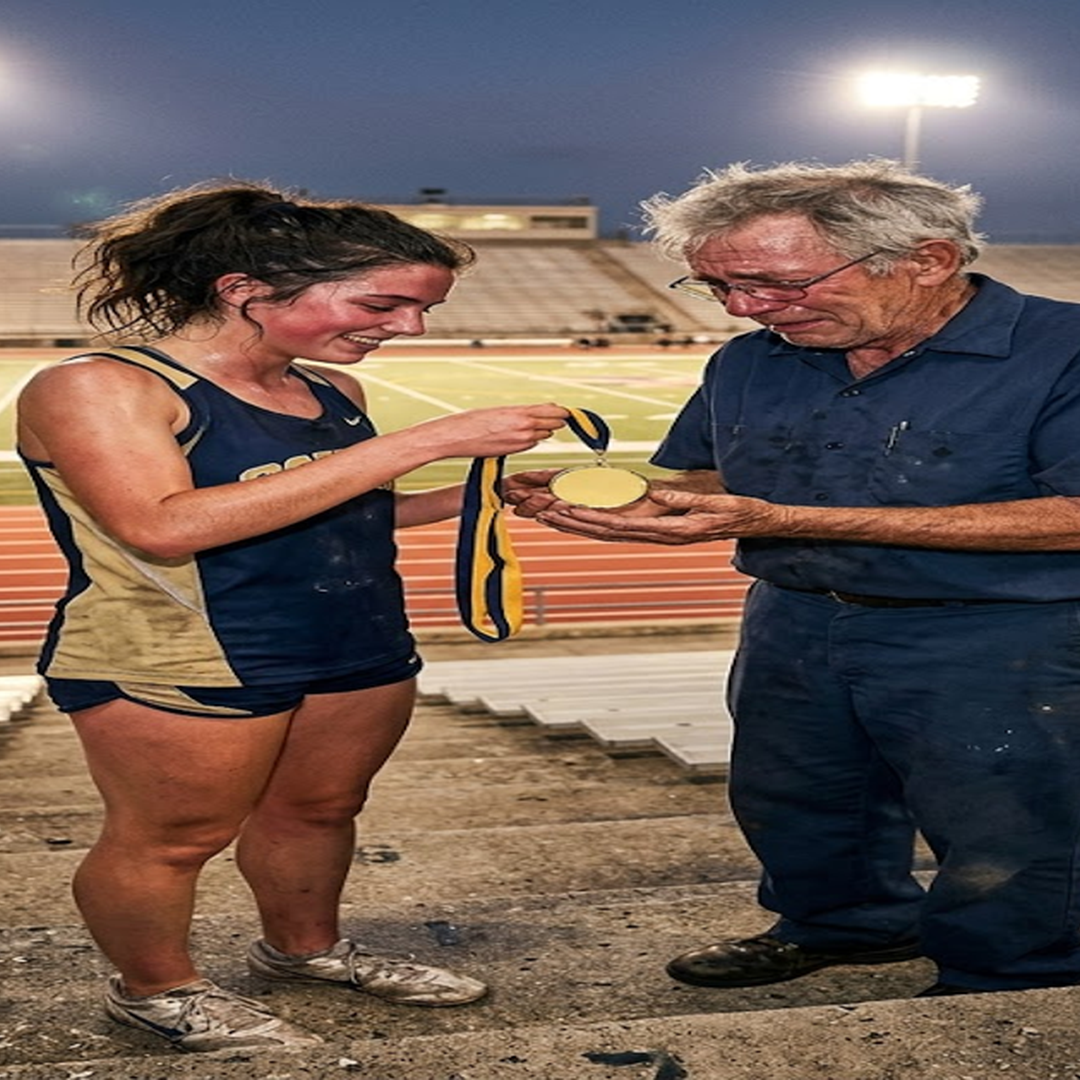
Without making a speech, she removed the medal from around her neck and placed it into his weathered hands.
He immediately tried to give it back.
She gently closed his fingers around it.
“You earned this long before I did,” she whispered.
Those nearby fell silent.
Many had no idea what she meant.
Only after teachers, students, and coaches began sharing stories did the full picture emerge.
People learned about the freezing mornings.
They learned about the lights switched on before sunrise.
They learned about the unlocked gate.
They learned about the silent encouragement that had never appeared in official records.
The photographs from that moment spread throughout the community.
Ironically, the most powerful image wasn’t the finish-line victory.
It was the simple photograph of an elderly janitor holding a gold medal with tears in his eyes while a young athlete smiled beside him.
The story reached school administrators.
They realized how many students might be facing invisible barriers similar to hers.
Within months, the school approved a free dawn-training program open to every athlete regardless of financial circumstances.
The track lights became a permanent part of the morning schedule.
Volunteer coaches donated their time.
Former students contributed equipment.
Local businesses helped provide breakfast after practice.
When the program officially opened, administrators announced its name.
It would forever carry the name of the runner whose determination had inspired it.
During the dedication ceremony, she thanked her family, her teammates, and her coaches.
But before leaving the microphone, she searched the audience until she found the janitor.
Everyone applauded as he reluctantly stood.
He looked embarrassed by the attention.
She smiled.
“This program exists because one person decided that believing in someone doesn’t always require a title.”
The audience stood with him.
Not because he had won a race.
Not because he had coached champions.
But because he had done something much rarer.
He had noticed someone the rest of the world had overlooked.
Years later, countless students trained before sunrise through the same program.
Many of them never met the original runner.
Some never even knew the janitor personally.
Yet every morning, the stadium lights came on before the first athlete arrived, just as they always had.
The tradition continued because kindness, like determination, can become a habit passed from one person to another.
People still debated which moment truly defined the story.
Was it the impossible victory by inches?
Was it the medal quietly placed into grateful hands?
Or was it the countless unseen mornings that made both moments possible?
Perhaps the greatest lesson wasn’t about running at all.
It was about how easily extraordinary potential can be dismissed when it arrives without privilege, attention, or perfect circumstances.
The fastest runner won a race.
But the quietest act of belief transformed an entire school.
And long after the medal’s shine faded, that simple decision to switch on a set of lights before dawn continued illuminating dreams for students who otherwise might never have believed they belonged on the track.
Readers were left asking themselves a difficult question: if someone had never bothered to notice the slowest runner on the team, how many remarkable stories would have remained unfinished forever?