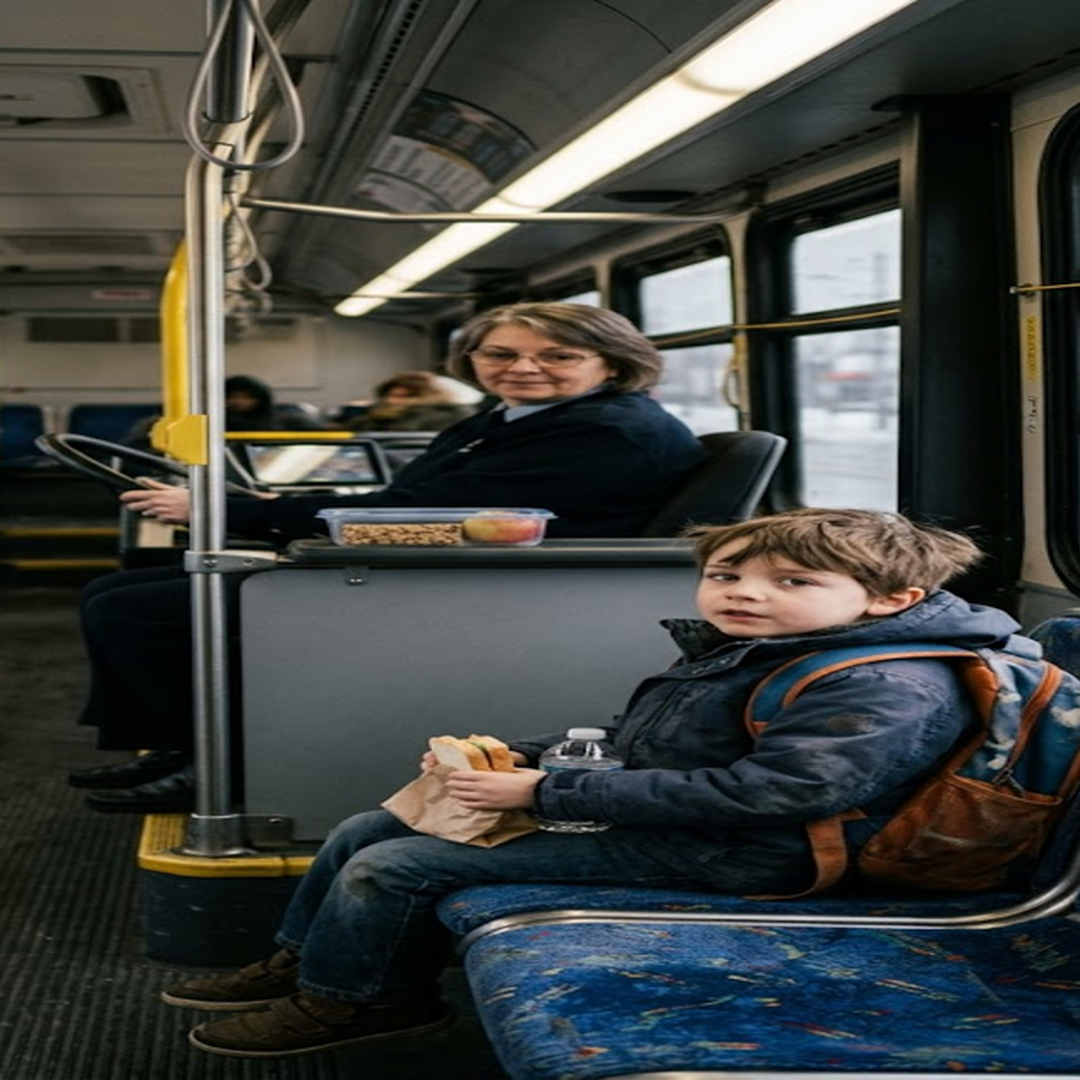
The new driver had only been assigned to the afternoon route for a few days when one passenger began to stand out.
Every weekday, shortly after schools dismissed, a small boy climbed aboard carrying the same faded backpack and a neatly wrapped sandwich. He greeted her with quiet politeness, paid little attention to the chatter around him, and settled into the same seat near the middle of the bus.
Nothing about him seemed alarming at first.
Children often had routines. Some rode a few extra stops because their parents worked late. Others simply enjoyed buses.
But after several afternoons, she noticed something unusual.
The boy never got off.
The bus completed its entire route, reached the last stop, emptied out, and prepared for the return journey. While every other passenger stepped onto the sidewalk, he remained seated, waiting patiently as if continuing the ride had always been part of the plan.
Only after the return trip, when evening began settling over the neighborhood, did he leave the bus near the stop where he had first boarded.
The pattern repeated every single day.
She believed in respecting people’s privacy. Bus drivers witnessed countless pieces of other people’s lives without truly knowing them. She had learned long ago that assumptions often caused more harm than kindness.
So she said nothing.
Instead, she paid attention.
The weather grew colder as autumn slipped toward winter. She began turning on the heater a few minutes earlier so his favorite seat would already be warm.
One afternoon she tucked a granola bar into the glove compartment.
The next day she added a small carton of juice.
When he climbed aboard looking tired, she smiled casually.
“I think someone forgot these. I’d hate to throw them away.”
He looked at her for a moment before accepting them.
“Thank you.”
It wasn’t much.
But the gratitude in his voice suggested it meant more than she had expected.
Days turned into weeks.
Slowly, tiny conversations replaced the silence.
She learned he enjoyed reading mystery books.
He learned she loved old detective movies.
He laughed when she admitted she could never solve the ending before everyone else.
Those brief exchanges became part of both their afternoons.
Other passengers noticed.
An older woman who rode three stops every day began waving to him.
A construction worker always shifted over so he could have the warmer window seat.
A college student occasionally left behind comics that somehow always ended up in the boy’s hands.
Nobody discussed it openly.
Nobody pitied him.
They simply included him.
One afternoon, as the bus approached its final stop, the driver finally asked a gentle question.
“You’ve become my most loyal passenger.”
He smiled.
“Can I ask why you ride all the way around every day?”
His smile faded.
For several seconds he stared down at his backpack.
“My mom works nights.”
He hesitated again.
“She has to leave before I get home.”
The driver listened quietly.
“She sleeps during the morning after work, then leaves before school ends. By the time I get home… she’s already gone.”
“So you wait?”
He nodded.
“There’s nowhere warm until she gets back after dark.”
He said it without self-pity.
It was simply the reality of his life.
His mother wasn’t neglecting him.
She was working exhausting overnight shifts to keep food on the table, sacrificing sleep and time with her son simply to survive.
The problem wasn’t love.
The problem was impossible circumstances.
The driver’s heart sank.
She knew she couldn’t solve everything.
But maybe she could solve one afternoon at a time.
During her lunch breaks, she began making phone calls.
She contacted the transit supervisor.
There happened to be an unused corner inside the depot that mostly stored old furniture.
Would anyone mind if it became a community space?
The answer surprised her.
“Go ahead.”
Next she spoke with people she’d come to know through the route.
A retired elementary school teacher immediately volunteered.
“I’ve missed helping with homework.”
A neighborhood baker smiled before she had even finished asking.
“I always have fresh bread left over.”
A nurse whose shifts ended early offered first-aid supplies, snacks, and a few hours every afternoon.
Word quietly spread.
Someone donated folding chairs.
Another person delivered books.
A local carpenter repaired old shelves instead of throwing them away.
Families dropped off board games their children had outgrown.
Within weeks, the forgotten corner of the depot looked completely different.
Bright paint covered the walls.
Simple tables filled the center.
Books lined homemade shelves.
There were puzzles, crayons, notebooks, blankets, and steaming mugs of cocoa waiting each afternoon.
The driver never announced the project.
She simply invited the boy to step inside after school.
“I think someone could use a homework partner.”
He entered cautiously.
The retired teacher greeted him like she’d known him for years.
“Perfect timing.”
She smiled.
“I’ve been losing at math all morning. Think you could help me?”
He laughed.
The ice disappeared almost instantly.
Over the following weeks, other children whose parents worked late began stopping by.
Nobody advertised the space.
People simply heard about it from neighbors.
The depot transformed into something far beyond an after-school room.
It became a place where people looked after one another.
The baker refused to let anyone leave hungry.
“If they’re growing,” he insisted, “they’re eating.”
The nurse remembered every scraped knee, every birthday, every upcoming test.
Mechanics repairing buses fixed broken bicycle chains while children watched with fascination.
Dispatchers brought donated winter coats.
Drivers finishing their routes stayed long enough to play one board game before heading home.
The boy slowly changed.
At first, he barely spoke above a whisper.
Months later, his laughter filled the room.
His homework improved.
His teachers noticed greater confidence.
His shoulders relaxed.
He no longer spent hours silently watching neighborhoods pass through bus windows.
Instead, he hurried toward people waiting to hear about spelling tests, soccer games, and science projects.
His mother eventually visited one afternoon after adjusting her schedule.
She expected to thank a single bus driver.
Instead, she found an entire room filled with people who already knew her son’s favorite stories, favorite snacks, and biggest dreams.
She struggled to hold back tears.
“I don’t know how to repay all of you.”
The retired teacher smiled.
“You already have.”
The mother looked confused.
“By raising a wonderful boy.”
No one spoke for a moment.
Sometimes gratitude leaves no room for words.
Winter arrived.
Snow covered sidewalks.
Temperatures dropped sharply.
Yet every afternoon, lights glowed inside the depot.
Children worked on homework.
Adults shared coffee.
Neighbors exchanged recipes, childcare advice, job leads, and encouragement.
Something unexpected had happened.
Helping one child had encouraged everyone to notice someone else.
Passengers who had once ridden in silence now greeted each other by name.
Teenagers carried groceries for older riders.
Someone shoveled a widow’s walkway before dawn.
Another organized rides for medical appointments.
Small acts multiplied.
The kindness became contagious.
The driver remained uncomfortable whenever people praised her.
She insisted she had only noticed something others might have overlooked.
But everyone else understood the truth.
Most people had seen the little boy.
She had truly looked.
Years later, many children would pass through that little room.
Some needed homework help.
Others needed warm meals.
Some simply needed adults willing to ask how their day had been.
The original boy eventually outgrew the afternoon program.
On his last regular day before entering high school, he boarded the bus one more time after classes.
He chose the same seat he had occupied years earlier.
The driver smiled.
“Going all the way to the end?”
He laughed.
“Just once.”
When they reached the depot, he stood, shouldered his backpack, and paused before stepping off.
“I used to think I was just passing time here.”
He looked around at the familiar faces gathering inside.
“Now I know this is where I found my family.”
The driver watched him disappear through the depot doors, where the retired teacher was already pretending to need help with another impossible math problem and the baker was arguing that teenagers required at least two cookies after school.
The room burst into laughter.
The driver quietly closed the bus doors and prepared for her next route.
Buses were built to carry people from one place to another.
She had never imagined that one ordinary route could carry an entire community toward each other instead.
Even years later, neighbors still told the story of the little boy who once rode buses in endless circles with a cold sandwich.
Not because it was a story about sadness.
But because it reminded them that the smallest act of paying attention could become the beginning of something that changed far more than a single child’s afternoons.
And perhaps the question that lingered wasn’t whether the driver had done something extraordinary. It was whether every community already has someone quietly riding through hardship, waiting for one person to notice.