Maya had worked enough late shifts to recognize the different kinds of hunger.
There was the hunger of tired truck drivers grabbing coffee before another hundred miles.
The hunger of teenagers spending every spare dollar on fries after football practice.
The hunger of parents quietly skipping their own meals so their children could eat.
And then there was another kind.
The kind hidden behind pride.
The kind that stared at menu prices instead of menu items.
That was the look she noticed the moment the stranger entered the diner.
He didn’t ask for a table.
He didn’t complain about the weather.
He simply walked to the corner booth, removed his soaked hat, folded his hands together, and stared silently at the menu without opening it.
He never looked at the pictures.
Only the numbers.
Maya’s heart tightened.
She had seen that same expression years earlier on her mother’s face.
Her mother had worked two jobs after Maya’s father disappeared, yet there were nights when she pretended she wasn’t hungry so the children could eat first.
She’d sit at the kitchen table smiling while quietly calculating what was left in the pantry.
Pride had always been more painful than poverty.
After her mother passed away, Maya promised herself one thing.
If she ever recognized that look in someone else’s eyes…
She would never ignore it.
She counted her tips.
Just enough.
Not enough for comfort, but enough for compassion.
She bought the cheapest meal available and carried it over.
The stranger looked genuinely confused.
“I didn’t order anything.”
“I know.”
“You don’t even know me.”
“I don’t have to.”
For several seconds, he simply stared at her.
No one had spoken kindly to him in a very long time.
Then everything changed.
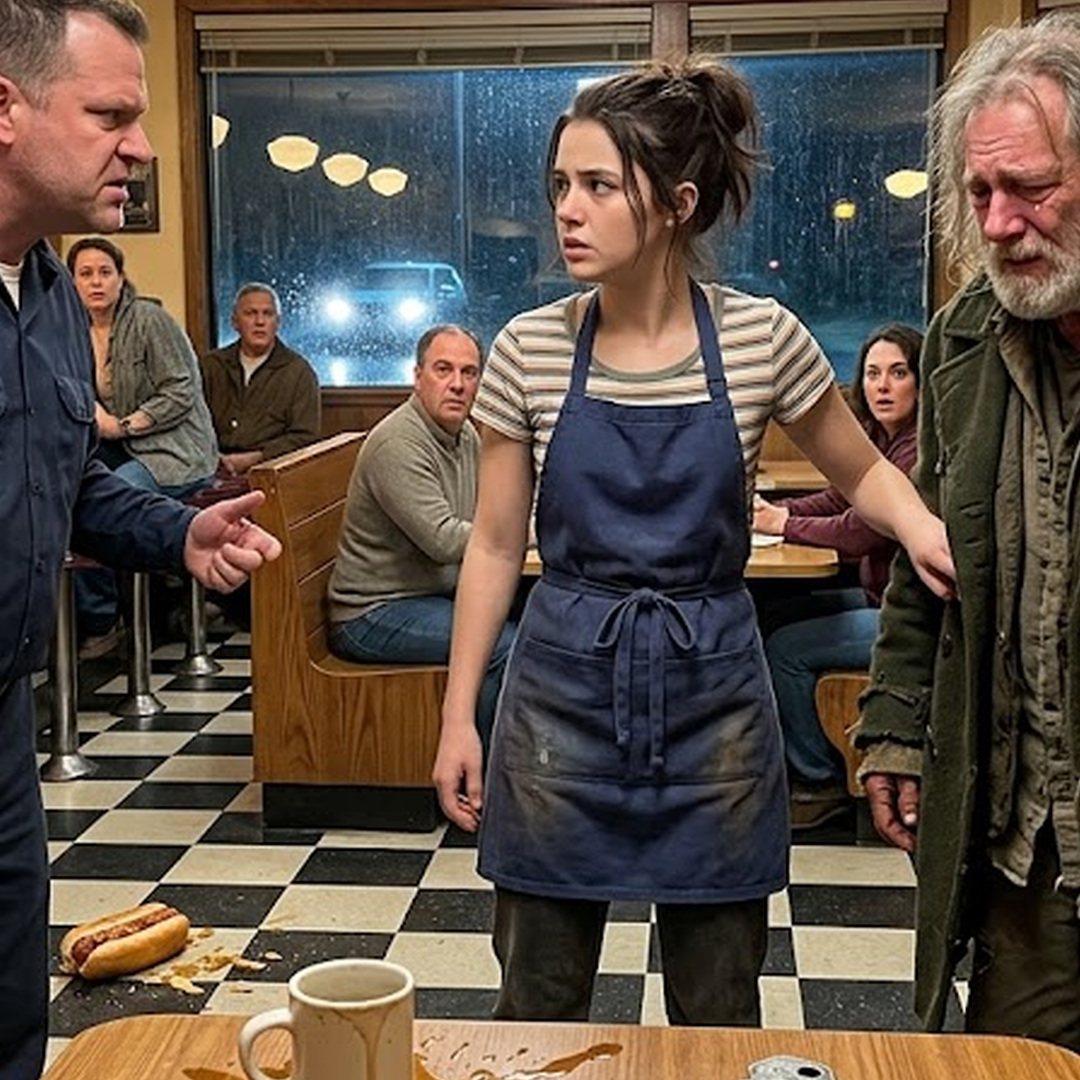
Mr. Barnes stormed across the diner.
Without warning, he slammed the plate onto the floor.
Coffee splashed across the stranger’s coat.
The room fell silent.
Customers froze with forks halfway to their mouths.
“This isn’t a charity,” Barnes barked.
Maya stepped forward.
“I paid for it.”
“I don’t care.”
Barnes pointed toward the door.
“He doesn’t belong here.”
The stranger looked down at the ruined meal.
His eyes didn’t show anger.
They showed memory.
Like this humiliation wasn’t new.
Like he’d lived it before.
Barnes turned to Maya.
“You paid with your own money?”
“Yes.”
“Take off the apron.”
She felt the blood drain from her face.
“I need this job.”
“You should’ve thought about that.”
Thoughts of her little brother flooded her mind.
His cough.
His medicine.
The overdue bills stacked on the kitchen counter.
She wanted to apologize.
To stay quiet.
To survive.
Instead, she heard herself say something she hadn’t planned.
“Then fire me.”
Barnes smiled coldly.
“Done.”
She removed her apron slowly.
Her hands shook.
But she stood beside the stranger anyway.
“You don’t get to treat people like they aren’t human.”
No one applauded.
Most customers simply looked away.
Silence can be its own form of agreement.
Then something unexpected happened.
The stranger stood.
His posture transformed.
Gone was the timid, exhausted man who had entered the diner.
He now carried himself with calm confidence.
“Interesting,” he said.
Barnes laughed.
“Get out.”
The stranger reached into his coat.
Barnes stiffened.
Instead of money…
Instead of identification…
The man placed a worn silver key on the table.
Barnes stared.
His expression changed instantly.
Fear replaced arrogance.
Recognition replaced contempt.
“You…”
The stranger nodded.
“My mother gave me this key when I was sixteen.”
The room stayed silent.
“She opened this diner fifty years ago.”
Several elderly customers slowly looked toward him.
One woman gasped softly.
“The eyes,” she whispered.
“You have her eyes.”
He smiled sadly.
“My mother believed no hungry person should ever leave this building without eating.”
He looked around the room.
“So I decided to see whether her dream had survived.”
Barnes tried to recover.
“I… I didn’t know—”
“No.”
“You chose not to know.”
The stranger removed another item from his pocket.
An envelope.
Inside were photographs.
Security stills.
Employee reports.
Customer complaints.
“I’ve been investigating quietly for months.”
Barnes’ confidence vanished.
The owner laid the evidence across the table.
Pictures of employees yelling at customers.
Receipts showing food intentionally thrown away.
Complaints ignored.
Workers fired for helping people in need.
Every page revealed the same pattern.
Cruelty.
Fear.
Greed.
Barnes looked trapped.
“I can explain.”
“Please do.”
The manager struggled for words.
“I was protecting profits.”
The owner shook his head.
“My mother built profits through kindness.”
Barnes had no answer.
One by one, customers began speaking.
“I saw him yell at an elderly woman.”
“He fired my niece.”
“He refused leftovers to a shelter.”
Stories poured out.
People who had stayed silent for years finally found their voices.
Barnes realized too late that fear only works while people stay quiet.
The owner looked at Maya.
“You lost your job because you showed compassion.”
She nodded.
“I’m sorry.”
He smiled.
“Don’t be.”
He reached into his wallet and handed her a business card.
“Would you accept another position?”
She looked confused.
“What position?”
He extended his hand.
“General manager.”
She stared.
“I’ve never managed anything.”
“I disagree.”
“You managed to protect this diner’s values when everyone else abandoned them.”
She blinked back tears.
“I don’t know what to say.”
“Say yes.”
She laughed through her tears.
“Yes.”
The customers erupted into applause.
Barnes lowered his head.
“I’ve made mistakes.”
“You made choices,” the owner replied quietly.
“There is a difference.”
Security arrived shortly afterward.
Barnes left without another word.
Before leaving, he glanced once at Maya.
She didn’t feel victorious.
Only relieved.
Over the following months, the diner changed.
A community meal board appeared near the register.
Customers could buy meals in advance for anyone in need.
No questions asked.
Employees were encouraged to treat every guest with dignity.
Unsold food was donated each evening.
Business grew faster than ever.
People came not only for the food but for the atmosphere.
Word spread that kindness had returned.
One evening, long after closing, Maya found the silver key resting beside the register.
The owner noticed her looking at it.
“My mother always believed buildings are just wood and brick.”
“What matters?” Maya asked.
He smiled.
“The people who walk through the door.”
Years later, customers would ask why that old key remained on display.
Every employee knew the answer.
It wasn’t a decoration.
It was a reminder.
A reminder that compassion costs something.
Sometimes a few dollars.
Sometimes a job.
But every act of kindness plants something that cruelty never can.
Looking back, people still debated who the hero truly was.
Was it Maya, who risked everything for a stranger?
Was it the owner, who tested the soul of the business his mother built?
Or was the greatest lesson reserved for everyone who stayed silent until someone else found the courage to stand first?
Perhaps the real question wasn’t who deserved praise.
It was whether any of us would have made the same choice if we’d been standing in that diner.